When you click on links to various merchants on this site and make a purchase, this can result in this site earning a commission. Affiliate programs and affiliations include, but are not limited to, the eBay Partner Network.
Questions:
* Are we positive I won't have any undesirable side effects from 12.5:1 compression on 92/93 octane? The builder is worried that I'll run into limitations with advance using that much compression. I think I'm going to shoot between 11.5-12 for peace of mind.
* We bought springs before we knew what the chosen cam will want for seat pressure, is that a concern? Should we just aim to have the installed height at the advertised 1.800"? Do we need to 'shim to within .00X0 of coil bind'?
* I spoke with CamMotion again, they say their advertised duration's are 55* higher than their .050 duration's. For DCR, how do I estimate advertised IVC based upon .050 IVC? Am I calculating this right on this example cam?
.050
-----
IVO=5.5, IVC = 43.5, EVO = 57, EVC = 7
229/244 duration, LCA = 112, ICL = 109 ECL = 115, overlap 12.5*, slight intake bias
So I would use 71 for my seat IVC for calculating DCR? CamMotion thought I'd build a lot of low end torque with this cam (which is what I want beginning around 3500-4000RPM), but thought it'd stop climbing and flatline after about 6000RPM. Without sacrificing street manners and torque above 3500RPM, are there any minor valve event changes I can make that would allow it continue to climb a little longer past 6000RPM?
You definitely do not want a camshaft with a 43.5 degree IVC in a 418 stroker with your desired RPM range. That is much too early.
You stated in your original post that you wanted strong low RPM torque in the 3500-4000 RPM range and a powerband that carries well past 6000 RPM. In general you must make some compromises between low RPM power and high RPM power when choosing a camshaft in single cam applications.
Ideally, you would pick a camshaft that is a good compromise between lower RPM torque and upper RPM performance. In a 418 stroker, this would look something like a 234/244 on 115.5+4.5 with about .621"/.604" lift. This would have valve events like this:
IVO 6
IVC 48
EVO 62
EVC 2
This camshaft would have a defined, prominent lope at idle, but still have very good drivability. It will have some bucking at low RPM at part throttle in a stick shift car, but much less than an aggressive camshaft would.
On the compression topic, my builds and my customers builds have been successful repeatedly with compression ratios in the 11.5:1 area.
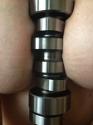
After much deliberation, I'm going with the CamMotion Torquey Stroker LS camshaft for rectangular ports, I think Bob said that was in stock. He also said 140-160 seat and 350-380 open is all this will need, and the springs are advertised as 150 on the seat and 420 open. Do we still need to shim to within 0.0050"/0.0060" of coil bind, or just install them at 1.800" height?
That cam is 232/242-114+4 or IVO 6 IVC 46 EVO 59 EVC 3
Last edited by JimMueller; Mar 28, 2019 at 01:51 AM.
After much deliberation, I'm going with the CamMotion Torquey Stroker LS camshaft for rectangular ports, I think Bob said that was in stock. He also said 140-160 seat and 350-380 open is all this will need, and the springs are advertised as 150 on the seat and 420 open. Do we still need to shim to within 0.0050"/0.0060" of coil bind, or just install them at 1.800" height?
That cam is 232/242-114+4 or IVO 6 IVC 46 EVO 59 EVC 3
No need to shim your springs Jim. We look forward to seeing the results of your build! Thank you for choosing Cam Motion!
Cam is out for delivery on Saturday, but shipped with Direct Signature required (the same nightmare I had with getting my package from Scoggin Dickey). I'm trying to avoid that issue again.
Without advance notice, the builder asked the machine shop to shim the springs 30 thousandths for a bit more seat pressure. The builders valve spring tester indicated about 140lbs at 1.8" height when we tested a spring new out of the box, although it's advertised as 150lbs on the seat. I asked them to see if they can measure what it is shimmed before completing the head assembly.
Last edited by JimMueller; Mar 29, 2019 at 09:39 AM.
I opened one of the Fel-Pro 1161 *041 packages tonight. Definitely 4.100 bore, but they sure must compress. The thinnest I could come up with around the perimeter was .060 vs the .041 compressed advertised on the enclosed materials.
The shop had to disassemble the rotating assembly because the rod bolt to block clearance did technically clear but was inadequate, so they needed to massage it a bit. They got it all put back together, then used the new .041 head gaskets and torqued down the heads so we could get push rod lengths. The otherwise new head gaskets can safely be re-used since they have not been exposed to heat?
They said they followed the directions given to me by Al at Manton... confirm valve is on the base circle, torque rocker to 22ft-lbs, extend adjustable checker to 0 lash, then measure overall length of checker with a digital caliper. They come up with all intake push rods at 7.415" and all exhaust push rods at 7.400". I find that uncannily similar to the OEM 7.400" length.They did measure the base circle and said that the intake & exhaust were slightly different, and that was the reason for the different push rod length difference.
* the 823 head had a 65.5cc chamber (stock chamber is ~70cc-65.5cc=4.5cc * 0.0055in/cc = ~0.025" milled)
* the head gasket is about 0.010-0.015 thinner
* we took 0,013 off the deck
* Randy at Johnson said that this lifter generally needs about a .190" longer push rod
* perhaps a difference base circle than stock
Al said to send him the numbers in a spreadsheet and he'd see if they were all close enough to use a common length with this lifter. The numbers don't seem to add up with the change in the stacked height... do I just go with what they measured and add the .0035" preload to the lengths?
When measuring the passenger side push rods, we found that one was really off. Looking at the stand. the cradle the rocker sat in is gouged up from whomever it's previous life. So we're going to replace the rocker stands. Should I consider anything besides OEM rocker stands? In the interest of time, my preference will be OEM.
After replacing the rocker mounts, it's more consistent but it didn't resolve the large error on the #2 exhaust and the lesser error on #7 exhaust. We're hypothesizing that it's a a combination of these potential issues:
1) I was originally told the old valves in the used head were sunken too far, and they said we could clean up the valves and do a valve job or get all new valves and a VJ. So I bought all new valves and they sent the head to a machine shop for a valve job and for the machine shop to install the springs. The springs were supposed to have been shimmed .030 to increase seat pressure at 1.8" installed height. My shop told the machine shop to not replace the seats due to time and cost concerns (although I was not directly consulted on this decision). It's possible this valve is sunken a little further, which would raise the stem tip, and reduce the push rod height. It's also possible that due to the higher tip, the seat pressure is not correct if the machine shop didn't measure all heights. I suppose if the valve is sunken a bit further, that would cause that chamber to be a bit larger as well.
2) Perhaps the new rocker, or a new valve that is slightly longer, or a a lifter that has bled down a bit, but I think those are less likely scenarios.
I've asked my shop to verify the installed height on the #2 exhaust spring and/or the height of the stem tip compared to another exhaust valve on the same head. If the installed height is wrong, correct it. That won't fix the need for a shorter push rod on that valve though.
How big a difference are we talking? When I do mine I measure all 16 and order custom if necessary. I typically get one or two bastard length pushrods. Generally see 030-040 variation between smallest and longest. If that is what you are talking about, just order the two custom length ones you need.
How big a difference are we talking? When I do mine I measure all 16 and order custom if necessary. I typically get one or two bastard length pushrods. Generally see 030-040 variation between smallest and longest. If that is what you are talking about, just order the two custom length ones you need.
The overall lengths (w/o preload) are in the colored columns above. So don't worry about the cause for needing the shorter pushrod, simply bandaid it with a shorter pushrod instead of trying to address the root cause?
Motor was expected to be fired for the first time around noon today and the shop just found that one of my Firecore50 ignition wires that is about 5 years old was melted under the titanium sleeve. The shop prefers the titanium sleeves over the metal heat shields, and wants to re-use the sleeves. Time is tight to get a set of them before the weekend. Will the Firecore50's benefit me or will a less expensive solution be adequate?
They fired up the car last night and had to shut it down quickly because the OEM dash oil pressure gauge was pegged above 80. They put a mechanical gauge on it and it's fine. They're saying engine off, key on, the gauge reads 40psi. They're trying to convince me that my gauges are supposed to sweep after key on, or after starting the engine. I don't recall that ever happening in the 20 years I've owned that car. I know other GM cars do that, though.
Problem didn't exist prior to it being towed to the shop, and I provided a new OEM oil pressure sender for them to install, and they said they used the new sender. Ideas?
In front of the intake, does my 85mm lid, 100mm MAF and 92mm TB combo cause a significant restriction? I don't want to go too large and risk idle & part throttle cruise challenges.
I run a 102TB on my twin turbo LS3 that has a 218/222 cam in it. I can release clutch at idle and idle around a carpark for as long as I like.
As I come to the end of this project, please let me know if any of these thoughts are unreasonable: I was explicitly told that my labor was not to exceed $4000, and that was for 40 hours @ $100/hr (they normally charge $120/hr). This engine overhaul included things like polishing crank, cleaning valves, valve job, etc., although I was not provided a detailed list of what was included.
* The shop labor to measure the push rod lengths should be reduced or eliminated since they came up with incorrect lengths, short by about .100". I provided written instructions to them from Manton on how to come up with the correct lengths before they started the process. I spent 5-6 hours doing it myself at their shop for the final numbers. Or, give me a partial credit against my time to obtain the proper lengths.
* The block was sent to a machine shop to be bored to be compatible with the shops desired piston size, and for the block to be cleaned. After the block was returned, the rotating assembly was mocked up and deck clearance was measured, it was sent back to the machine shop for the deck to be milled to 0 deck. After the shop installed the rotating assembly again, they determined that their staff incorrectly diagnosed the rod bolt clearance as adequate. They needed to disassemble, massage the block, clean the block again, and reassemble. If that the clearance problem had been realized prior to the last time it was sent to the machine shop, the additional disassembly/reassembly/cleaning would not have had to be done. I'm fine with paying for the labor to massage the block, but this was done out of order and I should only pay for the time to massage the block, not to disassemble/reassemble/clean the block yet again.
* Valve job is supposed to be included in the initial quote. Shop owner had the machine shop perform the valve job, and add .030" shim to increase seat pressure without my prior approval (taking it from 140lbs to 150lbs). This information wasn't given to me until after the work had been done. I don't feel as I should pay extra for this since it wasn't pre-approved.
*Dash oil pressure gauge reporting high PSI (pegged above 80) and high when key on, engine off (40) after engine reinstall with a new sender, that issue was definitely not occurring with the old sender prior to teardown. I seem to recall being told that the old sender was damaged during teardown. My opinion is that if a another new OEM sender doesn't fix the issue, then the problem was caused after the vehicle was loaded onto the tow truck and I shouldn't have to pay for that labor to fix this issue. When I was there yesterday, they had the passenger kick panel removed like they were checking wires.
After much deliberation, I'm going with the CamMotion Torquey Stroker LS camshaft for rectangular ports, I think Bob said that was in stock. He also said 140-160 seat and 350-380 open is all this will need, and the springs are advertised as 150 on the seat and 420 open. Do we still need to shim to within 0.0050"/0.0060" of coil bind, or just install them at 1.800" height?
That cam is 232/242-114+4 or IVO 6 IVC 46 EVO 59 EVC 3
That is not a good camshaft specification for your type of engine. The EVO is a little too late and your intake and exhaust bias is not balanced.
Too biased to the intake side which will sacrifice your top end.
It's not taking advantage of the high compression or the cubes you have either/
Something like a 236/250 115 LSA+3 would work better and still drive pretty good in a 418 CID with 13 degrees of overlap.
IVO 6
IVC 50
EVO 63
EVC 7
Gas Monkey Built a 6-Wheel Ferrari Testarossa With a Corvette LT4 Engine
Slideshow: The controversial Ferrari F6 swaps its original flat-12 for a Corvette Z06-derived LT4 V8 and sends power to four rear wheels through a custom-built drivetrain.
7 Most Reliable High-Performance Engines GM Has Ever Built
Slideshow:These GM engines didn't just make huge power, they survived abuse, boost, track days, and six-digit mileage with a reputation for refusing to quit.
6 Common C5 Corvette Failures and What's Involved In Repairing Them
Slideshow: From wobbling harmonic balancers to failed EBCMs, these are the issues that define long-term C5 ownership and what repairs typically involve.
Retro Modern Bandit Pontiac Trans AM Comes With Burt Reynolds' Autograph
Slideshow: A modern Camaro transformed into a retro icon, this limited-run "Bandit" build blends nostalgia with brute force in a way few revivals manage.
Top 10 Greatest Cadillac V Series Performance Models Ever, Ranked
Slideshow: Cadillac didn't just crash the high-performance luxury vehicle party, it showed up loud, supercharged, and occasionally a little unhinged...
Coachbuilt N2A Anteros Is an LS2-Powered C6 Corvette In Italian Clothes
Slideshow: A one-off sports car that looks like a vintage Italian exotic-but hides a C6 Corvette underneath-just sold for the price of a new mid-engine Corvette.