





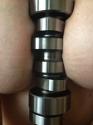



LS7 Texas Speed PRC285cc heads

Lots of info going in here. Not all of it good.
1. Wipe pattern - set via pedestal height under the rocker. You use shins underneath to set the wipe pattern. Completely unaffected by pushrod length. Pushrods too long causes the valves to not fully close. Pushrods too short causes them to be loose. HOWEVER-- wipe pattern is worthless on stock rockers which scrub the valve tip. Wipe pattern is for roller tips. Based on OP, I do not think roller tips were used.
2. Lash caps. When running stock rockers on ls7, lash caps are needed to spread the load and ovoid scrubbing out the tips of the valves and to avoid scrubbing away at valve guides. This is LS7-specific.
3. When running bronze valve guides on ls7 parts, roller tips are needed. Lash caps also if running titanium valves. If running stainless valves or if titanium valves have the hardened tips lash caps are not needed. If you plan to run stock rockers on ls7 heads you need the powder metal guides or cast steel guides. If you use stock rockers with bronze guides you will end up breaking intake valves.
4. Short travel lifters have a very narrow preload window. Having two different length pushrods is not unusual in this application. In fact for short travel lifters, best play is to measure all 16 valves. Then order custom pushrods from a vendor who makes them to spec vs .025 increments. On a short travel valvetrain, it is not unusual to have 4-6 different pushrod lengths.
Hope that clears it up some. Edit -- TSP would know all of these things and should not be saying two diff length pushrods is the root cause of any of this.
My bet is high lift, stock rockers, bronze guides. Bad combo
1. Wipe pattern - set via pedestal height under the rocker. You use shins underneath to set the wipe pattern. Completely unaffected by pushrod length. Pushrods too long causes the valves to not fully close. Pushrods too short causes them to be loose. HOWEVER-- wipe pattern is worthless on stock rockers which scrub the valve tip. Wipe pattern is for roller tips. Based on OP, I do not think roller tips were used.
2. Lash caps. When running stock rockers on ls7, lash caps are needed to spread the load and ovoid scrubbing out the tips of the valves and to avoid scrubbing away at valve guides. This is LS7-specific.
3. When running bronze valve guides on ls7 parts, roller tips are needed. Lash caps also if running titanium valves. If running stainless valves or if titanium valves have the hardened tips lash caps are not needed. If you plan to run stock rockers on ls7 heads you need the powder metal guides or cast steel guides. If you use stock rockers with bronze guides you will end up breaking intake valves.
4. Short travel lifters have a very narrow preload window. Having two different length pushrods is not unusual in this application. In fact for short travel lifters, best play is to measure all 16 valves. Then order custom pushrods from a vendor who makes them to spec vs .025 increments. On a short travel valvetrain, it is not unusual to have 4-6 different pushrod lengths.
Hope that clears it up some. Edit -- TSP would know all of these things and should not be saying two diff length pushrods is the root cause of any of this.
My bet is high lift, stock rockers, bronze guides. Bad combo
I ran 9 different length pushrods on my Johnson short travel lifters to get around .035" preload. I wouldn't recommend them for folks who just bolt and go.
But that wouldn't be a geometry issue. The rest of what Darth states is what actually causes geometry issues.
The Johnson short-travel lifter preload specs are so tight that you really need to get measurements down to the gnats ***. The "turns to length" method of the checker tool isn't good enough. You'll need a proper 12" or 16" caliper to measure actual length. And you'll have to partner with a company like Manton that has experience with those lifters and will make custom length pushrods to suit your engine.
After you make repairs to your engine and change out damaged lifters, measure for pushrod length using technique described in this thread and keep track of which measurement belongs to which hole, https://ls1tech.com/forums/generatio...od-length.html
But the measured length is NOT the length you'll order. Call up Manton and share your measurements and the brand and part number of length checker tool you used. They'll add more length to account for differences of shape of the ends of the pushrods vs. the checker tool, and things like growth of the block after engine warm up. Then they'll group your results according to the length increments they are able to manufacture. You'll likely end up with 4 or more different pushrod lengths when they're done, and you'll need to keep track of which one goes in which hole.
Now the pushrods themselves have a tolerance as well, so you'll want to measure every pushrod that you receive. I ended up switching a couple around based on actual measurements in the groups that I received. Don't be surprised if they're not exactly what you ordered because they will shrink or grow depending on room temp. Manton verifies measurements in the factory at 70°F.
The whole process sounds really **** because it is. In reality the Johnson lifters aren't quite that sensitive to preload, but in practice we aim small so we miss small.
For what it's worth, I cross-checked technical advice from Mamo, Johnson, and Manton when I did the H/C/I swap on my LS7. Here are my own notes from each phone call.
Mamo: Shoot for 0.038" preload when ordering pushrods. Real concern is preload when assembled. Acceptable range is between 1/3 to 3/4 turns of wrench.
Johnson: 5W-30 oil is ideal to pump up the lifter. Preload spec is 0.030" +/- 0.005.
Manton: Pushrods have a 0.003- 0.008" tolerance as manufactured and will grow or shrink by 0.015" with a 25F temp swing. Manton sells and has a lot of experience with Johnson lifters and is the primary supplier of pushrods because they are so accurate with lengths. 0.045" preload is what Manton uses which accounts for 0.015" growth of aluminum head and block. Main goal is to not overload the lifter. A 0.025" preload when hot is perfect (corresponds to 0.040 cold). A window of 0.038 - 0.045" preload during assembly is a good range. The more the plunger is pushed in (preloaded) the less vacuum the engine will produce. Johnson is being really conservative about the preload tolerance because they don't want to overload the lifters, they used to advertise wider specs with the same product.
Mamo: Shoot for 0.038" preload when ordering pushrods. Real concern is preload when assembled. Acceptable range is between 1/3 to 3/4 turns of wrench.
Johnson: 5W-30 oil is ideal to pump up the lifter. Preload spec is 0.030" +/- 0.005.
Manton: Pushrods have a 0.003- 0.008" tolerance as manufactured and will grow or shrink by 0.015" with a 25F temp swing. Manton sells and has a lot of experience with Johnson lifters and is the primary supplier of pushrods because they are so accurate with lengths. 0.045" preload is what Manton uses which accounts for 0.015" growth of aluminum head and block. Main goal is to not overload the lifter. A 0.025" preload when hot is perfect (corresponds to 0.040 cold). A window of 0.038 - 0.045" preload during assembly is a good range. The more the plunger is pushed in (preloaded) the less vacuum the engine will produce. Johnson is being really conservative about the preload tolerance because they don't want to overload the lifters, they used to advertise wider specs with the same product.

Thread Starter
Teching In
Joined: Feb 2020
Posts: 12
Likes: 0
Alright, I really appreciate the good info guys! It really is a massive help to me because it is hard and tedious to do all of the research by yourself and compare what a lot of manufacturers and builders prefer. I will take all of this into account when I get it put back together
LS1 Tech Stories
The Best V8 Stories One Small Block at Time

Top 10 Greatest Cadillac V Series Performance Models Ever, Ranked
Pouria Savadkouei
Top 10 Most Powerful Chevy Trucks Ever Made!

Hennessey's New Supercharged Silverado ZR2 Has 700 HP
Verdad Gallardo
Coachbuilt N2A Anteros Is an LS2-Powered C6 Corvette In Italian Clothes
Verdad Gallardo
Awesome K5 Blazer Restomod Comes With C7 Corvette Power
Verdad Gallardo
10 Camaros You Should Never Buy

10 LS Engine Myths That Refuse to Die
Verdad Gallardo
Five Reasons the Camaro Was the Most Pivotal Player in the Pony Car Wars 2.0
Brett Foote
10 Reasons the LS7 Is GM's Most Extreme Naturally Aspirated V8 Engine Ever
Verdad Gallardo
Originally Posted by Isgale
Alright, I really appreciate the good info guys! It really is a massive help to me because it is hard and tedious to do all of the research by yourself and compare what a lot of manufacturers and builders prefer. I will take all of this into account when I get it put back together
I ended up doing the measurements many times over and probably drove Tony FREAKIN' CRAZY with my e-mails. I know I'm one of those "high maintenance" customers that over thinks to the point of confusion. I learn better by watching, not so much reading, and there was nobody to watch in my garage. But it's all pretty straight forward in hind-sight.

Here is solution to your pushrod problem https://www.compcams.com/xd-a-7-320-...-shim-kit.html
Comp Cams XD-A™ Adjustable Pushrods, you can adjust all individual pushrods exactly the lenght/preload you need. And they are extra stiff too😉
Comp Cams XD-A™ Adjustable Pushrods, you can adjust all individual pushrods exactly the lenght/preload you need. And they are extra stiff too😉
Thread Starter
Teching In
Joined: Feb 2020
Posts: 12
Likes: 0
I wanna day thank you to Darth for all of the info! It’s great I will be using it all for years to come.
QwikTrip I completely understand. I’m very **** myself and if they had said to measure every hole I would have. If they had said I needed shims or roller tipped rockers I would have. But I guess you love and learn. It’s sad cause I thought I was building a bullet proof motor basically and gonna have something great and fun and people are building junkyard motors and daily them with more power and more reliability
QwikTrip I completely understand. I’m very **** myself and if they had said to measure every hole I would have. If they had said I needed shims or roller tipped rockers I would have. But I guess you love and learn. It’s sad cause I thought I was building a bullet proof motor basically and gonna have something great and fun and people are building junkyard motors and daily them with more power and more reliability
Here is solution to your pushrod problem https://www.compcams.com/xd-a-7-320-...-shim-kit.html
Comp Cams XD-A™ Adjustable Pushrods, you can adjust all individual pushrods exactly the lenght/preload you need. And they are extra stiff too😉
Comp Cams XD-A™ Adjustable Pushrods, you can adjust all individual pushrods exactly the lenght/preload you need. And they are extra stiff too😉

So, setup on those is a bit of an investment. For a solid roller lash adjustment you need to go to the next size higher shim, and lap the thickness down by the .001" on a wetstone or something.