When you click on links to various merchants on this site and make a purchase, this can result in this site earning a commission. Affiliate programs and affiliations include, but are not limited to, the eBay Partner Network.
I have a LS3 crate engine in my 2006 Porsche Cayman. Been driving the car for a year or so with around 10K on the package. I'm setting up an oil cooler and wonder if upgrading my oil pump is a good idea. I'm using a 60 row Earls and 10an lines. The Cayman is geared for a flat 6 cylinder and at 70 mph the engine is at approximately 2700 rpm. I want to be able to keep oil temps down when I push the car hard. I haven't installed the cooler yet just gathering parts. The high pressure / or high volume pumps are out there just don't know what might be best for my setup. Any suggestions ???
Why high volume on a stock clearance crate engine?
I agree with this. If standard volume maintains sufficient pressure, more oil volume solves nothing.
More volume IS needed for more bearing clearances and/or DOD/VVT, but that's about it.
Thank you guys for the input ! Thought I might fill in some of the blanks. My engine typically runs 25 psi @ 800 rpm and 40 psi at 3,000 rpm both at 200 - 225 degrees of oil temp (Autometer electronic non-mechanical pressure and temp gauges) . I am going to use a large cooler 60 row / 10an which will be fitted with a 1800 cfm Spal fan and a 180 degree oil thermostat. The setup is going to run in the trunk area so there will be a mix of cool and warm air across the cooler .
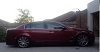
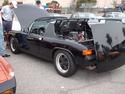
Something like this below (not my car) as yet air in through the trunk lid and out under the car. Clearly I will be changing the air cleaner location to fit this cooler / fan setup.
So get a higher pressure pump and not a volume ???
The reason I’d go high volume is to make up for the extra oil in the engine due to oil cooler , more oil , more volume, I’d use the standard pressure spring.
I use an extra quart of oil after installing oil cooler, that’s about the same % more the hv oil pump puts out
10296 Melling. The small amount of extra volume will help with the large -10 lines and cooler capacity. I’m running the same setup and pump.
Anyway you can re-gear the car to get the rpms down to 1800-1900ish at 70 mph for mileage and a more enjoyable highway car?
Maybe I'm wrong but the way it was explained to me many many years ago was like this.
High pressure will flow more oil (bypass less) with stock clearances versus high pressure high volume
High Pressure High Volume is to be used with larger clearances that can use the extra volume at a higher pressure. Using high pressure high volume with stock clearances does not flow more oil because the tighter clearance only allows X amount of oil to pass at X pressure and bypasses the rest regardless of pump volume and can actually put heat in the oil.
Kind of like someone using a higher volume fuel pump than needed and having the regulator bypass it right back to the tank heating up the fuel.
Something to think about besides the cooler is oil control in the pan if you plan on cornering hard and windage issues possible whipping the oil.
What I did was call the manufacturer themselves. You will get too many incorrect answers ask in the internet like this. I used melling so I called them and they explained to me why I needed the pump I went with and why I shouldn’t go with the other pump.
No oil cooler here but one massive oil filter that utilizes 10AN lines to a 6 quart oil pan and zero problems running a HVP on an iron block with .0025-.0030 clearances.
"Volume", when speaking of an oil pump, has NOTHING WHATSOEVER to do with the "volume" of the sump, oil cooler, or ANYTHING ELSE.
An oil pump is a CONSTANT VOLUME device. Each rotation moves a certain amount of oil. It is designed in such a way that once the oil gets into it, it has no way to go, other than out the discharge. Unlike some other types of pumps, the "volume" that it delivers, DOES NOT CHANGE due to restriction.
The pump contains a "bypass" valve that is spring loaded, to allow the constant volume of oil moved by the pump gears, to return to the sump, once some pressure limit is reached. This prevents things from happening like, exploding oil filters, "hydraulic-ing" the pump, and so on, when the downstream restrictions (bearing clearances, and nothing else, ideally) are such that more oil is being delivered by the pump gears than can be forced through them, without excessive pressure developing.
The ONLY reason that there is ANY pressure AT ALL is because of whatever restrictions exist downstream of it. In the absence of the "bypass" inside the pump, the pressure will always rise to a value such that the flow through those restrictions is equal to the "volume" of the pump. If it takes 100, or 150, or 200 psi to force that much oil through the bearings, then that's what the pressure will rise to. If the pump can deliver more "volume" than can flow through the restrictions (bearings) at a safe pressure level, let's say 70 psi or whatever,, the bypass will open, thus allowing the "extra" pump delivery to escape back to the sump.
Coolers, filters, long lines, etc. are additional restrictions to oil flow. Maybe not all that much, but restrictions nonetheless. They require pressure to move the oil through them, or in another choice of words, create a pressure drop. So if your pump's bypass regulator is set to, say 50 psi, and the sum of all that stuff that's between the pump and the engine produce, say, 10 psi of pressure drop, your 50 psi pump will ACTUALLY only be delivering 40 psi to the bearings.
For this reason, the addition of coolers etc. requires higher PRESSURE to be supplied AT THE PUMP, so that after the pressure drop that those things create has occurred, there is still the desired pressure AT THE ENGINE to keep the flow through the bearings at an adequate level.
The pump can be thought of as "doing work", like any other pump; the amount of work it can do is characterized by its pressure vs volume curve. Pressure × volume = work.
Therefore, when adding coolers lines filters etc., the pump's regulator setting needs to be at a higher PRESSURE than it would otherwise. The pump VOLUME requirements are determined by the degree of restriction presented by the BEARINGS, and nothing else, same as without the cooler etc.
The pump MIGHT however, have to have a higher VOLUME capacity to be able to deliver the higher PRESSURE needed to overcome the added restriction of the cooler etc., at whatever FLOW RATE (volume) the bearings require to remain properly lubed and cooled, than it would if that extra "work" requirement wasn't there. Probably won't be by much but it doesn't hurt to provide for it.
I agree, the 10296 is a good all-around choice for most of these motors that don't have VVT etc., which require flow OTHER THAN that to the bearings. Its regulator has a stiffer spring and therefore it can deliver the higher pressure needed to overcome the restriction of coolers and such things, and may need some extra volume capacity to be able to do the extra work of forcing the oil through those other things.
10296 pumps on both of my engines because I see no benefit to running a standard pump. Having 7 quarts of oil capacity and 60psi works for me so I'll take it.
Strictly speaking, the oil pressure relief valve doesn't return oil to the pan, but the pickup side of the pump. It's not just spraying oil into your oil pan eating power and aerating your oil.
I may be mistaken but I think that's how it works.
6 Common C5 Corvette Failures and What's Involved In Repairing Them
Slideshow: From wobbling harmonic balancers to failed EBCMs, these are the issues that define long-term C5 ownership and what repairs typically involve.
Retro Modern Bandit Pontiac Trans AM Comes With Burt Reynolds' Autograph
Slideshow: A modern Camaro transformed into a retro icon, this limited-run "Bandit" build blends nostalgia with brute force in a way few revivals manage.
Top 10 Greatest Cadillac V Series Performance Models Ever, Ranked
Slideshow: Cadillac didn't just crash the high-performance luxury vehicle party, it showed up loud, supercharged, and occasionally a little unhinged...
Coachbuilt N2A Anteros Is an LS2-Powered C6 Corvette In Italian Clothes
Slideshow: A one-off sports car that looks like a vintage Italian exotic-but hides a C6 Corvette underneath-just sold for the price of a new mid-engine Corvette.






 Oil Pump choice ???