When you click on links to various merchants on this site and make a purchase, this can result in this site earning a commission. Affiliate programs and affiliations include, but are not limited to, the eBay Partner Network.
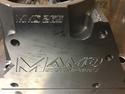
Disassembling a rebuilt LS3 that had oil consumption and high crankcase pressure, first cylinder I pop out shows this. Should the bottom support ring have detents so it won't rotate into the gaps and allow the oil ring to bunch up? Was this built wrong?
Second question - I have .027 and .021 for the compression ring gaps, seems a bit large for a 4.065 bore but would that be noticeable?
Disassembling a rebuilt LS3 that had oil consumption and high crankcase pressure, first cylinder I pop out shows this. Should the bottom support ring have detents so it won't rotate into the gaps and allow the oil ring to bunch up? Was this built wrong?
Second question - I have .027 and .021 for the compression ring gaps, seems a bit large for a 4.065 bore but would that be noticeable?
Thanks,
Jim
Ok, that isn’t a support ring, that’s the actual oil ring. The expander between the oil rings is what’s overlapped. Orientation is critical here for the oil rings at setup. The oil ring gaps should be oriented in such a way as to keep the gaps away from that void. In a sense, yes, it was built wrong. Oil rings typically don’t move around like a top or second ring does. There is no detent on them in this application.
The .027 ring gap is big for a N/A setup. It’s ok for boost. Mixing the .027 with a .021 doesn’t make sense. Again, I’d classify this as built wrong. Could you tell the difference, or would it be noticeable you asked? It would be negligible at best from a performance standpoint, but might be the cause of the high crankcase pressure.
Precisely. And not even "in a sense"; quite literally, somebody botched it.
The 2 oil ring rails should be installed on top of the expander such that their gaps are each about 120° (1/3 of the way around) in opposite directions from the expander gap. That way, the 3 gaps are about evenly spaced all the way around, with none coinciding with any other, and the max possible distance among them. Doesn't have to be measured with a protractor or anything, just, common sense.
Whoever built that, spaced the gaps of the lower rail and the expander incorrectly, right on top of each other. That's why it failed that way. There's also a good possibility that the ring groove in the piston is damaged. In fact it looks like the end of the rail that isn't bent into the gap, has dug a divot out of the side of the groove, which is a critical sealing surface; if so, that piston will NEVER not leak oil into the cyl and will need to be replaced.
The entire assembly - the expander and both rails - should be free to rotate around the piston. In fact that's what they do during normal operation. When building an engine you can even mark where they are as you put the piston into the cyl, connect it to the crank, spin the crank and let it move up and down a couple of times, and take it back apart; and see that the whole thing has spun around the piston, all together, with the 3 pieces holding their relationship to each other. Yours there can't do that. It will rapidly destroy everything; most especially the cyl wall.
.021" on the top ring and .027" on the 2nd are a bit on the high side but not "problematic". A more normal gap for a hot street / strip N/A motor would probably be more like .020"/.024". But the difference in performance, if there's even any at all, would probably be undetectable. Since there's no such thing as "the one" "perfect" number, only a continuum of choices and outcomes, I'd rather have slightly too much gap - HEAVY emphasis on "slightly", which is how I'd describe what you've got there - than ANY too little.
I'd tear that whole thing back down and correct whatever else Stimpy got wrong in that build, lest you fix this one stuuuupidity and go through the trouble of reinstalling the engine, and then find yourself with yet another malfunction of some sort requiring yet another R&R & teardown.
The 2 oil ring rails should be installed on top of the expander
So, both oil rings above the expander? Did I read that right? That would certainly keep the bottom ring from sneaking into that break in the ring land, just didn't think that was advisable. Thanks for the help - learning as I go.
To install them, you put the expander in first, then wrap one rail "on top of" (kind of more "around", so to speak) the expander from the top of the piston, settling it into the groove formed by the expander on the side of it closer to the top of the piston; then you wrap the other rail around the first rail and the expander also from the top of the piston, and put it "on top of" the expander on the side toward the bottom of the piston. The expander is the full width of the groove in the piston, down deep at the bottom of the groove; but then is notched to leave space for the rails up at the top of the groove. When it's fully installed, the ends of the expander must be butted straight up against each other and not overlapping in any way; and each rail then "encloses" the expander, such that the expander ... expands ... the rails out against the cyl wall, by way of the bottom of the notch features supporting the inner dia of the rails and pressing them uniformly outwards. The gap in each rail and the gap in the expander should all be as far from overlapping as possible. The whole thing, all 3 pieces together as an assembly, should spin freely in the groove, but each piece should be rather difficult to move with respect to the other pieces. If it's not like that, then when you attempt to install it into the cyl, it probably won't even go in right, and even worse, SOMETHING (usually more than one thing) will get mangled and destroyed.
All of the rings, the oil ring included, MUST NOT scratch or otherwise damage ANY surface of the piston. Most especially, not the sides of the groove where the flat sides of the rings touch, because that's the primary sealing surface. Any damage there will allow blowby and/or oil infiltration.
Thanks RB04Av, that makes sense. The piston for that cylinder was almost carbon-free, as apposed to the others that had some uniform buildup, tells me that there was oil in that chamber, and my consumption and smoke issue was likely caused by that ring failure. Now if i can only figure out the crankcase pressure issue that blew oil out of every vent. Next is to check the rest of the ring gaps, and piston clearances.
Probably had something to do with those fornicated rings.
Don't forget, if a piston is damaged AT ALL in the ring grooves, it MUST BE replaced. The one in your photo is almost certainly garbage.
Don't worry so much about the ring gaps. In fact don't concern yourself about them at all. If they were just some box-stock set that somebody put into a motor that already had a couple of .001"s of bore wear, then the end gaps will naturally be slightly larger than they might otherwise be, and there wouldn't be any anything that could be done about it anyway. In your case, they are NOT The Problem. Concentrate on assembly mistakes and parts damaged by any such improper assembly. Avoid being distracted by shiny things laying of to the side of The Path, like a .001" or 2 of ring end gap.
6 Common C5 Corvette Failures and What's Involved In Repairing Them
Slideshow: From wobbling harmonic balancers to failed EBCMs, these are the issues that define long-term C5 ownership and what repairs typically involve.
Retro Modern Bandit Pontiac Trans AM Comes With Burt Reynolds' Autograph
Slideshow: A modern Camaro transformed into a retro icon, this limited-run "Bandit" build blends nostalgia with brute force in a way few revivals manage.
Top 10 Greatest Cadillac V Series Performance Models Ever, Ranked
Slideshow: Cadillac didn't just crash the high-performance luxury vehicle party, it showed up loud, supercharged, and occasionally a little unhinged...
Coachbuilt N2A Anteros Is an LS2-Powered C6 Corvette In Italian Clothes
Slideshow: A one-off sports car that looks like a vintage Italian exotic-but hides a C6 Corvette underneath-just sold for the price of a new mid-engine Corvette.


 Oil Control Ring Supports