When you click on links to various merchants on this site and make a purchase, this can result in this site earning a commission. Affiliate programs and affiliations include, but are not limited to, the eBay Partner Network.
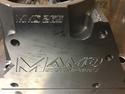
Yeah, that's where the oil was going. I also plugged the gen-4 oil pan, just for good measure. It's ready to dyno, again. I just don't have time right now.
The spring tensioners were designed for engines with VVT, as cam timing from a firm chain is imperative in a VVT application. Did some engines get the spring tensioners that didn’t have VVT? I’ve never seen one personally. I buy aluminum blocks, and do a fair amount of high end LS builds for clients. Sometimes I’ll buy a core for the block and if it’s a VVT engine, it will still have the spring tensioner in there. I’ve tore a lot of those down and the tensioner is broke, and the spring from it is in the oil pan…it’s common. I’ve had a couple where the failed tensioner caused undo wear on the chain, from the chain rubbing on the steel frame of the tensioner, and the chain is broke. Save yourself the trouble and buy the LS2 damper block. It’s stable and does a good job at keeping chain harmonics down. It’s fits your block, zero issues. Here’s a pic from one of my builds…
Bumping this one back up. I bought a couple cores recently and lo and behold, I had one with a spring style tensioner and no VVT…single bolt cam…’07 aluminum truck 5.3. Here’s a pic for proof. First one I have ever seen personally….Just wanted to share as I posted previously that I’d never seen one…
I believe the 2 complete 5.3's I have use the leaf spring tensioner and I believe it was used in most ls3's but don't quote me on that. I like the idea, but with as many broken ones I've seen over the years on here there is no way I'd use one, just the simple block for me.
What amazes me is GM seems to have a Helluva time designing/building reliable spring tensioners. I say that because SOHC & DOHC Japanese motorcycle engines, even the old air cooled ones, had no problems with this same basic design. These were 10,000+ rpm engines that sometimes made over 2hp/cubic inch. If they can do it, we sure as Hell should be able to do it, too. I suspect the bike engineers have more freedom from bean counters trying to save 50 cents on a $30 part than our domestic engineers do....
What amazes me is GM seems to have a Helluva time designing/building reliable spring tensioners. I say that because SOHC & DOHC Japanese motorcycle engines, even the old air cooled ones, had no problems with this same basic design. These were 10,000+ rpm engines that sometimes made over 2hp/cubic inch. If they can do it, we sure as Hell should be able to do it, too. I suspect the bike engineers have more freedom from bean counters trying to save 50 cents on a $30 part than our domestic engineers do....
Unfortunately If they can save even 1 cent by using an Inferior part and make it just past the warranty, That's what they will do. Look at the crankshaft issues they are having. Some one decided to skip the last step and not polish the crank shaft. Now its costing them in warranty claims... They came up with all sorts of things and ultimately it comes back to the surface finish on the crank shaft.
Unfortunately If they can save even 1 cent by using an Inferior part and make it just past the warranty, That's what they will do. Look at the crankshaft issues they are having. Some one decided to skip the last step and not polish the crank shaft. Now its costing them in warranty claims... They came up with all sorts of things and ultimately it comes back to the surface finish on the crank shaft.
I worked for John Deere for 20 years and you hit the nail on the head, but that also brings up the point that if the factory did add something here or doesn't use 4" stroke cranks etc etc you can be damn sure it's for a good reason. I always love it when people bash the tuning from the factory, like they don't know better or something. It's hard to get products to live out in the environment, with random end users, but at the same time accelerated life tests do not perfectly simulate the real world so they drop the ball on things like the crankshaft deal etc.
The GM Billion dollar issue is surface texture…not surface finish. Texture is the underlying finish BEFORE the semi-polish and final polish begins. You can’t feel…or even see the texture of the material. It has to be analyzed with scopes to actually see. The final polish is ok, considering the texture…it looks and feels great to you and me. I’ve seen it first hand. It’s a step that GM decided to skip to save a little money. But final polish on a surface that’s not ready to be polished is a no. Again, it really looks like any other finish on an OEM crank that I’ve ever seen…but it’s not correct. Oooops.
The GM Billion dollar issue is surface texture…not surface finish. Texture is the underlying finish BEFORE the semi-polish and final polish begins. You can’t feel…or even see the texture of the material. It has to be analyzed with scopes to actually see. The final polish is ok, considering the texture…it looks and feels great to you and me. I’ve seen it first hand. It’s a step that GM decided to skip to save a little money. But final polish on a surface that’s not ready to be polished is a no. Again, it really looks like any other finish on an OEM crank that I’ve ever seen…but it’s not correct. Oooops.
Thanks for the explanation.
The way I understood Or should I say the way It was explained, It seemed like they eliminated something in the final finish process and just let it out the door as acceptable.