







Huge Split Duration Camshaft for Stroked L92

Thread Starter
On The Tree
Joined: Dec 2006
Posts: 126
Likes: 0
From: Indianapolis, IN
 Huge Split Duration Camshaft for Stroked L92
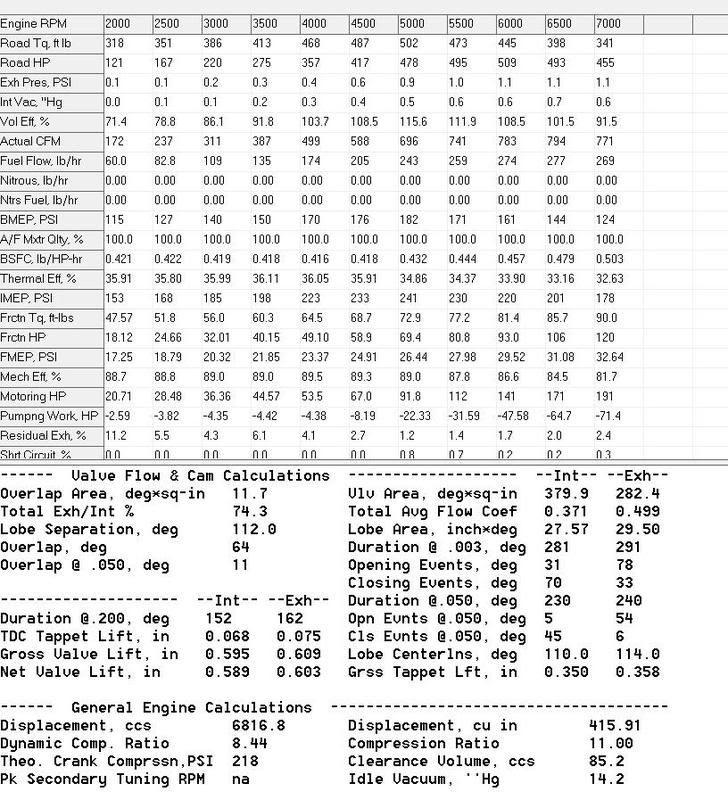
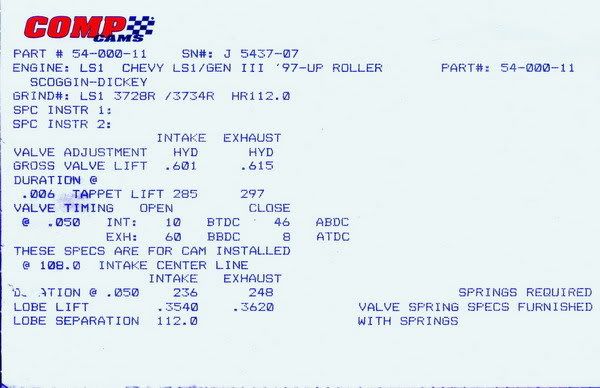
 I realize that the intake ports way outflows the exhaust ports on my stock (Unported) L92 heads. My cam was custom designed by Comp Cams in Dec 2006. The specs are 236/248 duration @.050; .601"/.615" lift, 112 LSA. However I've never seen a camshaft with a 12 degree split. What do you guys think? Was this large of a split necessary? I wouldn't mind replacing my current cam with something a little smaller. What do you think would be a good replacement? I drive daily in heavy bumper to bumper traffic.
My setup is as follows:
2005 GTO
3.91 ring & Pinion
4.00" stroke X 4.067" Bore
416 CID Stroked L92
L76 Intake
Stock L92 heads
40 Lb GM Fuel injectors
SLP Long Tube headers & 3" exhaust
My setup is as follows:
2005 GTO
3.91 ring & Pinion
4.00" stroke X 4.067" Bore
416 CID Stroked L92
L76 Intake
Stock L92 heads
40 Lb GM Fuel injectors
SLP Long Tube headers & 3" exhaust
My first cam was a big split - larger than your current cam with 19 degrees of overlap. Drivability was an issue. There are a few good post with people running anywhere from 2 to 6 degrees split with good results. I would however like to see one of these setup running something like a 228-240 112 cam. My next one may look something like that.
My $.02
My $.02
The cam in my LS-7 is stock and has a 211/230 duration figure but it's on a large split. You can tell it has a cam in it as it has a slight rock to the car. It has outstanding performance for a stock engine. My 346 C-5 has a large cam in it and it's not very fun to drive in traffic. It all depends on what you can put up with.
D.J.
D.J.
My first cam was a big split - larger than your current cam with 19 degrees of overlap. Drivability was an issue. There are a few good post with people running anywhere from 2 to 6 degrees split with good results. I would however like to see one of these setup running something like a 228-240 112 cam. My next one may look something like that.
My $.02
My $.02
With a 12* split on a 114
Keep the change

My heads where ported and I purchased a cam from Rick at Synergy..... he sent me a single pattern cam with very little overlap and less than 240's duration. Of course seat timing is what matters for cam selection.... and it appears that the L92's dont need a load of duration.... likely due to the fact that the heads flow so well.
Example:
Cam only...... big duration (think about the T-Rex cam that works well peak in 346's)
Heads Cam..... you typically cut back on the duration (think of all the 232/236 type cams that work well in H/C 346's) it is likely you wouldnt put a T-rex with a set of great heads.......... atleast it is not the norm.
and when you throw a head in the mix that flows its *** off... I assume you need less duration to fill the chamber properly. As far as the split..... it is easy to assume it is necessary when the exhaust needs a bit of work to compete/keep up with the intake
Example:
Cam only...... big duration (think about the T-Rex cam that works well peak in 346's)
Heads Cam..... you typically cut back on the duration (think of all the 232/236 type cams that work well in H/C 346's) it is likely you wouldnt put a T-rex with a set of great heads.......... atleast it is not the norm.
and when you throw a head in the mix that flows its *** off... I assume you need less duration to fill the chamber properly. As far as the split..... it is easy to assume it is necessary when the exhaust needs a bit of work to compete/keep up with the intake
Trending Topics
My heads where ported and I purchased a cam from Rick at Synergy..... he sent me a single pattern cam with very little overlap and less than 240's duration. Of course seat timing is what matters for cam selection.... and it appears that the L92's dont need a load of duration.... likely due to the fact that the heads flow so well.
Example:
Cam only...... big duration (think about the T-Rex cam that works well peak in 346's)
Heads Cam..... you typically cut back on the duration (think of all the 232/236 type cams that work well in H/C 346's) it is likely you wouldnt put a T-rex with a set of great heads.......... atleast it is not the norm.
and when you throw a head in the mix that flows its *** off... I assume you need less duration to fill the chamber properly. As far as the split..... it is easy to assume it is necessary when the exhaust needs a bit of work to compete/keep up with the intake
Example:
Cam only...... big duration (think about the T-Rex cam that works well peak in 346's)
Heads Cam..... you typically cut back on the duration (think of all the 232/236 type cams that work well in H/C 346's) it is likely you wouldnt put a T-rex with a set of great heads.......... atleast it is not the norm.
and when you throw a head in the mix that flows its *** off... I assume you need less duration to fill the chamber properly. As far as the split..... it is easy to assume it is necessary when the exhaust needs a bit of work to compete/keep up with the intake
 What he said ^
 LS1 Tech Stories
The Best V8 Stories One Small Block at Time

Gas Monkey Built a 6-Wheel Ferrari Testarossa With a Corvette LT4 Engine
Verdad Gallardo
7 Most Reliable High-Performance Engines GM Has Ever Built
Verdad Gallardo
Amazing '71 Camaro Restomod Is Modern Muscle Car Under the Skin
Verdad Gallardo
6 Common C5 Corvette Failures and What's Involved In Repairing Them
Pouria Savadkouei
Retro Modern Bandit Pontiac Trans AM Comes With Burt Reynolds' Autograph
Verdad Gallardo
Top 10 Greatest Cadillac V Series Performance Models Ever, Ranked
Pouria Savadkouei
Top 10 Most Powerful Chevy Trucks Ever Made!

Hennessey's New Supercharged Silverado ZR2 Has 700 HP
Verdad Gallardo
Coachbuilt N2A Anteros Is an LS2-Powered C6 Corvette In Italian Clothes
Verdad Gallardo
What are the chances of more intake duration helping the power numbers? I would say slim to none.
The clues were everywhere, people where making dissappointing power with the LS7 heads and big cams, I knew the L92's would follow suit.
There are a ton of ways to build a combination, a set of L92's and a conservative cam is one way to build good power on a budget, but when it doesn't make the power of the best cathedral port stuff out there then don't be so disillusioned.
The clues were everywhere, people where making dissappointing power with the LS7 heads and big cams, I knew the L92's would follow suit.
There are a ton of ways to build a combination, a set of L92's and a conservative cam is one way to build good power on a budget, but when it doesn't make the power of the best cathedral port stuff out there then don't be so disillusioned.
Patrick, what do you think about the IVO? I have been talking to some old school cam guys and they have been telling me to open the intake as late as I can with these heads. They say you need to create a little "suction" to get the air moving because it is a lazy port. Running higher LSA's also has the effect of opening the intake later too.
-Geoff
-Geoff
Why smaller cams on L92’s????? Hmmmmm
I didn't say anything about port velocity (charge speed). What we're dealing with here is a simple situation where air flows from a high pressure area (the intake port) towards a low pressure area (the incompletlely filled cylinder). What I was saying is that the cylinder would have to be completely full some time before the intake valve closes for mixture to be pushed back up into the head before the intake valve closes. That's not happening past peak torque wiith a smallish hydraulic roller cam. It only happens in daydreams and on laptops. Backflow before peak torque is not the real problem with big intake valves. It's at the beginning of the intake stroke where the intake valve just opens (while the engine is still on the exhaust stroke) that causes the problem. A bigger higher flowing intake valve will allow more exhaust into the intake port. Bad Ju-Ju. keep in mind that during the first phase of overlap (the part before TDC) BOTH valves are in effect exhaust valves. Engines with big intake valves are more sensitive to the intake opening point (cam can't be advanced as much) than an engine with smaller less back flowing intake valves.
Last edited by WizeAss; Feb 2, 2008 at 11:14 AM.

FormerVendor
Joined: Jan 2002
Posts: 173
Likes: 0
From: Mpls., MN
Quote:
Originally Posted by Greg Good
.....What we're dealing with here is a simple situation where air flows from a high pressure area (the intake port) towards a low pressure area (the incompletlely filled cylinder). ........ Backflow before peak torque is not the real problem with big intake valves. It's at the beginning of the intake stroke where the intake valve just opens (while the engine is still on the exhaust stroke) that causes the problem. A bigger higher flowing intake valve will allow more exhaust into the intake port.....
How does exhaust flow from the cylinder into the intake port if the pressure in the manifold is higher than that of the cylinder?
Originally posted by Greg Good
...... keep in mind that during the first phase of overlap (the part before TDC) BOTH valves are in effect exhaust valves......
Maybe with a plugged cat or some other obstruction.
Originally posted by WizeAss
..... the exhaust needs a bit of work to compete/keep up with the intake ....
Are you sure about that?
Please note..... not trying to pick on any individual here, I feel these statements represent beliefs held by many on this forum.
Maybe these beliefs need some more thought......
Originally Posted by Greg Good
.....What we're dealing with here is a simple situation where air flows from a high pressure area (the intake port) towards a low pressure area (the incompletlely filled cylinder). ........ Backflow before peak torque is not the real problem with big intake valves. It's at the beginning of the intake stroke where the intake valve just opens (while the engine is still on the exhaust stroke) that causes the problem. A bigger higher flowing intake valve will allow more exhaust into the intake port.....
How does exhaust flow from the cylinder into the intake port if the pressure in the manifold is higher than that of the cylinder?
Originally posted by Greg Good
...... keep in mind that during the first phase of overlap (the part before TDC) BOTH valves are in effect exhaust valves......
Maybe with a plugged cat or some other obstruction.
Originally posted by WizeAss
..... the exhaust needs a bit of work to compete/keep up with the intake ....
Are you sure about that?
Please note..... not trying to pick on any individual here, I feel these statements represent beliefs held by many on this forum.
Maybe these beliefs need some more thought......

TECH Apprentice


Joined: Oct 2007
Posts: 302
Likes: 20
With regards to "both valves acting as exhaust valves" - that only happens at lower revs. Once you get 'er wound up, it's the scavenging effect from both valves being open at once that fills the cylinder since the incoming charge is actually pulled into the cylinder from a combination of piston movement and negative pressure in the exhaust. Without that, there's no way a performance engine could even approach 100% V/E.
At 7200 RPM, each valve is opening and closing 60 times EVERY SECOND - there's no way to get enough of a pull on the intake ports with just negative pressure from the downward moving piston. At this speed, the engine is actually "trapping" air in the cylinders when the intake closes. In addition, keep in mind that inertia has a great deal to do with what's going on in the intake manifold. Air in motion tends to keep moving - when you close the intake valve, the air wants to keep moving, so it "piles up" and builds a small amount of pressure against the back of the intake valve. At lower revs, there's not enough inertia to build any pressure, so the diluted charge sneaks back into the intake a bit. Once the revs build and the air gets up to speed, the dynamics change.
I've heard more than one engine builder call the overlap/scavenging effect as the 5th cycle of a 4 cycle engine. It's a bit like timing - it doesn't make sense that we fire the plug 35* or so before the piston reaches the top of it's stroke, but it works.
At 7200 RPM, each valve is opening and closing 60 times EVERY SECOND - there's no way to get enough of a pull on the intake ports with just negative pressure from the downward moving piston. At this speed, the engine is actually "trapping" air in the cylinders when the intake closes. In addition, keep in mind that inertia has a great deal to do with what's going on in the intake manifold. Air in motion tends to keep moving - when you close the intake valve, the air wants to keep moving, so it "piles up" and builds a small amount of pressure against the back of the intake valve. At lower revs, there's not enough inertia to build any pressure, so the diluted charge sneaks back into the intake a bit. Once the revs build and the air gets up to speed, the dynamics change.
I've heard more than one engine builder call the overlap/scavenging effect as the 5th cycle of a 4 cycle engine. It's a bit like timing - it doesn't make sense that we fire the plug 35* or so before the piston reaches the top of it's stroke, but it works.

Staging Lane
Joined: Sep 2007
Posts: 50
Likes: 0
From: East Oakland, CA
I realize that the intake ports way outflows the exhaust ports on my stock (Unported) L92 heads. My cam was custom designed by Comp Cams in Dec 2006. The specs are 236/248 duration @.050; .601"/.615" lift, 112 LSA. However I've never seen a camshaft with a 12 degree split. What do you guys think? Was this large of a split necessary? I wouldn't mind replacing my current cam with something a little smaller. What do you think would be a good replacement? I drive daily in heavy bumper to bumper traffic.
My setup is as follows:
2005 GTO
3.91 ring & Pinion
4.00" stroke X 4.067" Bore
416 CID Stroked L92
L76 Intake
Stock L92 heads
40 Lb GM Fuel injectors
SLP Long Tube headers & 3" exhaust
My setup is as follows:
2005 GTO
3.91 ring & Pinion
4.00" stroke X 4.067" Bore
416 CID Stroked L92
L76 Intake
Stock L92 heads
40 Lb GM Fuel injectors
SLP Long Tube headers & 3" exhaust
In my opinion, the cam specs that you have chosen, as far as lift is concerned are correct for the L92 heads. The heads like a lot of lift on the intake side. The "split" duration of the camshaft that you have chosen is what "makes up" for the inability of the exhaust ports to flow the #'s in relation to the intake ports. I believe the cam IS adequate for a performance vehicle where everday drivability is NOT a factor. I also believe that the exhaust ports should be ported/flowed right from the box on ANYONE'S L92 heads, for ANY application other than stock, because they definitely lack the desired flow characteristics for performance.
PS-I bet it sounds BAD-*** though. Good luck with your build and keep us posted on progress.
In my opinion, the cam specs that you have chosen, as far as lift is concerned are correct for the L92 heads. The heads like a lot of lift on the intake side. The "split" duration of the camshaft that you have chosen is what "makes up" for the inability of the exhaust ports to flow the #'s in relation to the intake ports. I believe the cam IS adequate for a performance vehicle where everday drivability is NOT a factor. I also believe that the exhaust ports should be ported/flowed right from the box on ANYONE'S L92 heads, for ANY application other than stock, because they definitely lack the desired flow characteristics for performance.
PS-I bet it sounds BAD-*** though. Good luck with your build and keep us posted on progress.
PS-I bet it sounds BAD-*** though. Good luck with your build and keep us posted on progress.
I agree... looking at the cam that Rick at Synergy spec'd for me... Cybernco's isnt that far off. And the split should help with an unported exhaust port. Also... Rick's intake does have more lift than the exhaust... I assume this also helps with shrouding of the valve, as it spends more time over the horrible .400-.500 range where the shrouding hurts flow.
I had a cam with a large exhaust split, it was specifically built for nitrous though. If you plan to run nitrous or a blower they seem to really like the bigger exhaust split.
My old n20 cam 270/284 @.050 660/680 114 lobe.
My old n20 cam 270/284 @.050 660/680 114 lobe.
Thread Starter
On The Tree
Joined: Dec 2006
Posts: 126
Likes: 0
From: Indianapolis, IN
Further Info Yeah it sounds great but my cam is just too big for the extremely heavy traffic in Honolulu.
Here's my cam card
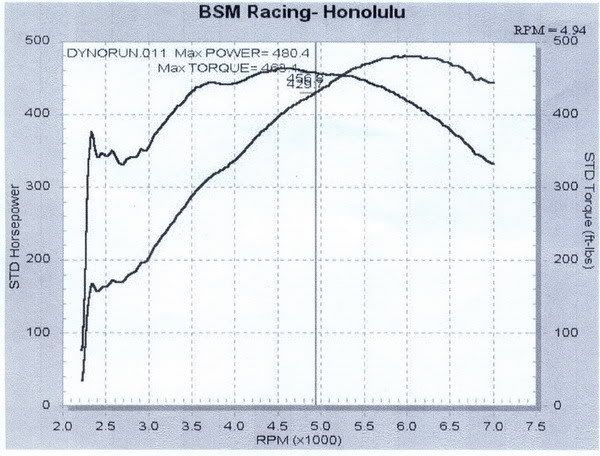
Here's my dyno
Here's my cam card
Here's my dyno
Last edited by cybernco; Feb 4, 2008 at 02:18 AM.