






No need for full e85

Thread Starter
Registered User
Joined: Jul 2013
Posts: 3
Likes: 0
 No need for full e85
 This is my first post on the forum. This is the forum I come to when I need to find all things ls...I dont own a ls currently but am contemplating the new c7. I own a 295whp 340 ftlbs<(mustangdyno) mazdaspeed3.
I dont know if this has been covered yet, I doubt it as the lt1 will be the first american v8 with a high pressure fuel system that i know of. please correct me if im wrong.( When I say high pressure I mean during WOT your fuel pressure will be 2000 psi.) e85 has an octane rating of 105 to 110 in normal port lower pressure injected engines(all previous LSs) BUT when used in a direct injection HPFS, the effective octane is about 140 (160 for pure E). Whats great about this is and what my platform does is run e85 mixes. so 3 gallons of e85 and 9 of 93 or 91. This allows for an octane rating = or greater than race gas. we have had people go from 230 whp to 310 whp with an intake, fuelpump and tune. Ide be able to bump out 330whp and around 400 ftlbs if i switched to an e85 tune due to timing alone. We are able to reach MBT with 50/50 mixes.
Problems my platform as well with the bmw and vw people who have HPFS have run into:
-stock fuel pump could not support modding and will not maintain the 1800 psi i run. less pressure less atomization, more knock and boom
-People running greater than 50% e85 get the black sludge of death after about 10k
Lack of fuel pressure was fixed with new fuel pump internals. $300 and and hour of time http://www.goapr.com/includes/img/pr...pump_parts.jpg
Here is the reference to all the octane stuff, very technical but interesting.
http://www.psfc.mit.edu/library1/cat...ja002_full.pdf
I hope that all this has been discussed before and if not that it will help the aftermarket vette community in designing some awesome parts and get over the DI HPFS hurdles other platforms have run into, faster. As well as any vette tuners lucky enough to get to play with the LT1 software.
I dont know if this has been covered yet, I doubt it as the lt1 will be the first american v8 with a high pressure fuel system that i know of. please correct me if im wrong.( When I say high pressure I mean during WOT your fuel pressure will be 2000 psi.) e85 has an octane rating of 105 to 110 in normal port lower pressure injected engines(all previous LSs) BUT when used in a direct injection HPFS, the effective octane is about 140 (160 for pure E). Whats great about this is and what my platform does is run e85 mixes. so 3 gallons of e85 and 9 of 93 or 91. This allows for an octane rating = or greater than race gas. we have had people go from 230 whp to 310 whp with an intake, fuelpump and tune. Ide be able to bump out 330whp and around 400 ftlbs if i switched to an e85 tune due to timing alone. We are able to reach MBT with 50/50 mixes.
Problems my platform as well with the bmw and vw people who have HPFS have run into:
-stock fuel pump could not support modding and will not maintain the 1800 psi i run. less pressure less atomization, more knock and boom
-People running greater than 50% e85 get the black sludge of death after about 10k
Lack of fuel pressure was fixed with new fuel pump internals. $300 and and hour of time http://www.goapr.com/includes/img/pr...pump_parts.jpg
Here is the reference to all the octane stuff, very technical but interesting.
http://www.psfc.mit.edu/library1/cat...ja002_full.pdf
I hope that all this has been discussed before and if not that it will help the aftermarket vette community in designing some awesome parts and get over the DI HPFS hurdles other platforms have run into, faster. As well as any vette tuners lucky enough to get to play with the LT1 software.
No. The only reason shitty 4 cylinders get such good gains is the e85 vaporizes and cools their overheated overworked and generally undersized turbos' intake charges immensely, not because unicorns exist at 2000psi and create imaginary octane that doesn't exist.
To add to that, amount of timing before knock is irrelevant "your imaginary effective octane number". The engines will cease making power long before you will create knock. This is poor science and a bad analysis of usefulness in reality.
smallturbo meet Diet Coke.
Diet coke, meet smallturbo.
You're welcome.
... Smallturbo, Diet Coke is right here. Fuel pressure does not increase octane, it atomizes the air/fuel mixture better, and creates a cooling effect.
Diet coke, meet smallturbo.
You're welcome.
... Smallturbo, Diet Coke is right here. Fuel pressure does not increase octane, it atomizes the air/fuel mixture better, and creates a cooling effect.

Teching In
Joined: May 2013
Posts: 41
Likes: 0
Whats great about this is and what my platform does is run e85 mixes. so 3 gallons of e85 and 9 of 93 or 91. This allows for an octane rating = or greater than race gas. we have had people go from 230 whp to 310 whp with an intake, fuelpump and tune. Ide be able to bump out 330whp and around 400 ftlbs if i switched to an e85 tune due to timing alone. We are able to reach MBT with 50/50 mixes.
Part1 and Part2
It was performed on the GM LNF engine first found in the Pontiac Solstice GXP. Basically, it found that direct injected engines benefit from ethanol more than PFI. So it doesn't surprise me that you could get sufficient knock relief at E50. Note that the above image is in Research Octane Number, where typical pump premium gas is between 95-98 RON.
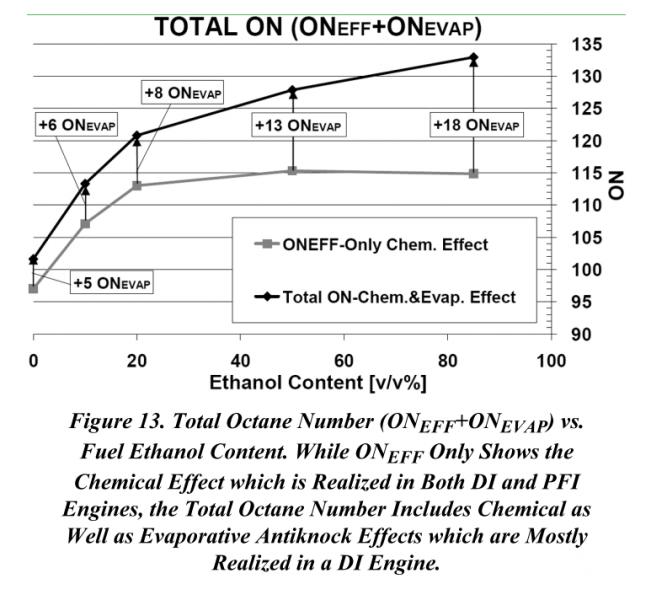
Ford has been playing around with twin turbo boosted Coyote V8's for a while and have published a few things. One of the things they did was investigate the trade off between changing the ethanol mix to save E85 consumption (it used dual fuel system with dual injectors) while messing with the ignition timing.
Problems my platform as well with the bmw and vw people who have HPFS have run into:
-stock fuel pump could not support modding and will not maintain the 1800 psi i run. less pressure less atomization, more knock and boom
-People running greater than 50% e85 get the black sludge of death after about 10k
-stock fuel pump could not support modding and will not maintain the 1800 psi i run. less pressure less atomization, more knock and boom
-People running greater than 50% e85 get the black sludge of death after about 10k
One nice thing about DI technology migrating to small block GM V8's is that there will be a wider market for higher flow E85 compatible HPFP.
If the fuel pump can't keep up, fuel pressure will drop, spray penetration and atomization will decrease. This might cause localized knocking phenomenon if it affects the mixture formation enough. It can disrupt the charge motion in the cylinder, causing the flame to develop asymmetrically and leaving an unburned gas region that is prone to knock. This is similar to what GM ran into on the early Gen V LT1 designs, where the flame was drifting to the edge of the combustion chamber and causing knock. See my thread on this: https://ls1tech.com/forums/advanced-...on-system.html
The only way to be sure would be with a single cylinder optical engine, or an optical spark plug placed in a one cylinder of a multi-cylinder engine. Anyway, with enough ethanol concentration the engine won't be very sensitive to mixture formation, and has been pointed out you can reach actual MBT instead of retarding timing to knock limit.
Last edited by arghx7; Jul 26, 2013 at 11:31 PM.
Thread Starter
Registered User
Joined: Jul 2013
Posts: 3
Likes: 0
Than I guess this is more geared to an lt1 with fi. it was just assumed that high pressure = more atomization. Well see what the lt1 can do. The mit paper is still a good read. thanks arghx7 for the new study. I am just interested to see what some e85 and a tune will pull out of this engine. early before new fuel internals were released, peoples pressures would drop well below 1000 form over 1800 causing knock and in a couple cases, blown motors and that was not with e85. hopefully no one will need to make those mistakes again on lt1s'
Last edited by smallturbo; Jul 27, 2013 at 12:30 AM.
Trending Topics
It wont matter, since these engines will actually have an aftermarket, unlike the 4cyl stuff. All you have to do is put in a higher lift cam lobe, work the internals of the hpfp, and instant fuel pump capacity is realized.
FWIW I had an LNF for several years that saw 30psi on pump corn and a 3582R. Neat motor, junk package (sky).
arghx7 What you said about latent heat is the same thing I said about the e85 cooling the charge. Alcohol cools when it atomizes. Naturally e85 would cool more then gas (and thus the 4cyls seeing super high IATs from tiny turbos see the large benefit)
FWIW I had an LNF for several years that saw 30psi on pump corn and a 3582R. Neat motor, junk package (sky).
arghx7 What you said about latent heat is the same thing I said about the e85 cooling the charge. Alcohol cools when it atomizes. Naturally e85 would cool more then gas (and thus the 4cyls seeing super high IATs from tiny turbos see the large benefit)
LS1 Tech Stories
The Best V8 Stories One Small Block at Time

Top 10 Greatest Cadillac V Series Performance Models Ever, Ranked
Pouria Savadkouei
Top 10 Most Powerful Chevy Trucks Ever Made!

Hennessey's New Supercharged Silverado ZR2 Has 700 HP
Verdad Gallardo
Coachbuilt N2A Anteros Is an LS2-Powered C6 Corvette In Italian Clothes
Verdad Gallardo
Awesome K5 Blazer Restomod Comes With C7 Corvette Power
Verdad Gallardo
10 Camaros You Should Never Buy

10 LS Engine Myths That Refuse to Die
Verdad Gallardo
Five Reasons the Camaro Was the Most Pivotal Player in the Pony Car Wars 2.0
Brett Foote
10 Reasons the LS7 Is GM's Most Extreme Naturally Aspirated V8 Engine Ever
Verdad Gallardo
Teching In
Joined: May 2013
Posts: 41
Likes: 0
I am just interested to see what some e85 and a tune will pull out of this engine. early before new fuel internals were released, peoples pressures would drop well below 1000 form over 1800 causing knock and in a couple cases, blown motors and that was not with e85. hopefully no one will need to make those mistakes again on lt1s'
I'm pretty wary of just dropping in E85 into a high pressure fuel system that wasn't designed for it, at least on a brand new engine design. Eventually the pump and injectors could get gummed up. PFI is not as sensitive. It's highly likely that vendors may start marketing E85 tunes for Gen V if it picks up enough power, and people will just ignore potential durability concerns initially.
Thread Starter
Registered User
Joined: Jul 2013
Posts: 3
Likes: 0
One naturally aspirated DI engine I can think of that responds well to E85 is the 2.0 liter flat 4 in the Subaru BRZ/Toyota GT86/Scion FR-S. Now in terms of absolute horsepower gain it's not going to be huge, (seems like 10hp or so) because it's a small engine. It must have been significantly knock limited on premium fuel. One thing that's still up in the air is how well the HPFP will hold up in that engine to sustained E85 use.
I'm pretty wary of just dropping in E85 into a high pressure fuel system that wasn't designed for it, at least on a brand new engine design. Eventually the pump and injectors could get gummed up. PFI is not as sensitive. It's highly likely that vendors may start marketing E85 tunes for Gen V if it picks up enough power, and people will just ignore potential durability concerns initially.
I'm pretty wary of just dropping in E85 into a high pressure fuel system that wasn't designed for it, at least on a brand new engine design. Eventually the pump and injectors could get gummed up. PFI is not as sensitive. It's highly likely that vendors may start marketing E85 tunes for Gen V if it picks up enough power, and people will just ignore potential durability concerns initially.

On The Tree
Joined: Oct 2010
Posts: 124
Likes: 2
From: Desert
If the LT1 is anything like the LNF/LHU/LDK and Gen IV LTG, the HPFP will have plenty of room to grow.
Regarding DI and Ethanol, according to both the MIT and Delphi study, E20 provided the best of both worlds in terms of fuel consumption and performance. After E50, there were diminishing returns on performance.
Going to be really damn cool to see the results of E-blend tuned LT1's
MIT Knock Testing on Direct Injection
https://docs.google.com/file/d/0Bwxy...it?usp=sharing
MIT Ethanol Testing on Direct Injection
https://docs.google.com/file/d/0Bwxy...it?usp=sharing
Ethanol Fuel Blends in a GDi VVA Flex Fuel Engine
http://delphi.com/pdf/techpapers/2011-01-0900.pdf
Regarding DI and Ethanol, according to both the MIT and Delphi study, E20 provided the best of both worlds in terms of fuel consumption and performance. After E50, there were diminishing returns on performance.
Going to be really damn cool to see the results of E-blend tuned LT1's
MIT Knock Testing on Direct Injection
https://docs.google.com/file/d/0Bwxy...it?usp=sharing
MIT Ethanol Testing on Direct Injection
https://docs.google.com/file/d/0Bwxy...it?usp=sharing
Ethanol Fuel Blends in a GDi VVA Flex Fuel Engine
http://delphi.com/pdf/techpapers/2011-01-0900.pdf
Teching In
Joined: May 2013
Posts: 41
Likes: 0
Basically, it may seem like there is a lot of headroom on DI injectors but that's because from the factory they are tuned to hit max load with very little spray hitting the piston or cylinder wall. Once your start of injection hits anywhere from 310-340 degrees BTDC firing (depending on RPM and combustion chamber geometry) you start spraying fuel right on the piston.
On the other hand, DI injectors might as well be considered unavailable to the aftermarket. Now that GM smallblocks have DI though the market will open up for aftermarket multihole solenoid type injectors at least.
Last edited by arghx7; Jul 31, 2013 at 09:09 PM.

heres how the injector timing works:
base table says "each injector will fire for this amount of time in crank degrees" [table is RPM vs Cylinder Airmass vs Crank Degrees]
a modifier like one for alcohol says "add or subtract this many degrees from the amount of time the injector will fire."
kind of an interesting way to do it.
base table says "each injector will fire for this amount of time in crank degrees" [table is RPM vs Cylinder Airmass vs Crank Degrees]
a modifier like one for alcohol says "add or subtract this many degrees from the amount of time the injector will fire."
kind of an interesting way to do it.
On The Tree
Joined: Oct 2010
Posts: 124
Likes: 2
From: Desert
I'm not sure how exactly they are defining the "injector duty cycle" in this context. If it's literally on time vs off time over 720 crank angle degrees (like on a PFI engine), you're probably spraying the crap out of the piston and cylinder wall, getting major bore washing. I guess if you don't care that much about oil dilution, smoke, and ring wear it doesn't matter that much. I'd have to see the start and end of injection timing to be sure. Injection timing is basically a poorly understood black art in the aftermarket, which is why you'll see vague duty cycle numbers which don't give the whole story instead of start and end of injection values. That's even on PFI.
Basically, it may seem like there is a lot of headroom on DI injectors but that's because from the factory they are tuned to hit max load with very little spray hitting the piston or cylinder wall. Once your start of injection hits anywhere from 310-340 degrees BTDC firing (depending on RPM and combustion chamber geometry) you start spraying fuel right on the piston.
On the other hand, DI injectors might as well be considered unavailable to the aftermarket. Now that GM smallblocks have DI though the market will open up for aftermarket multihole solenoid type injectors at least.
Basically, it may seem like there is a lot of headroom on DI injectors but that's because from the factory they are tuned to hit max load with very little spray hitting the piston or cylinder wall. Once your start of injection hits anywhere from 310-340 degrees BTDC firing (depending on RPM and combustion chamber geometry) you start spraying fuel right on the piston.
On the other hand, DI injectors might as well be considered unavailable to the aftermarket. Now that GM smallblocks have DI though the market will open up for aftermarket multihole solenoid type injectors at least.
Not sure about the Mazda 2.3 motor but the LNF stock commands 360° BTDC injection timing at idle and high load, with the ability to advance it to 431°. Extremely important to revisit injection timing when making ignition timing changes and fueling changes. I agree with you that using injector duty cycle doesn't tell you much. However looking at the injection window m/s can. With such a limited window, the LNF typically starts to see injection related misfires around 6 m/s around 5500-6k.
Regarding the injectors it's typically the HPFP that's the issue, not the in tank pump or the injectors.
Last edited by T.Man; Aug 1, 2013 at 11:33 PM.


