


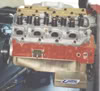


gmpp head bolt history?

Bolts/studs will leak if you use the wrong thread sealant. Do NOT use a thread sealer with a moly or Teflon lube-it can wash away. Use a sticky goopy gasket sealant without any type of lubricant in it.
I respectfully disagree about using studs in a block honed with bolts. The resultant tug on the deck, clamping force on the head and cylinder distortion will be identical.
It makes no difference to block distortion as to which was used to hone then assemble the engine.
Studs are a better fastening method because you're using fine threads on a nut with the block end of the stud fully engaged in the block rather than a course thread bolt not fully engaged. Your torquing measurements will be more accurate.
I respectfully disagree about using studs in a block honed with bolts. The resultant tug on the deck, clamping force on the head and cylinder distortion will be identical.
It makes no difference to block distortion as to which was used to hone then assemble the engine.
Studs are a better fastening method because you're using fine threads on a nut with the block end of the stud fully engaged in the block rather than a course thread bolt not fully engaged. Your torquing measurements will be more accurate.
Last edited by Paul Bell; Jun 30, 2011 at 07:39 PM.
While I agree with studs being superior in most aspects, for 99.9% of the builds on this forum they are overkill and add a degree of complexity most people don't understand.
Agreed, they are overkill for most applications.
I however, will use them at every opportunity.
A disclaimer: Coating head bolts/studs with sealant pertains to fasteners that are going to be exposed to coolant such as in small/big block Chevy engines. Head bolts for LS engines MUST BE DRY as should be the blind hole they thread into. Any amount of liquids of any type will in all likelihood result in a terminally cracked engine block and epic failure/head banging on the nearest wall.
I however, will use them at every opportunity.
A disclaimer: Coating head bolts/studs with sealant pertains to fasteners that are going to be exposed to coolant such as in small/big block Chevy engines. Head bolts for LS engines MUST BE DRY as should be the blind hole they thread into. Any amount of liquids of any type will in all likelihood result in a terminally cracked engine block and epic failure/head banging on the nearest wall.
Incorrect. Red locktite will not seal boiling fluids.
https://ls1tech.com/forums/15073701-post6.html
https://ls1tech.com/forums/15073701-post6.html
I had the same problem. I bought a set and was trying to torque them down, and they would just turn. I found out they are 2 thousands of a inch smaller in diameter, then the head bolts that came out of my car. I kinda wrote it off, but if you and I contact gmpartsdirect, maybe they will see it is a problem on their part, and refund us our money. I only did one side, and did not even torque 3 bolts. Just let me know if you are interested in perusing this.
tia
andy schuck
tia
andy schuck

TECH Veteran


Joined: Dec 2008
Posts: 4,147
Likes: 62
From: Little Rock, AR
I had the same problem. I bought a set and was trying to torque them down, and they would just turn. I found out they are 2 thousands of a inch smaller in diameter, then the head bolts that came out of my car. I kinda wrote it off, but if you and I contact gmpartsdirect, maybe they will see it is a problem on their part, and refund us our money. I only did one side, and did not even torque 3 bolts. Just let me know if you are interested in perusing this.
tia
andy schuck
tia
andy schuck
they're obviously the wrong product for the job if they're tty. they shouldn't even be for sale for the sbc or LT1
Andy, how should we go about persuing ther problem?
Andy, how should we go about persuing ther problem?
Last edited by diablizzard; Jul 1, 2011 at 07:57 AM.
LS1 Tech Stories
The Best V8 Stories One Small Block at Time

Gas Monkey Built a 6-Wheel Ferrari Testarossa With a Corvette LT4 Engine
Verdad Gallardo
7 Most Reliable High-Performance Engines GM Has Ever Built
Verdad Gallardo
Amazing '71 Camaro Restomod Is Modern Muscle Car Under the Skin
Verdad Gallardo
6 Common C5 Corvette Failures and What's Involved In Repairing Them
Pouria Savadkouei
Retro Modern Bandit Pontiac Trans AM Comes With Burt Reynolds' Autograph
Verdad Gallardo
Top 10 Greatest Cadillac V Series Performance Models Ever, Ranked
Pouria Savadkouei
Top 10 Most Powerful Chevy Trucks Ever Made!

Hennessey's New Supercharged Silverado ZR2 Has 700 HP
Verdad Gallardo
Coachbuilt N2A Anteros Is an LS2-Powered C6 Corvette In Italian Clothes
Verdad Gallardo
How thick are you people. As has been covered the later LT1s came with TTY bolts.
My own speculation is that GMPP probably then went back and superseded the old part numbers as is commonly done when they make minor changes to parts.
My own speculation is that GMPP probably then went back and superseded the old part numbers as is commonly done when they make minor changes to parts.
