






Quench question

Thread Starter
On The Tree
Joined: Apr 2013
Posts: 116
Likes: 0
 Quench question
 Trying to learn all of the things I need to know (and do) when putting my engine back together after rebuild. I have been reading and see that optimal quench (after gasket) is the in mid .030" and that stock was .067-.069". Mine look to be in the hole .15-.20. Does that look right? You can see the oil residue on the cylinder walls where the piston stopped travel.
IIRC stock CH pistons are 1.55, so 3.48/2 = 1.74 + 5.7 + 1.55 = 8.99. 9.025 - 8.99 = .035 in the hole stock. So with a .051 gasket, you're at .086 stock quench (Impalla SS is .063). .035 quench is about the tightest I'd go (.040 if you're running a decent size N2O shot).

TECH Fanatic

Joined: Jun 2007
Posts: 1,255
Likes: 11
From: centerville, ohio

TECH Addict
Joined: Jun 2009
Posts: 2,012
Likes: 0
From: Tulsa, OK
Thread Starter
On The Tree
Joined: Apr 2013
Posts: 116
Likes: 0
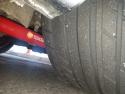
Ok thanks for the info, I thought that we had 1 and 6 completely at the top of the stroke when these pictures were taken. Just looking for info since I didn't know for sure. The car was supercharged, so I didn't know if when they had it torn down they changed compression. Thanks again!
TECH Addict
Joined: Dec 2010
Posts: 2,610
Likes: 4
From: Maricopa, AZ
I calculated my quench based on my stroke, connecting rod length, and piston compression height difference from the deck height (like the formula above) plus had gasket difference. But, mine was easy I had my block zero decked. Then I got a .045" head gasket (was shooting for .035" but ordered the wrong gasket).
I verified the quench during PTV clearance checks (the same way I did the PTV checks) and found the actual quench to be .043" So either the gasket compressed more than rated or the pistons are out of the hole a little bit.
This is all to say, the stock deck height on an LT1 is 9.025" (supposedly anyway, this can actually change from block to block slightly and even from the front of the block to the back -have the engine decked!). So if you get 1.560" Compression height pistons, 3.48" stroke, and 5.7" rods you'll be "in the hole" .025 inches, theoretically. But this can be measure with depth gauges and compressed head gasket thickness, or the same way you do a PTV check (clay or playdough).
I verified the quench during PTV clearance checks (the same way I did the PTV checks) and found the actual quench to be .043" So either the gasket compressed more than rated or the pistons are out of the hole a little bit.
This is all to say, the stock deck height on an LT1 is 9.025" (supposedly anyway, this can actually change from block to block slightly and even from the front of the block to the back -have the engine decked!). So if you get 1.560" Compression height pistons, 3.48" stroke, and 5.7" rods you'll be "in the hole" .025 inches, theoretically. But this can be measure with depth gauges and compressed head gasket thickness, or the same way you do a PTV check (clay or playdough).
Trending Topics
Best way I could imagine measuring depth would be using the top surface as zero and using either a depth mike or dial indicator to the top of the piston. Then again I'm not an automotive machinist
LS1 Tech Stories
The Best V8 Stories One Small Block at Time

Topdon ONE vs. Artidiag 800 BT2: Which is the Diagnostic Tablet For You?
Pouria Savadkouei
Gas Monkey Built a 6-Wheel Ferrari Testarossa With a Corvette LT4 Engine
Verdad Gallardo
7 Most Reliable High-Performance Engines GM Has Ever Built
Verdad Gallardo
Amazing '71 Camaro Restomod Is Modern Muscle Car Under the Skin
Verdad Gallardo
6 Common C5 Corvette Failures and What's Involved In Repairing Them
Pouria Savadkouei
Retro Modern Bandit Pontiac Trans AM Comes With Burt Reynolds' Autograph
Verdad Gallardo
Top 10 Greatest Cadillac V Series Performance Models Ever, Ranked
Pouria Savadkouei
Top 10 Most Powerful Chevy Trucks Ever Made!

Hennessey's New Supercharged Silverado ZR2 Has 700 HP
Verdad Gallardo TECH Addict
Joined: Dec 2010
Posts: 2,610
Likes: 4
From: Maricopa, AZ
Ok thanks for the info, I thought that we had 1 and 6 completely at the top of the stroke when these pictures were taken. Just looking for info since I didn't know for sure. The car was supercharged, so I didn't know if when they had it torn down they changed compression. Thanks again!
That could be done with 6" rods and 1.125" compression height pistons. It'd give a HUGE quench of .160", detonation wouldn't be an issue though. And it would love boost. Although efficiency would be out the window.
Thread Starter
On The Tree
Joined: Apr 2013
Posts: 116
Likes: 0
We pulled the engine apart so I can't check anything now. I was positive the pictures I had were at TDC for 1 and 6, thats the only reason I asked. We had been comparing TDC with cam dowel position and I thought we left it there. I was obviously wrong. Just wondered if they did something to it since it had a T-Trim SC and it was stamped "race" on ID plate. Thanks again, just trying to learn this stuff.

You're no machinist but you are correct, taking stroke, and rod length and decking to me is also a shot in the dark due to tolerances that are given for each, if you have the motor apart why not just use the proper tools and gauge it...

+/- 0.005 or even 0.002 adds up to outside the desired number range when all of them are on the high or low end.