











Pinion adjustment for TQ-arm?
 Pinion adjustment for TQ-arm?
 Just wondering what everybody thinks is a good setting for pinion angle on the street. I would like to have a decent compromise to take advantage of the suspension that is on the car, but I don't want it to be to aggressive. The pinion angle is currently set at -1 for the street. Let me know what you think 
Ok, so I checked the angle on my drive-shaft (0), and the bottom of the BMR tq-arm rear mount plate @ pinion (-2) (rear-end is slightly pointing towards the ground (down). drive-shaft (0 - 2) rear end. If I did this correctly I believe it is set at (-2) now. Let me know what you think?
Trending Topics
LS1 Tech Stories
The Best V8 Stories One Small Block at Time

Gas Monkey Built a 6-Wheel Ferrari Testarossa With a Corvette LT4 Engine
Verdad Gallardo
7 Most Reliable High-Performance Engines GM Has Ever Built
Verdad Gallardo
Amazing '71 Camaro Restomod Is Modern Muscle Car Under the Skin
Verdad Gallardo
6 Common C5 Corvette Failures and What's Involved In Repairing Them
Pouria Savadkouei
Retro Modern Bandit Pontiac Trans AM Comes With Burt Reynolds' Autograph
Verdad Gallardo
Top 10 Greatest Cadillac V Series Performance Models Ever, Ranked
Pouria Savadkouei
Top 10 Most Powerful Chevy Trucks Ever Made!

Hennessey's New Supercharged Silverado ZR2 Has 700 HP
Verdad Gallardo
Coachbuilt N2A Anteros Is an LS2-Powered C6 Corvette In Italian Clothes
Verdad Gallardo
You also have to take the angle of the driveshaft into consideration. There are plenty of how to's on doing this.
No.
No.

Just want to clarify a few things here:
First off, pinion angle does not affect traction or performance, nor is it affected by driving application
The only thing that factors into where pinion angle should be set is if you run a rubber/poly bushing lower control arm or a rod end. Poly/rubber will be -2* and rod ends will be -1 or 0.
The simplest and most effective way to measure the correct working angle of your driveline is to measure a good point that is an accurate reference to the centerline of the crankshaft. I like to use the crank pulley/balancer personally. But any machined surface on the engine or trans will work. You want the difference to measure between the engine and pinion. Driveshaft angle is irrelevant.
For example if your engine measures 5* (down towards the rear of the car) you will want the pinion to be pointed up 3*. They should be running on the same plane. The difference in angle is to allow for the slack in the drivetrain under load so that ideally you will have 0* under acceleration which means your engine and pinion centerlines are perfectly parallel and the u-joint working angles are identical.
Hope this helps a little
First off, pinion angle does not affect traction or performance, nor is it affected by driving application
The only thing that factors into where pinion angle should be set is if you run a rubber/poly bushing lower control arm or a rod end. Poly/rubber will be -2* and rod ends will be -1 or 0.
The simplest and most effective way to measure the correct working angle of your driveline is to measure a good point that is an accurate reference to the centerline of the crankshaft. I like to use the crank pulley/balancer personally. But any machined surface on the engine or trans will work. You want the difference to measure between the engine and pinion. Driveshaft angle is irrelevant.
For example if your engine measures 5* (down towards the rear of the car) you will want the pinion to be pointed up 3*. They should be running on the same plane. The difference in angle is to allow for the slack in the drivetrain under load so that ideally you will have 0* under acceleration which means your engine and pinion centerlines are perfectly parallel and the u-joint working angles are identical.
Hope this helps a little
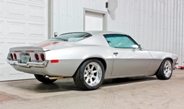


I've got to ask, how much of an improvement are one of these aftermarket torque arms over stock for a car that rarely sees the track?  I've got a nearly full aftermarket suspension (control arms, relocation brackets, panhard bar, subframe connectors, 25mm solid sway bar) and the stock torque arm is the only part yet to be replaced. My car is built more for handling than a drag setup like most on here...how much benefit is there in that regard for road course/street/auto x type setup? Also, mine's lowered 1.5"...does that require the adjustable version to compensate I would assume?
To those that have one, was it an immediate noticeable difference on the street? Or something I would only notice launching on a drag strip?
I've got a nearly full aftermarket suspension (control arms, relocation brackets, panhard bar, subframe connectors, 25mm solid sway bar) and the stock torque arm is the only part yet to be replaced. My car is built more for handling than a drag setup like most on here...how much benefit is there in that regard for road course/street/auto x type setup? Also, mine's lowered 1.5"...does that require the adjustable version to compensate I would assume? To those that have one, was it an immediate noticeable difference on the street? Or something I would only notice launching on a drag strip?

Just want to clarify a few things here:
First off, pinion angle does not affect traction or performance, nor is it affected by driving application
The only thing that factors into where pinion angle should be set is if you run a rubber/poly bushing lower control arm or a rod end. Poly/rubber will be -2* and rod ends will be -1 or 0.
The simplest and most effective way to measure the correct working angle of your driveline is to measure a good point that is an accurate reference to the centerline of the crankshaft. I like to use the crank pulley/balancer personally. But any machined surface on the engine or trans will work. You want the difference to measure between the engine and pinion. Driveshaft angle is irrelevant.
For example if your engine measures 5* (down towards the rear of the car) you will want the pinion to be pointed up 3*. They should be running on the same plane. The difference in angle is to allow for the slack in the drivetrain under load so that ideally you will have 0* under acceleration which means your engine and pinion centerlines are perfectly parallel and the u-joint working angles are identical.
Hope this helps a little
First off, pinion angle does not affect traction or performance, nor is it affected by driving application
The only thing that factors into where pinion angle should be set is if you run a rubber/poly bushing lower control arm or a rod end. Poly/rubber will be -2* and rod ends will be -1 or 0.
The simplest and most effective way to measure the correct working angle of your driveline is to measure a good point that is an accurate reference to the centerline of the crankshaft. I like to use the crank pulley/balancer personally. But any machined surface on the engine or trans will work. You want the difference to measure between the engine and pinion. Driveshaft angle is irrelevant.
For example if your engine measures 5* (down towards the rear of the car) you will want the pinion to be pointed up 3*. They should be running on the same plane. The difference in angle is to allow for the slack in the drivetrain under load so that ideally you will have 0* under acceleration which means your engine and pinion centerlines are perfectly parallel and the u-joint working angles are identical.
Hope this helps a little
Maybe I am missing what is being said here, but at this point in the video:
https://www.youtube.com/watch?featur...75ZQvpws#t=107
Where he says two equal angles cancel out accel/decel you can clearly hear there is accel/decel at the end point, or what would be the differential as well as in the middle of the driveline.
https://www.youtube.com/watch?featur...75ZQvpws#t=107
Where he says two equal angles cancel out accel/decel you can clearly hear there is accel/decel at the end point, or what would be the differential as well as in the middle of the driveline.
I've got to ask, how much of an improvement are one of these aftermarket torque arms over stock for a car that rarely sees the track? I've got a nearly full aftermarket suspension (control arms, relocation brackets, panhard bar, subframe connectors, 25mm solid sway bar) and the stock torque arm is the only part yet to be replaced. My car is built more for handling than a drag setup like most on here...how much benefit is there in that regard for road course/street/auto x type setup? Also, mine's lowered 1.5"...does that require the adjustable version to compensate I would assume?
To those that have one, was it an immediate noticeable difference on the street? Or something I would only notice launching on a drag strip?
I've got a nearly full aftermarket suspension (control arms, relocation brackets, panhard bar, subframe connectors, 25mm solid sway bar) and the stock torque arm is the only part yet to be replaced. My car is built more for handling than a drag setup like most on here...how much benefit is there in that regard for road course/street/auto x type setup? Also, mine's lowered 1.5"...does that require the adjustable version to compensate I would assume? To those that have one, was it an immediate noticeable difference on the street? Or something I would only notice launching on a drag strip?
When I removed my stocker it was bent from mostly street duty with only 2-3 track trips. That was only with bolt-ons too, car was slow and ran high 12s.
If pinion angle has no effect on traction, Then is this what we are trying to achive like in this video?
Driveshaft Angle Trainer - YouTube
Driveshaft Angle Trainer - YouTube