



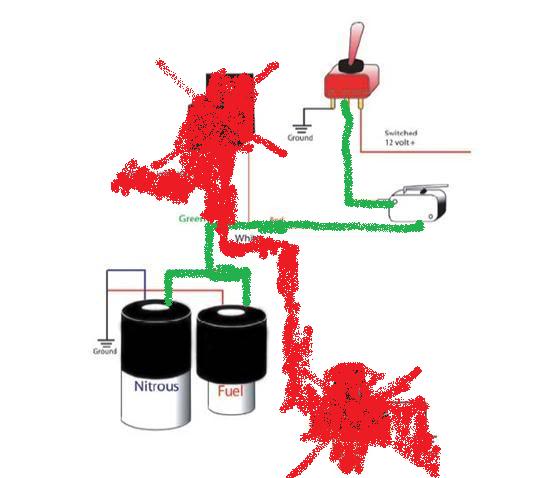




Basic nitrous wiring questions
 Basic nitrous wiring questions
 1. Where is the best spot to run wires from the inside to the engine bay?
2. Where are you guys getting your 12v source for inside switches? And where for the engine bay switches?
3. What is the point of the relay between the WOT switch and the selenoids?
2. Where are you guys getting your 12v source for inside switches? And where for the engine bay switches?
3. What is the point of the relay between the WOT switch and the selenoids?
U can run the wires where the computer wires come in on the pass side or in by the brake booster under the driver side. Grounds are all over the car, and u could use the terminal right by the abs block for power, run a wire inside the car and put a fuse able link on it

10 Second Club


Joined: Aug 2010
Posts: 4,465
Likes: 192
From: Harford Co. Maryland
I don't think the switchs are rated for the amp draw the 'noids require, and if thats the case... you're looking at a fire. (worse case)
Always use a relay rated for the amps needed.
Always use a relay rated for the amps needed.
1. Where is the best spot to run wires from the inside to the engine bay?
theres a Grommet in the firewall Right next to the PCM...its easy to get to if you pull the pcm out of the way, the inside is just removing the under dash panels to be able to access it...its way up and to the right when you pull the panels off... easiest to fish a line through from the engine bay and pull your wires through that way
2. Where are you guys getting your 12v source for inside switches? And where for the engine bay switches?
there are lots of common spots to get power from.. grab it from a cigarette lighter wire since its in the center area...
you can get it from the fog light or ASR/TCS Switches, you can get it straight from the fuse box... whatever works for you and your switch location
3. What is the point of the relay between the WOT switch and the solenoids?
The Switches are not rated for the Amperage draw that the Solenoids pull..
you MUST use a relay to power the solenoids.
basic wiring...
From 12v power to Switch
Switch output goes to Relay
pin 85 = 12v from switch output
pin 86 = to a Ground
pin 87 = output to hot side of solenoid
pin 30 = From 12v constant power(typically from the battery with a 30amp fuse)
Solenoid gets grounded to any ground or straight to the battery
theres a Grommet in the firewall Right next to the PCM...its easy to get to if you pull the pcm out of the way, the inside is just removing the under dash panels to be able to access it...its way up and to the right when you pull the panels off... easiest to fish a line through from the engine bay and pull your wires through that way
2. Where are you guys getting your 12v source for inside switches? And where for the engine bay switches?
there are lots of common spots to get power from.. grab it from a cigarette lighter wire since its in the center area...
you can get it from the fog light or ASR/TCS Switches, you can get it straight from the fuse box... whatever works for you and your switch location
3. What is the point of the relay between the WOT switch and the solenoids?
The Switches are not rated for the Amperage draw that the Solenoids pull..
you MUST use a relay to power the solenoids.
basic wiring...
From 12v power to Switch
Switch output goes to Relay
pin 85 = 12v from switch output
pin 86 = to a Ground
pin 87 = output to hot side of solenoid
pin 30 = From 12v constant power(typically from the battery with a 30amp fuse)
Solenoid gets grounded to any ground or straight to the battery
1. Where is the best spot to run wires from the inside to the engine bay?
theres a Grommet in the firewall Right next to the PCM...its easy to get to if you pull the pcm out of the way, the inside is just removing the under dash panels to be able to access it...its way up and to the right when you pull the panels off... easiest to fish a line through from the engine bay and pull your wires through that way
2. Where are you guys getting your 12v source for inside switches? And where for the engine bay switches?
there are lots of common spots to get power from.. grab it from a cigarette lighter wire since its in the center area...
you can get it from the fog light or ASR/TCS Switches, you can get it straight from the fuse box... whatever works for you and your switch location
3. What is the point of the relay between the WOT switch and the solenoids?
The Switches are not rated for the Amperage draw that the Solenoids pull..
you MUST use a relay to power the solenoids.
basic wiring...
From 12v power to Switch
Switch output goes to Relay
pin 85 = 12v from switch output
pin 86 = to a Ground
pin 87 = output to hot side of solenoid
pin 30 = From 12v constant power(typically from the battery with a 30amp fuse)
Solenoid gets grounded to any ground or straight to the battery
theres a Grommet in the firewall Right next to the PCM...its easy to get to if you pull the pcm out of the way, the inside is just removing the under dash panels to be able to access it...its way up and to the right when you pull the panels off... easiest to fish a line through from the engine bay and pull your wires through that way
2. Where are you guys getting your 12v source for inside switches? And where for the engine bay switches?
there are lots of common spots to get power from.. grab it from a cigarette lighter wire since its in the center area...
you can get it from the fog light or ASR/TCS Switches, you can get it straight from the fuse box... whatever works for you and your switch location
3. What is the point of the relay between the WOT switch and the solenoids?
The Switches are not rated for the Amperage draw that the Solenoids pull..
you MUST use a relay to power the solenoids.
basic wiring...
From 12v power to Switch
Switch output goes to Relay
pin 85 = 12v from switch output
pin 86 = to a Ground
pin 87 = output to hot side of solenoid
pin 30 = From 12v constant power(typically from the battery with a 30amp fuse)
Solenoid gets grounded to any ground or straight to the battery
I prefer the relay to be inside the car protected from the elements
others prefer it to be outside in the engine bay
for my setup, I have no HVAC stuff, so my relay/fuse box is mounted on my HVAC Delete Plate, up under the dash..
I bought a Universal Auxiliary Relay Box from Wagon Gear / Wired Wagon
http://wagongear.com/WiredWagon.html
I use a Bus Bar to get my +12v from the battery out to all my devices
for me its 2 Nitrous Solenoids, 2 Purge Solenoids(wired to 1 relay), and 2 Bottle Heaters
others prefer it to be outside in the engine bay
for my setup, I have no HVAC stuff, so my relay/fuse box is mounted on my HVAC Delete Plate, up under the dash..
I bought a Universal Auxiliary Relay Box from Wagon Gear / Wired Wagon
http://wagongear.com/WiredWagon.html
I use a Bus Bar to get my +12v from the battery out to all my devices
for me its 2 Nitrous Solenoids, 2 Purge Solenoids(wired to 1 relay), and 2 Bottle Heaters
Trending Topics
I prefer the relay to be inside the car protected from the elements
others prefer it to be outside in the engine bay
for my setup, I have no HVAC stuff, so my relay/fuse box is mounted on my HVAC Delete Plate, up under the dash..
I bought a Universal Auxiliary Relay Box from Wagon Gear / Wired Wagon
http://wagongear.com/WiredWagon.html
I use a Bus Bar to get my +12v from the battery out to all my devices
for me its 2 Nitrous Solenoids, 2 Purge Solenoids(wired to 1 relay), and 2 Bottle Heaters
others prefer it to be outside in the engine bay
for my setup, I have no HVAC stuff, so my relay/fuse box is mounted on my HVAC Delete Plate, up under the dash..
I bought a Universal Auxiliary Relay Box from Wagon Gear / Wired Wagon
http://wagongear.com/WiredWagon.html
I use a Bus Bar to get my +12v from the battery out to all my devices
for me its 2 Nitrous Solenoids, 2 Purge Solenoids(wired to 1 relay), and 2 Bottle Heaters
LS1 Tech Stories
The Best V8 Stories One Small Block at Time

6 Common C5 Corvette Failures and What's Involved In Repairing Them
Pouria Savadkouei
Retro Modern Bandit Pontiac Trans AM Comes With Burt Reynolds' Autograph
Verdad Gallardo
Top 10 Greatest Cadillac V Series Performance Models Ever, Ranked
Pouria Savadkouei
Top 10 Most Powerful Chevy Trucks Ever Made!

Hennessey's New Supercharged Silverado ZR2 Has 700 HP
Verdad Gallardo
Coachbuilt N2A Anteros Is an LS2-Powered C6 Corvette In Italian Clothes
Verdad Gallardo
Awesome K5 Blazer Restomod Comes With C7 Corvette Power
Verdad Gallardo
10 Camaros You Should Never Buy

10 LS Engine Myths That Refuse to Die
Verdad Gallardo just use the same gauge as already on the solenoids(its usually a 14awg or a 16awg)
wire from the switch to the relay can be smaller as it has no real current draw, it only takes a fraction of an amp to open a relay
yeah.. any auto parts store will have wire.. (its called "Primary" wire)
just use the same gauge as already on the solenoids(its usually a 14awg or a 16awg)
wire from the switch to the relay can be smaller as it has no real current draw, it only takes a fraction of an amp to open a relay
just use the same gauge as already on the solenoids(its usually a 14awg or a 16awg)
wire from the switch to the relay can be smaller as it has no real current draw, it only takes a fraction of an amp to open a relay
Ok I lied I still probaby have a few more questions. If I go ahead and wire everything in (basice kit) as in (activation switch-WOT switch-relay-selinoids) will I have to disconect any of that when I go back in to install my lingenfelter lnc-2000?

No you won't need any of that for the LNC. It plugs into the main harness that feeds the coil packs on both sides and it connects to the tach wire from the pcm. The rest are power and ground.
Ok so I went to wallmart and got 20 feet of 14 gauge wire like this
http://www.walmart.com/ip/Everstart-...-Wire/16880583
And also got 12 feet of 12 gauge wire to go to the selenoids.
Next question- Is it bad to mix 14g with 12g or 14g with 16g?
http://www.walmart.com/ip/Everstart-...-Wire/16880583
And also got 12 feet of 12 gauge wire to go to the selenoids.
Next question- Is it bad to mix 14g with 12g or 14g with 16g?
yes... the main feed to your relay pin 30 can be straight to the battery...its actually preferred
as far as your other wiring question...
In an ideal world, you want to keep the wire gauge consistent from one end to the other with as few splices as possible
it wont hurt anything to mix and match, just know that you have to consider it as if it was one giant piece of the smallest size...
your smallest gauge wire will act like a fuse in the system if you dont have a proper fuse installed..
example:
lets say your solenoids are going to draw(dependent on brand and style and size) somewhere around 15-20 amps.. that means a minimum wire gauge of 16 would(16 is rated to 22amps) but you want some cushion, so you use 14 instead rated to 32 amps
if you use a combo...the 14 gauge wire will be fine...but the 16 will burn up when if the solenoid uses more than 22 amps for any length of time...
so yes.. you can mix and match... however.. its best to keep consistent sizes and use a fuse that is smaller than your wire amperage maximums.
this is a beneficial chart that may help
http://www.powerstream.com/Wire_Size.htm
yes... the main feed to your relay pin 30 can be straight to the battery...its actually preferred
as far as your other wiring question...
In an ideal world, you want to keep the wire gauge consistent from one end to the other with as few splices as possible
it wont hurt anything to mix and match, just know that you have to consider it as if it was one giant piece of the smallest size...
your smallest gauge wire will act like a fuse in the system if you dont have a proper fuse installed..
example:
lets say your solenoids are going to draw(dependent on brand and style and size) somewhere around 15-20 amps.. that means a minimum wire gauge of 16 would(16 is rated to 22amps) but you want some cushion, so you use 14 instead rated to 32 amps
if you use a combo...the 14 gauge wire will be fine...but the 16 will burn up when if the solenoid uses more than 22 amps for any length of time...
so yes.. you can mix and match... however.. its best to keep consistent sizes and use a fuse that is smaller than your wire amperage maximums.
this is a beneficial chart that may help
http://www.powerstream.com/Wire_Size.htm
as far as your other wiring question...
In an ideal world, you want to keep the wire gauge consistent from one end to the other with as few splices as possible
it wont hurt anything to mix and match, just know that you have to consider it as if it was one giant piece of the smallest size...
your smallest gauge wire will act like a fuse in the system if you dont have a proper fuse installed..
example:
lets say your solenoids are going to draw(dependent on brand and style and size) somewhere around 15-20 amps.. that means a minimum wire gauge of 16 would(16 is rated to 22amps) but you want some cushion, so you use 14 instead rated to 32 amps
if you use a combo...the 14 gauge wire will be fine...but the 16 will burn up when if the solenoid uses more than 22 amps for any length of time...
so yes.. you can mix and match... however.. its best to keep consistent sizes and use a fuse that is smaller than your wire amperage maximums.
this is a beneficial chart that may help
http://www.powerstream.com/Wire_Size.htm