




tvs2300 and nitrous

Thread Starter
11 Second Club
iTrader: (17)
Joined: Oct 2007
Posts: 344
Likes: 0
From: pleasanton ca
 tvs2300 and nitrous
 I've never messed with nitrous and would like to give it a shot 
Right now I've got a forged 402 with a magnacharger, cam, heads, meth injection etc etc making 18psi... its at just over 750 rwhp... i dont really know where to begin with nitrous and would like some advice.
I'd just run a small shot like 50, or 75... but id want to go about it the best way possible... wet vs dry? plate vs nozzle? brand? etc
ask any questions and any help is appreciated.
Thanks,
Gary
Right now I've got a forged 402 with a magnacharger, cam, heads, meth injection etc etc making 18psi... its at just over 750 rwhp... i dont really know where to begin with nitrous and would like some advice.
I'd just run a small shot like 50, or 75... but id want to go about it the best way possible... wet vs dry? plate vs nozzle? brand? etc
ask any questions and any help is appreciated.
Thanks,
Gary
http://www.nitrousoutlet.com/nitrous...plate-kit.html
Check out this system we have for the Magnacharger. It will be able to support your 50 and 75 shot and also leave you plenty of room to grow later as the plate and solenoids are good for 400HP. If you have any more questions or need some help please let me know!
Check out this system we have for the Magnacharger. It will be able to support your 50 and 75 shot and also leave you plenty of room to grow later as the plate and solenoids are good for 400HP. If you have any more questions or need some help please let me know!

Ls1tech & Truck Sponsor
iTrader: (4)
Joined: Jun 2010
Posts: 2,267
Likes: 1
From: Wichita falls Texas
You could use either a plate or a single nozzle on that setup. There is no problem putting wet nitrous through a blower...even with the 50-75 shot it will pick up a pretty significant amount of torque, and help cool things off.
-Garrett
-Garrett
Thread Starter
11 Second Club
iTrader: (17)
Joined: Oct 2007
Posts: 344
Likes: 0
From: pleasanton ca
im running a 102mm throttle body/ snout, will that plate still work... on the site it says for the 90mm... how reliable are the nozzles with a small shot and what supporting mods should i need? bottle heater, window switches any sort of fail safe stuff? im neeeeew i dont know what to dooooo lol
Trending Topics
im running a 102mm throttle body/ snout, will that plate still work... on the site it says for the 90mm... how reliable are the nozzles with a small shot and what supporting mods should i need? bottle heater, window switches any sort of fail safe stuff? im neeeeew i dont know what to dooooo lol

We also have a 102 plate with the inlets on the passenger side:

A bottle heater, purge and window switch are the minimum anyone should run on a nitrous system. You should also consider something to pull timing with. Lingenfelter makes some nice timing boxes that can handle that. Feel free to call, pm or email me and I can help you get sorted out.
Thanks!
LS1 Tech Stories
The Best V8 Stories One Small Block at Time

6 Common C5 Corvette Failures and What's Involved In Repairing Them
Pouria Savadkouei
Retro Modern Bandit Pontiac Trans AM Comes With Burt Reynolds' Autograph
Verdad Gallardo
Top 10 Greatest Cadillac V Series Performance Models Ever, Ranked
Pouria Savadkouei
Top 10 Most Powerful Chevy Trucks Ever Made!

Hennessey's New Supercharged Silverado ZR2 Has 700 HP
Verdad Gallardo
Coachbuilt N2A Anteros Is an LS2-Powered C6 Corvette In Italian Clothes
Verdad Gallardo
Awesome K5 Blazer Restomod Comes With C7 Corvette Power
Verdad Gallardo
10 Camaros You Should Never Buy

10 LS Engine Myths That Refuse to Die
Verdad Gallardo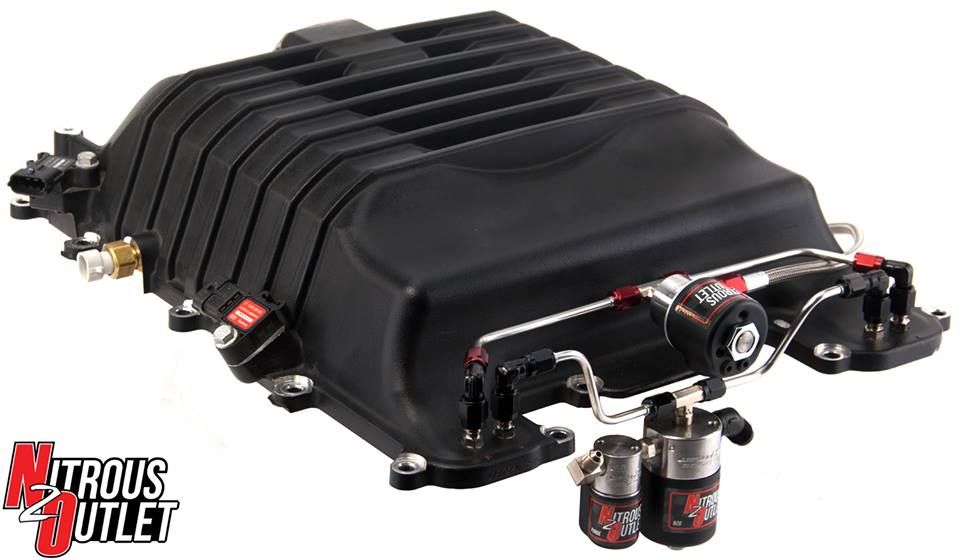

LS1Tech Sponsor
Joined: Oct 2002
Posts: 603
Likes: 1
From: Decatur, IN
Nitrous and supercharger Nitrous in a supercharged application works very well because you get the added benefit of cooling the air charge that gets heated up by the compression of the air. At very high supercharger speeds and high boost pressures, it may also help keep the supercharger itself cool (keeping the outlet temperature below critical ranges, reducing thermal expansion etc.).
One thing to keep in mind on the supercharger though is that, if you can, it is better to put the fuel into the system after the supercharger. This is true for a couple of reasons:
A nice solution to this if you don't want to have to plumb up all of the individual fuel nozzles and modify the manifold etc for them is to use a "dry system" and then use the main fuel injectors for the additional fueling. With aftermarket engine management systems this is usually fairly easy to do as you can target a different air:fuel ratio or injector pulse width etc when the nitrous is active. Some even allow an external analog input from a nitrous controller to be used to modify the amount of fuel.
Even when using an OEM ECM you can make this work, especially when custom nitrous operating systems exist like the ones from EFILive for some of the E38 and E67 applications. We used this on our 427 CID LS9 TVS2300 engine in our 2010 Camaro. We were spraying over 500 hp worth of nitrous into the supercharger in a dry system and then doing all of the fueling via the primary injectors. We did this as a two stage system, with the fueling for the first stage done in the main PE vs RPM table. The fueling for the second stage was controlled by the custom EFILive operating system. Basically when the second stage became active, the nitrous controller would activate the PIN on the ECM that tells the ECM that the nitrous is active and to target a different AFR and timing curve.
Hope this helps.
Jason
One thing to keep in mind on the supercharger though is that, if you can, it is better to put the fuel into the system after the supercharger. This is true for a couple of reasons:
- The supercharger manifold and the intercoolers were not designed to evenly distribute the much heavier fuel so you are unlikely to get even cylinder to cylinder distribution if the fuel is injected before the supercharger. This also means it is important where you inject the fuel after the supercharger too and depending on the supercharger design, you probably don't want to inject the fuel before the intercooler (you want it close to the individual intake ports).
- The supercharger drive load is controlled by several variables including the amount of work it is doing which is dependent on the pressure rise across the supercharger AND the mass flow. If you run more mass into the supercharger (the fuel is more mass) then your supercharger load goes up and it takes more power to drive the supercharger. This will increase parasitic load from the supercharger, including increasing the belt load. If you are at the limit of belt slip due to the belt load the added mass flow from the fuel may put you over the edge from a belt slip standpoint (requiring more belt tension and/or a wider belt).
- The fuel displaces air. If you are at or near the limit of the airflow capability of your supercharger the added fuel volume may hurt your ability to flow as much air as you want. If the fuel is injected after the supercharger, you won't have that issue.
- Some superchargers don't have all of the bearings sealed or don't have both sides of the bearings sealed in order to be able to operate at high RPM (seals tend to generate heat/friction and usually reduce the operating RPM of a bearing). Fuel can more easily get into the bearings, possibly causing earlier bearing failure.
- Areas exist in the supercharger that might be a location for fuel to build up (again, normally liquids aren't present in that side of the system) that could be damaging/dangerous in a backfire event.
A nice solution to this if you don't want to have to plumb up all of the individual fuel nozzles and modify the manifold etc for them is to use a "dry system" and then use the main fuel injectors for the additional fueling. With aftermarket engine management systems this is usually fairly easy to do as you can target a different air:fuel ratio or injector pulse width etc when the nitrous is active. Some even allow an external analog input from a nitrous controller to be used to modify the amount of fuel.
Even when using an OEM ECM you can make this work, especially when custom nitrous operating systems exist like the ones from EFILive for some of the E38 and E67 applications. We used this on our 427 CID LS9 TVS2300 engine in our 2010 Camaro. We were spraying over 500 hp worth of nitrous into the supercharger in a dry system and then doing all of the fueling via the primary injectors. We did this as a two stage system, with the fueling for the first stage done in the main PE vs RPM table. The fueling for the second stage was controlled by the custom EFILive operating system. Basically when the second stage became active, the nitrous controller would activate the PIN on the ECM that tells the ECM that the nitrous is active and to target a different AFR and timing curve.
Hope this helps.
Jason
I've never messed with nitrous and would like to give it a shot
Right now I've got a forged 402 with a magnacharger, cam, heads, meth injection etc etc making 18psi... its at just over 750 rwhp... i dont really know where to begin with nitrous and would like some advice.
I'd just run a small shot like 50, or 75... but id want to go about it the best way possible... wet vs dry? plate vs nozzle? brand? etc
ask any questions and any help is appreciated.
Thanks,
Gary
Right now I've got a forged 402 with a magnacharger, cam, heads, meth injection etc etc making 18psi... its at just over 750 rwhp... i dont really know where to begin with nitrous and would like some advice.
I'd just run a small shot like 50, or 75... but id want to go about it the best way possible... wet vs dry? plate vs nozzle? brand? etc
ask any questions and any help is appreciated.
Thanks,
Gary


I'm about to do the same thing.
I have a 122 that's pretty close to maxed out, blower rpm is somewhere north of 18k.
Iats on a long pull will get close to 150
I'm running 91 pump gas with 11:1 ish afr and 19 degrees of timing. ill be spraying a little 50-75 shot for now to see how it likes it.
Hoping with such a little shot the timing won't need backed down much. I only plan on spraying it at the track and i don't want to switch tunes back and forth.
I'm on a stock bottom end ls2, and i don't know how much more than that it'll take...lol
I have a 122 that's pretty close to maxed out, blower rpm is somewhere north of 18k.
Iats on a long pull will get close to 150
I'm running 91 pump gas with 11:1 ish afr and 19 degrees of timing. ill be spraying a little 50-75 shot for now to see how it likes it.
Hoping with such a little shot the timing won't need backed down much. I only plan on spraying it at the track and i don't want to switch tunes back and forth.
I'm on a stock bottom end ls2, and i don't know how much more than that it'll take...lol
Sprayed a 35 jet this weekend through a nozzle, few gallons of 110 in the tank just to be safe.
It picked up 7 mph and ran an 11.2 only spraying in 2nd and 3rd. The overdrive crank pulley exploded a few days before so it only made 4 or 5 lbs of boost.
Pretty happy with the results
It picked up 7 mph and ran an 11.2 only spraying in 2nd and 3rd. The overdrive crank pulley exploded a few days before so it only made 4 or 5 lbs of boost.
Pretty happy with the results