


My old C5.. numbers to support the theory


IAT vs...advance IAT vs AF Multiplier. Yes you have to make sure the dry nitrous actually is seen by the IAT, but nothing a IAT in MAF sensor cant fix. As it see's the temp and the airflow simultaneously, the PCM is already going to add fuel based of sheer airflow, so the IAT vs tables increase as needed as well as reduce advance. I guess you could do the same thing with just an IAT Sensor, using OL or CL, and OLSD mode, but not have the "tunability" your CTS-pot provides. I like that pot idea, I'm just not sure I'd ever have a need for it. Will have to think about this.
Originally Posted by CAT3
IAT vs AF Multiplier.
CTS = coolant temp sensor.
The upper end of the temp scale isn't usuable though due to the overtemp-protection feature.

It still works but some resolution is lost.
The new pots I found have great resolution to make up for that. They just cost more.
White, do you have any pics of the Pot as used? I am picturing a dial on the dash with a larger arrow on the **** going in a clockwise rotation  98's + tuning = PITA. I'd like to check out this pot sometime, sounds like a great setup.
98's + tuning = PITA. I'd like to check out this pot sometime, sounds like a great setup. You use whatever type of **** you like. They don't come with ***** or dials.

They can be wired to work in either rotation direction.
The switching and getting the gauge to work can be tricky on some cars though. Cars with a single two-wire CTS are easiest to work with.
They can be wired to work in either rotation direction.
The switching and getting the gauge to work can be tricky on some cars though. Cars with a single two-wire CTS are easiest to work with.

11 Second Club
Joined: Feb 2005
Posts: 176
Likes: 0
From: Alton IL
Heres a pic of the switch panel in the Corvette, I havent put a actual dial on the Pot, since I just watch the coolant temp while turning the dial.
Gauges are as follows:
Bottle pressure, Bottle heater, Fans, Pot on/off, then Pot dial.
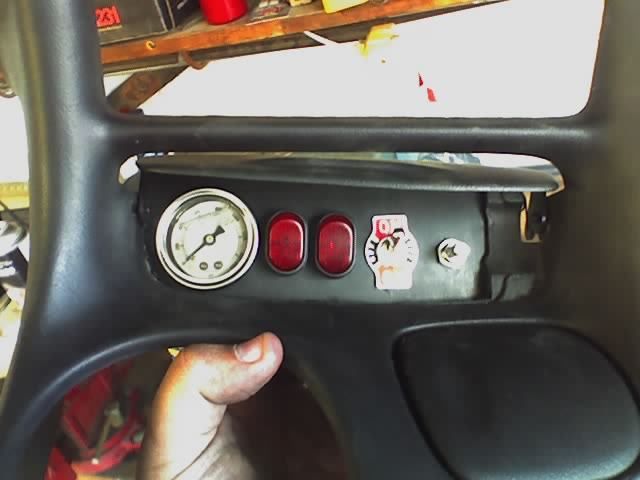
Gauges are as follows:
Bottle pressure, Bottle heater, Fans, Pot on/off, then Pot dial.
You "arm" the Pot, and as you turn it, the temp gauge in the dash starts moving? Then your prepped for xxx amount of nitrous as per the temp range? Sweet. I like that. You can disable the pot and then enable and blast off...pure genius. Thanks Kolk.
11 Second Club
Joined: Feb 2005
Posts: 176
Likes: 0
From: Alton IL
Well, through prior testing I know for a 125 shot, I need 17% more fuel, So I just leave the POT at 239*, I never adjust it again until we change the shot, or some thing else changes. Then, If I want to spray, I just turn the pot on, and it goes directly to 239. Basically, I just think of the On/off switch, as my Arm switch, Just turn it on, then spray.
Does it reflect the temp onto the factory dash gauge as well? Thats pimp. I was trying to get it when White first mentioned this to me, but hadnt quite had it til seeing it. Awesome.

Originally Posted by bsmith98
So can any one of our cars make more power on 87 than with 93 if you have stock cr, with a 87 specific tune??
Wow, talk about a loaded question.
No not everybody will due to so many possibilities of things that can go wrong.
A heavily loaded engine running at factory operating temp, and full emissions equipment will most likely not like the 87 octane at all.
The added heat in the chamber would put you into detonation too often.
The car presented in this post runs very cool and has no emissions equipment functioning. Some turbulence/swirl in the heads has been reduced in favor of better air flow. Cooler temps and less action in the chamber slow the burn-rate and reduce the chance of detonation.
Other contributing factors have also been addressed, such as filtering the PCV system and polishing of the combustion chamber surfaces. The exhaust valves have been radiused, so no sharp edges are present.
A lot of people however would run faster track times by switching to a lower octane fuel. A lightweight, aggressively geared car with a cool running engine would be a good example of one likely to pick up power with less octane.
It will always depend on the whole combination, so it depends.
Notice I said track times and not dyno power. Dynos load the engine differently and may either show no difference, or the reverse of what you see on the track.
