



All the same color for once!!

Thread Starter
Teching In
Joined: Nov 2008
Posts: 44
Likes: 0
From: Coolville, OH
 All the same color for once!!
 Hello everyone! This is my first post on here, although I've been trolling these forums for a while now. You guys have been a very helpful resource for me since I bought my 2000 Trans Am. I need to paint my right fender and right-side door. The car is arctic white. I have been searching for a while now and have found the answers to most of my questions. I have never painted before, and I do not paint often. I am looking for a good gun to start with, and from what I have read, devilbiss is a good brand to start with. I have been looking at a FLG 647 WB. This gun comes with a 1.3, 1.5, and 1.8 mm tips. From what I have read, I would do base and clear with the 1.3 mm and primer with the 1.8 mm (not in that order of course). My main questions are;
Does anyone know anything about this gun? I have been unsuccesful at finding a consumer review.
Is it ok to use the same gun to spray primer, base, and clear if it is thoroughly cleaned between each coat?
Do I just buy the paint or should I get it color matched etc.?
Do I need a flex agent?
Can anyone point me to a thread that explains common terminology for body/paint work?
Thanks all!
Does anyone know anything about this gun? I have been unsuccesful at finding a consumer review.
Is it ok to use the same gun to spray primer, base, and clear if it is thoroughly cleaned between each coat?
Do I just buy the paint or should I get it color matched etc.?
Do I need a flex agent?
Can anyone point me to a thread that explains common terminology for body/paint work?
Thanks all!

Registered User
Joined: Sep 2009
Posts: 6
Likes: 0
From: Rancho Cucamonga, CA
Thread Starter
Teching In
Joined: Nov 2008
Posts: 44
Likes: 0
From: Coolville, OH
Well at first I was planning to. I went to several body shops though and all the quotes I got were around $500. For that I am able to buy all the things I need to paint the car, so I did. Now I can paint the car and come out of it with new equipment. Now I just need to paint it. The goal is to do it this coming weekend, so we'll see how it turns out soon.
Thread Starter
Teching In
Joined: Nov 2008
Posts: 44
Likes: 0
From: Coolville, OH
Well its all done! Here are some pictures of the results. I'm sure it has some imperfections, but it's still a hundred times better than before. I think it turned out pretty well considering it was my first time holding a paint gun.
Trending Topics
LS1 Tech Stories
The Best V8 Stories One Small Block at Time

Topdon ONE vs. Artidiag 800 BT2: Which is the Diagnostic Tablet For You?
Pouria Savadkouei
Gas Monkey Built a 6-Wheel Ferrari Testarossa With a Corvette LT4 Engine
Verdad Gallardo
7 Most Reliable High-Performance Engines GM Has Ever Built
Verdad Gallardo
Amazing '71 Camaro Restomod Is Modern Muscle Car Under the Skin
Verdad Gallardo
6 Common C5 Corvette Failures and What's Involved In Repairing Them
Pouria Savadkouei
Retro Modern Bandit Pontiac Trans AM Comes With Burt Reynolds' Autograph
Verdad Gallardo
Top 10 Greatest Cadillac V Series Performance Models Ever, Ranked
Pouria Savadkouei
Top 10 Most Powerful Chevy Trucks Ever Made!

Hennessey's New Supercharged Silverado ZR2 Has 700 HP
Verdad Gallardo

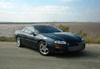
^^^Please do. I have a hood, front bumper, both front fenders, a rear spoiler, and valance to paint and I don't want to drop the coin to have some shitty place like Maaco do it.
What do I need to buy and what steps to take?
What do I need to buy and what steps to take?
Thread Starter
Teching In
Joined: Nov 2008
Posts: 44
Likes: 0
From: Coolville, OH
Well I'll start with materials used.
Materials:
Air compressor: 33 gallon Craftsman, 6.4 cfm@90PSI; 8.6 cfm@40PSI
1st paint gun (base coat/clear coat 1.3mm tip): Devilbiss FLG654
2nd paint gun (primer 1.8mm tip): Cheap HVLP gun from Harbor Freight
Lots of tarp for the 'booth'
Air cleaner/de-oiler/dryer plus a second oil/water separator.
New air hose that had never had oil run in it.
HEPA filter inside the 'booth' the help remove dust etc.
Paint/primer/clearcoat were all purchased at a local paint shop.
Mineral Spirits to clean surfaces to be painted and clean paint guns.
A decent respirator and goggles that sealed around all edges.
Lots of latex gloves to keep me from contaminating the primer/paint with body oil.
I had a fan placed in a hole I cut near the top or the booth to help exhaust fumes. It was aimed towards the open garage window.
Primer: The fender had never been painted, so I simply cleaned it well, and sanded it briefly with 320 grit sandpaper. I used a plastic covered chair to hold it. It was easy to prop it on the backrest, and still have unimpeded access to all surfaces needing paint. I sprayed on four coats of primer. I was planning three, but the second was a tad thick, and I got slight orange peel. Without sanding, the third coat nearly completely solved that, so I decided to do one more and it was completely gone. I gave each coat a 15-20 minute flash time before spraying the next. After the fourth, I sanded it lightly with 400 grit paper.
Basecoat: After giving the primer approximately two hours to cure (primer gun was thoroughly cleaned during this time), it was sanded. It was very thoroughly sprayed with clean, compressed air to remove any residual particles. The first coat of base was sprayed dry, the second and third wet, per articles I read. Granted, I didn't necessarily know what a 'dry' or 'wet' coat looked like, so I can't really help anyone there. I just put down my best approximation of each, and it seemed to turn out ok. Again, I planned to put down 3 coats, but a couple gnats made their way into the second, so after very carefully tweezing them out, I put on four coats of base. After this, any irregularities caused by these obnoxious and inconsiderate bugs was not present. Again, each coat received a 15-20 minute flash time.
Clearcoat: This was sprayed in a near identical way to the base. The basecoat was not sanded or touched in any way before application of the clear. It was left to cure for approximately 2 hours. I spent the vast majority of this time thoroughly cleaning the gun. Extra care was taken during this step, as I did not want any residual basecoat to contaminate the clear. Other than this, I cannot think of any differences between spraying the base vs spraying the clear. Again, each coat received a 15-20 minute flash time. After this, it was just left to cure.
Other notes: In prepping the guns (assumed already clean), mineral spirits was poured into the cup and sloshed around, then sprayed through the gun to remove any oil/contaminates. Then the material was mixed per manufacturers specifications. In my case, for primer/thinner it was a 1:1 ratio, respectively. For the paint/reducer it was 2:1; and the clear/hardener was 4:1. Granted this could vary per manufacturer. The material was then strained as it was poured into the cup.
The door was supported via the engine crane and cable to allow access to all sides. A wooden stand I built for my large fresnel lens was placed in contact with the bottom of the door to help stabilize it when painting. The paint on the door was removed with 60 grit paper. I mistakenly did not use a finer grit on the door before painting, and at first some of the residual pattern was visible in the paint texture. I was able to compensate by using 5 coats of base and spraying it a little heavy (so much that it almost ran, but didn't).
These are all the details I can think of at the moment. I will add more later if I think of any.
Disclaimer: I am by no means a professional. This is simply an account of how I did mine. I cannot say that my methods are either correct nor incorrect, but they worked well enough for me. If you choose to use this as reference to paint your car, I cannot guarantee the quality. I can say that mine came out looking pretty good I think. If you have any questions feel free to ask, I will be of as much assistance as possible. If you have any comments on, or corrections to my methods, feel free to add your $.02 as someday I will likely paint again. Hopefully this helps someone.
Thanks for reading my lengthy post!
Materials:
Air compressor: 33 gallon Craftsman, 6.4 cfm@90PSI; 8.6 cfm@40PSI
1st paint gun (base coat/clear coat 1.3mm tip): Devilbiss FLG654
2nd paint gun (primer 1.8mm tip): Cheap HVLP gun from Harbor Freight
Lots of tarp for the 'booth'
Air cleaner/de-oiler/dryer plus a second oil/water separator.
New air hose that had never had oil run in it.
HEPA filter inside the 'booth' the help remove dust etc.
Paint/primer/clearcoat were all purchased at a local paint shop.
Mineral Spirits to clean surfaces to be painted and clean paint guns.
A decent respirator and goggles that sealed around all edges.
Lots of latex gloves to keep me from contaminating the primer/paint with body oil.
I had a fan placed in a hole I cut near the top or the booth to help exhaust fumes. It was aimed towards the open garage window.
Primer: The fender had never been painted, so I simply cleaned it well, and sanded it briefly with 320 grit sandpaper. I used a plastic covered chair to hold it. It was easy to prop it on the backrest, and still have unimpeded access to all surfaces needing paint. I sprayed on four coats of primer. I was planning three, but the second was a tad thick, and I got slight orange peel. Without sanding, the third coat nearly completely solved that, so I decided to do one more and it was completely gone. I gave each coat a 15-20 minute flash time before spraying the next. After the fourth, I sanded it lightly with 400 grit paper.
Basecoat: After giving the primer approximately two hours to cure (primer gun was thoroughly cleaned during this time), it was sanded. It was very thoroughly sprayed with clean, compressed air to remove any residual particles. The first coat of base was sprayed dry, the second and third wet, per articles I read. Granted, I didn't necessarily know what a 'dry' or 'wet' coat looked like, so I can't really help anyone there. I just put down my best approximation of each, and it seemed to turn out ok. Again, I planned to put down 3 coats, but a couple gnats made their way into the second, so after very carefully tweezing them out, I put on four coats of base. After this, any irregularities caused by these obnoxious and inconsiderate bugs was not present. Again, each coat received a 15-20 minute flash time.
Clearcoat: This was sprayed in a near identical way to the base. The basecoat was not sanded or touched in any way before application of the clear. It was left to cure for approximately 2 hours. I spent the vast majority of this time thoroughly cleaning the gun. Extra care was taken during this step, as I did not want any residual basecoat to contaminate the clear. Other than this, I cannot think of any differences between spraying the base vs spraying the clear. Again, each coat received a 15-20 minute flash time. After this, it was just left to cure.
Other notes: In prepping the guns (assumed already clean), mineral spirits was poured into the cup and sloshed around, then sprayed through the gun to remove any oil/contaminates. Then the material was mixed per manufacturers specifications. In my case, for primer/thinner it was a 1:1 ratio, respectively. For the paint/reducer it was 2:1; and the clear/hardener was 4:1. Granted this could vary per manufacturer. The material was then strained as it was poured into the cup.
The door was supported via the engine crane and cable to allow access to all sides. A wooden stand I built for my large fresnel lens was placed in contact with the bottom of the door to help stabilize it when painting. The paint on the door was removed with 60 grit paper. I mistakenly did not use a finer grit on the door before painting, and at first some of the residual pattern was visible in the paint texture. I was able to compensate by using 5 coats of base and spraying it a little heavy (so much that it almost ran, but didn't).
These are all the details I can think of at the moment. I will add more later if I think of any.
Disclaimer: I am by no means a professional. This is simply an account of how I did mine. I cannot say that my methods are either correct nor incorrect, but they worked well enough for me. If you choose to use this as reference to paint your car, I cannot guarantee the quality. I can say that mine came out looking pretty good I think. If you have any questions feel free to ask, I will be of as much assistance as possible. If you have any comments on, or corrections to my methods, feel free to add your $.02 as someday I will likely paint again. Hopefully this helps someone.
Thanks for reading my lengthy post!
