





No VE Tuning?

Off topic but as said above,A full OLSD is pretty easy to do.You need to filter out the cells while logging to get a correct value.My personal Cam/Turbo truck took 1/2 hour to fully OLSD tune then I put back in the S-trims.Ran perfect for years.Then I tested it with the MAF,then put the VE back to a stock table. The truck ran exactly the same with all tunes.
OLSD tuning is great but needs work everytime a part is changed.This is the main reason to run a MAF so it corrects for weather easilly along with parts being changed without tuning.
OLSD tuning is great but needs work everytime a part is changed.This is the main reason to run a MAF so it corrects for weather easilly along with parts being changed without tuning.

Joined: Nov 2003
Posts: 6,216
Likes: 236
From: Wichita KS / Rancho San Diego

TECH Enthusiast
Joined: Nov 2006
Posts: 620
Likes: 0
From: Katherine N.T Australia
Off topic but as said above,A full OLSD is pretty easy to do.You need to filter out the cells while logging to get a correct value.My personal Cam/Turbo truck took 1/2 hour to fully OLSD tune then I put back in the S-trims.Ran perfect for years.Then I tested it with the MAF,then put the VE back to a stock table. The truck ran exactly the same with all tunes.
OLSD tuning is great but needs work everytime a part is changed.This is the main reason to run a MAF so it corrects for weather easilly along with parts being changed without tuning.
OLSD tuning is great but needs work everytime a part is changed.This is the main reason to run a MAF so it corrects for weather easilly along with parts being changed without tuning.
My experience shows notable differences between SD and MAF equipped engines with efficient intake setups. Ignoring the differences in how the PCM determines air mass the main fact is a MAF is a restriction and you can never ignore that. Plus for Boost you quickly run out of resolution when you start really getting the air in the engine. A common trait I've seen tuners do is let the MAF max out and run the engine extra rich for safety so that its got enough fuel in the areas above max resolution. That's never a problem with SD tuning. As long as you are under the max scale of the MAP sensor be it 2bar or 3bar the rest is just numbers in the VE table calculating the airflow model.

TECH Enthusiast
iTrader: (1)
Joined: Dec 2005
Posts: 549
Likes: 0
From: Denver International Airport, Colorado USA
I think that part of the frustration of the 'VE vs MAF' argument, is that there is very little documentation that shows the exact interaction of the VE Table on an auto that is primarily using the MAF to determine airflow.
So, we are all left with this ambitious definition of "combination of VE Table & MAF below 4000 rpm's..VE Table is used to compare airflow against MAF and correction is applied".
A lot of times I just want to say "prove it". I like others have worked many hours toting around a wideband and laptop in order to map a 'perfect' VE Table. A number of times it all worked perfectly, but for those of us who choose to go back to closed-loop..you are adjusting fueling once gain in order to address the Trim issues, and that usually requires a different method (LTFT, STFT's etc) to address those issues.
I have not yet seen the software that says..you are now using 90% MAF, 10% VE etc.
Lately, I have just simply logged MAF freq & g/s and let the software compute a VE % Table for me. Like everything else, it has some sampling flaws, but it lines up SD dynamic air against MAF based airflow..just uses the MAF to drive the VE Table, instead of vice-versa.
In my case H/C has altered the VE Table, but the MAF frequency changes and resulting airflow computations has pretty much lined up..in other words that MAF has accurately reflected the new VE changes. So, both airflow models match.
It does seem that unless you are boosted or have really demonstrated that your MAF is a genuine restriction, the disproportionate emphasis on the VE Table seems to be misplaced.
I am only tuning my car for my own personal satisfaction. I can certainly understand the pro's who have tuned hundreds or thousands of cars have pretty much figured it out.
To the OP, unless you like getting into all of this, I would not worry about your VE Table at this point. If you get your own software and can't resist, then you can apply all the techniques and 'perfect' your tune.
Good luck.
..WeathermanShawn..
So, we are all left with this ambitious definition of "combination of VE Table & MAF below 4000 rpm's..VE Table is used to compare airflow against MAF and correction is applied".
A lot of times I just want to say "prove it". I like others have worked many hours toting around a wideband and laptop in order to map a 'perfect' VE Table. A number of times it all worked perfectly, but for those of us who choose to go back to closed-loop..you are adjusting fueling once gain in order to address the Trim issues, and that usually requires a different method (LTFT, STFT's etc) to address those issues.
I have not yet seen the software that says..you are now using 90% MAF, 10% VE etc.
Lately, I have just simply logged MAF freq & g/s and let the software compute a VE % Table for me. Like everything else, it has some sampling flaws, but it lines up SD dynamic air against MAF based airflow..just uses the MAF to drive the VE Table, instead of vice-versa.
In my case H/C has altered the VE Table, but the MAF frequency changes and resulting airflow computations has pretty much lined up..in other words that MAF has accurately reflected the new VE changes. So, both airflow models match.
It does seem that unless you are boosted or have really demonstrated that your MAF is a genuine restriction, the disproportionate emphasis on the VE Table seems to be misplaced.
I am only tuning my car for my own personal satisfaction. I can certainly understand the pro's who have tuned hundreds or thousands of cars have pretty much figured it out.
To the OP, unless you like getting into all of this, I would not worry about your VE Table at this point. If you get your own software and can't resist, then you can apply all the techniques and 'perfect' your tune.
Good luck.
..WeathermanShawn..
TECH Enthusiast
Joined: Nov 2006
Posts: 620
Likes: 0
From: Katherine N.T Australia
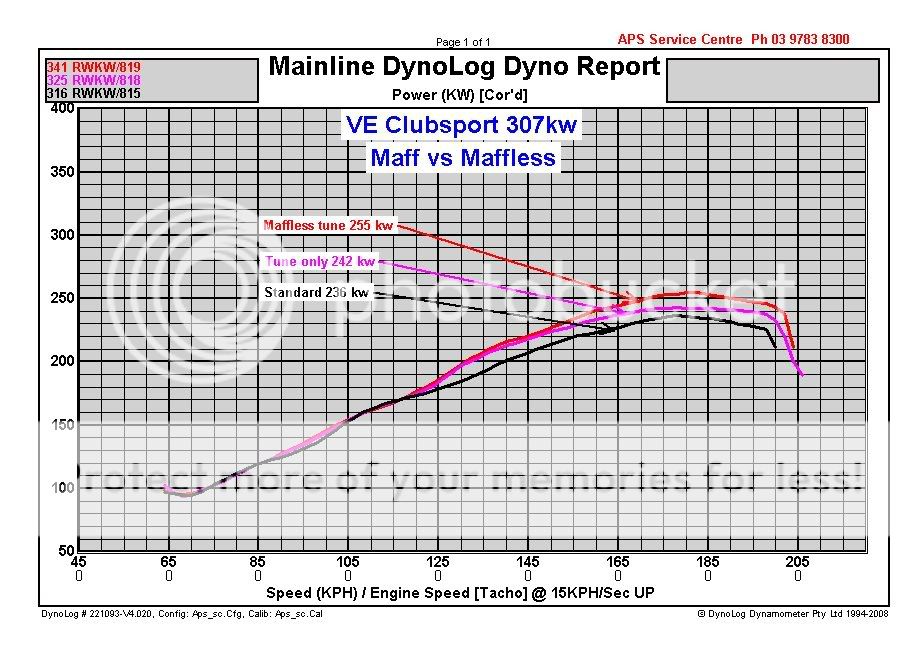
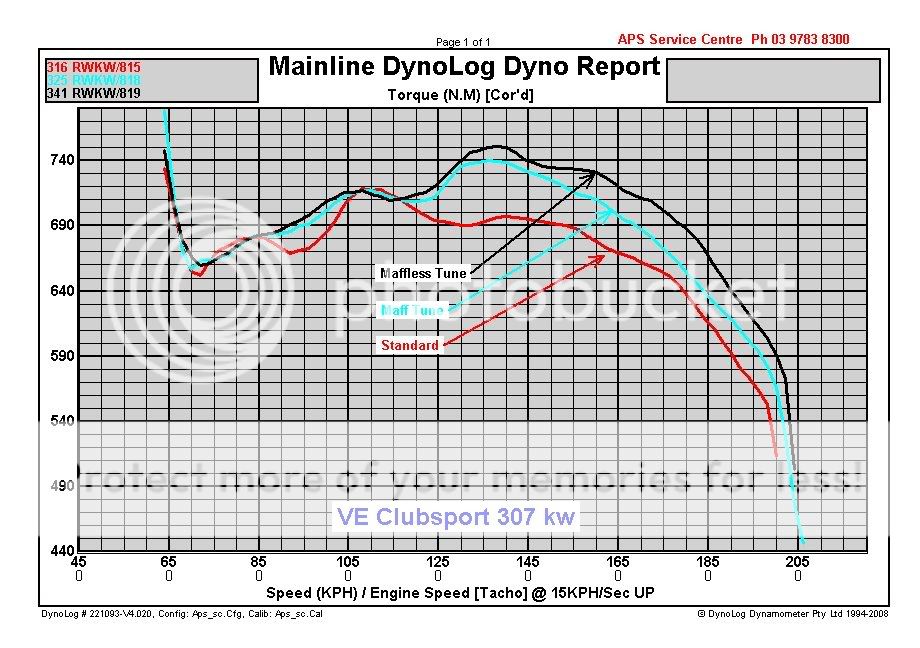
Ok I dug up an old thread of testing done by a leading workshop. This is performed on an LS2 6.0L with the E38 controller retained (ie Pontiac G8 GXP for you guys). On an LS1 with the far more restrictive MAF, the gains are larger again. Have a read.
http://www.ls1.com.au/forum/showthre...mafless+vs+maf
Here are a couple of dyno sheets showing the difference. Notice its all in the upper echelon where the MAF restriction is present.
http://www.ls1.com.au/forum/showthre...mafless+vs+maf
Here are a couple of dyno sheets showing the difference. Notice its all in the upper echelon where the MAF restriction is present.
Couple nuggets of info to keep in mind concerning MAF V. VE tuning, and how they contribute to fueling.
1: MAF is an airflow calculation. It IS NOT a calculation, or estimate, or model of LOAD. This is important to understand, in that you can be in any given Hz cell under various load conditions. So, even though the airflow is estimated as XX amount, the fact that the load may vary, requires different fueling. This is obvious by dialing in a MAF under steady state, then varying the load with rapid changes in throttle position.
2: VE is, as I understand it, an AIR MASS calculation, and because the table is RPM V. MAP, it IS an estimation of LOAD. Because it's a 3D model of 2 different scales, it can accurately model load. You will never be in the same cell under different load conditions.
In a MAF only application, the ECU would have to reference both MAF and TPS to determine different load conditions. Whether or not the LS controllers have this ability, there are no tables to adjust this.
I'm sure Marcin could elaborate.........
1: MAF is an airflow calculation. It IS NOT a calculation, or estimate, or model of LOAD. This is important to understand, in that you can be in any given Hz cell under various load conditions. So, even though the airflow is estimated as XX amount, the fact that the load may vary, requires different fueling. This is obvious by dialing in a MAF under steady state, then varying the load with rapid changes in throttle position.
2: VE is, as I understand it, an AIR MASS calculation, and because the table is RPM V. MAP, it IS an estimation of LOAD. Because it's a 3D model of 2 different scales, it can accurately model load. You will never be in the same cell under different load conditions.
In a MAF only application, the ECU would have to reference both MAF and TPS to determine different load conditions. Whether or not the LS controllers have this ability, there are no tables to adjust this.
I'm sure Marcin could elaborate.........
The MAF sensor itself does not calculate. It provides a direct measurement of the mass or weight of intake air before any calculations are made.
Based on my experience tuning and countless hours datalogging, I've noticed the VE table is used as some point of reference (but not relied as heavily as the MAF) during all rpm and load conditions in CL with a MAF. Some VE cells will be used during multiple load/operating conditions but the MAF hz will obviously change based on the incoming air mass. The combination of the two would seem to be the basis or foundation to calculate engine load. My .02
Based on my experience tuning and countless hours datalogging, I've noticed the VE table is used as some point of reference (but not relied as heavily as the MAF) during all rpm and load conditions in CL with a MAF. Some VE cells will be used during multiple load/operating conditions but the MAF hz will obviously change based on the incoming air mass. The combination of the two would seem to be the basis or foundation to calculate engine load. My .02
Hmmm...I'm really glad so many experts jumped in here to debate! I really love getting a varying point of view! I think what I'm going to do is let my tuner do what he does on the 11th and then I will so the VE table myself just because if I'm not doing the full tune myself I'll be bored!
LS1 Tech Stories
The Best V8 Stories One Small Block at Time

Amazing '71 Camaro Restomod Is Modern Muscle Car Under the Skin
Verdad Gallardo
6 Common C5 Corvette Failures and What's Involved In Repairing Them
Pouria Savadkouei
Retro Modern Bandit Pontiac Trans AM Comes With Burt Reynolds' Autograph
Verdad Gallardo
Top 10 Greatest Cadillac V Series Performance Models Ever, Ranked
Pouria Savadkouei
Top 10 Most Powerful Chevy Trucks Ever Made!

Hennessey's New Supercharged Silverado ZR2 Has 700 HP
Verdad Gallardo
Coachbuilt N2A Anteros Is an LS2-Powered C6 Corvette In Italian Clothes
Verdad Gallardo
Awesome K5 Blazer Restomod Comes With C7 Corvette Power
Verdad Gallardo
10 Camaros You Should Never Buy


I'll qualify by saying that I'm not a pro, and will never claim to be. Now...with that out of the way...
http://redhardsupra.blogspot.com/200...ss-models.html
EVERYONE should read that. Airmass can be calculated by three different sets of inputs. In the perfect world all three airmasses are equal to each other. I'll paraphrase from his article, and I'll use MAF and VE since that's being discussed.
CAM -- Cylinder Airmass
You'll have one CAM for each of the three methods of calculating airmass. So....
CAM from MAF
CAM1=120*MAF/(CYL*RPM)
CAM from speed density
CAM3=GMVE*MAP/TEMP
In the perfect world, CAM1=CAM3 or:
120*MAF/(CYL*RPM)=GMVE*MAP/TEMP
If making changes to the MAF and not making the corresponding changes to VE, all of a sudden your forumlae are not equal. To me, that is bad science. I believe that the fudging should be left to the tables that are meant for fudging (OLFA, short pulse adders, throttle cracker/follower).
Again, I'm no pro so take it for what it's worth.
http://redhardsupra.blogspot.com/200...ss-models.html
EVERYONE should read that. Airmass can be calculated by three different sets of inputs. In the perfect world all three airmasses are equal to each other. I'll paraphrase from his article, and I'll use MAF and VE since that's being discussed.
CAM -- Cylinder Airmass
You'll have one CAM for each of the three methods of calculating airmass. So....
CAM from MAF
CAM1=120*MAF/(CYL*RPM)
CAM from speed density
CAM3=GMVE*MAP/TEMP
In the perfect world, CAM1=CAM3 or:
120*MAF/(CYL*RPM)=GMVE*MAP/TEMP
If making changes to the MAF and not making the corresponding changes to VE, all of a sudden your forumlae are not equal. To me, that is bad science. I believe that the fudging should be left to the tables that are meant for fudging (OLFA, short pulse adders, throttle cracker/follower).
Again, I'm no pro so take it for what it's worth.
TECH Enthusiast
iTrader: (1)
Joined: Dec 2005
Posts: 549
Likes: 0
From: Denver International Airport, Colorado USA
Even though 'closed-loop' gets somewhat of a bad rap..No matter the contribution of VE/MAF, you have a system that is always attempting to maintain stoich (~14.7 AFR).
A few times I would experiment with multiple VE Tables..stock, 2002 Z06 Table, doubling the VE Table, etc. The only thing I would notice is that loading up a really radical VE Table would affect PE fueling. I would hit a big time bog (rich) when I doubled the VE Table values. Something I would not recommend doing.
But under other conditions closed-loop LTFT's were almost always the same. Messing around with the VE Table did not really seem to affect the car's overall ability to maintain stoich.
Again, this is just my observations from my own personal tuning experience. As a LS1 H/C car, driving no MAF vs MAF..I could still hit the same max Kpa, with no HP/TQ loss.
Bottom line is it does only take you a few hours to log a good VE Table. And it was fairly easy then to 'calibrate' the MAF Hz and corresponding airflow. But attaining perfection is somewhat ridiculous. It really seems like the MAF is controlling ~90 % of the entire airflow/fueling calculation.
It would be hard for me to recommend that you construct a VE Table without a dyno. Holding the basic charge temperature steady would get you very close. Unless you have a level course and hold IAT and ECT steady..you are going to have a pretty rough looking VE Table.
OP, you asked a good question. It is good you will be there during the dyno tune. There is a lot to learn, so enjoy.
..WeathermanShawn..
A few times I would experiment with multiple VE Tables..stock, 2002 Z06 Table, doubling the VE Table, etc. The only thing I would notice is that loading up a really radical VE Table would affect PE fueling. I would hit a big time bog (rich) when I doubled the VE Table values. Something I would not recommend doing.
But under other conditions closed-loop LTFT's were almost always the same. Messing around with the VE Table did not really seem to affect the car's overall ability to maintain stoich.
Again, this is just my observations from my own personal tuning experience. As a LS1 H/C car, driving no MAF vs MAF..I could still hit the same max Kpa, with no HP/TQ loss.
Bottom line is it does only take you a few hours to log a good VE Table. And it was fairly easy then to 'calibrate' the MAF Hz and corresponding airflow. But attaining perfection is somewhat ridiculous. It really seems like the MAF is controlling ~90 % of the entire airflow/fueling calculation.
It would be hard for me to recommend that you construct a VE Table without a dyno. Holding the basic charge temperature steady would get you very close. Unless you have a level course and hold IAT and ECT steady..you are going to have a pretty rough looking VE Table.
OP, you asked a good question. It is good you will be there during the dyno tune. There is a lot to learn, so enjoy.
..WeathermanShawn..


The posts got waaay to big to read the whole thread... but I wanted to jump on the band-wagon and say you don't need to do the VE table for lightly modified cars.
Cammed and forced induction cars need the VE adjusted, but aside from that it is alot of work for little, if any, return.
Cammed and forced induction cars need the VE adjusted, but aside from that it is alot of work for little, if any, return.
TECH Fanatic


Joined: Aug 2005
Posts: 1,691
Likes: 1
From: Sunny London, UK
One benefit of SD tuned setups is your choice of intake filter and pipework is enhanced. otrcai, 8itb etc
The MAF is easy and accurate when calibrated right. But some of us a masocists. No pain, no gain
The MAF is easy and accurate when calibrated right. But some of us a masocists. No pain, no gain

Meh, same. I leave the SD stuff alone until there is a cam in the car.
I like the new program, but some of the very-very large cams I struggle with starting issues more with the new program.....a little trickier if you ask me.
I'm still on the learning curve with the big cam LS3's though. I've probably done less then 10 at this point.
I like the new program, but some of the very-very large cams I struggle with starting issues more with the new program.....a little trickier if you ask me.
I'm still on the learning curve with the big cam LS3's though. I've probably done less then 10 at this point.

Virtual VE is a completely wrong direction. It eliminates all the pros that the parametric VE gives us, and allows us to proceed with all the wrong assumptions of VE tuning we've had so far.