


Target Shift Points

 Target Shift Points
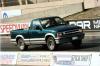
 I'm working on setting the target shift points for lowest ET on the drag strip. My setup is as follows:
5.7l iron block
317 heads shaved for about 10.5:1 CR With LS6 springs
LS6 cam
Holley 300-137 intake with Edelbrock elbow and 92mm TB
Long tube headers with 2.5" duel pipes, Aero Turbine mufflers and no cats
built 4l60e transmission with Yank PT4000 converter (4k stall)
3.73 gears
I'm thinking that the cam will be the limiting factor for how high it can rev. Any thoughts on a good starting point for data logging? I've heard these cams flatten out around 6000-6300rpm, but I don't know if that's with stock intake and exhaust or what.
Edit: This is at 5800' above sea level (Bandimere Speedway) in a 3500lb S10 Blazer by the way. If that matters.
5.7l iron block
317 heads shaved for about 10.5:1 CR With LS6 springs
LS6 cam
Holley 300-137 intake with Edelbrock elbow and 92mm TB
Long tube headers with 2.5" duel pipes, Aero Turbine mufflers and no cats
built 4l60e transmission with Yank PT4000 converter (4k stall)
3.73 gears
I'm thinking that the cam will be the limiting factor for how high it can rev. Any thoughts on a good starting point for data logging? I've heard these cams flatten out around 6000-6300rpm, but I don't know if that's with stock intake and exhaust or what.
Edit: This is at 5800' above sea level (Bandimere Speedway) in a 3500lb S10 Blazer by the way. If that matters.
Last edited by Kermit_The_Truck; Apr 15, 2015 at 12:40 PM. Reason: Additional information

I'd start with logging the RPM, trans current gear and
VSS pulses. Then look at it in Excel to find the per-
frame difference in VSS pulses which is acceleration
(well, that plus wheelspin, so forget anything useful
for the 1-2 shift). delta-VSS is your proxy for acceleration
(I will assume you do not have an accelerometer you
can datalog). Your best shift frame will maximize the
acceleration overall. What you want is to stay in present
gear until your acceleration has fallen below where it
would be if you shifted (which will be over the top since
gear ratio knocks acceleration down by about 30% at
each step, so a way-faded top of 2nd is still likely better
than going to 3rd, up to the point of valvetrain capability).
Though the converter's multiplication when you hit into
the shift extension may also make a difference in what
comes up best.
Knowing neither you might stick with what you believe
about durable redline, as your shiftpoint but it's possible
you could put a finer point on it (heh) by analyzing the
acceleration-in-gear and maximizing what you see.
VSS pulses. Then look at it in Excel to find the per-
frame difference in VSS pulses which is acceleration
(well, that plus wheelspin, so forget anything useful
for the 1-2 shift). delta-VSS is your proxy for acceleration
(I will assume you do not have an accelerometer you
can datalog). Your best shift frame will maximize the
acceleration overall. What you want is to stay in present
gear until your acceleration has fallen below where it
would be if you shifted (which will be over the top since
gear ratio knocks acceleration down by about 30% at
each step, so a way-faded top of 2nd is still likely better
than going to 3rd, up to the point of valvetrain capability).
Though the converter's multiplication when you hit into
the shift extension may also make a difference in what
comes up best.
Knowing neither you might stick with what you believe
about durable redline, as your shiftpoint but it's possible
you could put a finer point on it (heh) by analyzing the
acceleration-in-gear and maximizing what you see.
I'll be at the race track with a pair of slicks on it, so wheel spin shouldn't be a major issue. In general with the 4l60e, you want the 1-2 shift higher than the 2-3 shift due to the ratio differences right? Or is it the other way around?









