







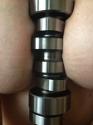

Dealing with lean condition after cam swap

Thread Starter
TECH Apprentice

Joined: Oct 2013
Posts: 350
Likes: 25
From: North Shore MA

Pulled the injectors and cleaned them. Even tried another set of stock truck injectors. I replaced the Corvette regulator just to make sure it was clean.
I threw a vacuum gauge on it, and it's steady @ 21" at idle, doesn't budge one bit. It's running incredibly smooth, but the AFR is off the charts lean.
Could the o2s be struggling due to the headers? They're mounted right in the collector, and I've heard they can be faked out.
I dunno

TECH Enthusiast

Joined: Oct 2017
Posts: 567
Likes: 159
Something rather simple to over look, have you sprayed around the intake gaskets/injectors while watching the A/F to see if it changes? I've seen vac. leaks at the injector O-rings, injectors not fully seated etc that often get over looked. More often then not I see warped intakes, like to the point all 8 cylinders are leaking and most of the time it seems like they leak on the valley pan side of the intake making it impossible to hear. Depending on how bad its warped...or not sealing you'd either need to plane the intake or force the intake down harder/tighter.
If your 100% sure the intakes not leaking then like others have said. Verify fuel pressure at the rail, make sure there are no large exhaust leaks near the O2's(or open headers).....check to make sure the O2's are actually reading.
If all that checks out, check with thee person tuning it and make sure they have the correct injector data.
Check the coolant temp in the scan tool and make sure its not reading significantly higher then actual engine temps.
At that point maybe check the injector wiring and make sure its getting a GOOD 12 volt signal. If the injectors were used and you have NOT run them prior to the cam/intake swap it might not hurt to see if they are flowing correctly. I just went though an ordeal with bad injectors on an LQ4 and I ended up having to use 4 complete sets of injectors(36 total) to get a good set of 8.
If it's still running lean at this point its going to 100% be a tuning issue
If your 100% sure the intakes not leaking then like others have said. Verify fuel pressure at the rail, make sure there are no large exhaust leaks near the O2's(or open headers).....check to make sure the O2's are actually reading.
If all that checks out, check with thee person tuning it and make sure they have the correct injector data.
Check the coolant temp in the scan tool and make sure its not reading significantly higher then actual engine temps.
At that point maybe check the injector wiring and make sure its getting a GOOD 12 volt signal. If the injectors were used and you have NOT run them prior to the cam/intake swap it might not hurt to see if they are flowing correctly. I just went though an ordeal with bad injectors on an LQ4 and I ended up having to use 4 complete sets of injectors(36 total) to get a good set of 8.
If it's still running lean at this point its going to 100% be a tuning issue
Thread Starter
TECH Apprentice
Joined: Oct 2013
Posts: 350
Likes: 25
From: North Shore MA
There is a full length system after the headers. I'll go over the intake area again to double check for leaks.
Here's a quick thought: Since the LTFT is maxed, the tune is commanding a proper AFR, but cant get it done. Is that idea right? The more I think about it, if it was lean, but not trying to correct the situation, then it would be in the tune right?
I'll attack it again tonight and see what I come up with.
Thanks for the help so far guys!
Here's a quick thought: Since the LTFT is maxed, the tune is commanding a proper AFR, but cant get it done. Is that idea right? The more I think about it, if it was lean, but not trying to correct the situation, then it would be in the tune right?
I'll attack it again tonight and see what I come up with.
Thanks for the help so far guys!
Order of operations:
1. compression test (just humor the engine)
2. leakdown if anything funny comes up with compression
3. Pressure test the intake air pathways (hook an air compressor up to the throttle body to provide it with 15~psi of "boost" pressure to find all the leaks
4. verify the wideband is working properly and there are no exhaust leaks (there have been some bad batches apparently recently)
https://forum.hptuners.com/showthrea...-leaner-it-got!
5. Engines are very simple and only need 3 things to run proper: air fuel spark. If the timing map is good and the spark is occurring when it should, then thats out of the picture. Next, compression you did a compression test so thats fine also.
All thats left is fuel. You have fuel pressure, fuel pump is working, rails are fully pressurized, great. Now just tune the engine and be done with it.
Other opinions
A. I would reduce fuel pressure if you have plenty of injector, now is your chance to bring it down some (45-50psi IMO if naturally aspirated with no vacuum reference)
B. learn to tune yourself, you seem like a smart guy I bet you can do fine just read HPtuners posts going back 10 years and you will be a pro
C. use Speed density mode only, ditch the maf IMO
MAF is for people that like to be lazy and don't fully... understand why it's there.
The maf is a very powerful tool if used correctly but it does nothing in terms of performance that speed density can't do, and it typically 'gets in the way' for both simplicity sake and when trying for max effort. Like many, I prefer a maf *only* for low-tech computer builds(i.e. power FC style), I am talking about 2.0L engines with 450rwhp max using a low power ECU. Whereas the HPtuners is an incredibly gifted ECU with so many advanced options it can easily be converted to SD with no tangible down side, except perhaps that its more time consuming to tune (takes more time) but in the end the result is worth it because you are more finely tuned rather than relying on the MAF.
D. Same idea but with closed loop: Immediately the first thing I do in a performance application is ditch the narrowband O2 sensors and run open loop full time. This forces you to learn and tune the entire ecu, every aspect with detail, to achieve the kind of a/f ratio and performance you desire, it will make you a better tuner and the engine will run better and get better fuel economy if done properly. 14.7:1 is just an emissions setting for ideal combustion gas, it does not make the engine run "best" or "more efficient".
E. stop troubling the engine with cam swaps. The next thing you are going to post is you ripped the rocker threads out of the head, or have a cam bearing spun or something. Don't ever open an engine unnecessarily.
F. In timing maps, never use the same exact number in an adjacent cell. Like never use 20 20 20 20 etc... as you see above.
It doesn't matter for idle areas- I mean mostly the regions under full power, like 80KPA and above.
The reason is because digital electronics are not 100% accurate so when the computer 'see's 20 20 20 its going to put out more like 19.98, 20.04, 20.12, 19.94, etc...
In other words you can't ever actually get exactly 20 20 20 consistently for each cylinder.
Instead you should program something like 20.1, 20.3, 20.5, 20.7, etc...
This way the digital electronics have a "future target" in the state space variables (they predict the future, sort of) which is linearly increasing or decreasing,
it will lend a moe stable, smooth engine operation.
1. compression test (just humor the engine)
2. leakdown if anything funny comes up with compression
3. Pressure test the intake air pathways (hook an air compressor up to the throttle body to provide it with 15~psi of "boost" pressure to find all the leaks
4. verify the wideband is working properly and there are no exhaust leaks (there have been some bad batches apparently recently)
https://forum.hptuners.com/showthrea...-leaner-it-got!
5. Engines are very simple and only need 3 things to run proper: air fuel spark. If the timing map is good and the spark is occurring when it should, then thats out of the picture. Next, compression you did a compression test so thats fine also.
All thats left is fuel. You have fuel pressure, fuel pump is working, rails are fully pressurized, great. Now just tune the engine and be done with it.
Other opinions
A. I would reduce fuel pressure if you have plenty of injector, now is your chance to bring it down some (45-50psi IMO if naturally aspirated with no vacuum reference)
B. learn to tune yourself, you seem like a smart guy I bet you can do fine just read HPtuners posts going back 10 years and you will be a pro
C. use Speed density mode only, ditch the maf IMO
MAF is for people that like to be lazy and don't fully... understand why it's there.
The maf is a very powerful tool if used correctly but it does nothing in terms of performance that speed density can't do, and it typically 'gets in the way' for both simplicity sake and when trying for max effort. Like many, I prefer a maf *only* for low-tech computer builds(i.e. power FC style), I am talking about 2.0L engines with 450rwhp max using a low power ECU. Whereas the HPtuners is an incredibly gifted ECU with so many advanced options it can easily be converted to SD with no tangible down side, except perhaps that its more time consuming to tune (takes more time) but in the end the result is worth it because you are more finely tuned rather than relying on the MAF.
D. Same idea but with closed loop: Immediately the first thing I do in a performance application is ditch the narrowband O2 sensors and run open loop full time. This forces you to learn and tune the entire ecu, every aspect with detail, to achieve the kind of a/f ratio and performance you desire, it will make you a better tuner and the engine will run better and get better fuel economy if done properly. 14.7:1 is just an emissions setting for ideal combustion gas, it does not make the engine run "best" or "more efficient".
E. stop troubling the engine with cam swaps. The next thing you are going to post is you ripped the rocker threads out of the head, or have a cam bearing spun or something. Don't ever open an engine unnecessarily.
F. In timing maps, never use the same exact number in an adjacent cell. Like never use 20 20 20 20 etc... as you see above.
It doesn't matter for idle areas- I mean mostly the regions under full power, like 80KPA and above.
The reason is because digital electronics are not 100% accurate so when the computer 'see's 20 20 20 its going to put out more like 19.98, 20.04, 20.12, 19.94, etc...
In other words you can't ever actually get exactly 20 20 20 consistently for each cylinder.
Instead you should program something like 20.1, 20.3, 20.5, 20.7, etc...
This way the digital electronics have a "future target" in the state space variables (they predict the future, sort of) which is linearly increasing or decreasing,
it will lend a moe stable, smooth engine operation.
LS1 Tech Stories
The Best V8 Stories One Small Block at Time

Gas Monkey Built a 6-Wheel Ferrari Testarossa With a Corvette LT4 Engine
Verdad Gallardo
7 Most Reliable High-Performance Engines GM Has Ever Built
Verdad Gallardo
Amazing '71 Camaro Restomod Is Modern Muscle Car Under the Skin
Verdad Gallardo
6 Common C5 Corvette Failures and What's Involved In Repairing Them
Pouria Savadkouei
Retro Modern Bandit Pontiac Trans AM Comes With Burt Reynolds' Autograph
Verdad Gallardo
Top 10 Greatest Cadillac V Series Performance Models Ever, Ranked
Pouria Savadkouei
Top 10 Most Powerful Chevy Trucks Ever Made!

Hennessey's New Supercharged Silverado ZR2 Has 700 HP
Verdad Gallardo