




corvette suspension conversion?

Thread Starter
Teching In
Joined: Aug 2008
Posts: 36
Likes: 0

i didn't post to start a fight and i AM new to the whole mechanics thing. that's the whole reason why i'm posting this. i want to know what i can do to my car before i just start buying crap and wasting my money and time. i was told by a guy i work with that used to work as a mechanic for a nascar team that it should be possible to convert my car to an independent rear suspension. he originally said he didn't think it would be worth it, assuming i was just gonna drag, but when he found out i want to autocross he said it may be worth looking into. the following statement isn't directed at all of you, nor the person i quoted. If i wanted to hear some d-bags talk crap then i would have said "hey d-bag, come here so i can crap in your mouth and you can tell me how much of a newbie i am." i already know i'm new retard! thanks to everyone that was actually trying to be helpful.
And fyi, if you were to custom fab an IRS for your F-body, you would get tossed in the full blown custom class where you could not be even remotely competitive.

TECH Addict
Joined: Sep 2006
Posts: 2,591
Likes: 1
From: Massachusetts
I have a lot of respect for Sam and what he's done, but I'm going to be honest here and say that doesn't say much for the car overall. It says more about the class the car's in, and also Sam's own ability. Live axles are worse. Period. Does that make all cars with them worse than all cars with IRS? No, and Sam demonstrates such.
Live axles are NOT worse in their entirety. Many members around here must remember that the main purposes of IRS's are to remove the majority of unsprung weight from the rear whilst allowing optimal static and dynamic control over camber and toe. Many older designs are actually worse at this than the 4th Gen Camaro or even some newer SRA's.
Also bear in mind that in CV and/or U-joint designs, there can be a measureable power loss from the use of half-shafts. Over the same power transmitted, this can exist. Nevertheless, there are designs that do require the use of a fully sprung differential with half-shafts, yet aren't independent (rare if even existant these days).
With that stated, there's been lot's of conjecture with "IRS retrofitting" and "C5 conversions" around this forum.
Nevertheless, I will restate this post to the OP:
Really, the OP should go back to basics first and deal more with spring rates, sway bar rates, and shock valving before venturing with IRS, because re-engineering the rear-end will takes lots of time, money, labour, and R&D and still could end up being substantially worse.
Also bear in mind that in CV and/or U-joint designs, there can be a measureable power loss from the use of half-shafts. Over the same power transmitted, this can exist. Nevertheless, there are designs that do require the use of a fully sprung differential with half-shafts, yet aren't independent (rare if even existant these days).
With that stated, there's been lot's of conjecture with "IRS retrofitting" and "C5 conversions" around this forum.
Nevertheless, I will restate this post to the OP:
1. How much money can one spend on this project? If one supposedly has "six-figure" income (or at least "six-figure" investment), what would be the ROI?
2. How much of the chassis statics and dynamics does one know before chopping and cutting?
3. When the project is finished, what has been improved? If it's performance, then...
4. Will it be reliable and/or easy to service?
2. How much of the chassis statics and dynamics does one know before chopping and cutting?
3. When the project is finished, what has been improved? If it's performance, then...
4. Will it be reliable and/or easy to service?
Most, if not ALL, autocrossing is done on smooth surfaces, which will negate about 90% of an IRS's "advantages".
I have made some detailed answers in other threads, so I won't re-type them. However, I want to follow up on leadfoot's post.
On a flat surface, a live axle will outcorner an IRS EVERY TIME. All other things being equal, of course.
Why? Well, with an independant suspension, the inside tire is tilted the wrong way. This means that only the inside corner of that tire is on the ground. The outside tire is carrying all the weight of the car.
With a live axle, both tires stay perpendicular to the ground at all times. Regardless of what the body is doing, both tires keep their entire tread on the ground. Sure, the tire itself can deform and load one side more than another, but when was the last time you saw in inside tire of a live axle in the air during a turn?
Plus, a live axle is usually lighter than an IRS. This means that the car is lighter. Of course, the difference is that the IRS has less unsprung weight. But, this helps mainly when bumps are encountered.
So, as long as you're on a relatively good surface, a live axle is not a handicap.
On a flat surface, a live axle will outcorner an IRS EVERY TIME. All other things being equal, of course.
Why? Well, with an independant suspension, the inside tire is tilted the wrong way. This means that only the inside corner of that tire is on the ground. The outside tire is carrying all the weight of the car.
With a live axle, both tires stay perpendicular to the ground at all times. Regardless of what the body is doing, both tires keep their entire tread on the ground. Sure, the tire itself can deform and load one side more than another, but when was the last time you saw in inside tire of a live axle in the air during a turn?
Plus, a live axle is usually lighter than an IRS. This means that the car is lighter. Of course, the difference is that the IRS has less unsprung weight. But, this helps mainly when bumps are encountered.
So, as long as you're on a relatively good surface, a live axle is not a handicap.
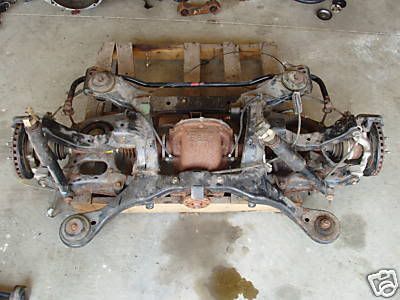
Maybe you would like to talk to me. I plan to install an IRS soon. The trick is which IRS. The vette units are no good for the 4th gens. Look into the 89-97 T-bird/Cougar/Mark 8 units. They have their own subframes which drop right down. The 8.8 diffs are plenty strong, they have disc brakes and used Cobra centers can be had cheaply with 3.42, 3.73 and 4.10 gears with posi. Cornering grip is much improved.
LS1 Tech Stories
The Best V8 Stories One Small Block at Time

Topdon ONE vs. Artidiag 800 BT2: Which is the Diagnostic Tablet For You?
Pouria Savadkouei
Gas Monkey Built a 6-Wheel Ferrari Testarossa With a Corvette LT4 Engine
Verdad Gallardo
7 Most Reliable High-Performance Engines GM Has Ever Built
Verdad Gallardo
Amazing '71 Camaro Restomod Is Modern Muscle Car Under the Skin
Verdad Gallardo
6 Common C5 Corvette Failures and What's Involved In Repairing Them
Pouria Savadkouei
Retro Modern Bandit Pontiac Trans AM Comes With Burt Reynolds' Autograph
Verdad Gallardo
Top 10 Greatest Cadillac V Series Performance Models Ever, Ranked
Pouria Savadkouei
Top 10 Most Powerful Chevy Trucks Ever Made!

Hennessey's New Supercharged Silverado ZR2 Has 700 HP
Verdad Gallardo No it doesn't. Under lateral loads the tires roll and the contact surface gets small. This is why performance cars have negative camber. Under hard cornering the contact patches get bigger. Even guys with live axles will sometimes modify them to add negative camber.
Who cares about the inside wheel? There is little to no weight on it. It's all about the outside wheel.
No it doesn't. Under lateral loads the tires roll and the contact surface gets small. This is why performance cars have negative camber. Under hard cornering the contact patches get bigger. Even guys with live axles will sometimes modify them to add negative camber.
No it doesn't. Under lateral loads the tires roll and the contact surface gets small. This is why performance cars have negative camber. Under hard cornering the contact patches get bigger. Even guys with live axles will sometimes modify them to add negative camber.
My axle has -.4* camber on each side.
When I say "flat roads" I don't mean glass. I mean parking lots, road courses and airports.
If live axles are so bad on road courses, then how do Nascar stock cars (live axles) run 5-10 seconds faster than the most prepared GT1 World Challenge cars (IRS)? Roughly equal hp (800 or so), both tube frame, GT1 is even more aerodynamic.
Here's a quote from the guys at Speedsource - "Only the best IRS are better than a live axle. Most are even worse. RX-7, C5/C6 and a few others are good."
A car with four tires creating lateral acceleration, will ALWAYS out corner a car with only two or three tires working. 25 years ago, when I was running a circle track car, we were always tweaking an tuning, to get ALL FOUR tires heated up and creating traction, especially the left front, in our case. Getting the inside front tire digging will AlWAYS get you around the corners faster.
Anybody who wants to corner with the maximun velocity, THAT'S WHO!!
A car with four tires creating lateral acceleration, will ALWAYS out corner a car with only two or three tires working. 25 years ago, when I was running a circle track car, we were always tweaking an tuning, to get ALL FOUR tires heated up and creating traction, especially the left front, in our case. Getting the inside front tire digging will AlWAYS get you around the corners faster.
A car with four tires creating lateral acceleration, will ALWAYS out corner a car with only two or three tires working. 25 years ago, when I was running a circle track car, we were always tweaking an tuning, to get ALL FOUR tires heated up and creating traction, especially the left front, in our case. Getting the inside front tire digging will AlWAYS get you around the corners faster.
Keep in mind guys, there is a reason we don't run solid axles up front anymore. They are just not as good as independant. I mean, you can do what you want. I've already verified that the IRS I want in my car is going to improve the cornering grip over the solid axle. So there is no way your going to convince me otherwise.
Last edited by JasonWW; Jun 18, 2009 at 11:51 PM.
Jason, I've followed a lot of your threads on suspension, and at one point thought that you might have had a good handle on things. This one statement has changed my mind..........
I'm being a little tongue in cheek, but think about it in theory.
You have 4 wheels. If your not unloading the inside wheels, then your not going fast enough!
Obviously, cars that can generate aerodynamic downforce are a different story.
You have 4 wheels. If your not unloading the inside wheels, then your not going fast enough!
Obviously, cars that can generate aerodynamic downforce are a different story.
If you want to get all technical, then look at this unequal length A-arm setup I'm working on for the front using aluminum C4 spindles.
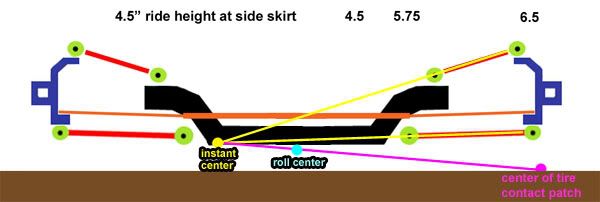
Now in a corner the car will roll some. This will cause the outer wheel to gain negative camber and the inner wheel to gain positive camber. Generally speaking. This is going to maximize your contact patch for both tires, not to mention that if one tire hits a bump or dip, it will not effect the other side wheel. There is just no way a solid axle can compete with that.
Now in a corner the car will roll some. This will cause the outer wheel to gain negative camber and the inner wheel to gain positive camber. Generally speaking. This is going to maximize your contact patch for both tires, not to mention that if one tire hits a bump or dip, it will not effect the other side wheel. There is just no way a solid axle can compete with that.
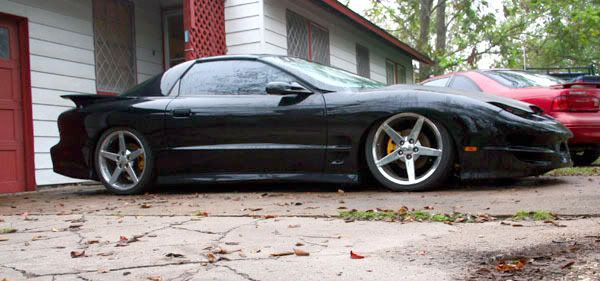
Then toss in my secret weapon of a lowered ride height plus extended suspension travel front and rear and boom! Game over. I win! 
Now back to your regularly scheduled program.
.
Now back to your regularly scheduled program.
.
Last edited by JasonWW; Jun 19, 2009 at 06:46 AM.
First off, most live axles actually have a little camber to them. They are tubes that have had the weight of a car sitting on them - they are going to bend slightly. That's why the manufacturers build in some camber tolerances into the rearends (roughly .5* in a 10-bolt). I didn't do anything to mine to bend them - when I had my last alignment we put lasers on the rear just to check. That's what we found.
Looks like your front suspension is going to be great. But, that's what I mean. A well-thought out, measured, plannned IRS is going to be better than a live axle under race conditions. But, few IRS out of street cars are that good. They are geared for comfort, quiet and a gazillion other things.
Take my friend's 2nd Gen RX-7 for example. He's got an LS2 in it, with a T-56, but the stock rear. It is a great car - better than mine. But, even it has a shortcoming. The diff is mounted to the car with a front bushing. It is meant to isolate the body from road vibrations and such. He snapped it in the middle of a race. It's now welded solid.
If you are custom building an IRS for your car, then I believe it can be made better than a live axle. But, to get every single angle correct, you'll likely have to cut out the rear frame and build your own rear clip with tubes, then make all the arms from scratch.
Oh, and I have yet to see ANY car that's has a good enough suspension to lift both inside wheels. Been watching LeMans for the past few days, and those guys can't do it. F1 guys can't do it.
Looks like your front suspension is going to be great. But, that's what I mean. A well-thought out, measured, plannned IRS is going to be better than a live axle under race conditions. But, few IRS out of street cars are that good. They are geared for comfort, quiet and a gazillion other things.
Take my friend's 2nd Gen RX-7 for example. He's got an LS2 in it, with a T-56, but the stock rear. It is a great car - better than mine. But, even it has a shortcoming. The diff is mounted to the car with a front bushing. It is meant to isolate the body from road vibrations and such. He snapped it in the middle of a race. It's now welded solid.
If you are custom building an IRS for your car, then I believe it can be made better than a live axle. But, to get every single angle correct, you'll likely have to cut out the rear frame and build your own rear clip with tubes, then make all the arms from scratch.
Oh, and I have yet to see ANY car that's has a good enough suspension to lift both inside wheels. Been watching LeMans for the past few days, and those guys can't do it. F1 guys can't do it.

Maybe you would like to talk to me. I plan to install an IRS soon. The trick is which IRS. The vette units are no good for the 4th gens. Look into the 89-97 T-bird/Cougar/Mark 8 units. They have their own subframes which drop right down. The 8.8 diffs are plenty strong, they have disc brakes and used Cobra centers can be had cheaply with 3.42, 3.73 and 4.10 gears with posi. Cornering grip is much improved.
First off, most live axles actually have a little camber to them. They are tubes that have had the weight of a car sitting on them - they are going to bend slightly. That's why the manufacturers build in some camber tolerances into the rearends (roughly .5* in a 10-bolt). I didn't do anything to mine to bend them - when I had my last alignment we put lasers on the rear just to check. That's what we found.
That's why we have poly bushings, rod ends, roller bearings, etc... Take my friend's 2nd Gen RX-7 for example. He's got an LS2 in it, with a T-56, but the stock rear. It is a great car - better than mine. But, even it has a shortcoming. The diff is mounted to the car with a front bushing. It is meant to isolate the body from road vibrations and such. He snapped it in the middle of a race. It's now welded solid.
You have to check out cars that are closer to stock. You must have the Speed Channel, check out the Koni Challenge. A great one, but not on right now is the British Touring Car races. They are usually small front wheel drive cars and the stewards let them play rough. Those guys will lift both inside tires on a tiny bump. Granted, having the drive end suspension soft enough to keep both tires putting the power to the ground is probably faster than lifting both inside tires. The one execption might be the Australian Supercars. They use spools in the back so I don't think they car if they lift both inside wheels. It's a facinating subject, so I could go on and on, but...As far as a C3, C4 or C5 IRS in a 3rd or 4th gen F-body, I would say it's not feasible.
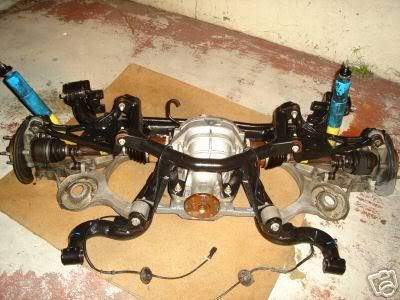
I'd consider a different assembly vs. the Cobra IRS. Even the Ford vehicle dynamic engineer who developed this system will tell you it's not intended to improve handling, just marketing sales. The suspension geometry was so compromised in order to package it under the mustang that the camber curves and scrub are just horrendous.
Here is the Cobra unit:
Here is the T-bird unit:
Here is the center diff:
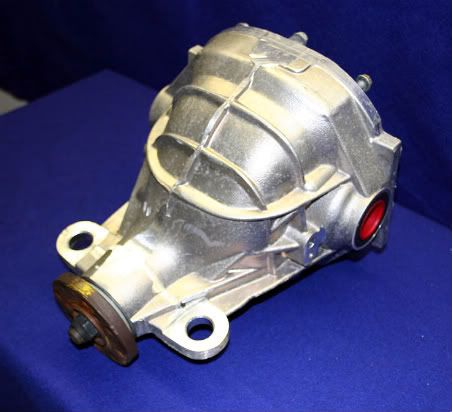
I have quite a few ideas to improve the geometry as well. It is not a bolt in kids, but it will fit.