





Wheel weight. Does it mater all that much
Thread Starter
TECH Veteran
iTrader: (14)
Joined: Mar 2009
Posts: 4,444
Likes: 9
From: Pompano Beach FL
 Wheel weight. Does it mater all that much
 I'm still on the stock snow flakes with the mods in sig and not only do I not like the way they look but the traction is really starting to suck lol. Im looking to go with something 10.5 or 11" wide out back which has me looking at TT2'S or c5 deep dish from oe wheels my only concern is that these wheels all come in around 25-27lbs while the stockers are around 19. Is that weight difference really going to hurt the 1/4mile times?
I'm still on the stock snow flakes with the mods in sig and not only do I not like the way they look but the traction is really starting to suck lol. Im looking to go with something 10.5 or 11" wide out back which has me looking at TT2'S or c5 deep dish from oe wheels my only concern is that these wheels all come in around 25-27lbs while the stockers are around 19. Is that weight difference really going to hurt the 1/4mile times?
The main issue is if the extra traction you'll gain by going with a wider wheel/tire setup outweighs the increased weight and rolling resistance. Tire selection will play a big part in that. You could also look for lighter wheels in the size you want to keep any weight increase to a minimum.
Thread Starter
TECH Veteran
iTrader: (14)
Joined: Mar 2009
Posts: 4,444
Likes: 9
From: Pompano Beach FL
The tires wont be cheap ones either way I go on it I'm looking at some bfg kdw's or nitto nt05's. Ya I totlaed it up in my head roughly and came up with 40lbs and to me thats a lot of weight. I've been looking for a lighter wheel but I havent found one under 2k. You have any recommendations
Thread Starter
TECH Veteran
iTrader: (14)
Joined: Mar 2009
Posts: 4,444
Likes: 9
From: Pompano Beach FL
thats what I'm looking at lol but who seriously sells them in the correct size i googled it and cant seem to find 17x11's or 17x8 or 17x9 in the size for our cars
Trending Topics
LS1 Tech Stories
The Best V8 Stories One Small Block at Time

6 Common C5 Corvette Failures and What's Involved In Repairing Them
Pouria Savadkouei
Retro Modern Bandit Pontiac Trans AM Comes With Burt Reynolds' Autograph
Verdad Gallardo
Top 10 Greatest Cadillac V Series Performance Models Ever, Ranked
Pouria Savadkouei
Top 10 Most Powerful Chevy Trucks Ever Made!

Hennessey's New Supercharged Silverado ZR2 Has 700 HP
Verdad Gallardo
Coachbuilt N2A Anteros Is an LS2-Powered C6 Corvette In Italian Clothes
Verdad Gallardo
Awesome K5 Blazer Restomod Comes With C7 Corvette Power
Verdad Gallardo
10 Camaros You Should Never Buy

10 LS Engine Myths That Refuse to Die
Verdad Gallardo
Thread Starter
TECH Veteran
iTrader: (14)
Joined: Mar 2009
Posts: 4,444
Likes: 9
From: Pompano Beach FL
Not that I'm disputing here but do you have anything to go off from this claim? I have multiple friends with kdw II's on their full bolt on cars and none of them have trouble hooking even with 6 speeds, from what I have seen they hook better than the nt05 nittos.
From who? And whats a ball park price figure, I would even take a used set but there never seem to be any for sale under what they would cost new.
I'm not sure I understand this. Are you saying 4lbs of rotating mass ie wheels and tires is equal to only 1lb of extra weight in the car meaning if I added 30lbs of wheels and tires it would be the same thing as roughly 120lbs to the car in dead weight?
I'm not sure I understand this. Are you saying 4lbs of rotating mass ie wheels and tires is equal to only 1lb of extra weight in the car meaning if I added 30lbs of wheels and tires it would be the same thing as roughly 120lbs to the car in dead weight?
The power needed to increase the rotational velocity of a wheel is P(rotation) = I*alpha*omega, where I = rotational moment of inertia of the wheel & tire, alpha is the rotational acceleration (in radians per sec squared), and omega is the instantaneous rotational velocity (in radians/sec). Alpha is related to the linear acceleration of the car by a = alpha*R, and omega is related to the car's velocity by v = omega*R. So the power required for rotational acceleration can be expressed in terms of a and v by: P=Iav/R^3. As for the value of I: for a 1 pound mass concentrated at a distance r from the center of rotation, I = mr^2. Putting it together: P(rotation) = I*alpha*omega = mr^2av/R^3. Since r = 3/4 ft and R = 1 ft, that means you have P(rotation) = 9/(diameter of your rim) * mav.
Regardless, a drop in wheel weight can have significant impact on the performance of the car, and it would be relatively higher than a similar reduction in non-rotating mass.
Last edited by westtexasbuff; Jun 5, 2011 at 11:47 PM.
I meant their not expensive. You said earlier how tires wouldnt be cheap. While no 18" tire is really cheap, the BFGs are the most affordable Ive seen other than Generals. I have heard great reports on them and will be buying a set when I get wheels myself. My point was really that most 18" tires are much much more expensive than the BFGs.


I couldnt read all of your second post lol
If my wheels weigh 25 lbs each, thats 100 lbs rotating(R). 400 total R
Lets say I replace with wheels that weigh 12.5 each (50 lbs R). 200 total R
According to the rule of thumb, I lose 2 tenths???
Pretty sweet, Thanks for posting. I tried explaining to a friend and I estimated it was x3 instead of x4. I was pretty close and glad to learn this
If my wheels weigh 25 lbs each, thats 100 lbs rotating(R). 400 total R
Lets say I replace with wheels that weigh 12.5 each (50 lbs R). 200 total R
According to the rule of thumb, I lose 2 tenths???
Pretty sweet, Thanks for posting. I tried explaining to a friend and I estimated it was x3 instead of x4. I was pretty close and glad to learn this
Thread Starter
TECH Veteran
iTrader: (14)
Joined: Mar 2009
Posts: 4,444
Likes: 9
From: Pompano Beach FL
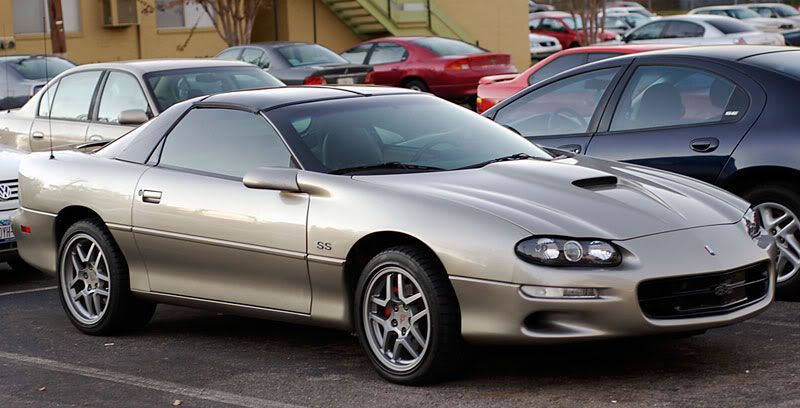
Thanks guys, I really do think 27lbs is really heavy for a wheel. So I have it narrowed down to the street lites or some c5 z06's. I know they are a little played out but I cant say I've seen the gray speedline or alcoa color on a pewter camaro like this... Mine is very similar only difference is I have a balck painted manta on mine. The oem z06 wheels come in at 21.4 for the back and 20 for the fronts so its not too much different I think the street lites are even around 17 and 20lbs. I kinda like the look in this pic, clean and simple what do you guys think? If the price is right for the street lites I'd probably go for them though.
Thread Starter
TECH Veteran
iTrader: (14)
Joined: Mar 2009
Posts: 4,444
Likes: 9
From: Pompano Beach FL
just curious but would there be any cons to daily driving on a front 17x7 wheel as opposed to a 17x8 or 17x9? Just wondering because I like the look of the smaller wheel up front and theyre are quite a bit cheaper than the wider ones.
Thread Starter
TECH Veteran
iTrader: (14)
Joined: Mar 2009
Posts: 4,444
Likes: 9
From: Pompano Beach FL
thanks for answering all the questions. as far as backspacing goes fro the 17x11 rears what is the general acceptance I have seen people using 7.5 ot 7 3/4 backspace for a stock rear will either one work?