



HID headlight help

Thread Starter
TECH Apprentice
Joined: Jul 2007
Posts: 325
Likes: 1
 HID headlight help
 Does anyone know a local store or business where I can go to get more information on HID headlights. I plan on taking my Equinox in, and just want to know where I can get this type of service at.
Thanks!!
Thanks!!

Copy & Paste Moderator


Joined: Apr 2002
Posts: 9,764
Likes: 208
From: Eastern MA
Please do some searching/reading on here and especially the forums at HID Planet before getting HID. What kind of headlights does your Equinox have? HID should not be placed in Halogen Reflector Housings, especially not dual filament ones (one bulb handles high and low beam).
Thread Starter
TECH Apprentice
Joined: Jul 2007
Posts: 325
Likes: 1
Please do some searching/reading on here and especially the forums at HID Planet before getting HID. What kind of headlights does your Equinox have? HID should not be placed in Halogen Reflector Housings, especially not dual filament ones (one bulb handles high and low beam).
Copy & Paste Moderator
Joined: Apr 2002
Posts: 9,764
Likes: 208
From: Eastern MA
Start with reading this:
http://www.danielsternlighting.com/t...nversions.html
Some good discussion here:
https://ls1tech.com/forums/appearanc...un-around.html
Basically Halogen and HID produce light differently (glowing filament vs. arc of light) and HID kits don't always place the arc in the same place as the Halogen filament. And some halogen filaments are horizontal to the glass tube. All HID arcs are vertical in the glass tube. Which means that the focal point will be off and you'll get a bad light pattern. Also, HID puts out a lot more light than Halogen. Therefore a Halogen Reflector Housing intended to spread a certain amount of light of a certain shape over a certain area now has a lot more light going outside this area not necessarily where it is needed and often where it shouldn't be (high, blotchy, and often into the eyes of others).
This problem becomes compounded with dual filament hi/lo applications. I've seen four kinds of so-called "bi-xenon" HID kits designed for dual filament applications:
1.) One fixed/non-movable HID capsule
You lose high beam but its position and resulting pattern is like the high beams are stuck on and you are blinding everyone.
2.) One HID capsule for low beam and One Halogen bulb for high beam attached to same base
Neither is positioned correctly and the high beam bulb is not replicable. Sucks for you if it blows.
3.) Two HID capsules on one base. Neither is positioned correctly and you have way too much light coming out for high beam and you can't flash-to-pass because HID starts up slowly and you can damage the bulbs and ballasts from frequent flashing.
4.) One Movable HID capsule often with a built-in shield/cap. This is the "best" of these options because it trys to put the arc in close to the correct position for high/low operation. The capsule will move depending on whether you have the high or low beam activated. The beam pattern is still not good, but not nearly as bad as the above options.
For clarification, a bi-xenon projector has only one fixed/non-movable HID bulb. When high beam is activated, the cut-off shield inside the projector moves to allow more light higher through the lens.
Check out the Lighting FAQ: https://ls1tech.com/forums/appearance-detailing/710357-lighting-faq.html
http://www.danielsternlighting.com/t...nversions.html
Some good discussion here:
https://ls1tech.com/forums/appearanc...un-around.html
Basically Halogen and HID produce light differently (glowing filament vs. arc of light) and HID kits don't always place the arc in the same place as the Halogen filament. And some halogen filaments are horizontal to the glass tube. All HID arcs are vertical in the glass tube. Which means that the focal point will be off and you'll get a bad light pattern. Also, HID puts out a lot more light than Halogen. Therefore a Halogen Reflector Housing intended to spread a certain amount of light of a certain shape over a certain area now has a lot more light going outside this area not necessarily where it is needed and often where it shouldn't be (high, blotchy, and often into the eyes of others).
This problem becomes compounded with dual filament hi/lo applications. I've seen four kinds of so-called "bi-xenon" HID kits designed for dual filament applications:
1.) One fixed/non-movable HID capsule
You lose high beam but its position and resulting pattern is like the high beams are stuck on and you are blinding everyone.
2.) One HID capsule for low beam and One Halogen bulb for high beam attached to same base
Neither is positioned correctly and the high beam bulb is not replicable. Sucks for you if it blows.
3.) Two HID capsules on one base. Neither is positioned correctly and you have way too much light coming out for high beam and you can't flash-to-pass because HID starts up slowly and you can damage the bulbs and ballasts from frequent flashing.
4.) One Movable HID capsule often with a built-in shield/cap. This is the "best" of these options because it trys to put the arc in close to the correct position for high/low operation. The capsule will move depending on whether you have the high or low beam activated. The beam pattern is still not good, but not nearly as bad as the above options.
For clarification, a bi-xenon projector has only one fixed/non-movable HID bulb. When high beam is activated, the cut-off shield inside the projector moves to allow more light higher through the lens.
Check out the Lighting FAQ: https://ls1tech.com/forums/appearance-detailing/710357-lighting-faq.html
Last edited by VIP1; Mar 10, 2009 at 09:11 AM.
Copy & Paste Moderator
Joined: Apr 2002
Posts: 9,764
Likes: 208
From: Eastern MA
Also, the K number is the color temp. It is not the brightness (well not directly, I'll explain). 4000K - 5000K is the brightest. Continuing up the color scale, the light gets bluer then purpler and the lumens output (the actual measurement of light) decreases. In other words, a 10000K HID kit is dimmer than a 4300K HID kit. Our eyes are least sensitive to blue light. Blue light also scatters more easily. In the end, we can see better with a 4300K HID kit for many reasons.
Thread Starter
TECH Apprentice
Joined: Jul 2007
Posts: 325
Likes: 1
Trending Topics
Copy & Paste Moderator
Joined: Apr 2002
Posts: 9,764
Likes: 208
From: Eastern MA
Originally Posted by 92builtbird
It's an 05. Stock it takes Sylvania HB5/9007 12V
Originally Posted by 92builtbird
By having to convert to a "bi-xenon" HID kit, I'm assuming it can get quite expensive.
LS1 Tech Stories
The Best V8 Stories One Small Block at Time

Topdon ONE vs. Artidiag 800 BT2: Which is the Diagnostic Tablet For You?
Pouria Savadkouei
Gas Monkey Built a 6-Wheel Ferrari Testarossa With a Corvette LT4 Engine
Verdad Gallardo
7 Most Reliable High-Performance Engines GM Has Ever Built
Verdad Gallardo
Amazing '71 Camaro Restomod Is Modern Muscle Car Under the Skin
Verdad Gallardo
6 Common C5 Corvette Failures and What's Involved In Repairing Them
Pouria Savadkouei
Retro Modern Bandit Pontiac Trans AM Comes With Burt Reynolds' Autograph
Verdad Gallardo
Top 10 Greatest Cadillac V Series Performance Models Ever, Ranked
Pouria Savadkouei
Top 10 Most Powerful Chevy Trucks Ever Made!

Hennessey's New Supercharged Silverado ZR2 Has 700 HP
Verdad Gallardo Thread Starter
TECH Apprentice
Joined: Jul 2007
Posts: 325
Likes: 1
Are there cetain places that specialize in this, such as sound security inc., or do they not do that stuff. Or am I going to have to go to a hole in the wall to get it done?
Thanks!!
Copy & Paste Moderator
Joined: Apr 2002
Posts: 9,764
Likes: 208
From: Eastern MA
Are you looking for a simple kit, or a retrofit with bi-xenon projectors?
Thread Starter
TECH Apprentice
Joined: Jul 2007
Posts: 325
Likes: 1
Well, since the simple kits may pose problems as you say (with the light being directed in several directions), I may have to go with the retrofit. Is there somewhere online that I can go that has specifically what I would need, or am I on my own?

TECH Enthusiast
Joined: Jun 2004
Posts: 597
Likes: 0
One your own more or less. Hidplanet is a great place for info as VIP has said. You can find alot of useful info and ideas on how to do it right just by poking around the threads, even if its not for your car the ideas within can help alot.
Mine is about the the hardest style of retrofit i've seen although it is not difficult either. Just time consuming in making the parts work right. Have to replace a sealed beam dual bulb system that never had any sort of protective lens or shroud around the lights to work with. I have to make a shroud setup for the back of the headlight bay, and I did find some clear light covers for the car i have. I don't have reflector housings to modify to accept the projector (thereby negating the reflector part). Still not done and don't have the car here.
Mine is about the the hardest style of retrofit i've seen although it is not difficult either. Just time consuming in making the parts work right. Have to replace a sealed beam dual bulb system that never had any sort of protective lens or shroud around the lights to work with. I have to make a shroud setup for the back of the headlight bay, and I did find some clear light covers for the car i have. I don't have reflector housings to modify to accept the projector (thereby negating the reflector part). Still not done and don't have the car here.
Thread Starter
TECH Apprentice
Joined: Jul 2007
Posts: 325
Likes: 1
One your own more or less. Hidplanet is a great place for info as VIP has said. You can find alot of useful info and ideas on how to do it right just by poking around the threads, even if its not for your car the ideas within can help alot.
Mine is about the the hardest style of retrofit i've seen although it is not difficult either. Just time consuming in making the parts work right. Have to replace a sealed beam dual bulb system that never had any sort of protective lens or shroud around the lights to work with. I have to make a shroud setup for the back of the headlight bay, and I did find some clear light covers for the car i have. I don't have reflector housings to modify to accept the projector (thereby negating the reflector part). Still not done and don't have the car here.
Mine is about the the hardest style of retrofit i've seen although it is not difficult either. Just time consuming in making the parts work right. Have to replace a sealed beam dual bulb system that never had any sort of protective lens or shroud around the lights to work with. I have to make a shroud setup for the back of the headlight bay, and I did find some clear light covers for the car i have. I don't have reflector housings to modify to accept the projector (thereby negating the reflector part). Still not done and don't have the car here.
Copy & Paste Moderator
Joined: Apr 2002
Posts: 9,764
Likes: 208
From: Eastern MA
Here is a primer...
HID = High Intensity Discharge
Its a bulb and ballast assembly. Instead of a filament glowing in a glass tube (incandescent & halogen), HID is a arc of electricity at a high voltage in a glass tube.
Projector Housing
Its a light housing with a reflector "bowl" in the rear, cut-off shield in the middle, and curved glass focus in front. It produces a wide even light pattern with a sharp flat or stepped line with light below and little to no light above. Some projectors are halogen, some are HID.
Reflector Housing
Standard incandescent & Halogen housing with a reflector in the rear and either Clear or Fresnel or Parabolic glass in front. The cut-off and general pattern is not as well defined as a projector. There is no cut-off shield. The beam pattern is determined by the glass pattern and reflector shape. Almost all reflector housings are halogen or incandescent. Only a couple HID reflector setups were available from the OEMs.
Check out the Lighting FAQ for some more info on Headlight upgrades and projectors. HID Planet's Forums is also a great place for information.
You shouldn't install HID in the High Beam location because they can't be flashed quickly. You'd loose the ability to signal other drivers with the high beams. Vehicles that come from the factory with HID high beam have Bi-Xenon projectors. Its one projector housing for low beam and high beam with a movable cut-off shield. For the high beam, the cut-off shield rises to let more light upwards like a standard high beam pattern.
Here are some examples of bare projectors:


(Not my hand.)
Here is an example of a projector beam pattern:
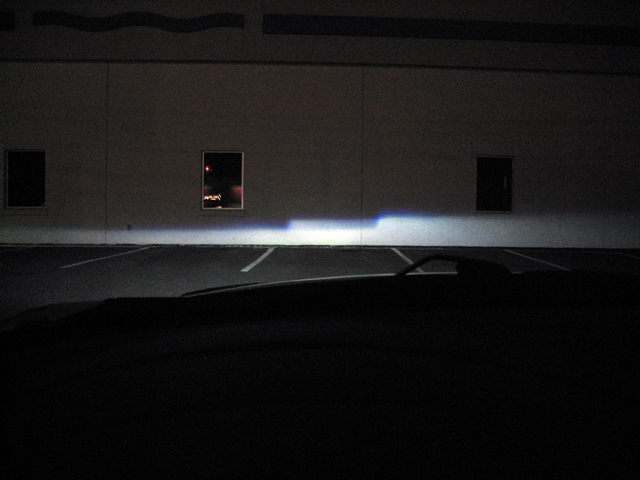
(My 2001 Formula with Hella 90mm H9 projector, modified cut-off, and 4300K HID kit.)
So back to what we are talking about....
We are recommending doing a retrofit where bi-xenon projectors are installed inside your stock reflector housings. That involves opening them up and mounting the bi-xenon projector inside and making a shroud to cover the left over gap around the projector. A FX projector should be a good fit. Depending on the size of your stock housings, a TL projector may fit.
Thread Starter
TECH Apprentice
Joined: Jul 2007
Posts: 325
Likes: 1
I don't mean to sound rude, but it sounds like you don't understand what we are talking about.
Here is a primer...
HID = High Intensity Discharge
Its a bulb and ballast assembly. Instead of a filament glowing in a glass tube (incandescent & halogen), HID is a arc of electricity at a high voltage in a glass tube.
Projector Housing
Its a light housing with a reflector "bowl" in the rear, cut-off shield in the middle, and curved glass focus in front. It produces a wide even light pattern with a sharp flat or stepped line with light below and little to no light above. Some projectors are halogen, some are HID.
Reflector Housing
Standard incandescent & Halogen housing with a reflector in the rear and either Clear or Fresnel or Parabolic glass in front. The cut-off and general pattern is not as well defined as a projector. There is no cut-off shield. The beam pattern is determined by the glass pattern and reflector shape. Almost all reflector housings are halogen or incandescent. Only a couple HID reflector setups were available from the OEMs.
Check out the Lighting FAQ for some more info on Headlight upgrades and projectors. HID Planet's Forums is also a great place for information.
You shouldn't install HID in the High Beam location because they can't be flashed quickly. You'd loose the ability to signal other drivers with the high beams. Vehicles that come from the factory with HID high beam have Bi-Xenon projectors. Its one projector housing for low beam and high beam with a movable cut-off shield. For the high beam, the cut-off shield rises to let more light upwards like a standard high beam pattern.
Here are some examples of bare projectors:
(Not my hand.)
Here is an example of a projector beam pattern:
(My 2001 Formula with Hella 90mm H9 projector, modified cut-off, and 4300K HID kit.)
Here is a primer...
HID = High Intensity Discharge
Its a bulb and ballast assembly. Instead of a filament glowing in a glass tube (incandescent & halogen), HID is a arc of electricity at a high voltage in a glass tube.
Projector Housing
Its a light housing with a reflector "bowl" in the rear, cut-off shield in the middle, and curved glass focus in front. It produces a wide even light pattern with a sharp flat or stepped line with light below and little to no light above. Some projectors are halogen, some are HID.
Reflector Housing
Standard incandescent & Halogen housing with a reflector in the rear and either Clear or Fresnel or Parabolic glass in front. The cut-off and general pattern is not as well defined as a projector. There is no cut-off shield. The beam pattern is determined by the glass pattern and reflector shape. Almost all reflector housings are halogen or incandescent. Only a couple HID reflector setups were available from the OEMs.
Check out the Lighting FAQ for some more info on Headlight upgrades and projectors. HID Planet's Forums is also a great place for information.
You shouldn't install HID in the High Beam location because they can't be flashed quickly. You'd loose the ability to signal other drivers with the high beams. Vehicles that come from the factory with HID high beam have Bi-Xenon projectors. Its one projector housing for low beam and high beam with a movable cut-off shield. For the high beam, the cut-off shield rises to let more light upwards like a standard high beam pattern.
Here are some examples of bare projectors:
(Not my hand.)
Here is an example of a projector beam pattern:
(My 2001 Formula with Hella 90mm H9 projector, modified cut-off, and 4300K HID kit.)
Copy & Paste Moderator
Joined: Apr 2002
Posts: 9,764
Likes: 208
From: Eastern MA
If you install bi-xenon projectors, you would still have high and low beams.
Copy & Paste Moderator
Joined: Apr 2002
Posts: 9,764
Likes: 208
From: Eastern MA
Here is an example of a projector retrofit:
Before:
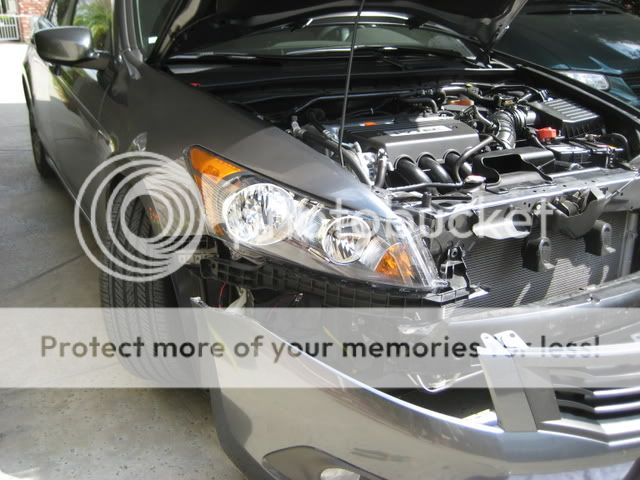
After:

http://www.hidplanet.com/forums/viewtopic.php?t=47878
In that example, he used a single-xenon projector since his stock housings use a separate high beam bulb. You will need a bi-xenon projector.
Before:
After:
http://www.hidplanet.com/forums/viewtopic.php?t=47878
In that example, he used a single-xenon projector since his stock housings use a separate high beam bulb. You will need a bi-xenon projector.
Thread Starter
TECH Apprentice
Joined: Jul 2007
Posts: 325
Likes: 1
Here is an example of a projector retrofit:
Before:
After:
http://www.hidplanet.com/forums/viewtopic.php?t=47878
In that example, he used a single-xenon projector since his stock housings use a separate high beam bulb. You will need a bi-xenon projector.
Before:
After:
http://www.hidplanet.com/forums/viewtopic.php?t=47878
In that example, he used a single-xenon projector since his stock housings use a separate high beam bulb. You will need a bi-xenon projector.

Copy & Paste Moderator
Joined: Apr 2002
Posts: 9,764
Likes: 208
From: Eastern MA
Yes. There will be some cutting and custom fabrication involved. If you are not comfortable doing this, there are people out there that perform retrofits. I don't know of any personally though.