Generation III Internal Engine - Rod Bolt Replacement Lesson if your thinking about doing this come in.....
quik95lt1
05-04-2012, 07:55 AM
Figured I'd share some machining infortmation of what replacing rod bolts can and cannot do. Theres been much controversy over the years espically on ths site pertaining to swapping out rod bolts in an engine and not resizing the journal ends. Many say its ok just do it and many say no take it apart and resize. A recent customer engine I took apart for a rebuild had ARP rod bolts put in it about a year ago and never had the rods resized. Below are the bearings from the engine.
Here is the rod cap and bearing.....as you can see there is a wear mark about .75" wide right on the bottom of the bearing.....you can clearly see the wear is fresh compared to the rest of the bearing......
http://i919.photobucket.com/albums/ad38/quik95lt1/ResizedImage951336098018793.jpg
Here is the bearing shell from the rod.....again notice the 1" wear mark at the bottom of the bearing again.....
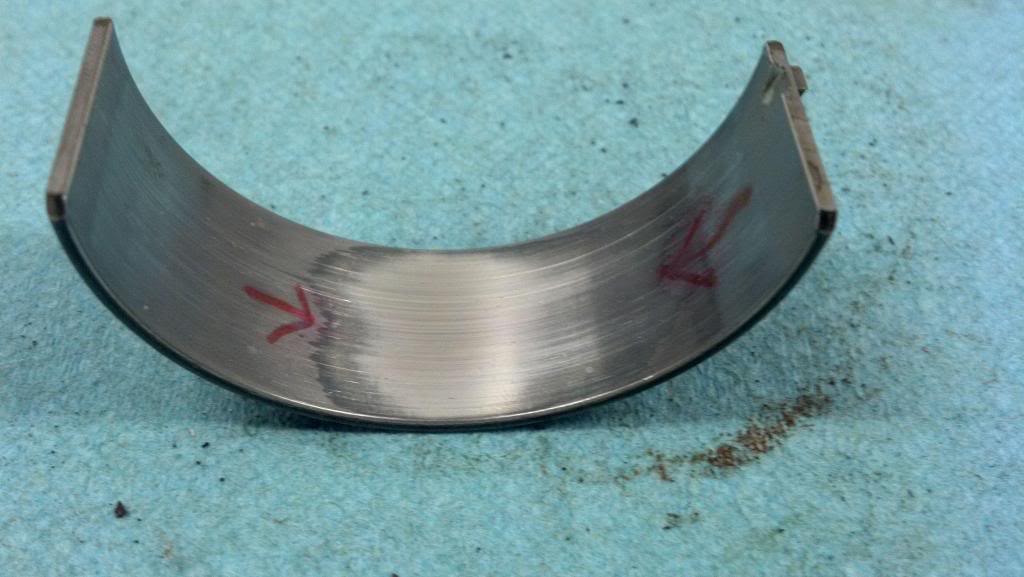
http://i919.photobucket.com/albums/ad38/quik95lt1/ResizedImage951336098035352.jpg
this was caused by the rods not being resized and the clamping force on the new bolts being different from the original GM bolts.......the arp 8740 bolts are supirior to the GM bolts in clamping force however the effect on the rod bearing is negated by the clamping force improvement. How this happens is the housing bore is distorted by the extra clamping force, it pulls down ths sides of the cap more which intern pushes the sides of the cap outward and pulls the top and bottom of the cap/rod inward. In essence "ovaling" the housing bore, had this motor been continued to be run and not taken apart failure wouldn't have been to far in the future. Hopefully this is some clear cut evidence for anyone replacing rod bolts and questioning whether to resize the rod ends. Basically, DON"T DO IT! When changing bolts if the clamping force is different the housings MUST be re-machined. This goes for rods and mains.
Hope this info is useful!!!
:D
Mike
Bramlok
05-04-2012, 08:15 AM
If you're not resizing, better off going with Katechs.
lemons12
05-04-2012, 08:23 AM
Katechs do not have to be re-sized, correct? Thats what I plan on going with in a couple weeks when I start putting everything together.
mark21742
05-04-2012, 08:33 AM
Katechs do not have to be re-sized, correct? Thats what I plan on going with in a couple weeks when I start putting everything together.
Correct...they are a direct replacement. Just stronger steel so they can be reused......if you go with the ARP bolts you need to have the rods resized because they actually grab better/different.
Good write up while95!
s346k
05-04-2012, 08:37 AM
katechs do not require rod resizing.
Jeremy@RPMTransmissions
05-04-2012, 08:37 AM
Im no machinest at all. I am asking because I have no idea.
Since the stock LS rods are cracked cap, how would you resize them?
quik95lt1
05-04-2012, 08:46 AM
Im no machinest at all. I am asking because I have no idea.
Since the stock LS rods are cracked cap, how would you resize them?
with the cracked cap rods yes you are right you cannot machine off the parting line and then rebore........the stock rod iirc can be bored .002 as is then a thicker bearing is used to make up the difference.....clevite makes bearings to make up the difference......at that point its usually cheaper to just put a set of scat i beams in and call it a day
ohioz
05-04-2012, 08:57 AM
It never made much sense to me how some one can say that if you replace the rod bolts with arp's you need to resize the rods. But if you use katech's bolts you do not. As the op says its the extra clamping force that distorts the big end of the rod. So you guys are trying to say that katech's bolts are stronger than stock, yet yield no extra clamping force? Not trying to be a ball buster, I've just wondered this for awhile. I've read countless threads on replacing rod bolts and everyone says you have to resize only with arp's and not katech's.
91sonomast
05-04-2012, 09:03 AM
I bought a set of rods with ARP bolts in them that have supposedly been resized. How do I check to make sure?
Tainted
05-04-2012, 09:11 AM
I bought a set of rods with ARP bolts in them that have supposedly been resized. How do I check to make sure?
Take one off and measure
Jeremy@RPMTransmissions
05-04-2012, 09:17 AM
with the cracked cap rods yes you are right you cannot machine off the parting line and then rebore........the stock rod iirc can be bored .002 as is then a thicker bearing is used to make up the difference.....clevite makes bearings to make up the difference......at that point its usually cheaper to just put a set of scat i beams in and call it a day
I gotcha. Boring the ID was the only was I could think about it work.
383camaroz28
05-04-2012, 09:23 AM
Thats my poor bearing lol
quik95lt1
05-04-2012, 09:33 AM
Thats my poor bearing lol
lol ill do a build thread for you mike when it goes back togheter.....
Good info. Have you measured the housing bore with the ARP bolts torqued?
quik95lt1
05-04-2012, 10:57 AM
Good info. Have you measured the housing bore with the ARP bolts torqued?
not on these rods but previously i have......i can pull one out of the trash can and check it when i go home though lol.......ill report back tomorrow with the #'s
Marc 85Z28
05-04-2012, 11:29 AM
There is controversy for good reason: because so many people have success with a basic rod bolt swap.
I swapped out my rod bolts for ARPs without resizing over 5 years and 30K miles ago. The engine sees 7K rpm EVERYTIME I drive it - lots of street abuse and dozens of track passes. I have no noise, good oil pressure, and no abnormal metals in my oil. And I'm not alone...
Your "conclusion" is flawed. You don't know the condition of the rod bearings before the bolts were changed.
SSdreamz
05-04-2012, 11:40 AM
good find and good info right here. I too have read countless threads pertaining to replacing the rod bolts (especially the 98's) cause of the inferior rod bolt. I was about to do this to my brothers engine when we did the oil pump, heads and cam swap.... glad we didnt
SSCamaro99_3
05-04-2012, 11:51 AM
It never made much sense to me how some one can say that if you replace the rod bolts with arp's you need to resize the rods. But if you use katech's bolts you do not. As the op says its the extra clamping force that distorts the big end of the rod. So you guys are trying to say that katech's bolts are stronger than stock, yet yield no extra clamping force? Not trying to be a ball buster, I've just wondered this for awhile. I've read countless threads on replacing rod bolts and everyone says you have to resize only with arp's and not katech's.

Katech is superior tensile strength comapred to stock with the same clamping force
ARP is superior tensile strength compared to stock with additional clamping force.
quik95lt1
05-04-2012, 12:19 PM
Your "conclusion" is flawed. You don't know the condition of the rod bearings before the bolts were changed.
my conclusion is not flawed, there is a much higher wear in the specific spot that would be affected by the bolts compared to the rest of the bearing which exhibited normal wear the only thing that would cause that type of bearing damage is an out of round housing.....and the rate at which it appeared to be wearing was not on par with the rest of the bearing.....find a GOOD performance machine shop and they will tell you the same thing......this is not the first time i have seen this......but it is the first time im sharing my find to try and save people some headaches............whether you chose to take the info or throw it out there is no sweat off of my back.......im merely stating a fact.......according to your theory then we can freely swap bolts in and out with no problem, interesting......do YOU have any data to back up your claims? any bearings or info from this engine you have other than the mileage you have on it and the wear that may or may not be on your bearings that you may be assuming? when it comes down to it can you take a chance on swapping bolts? of course.......will you have an issue.....maybe, maybe not.....but there are adverse affects to the change, me personally i work hard for my $$ and my reputation so id rather eer towards the side of caution :D
Katech is superior tensile strength comapred to stock with the same clamping force
If it has the same clamping force as an OEM bolt, what would be the advantage?
91sonomast
05-04-2012, 02:58 PM
You won't break the rod bolt and send a cap flying around inside the engine.
streetknight2
05-04-2012, 04:06 PM
I had my engine apart and put ARP bolts in. 2 of the 8 rods "ovaled" and needed to be resized, the other 6 mic'd fine. However, I had them all re sized so I can use the same bearings.
ALWAYS check, no matter what brand bolts you're using. It's just the right way to do it.
Thanks for the info OP
Marc 85Z28
05-04-2012, 07:34 PM
according to your theory then we can freely swap bolts in and out with no problem, interesting......do YOU have any data to back up your claims?
I didn't present any theory, or make a dedicated thread either, YOU DID. All I stated is that I, along with MANY others, have had no problems doing what you claim should never be done. If the ARP bolts cause the rod to distort with eventual bearing failure, it would show on every rod on every engine that they were installed in. Too bad theory and real life don't always align ;) Other factors are likely at play here if a 100% failure rate doesn't occur. Cheap or inaccurate torque wrenches, using 10mm socket instead of a 3/8", removing both bolts on one rod at the same time, etc etc.
And no, I don't have the bearings out of my engine so I can provide "data" to you! :lol: Why disassemble a good engine that was built properly?
You won't break the rod bolt and send a cap flying around inside the engine.
If you think of clamping force as a preload to oppose the forces trying to rip the bearing cap apart, then it makes sense that you would first want to increase clamping load as those forces increase (ie increasing RPM, bobweight, etc). Not enough clamping load can allow the rod bolt to stretch, ovaling the bearing bore, and if you don't spin the bearing first, you then cause a fatigue failure of the bolt itself.
So I don't think preventing a rod bolt failure is an accurate answer.
If the ARP bolts cause the rod to distort with eventual bearing failure, it would show on every rod on every engine that they were installed in. Too bad theory and real life don't always align ;) Other factors are likely at play here if a 100% failure rate doesn't occur. Cheap or inaccurate torque wrenches, using 10mm socket instead of a 3/8", removing both bolts on one rod at the same time, etc etc.
In my opinion, ARP rod bolts absolutely will distort the bearing bore in every application, but with manufacturing tolerances typical of mass produced products, the consequences vary. I saw .0005" variance putting ARP bolts in a set of LS3 rods. That's .0005" more/less bearing crush or .0005" more/less bearing clearance and that was the beefier generation of rods.
Bearing clearances in OEM engines vary greatly, some have as little as .0009"!!! In an instance like that, where bearing clearance is tight, and the ARP's make the bearing clearance tighter, then you WILL have issues like we see here. If the bearing clearances are looser, the engine may survive.
Again, just a theory...
s346k
05-04-2012, 08:19 PM
i have had a hand in multiple katech swaps on stock shorts varying in mileage from 50k to fresh rebuilds. none of those blew up from rod bearing failure...in fact, none of them blew up at all. for whatever reason, the katech bolts seem to work just fine without resizing rods. i don't really see the advantage to an arp bolt unless the big ends already needed resized to begin with. even at that point they are overkill for 99% of the engines. i've seen stock bottom cars that stretched rods with stock bolts in them. year indiscriminant.
noskcaj
05-04-2012, 09:00 PM
All these threads make me nervous, haha.
I have LS1 rods that have the basic ARP rod bolts installed. I brought them to a decent machine shop that specializes in ls1's near me and he said they are all within 0.0003 OoR, which is within spec. I don't have a way to measure a bore that accurately in my garage, so I trust his blessing, but still makes me nervous. Rods only have about 3k on them if that makes a difference.
I guess I'll keep my rod clearances on the looser side with the new bearings.....
ohioz
05-04-2012, 09:23 PM
Katech is superior tensile strength comapred to stock with the same clamping force
ARP is superior tensile strength compared to stock with additional clamping force.
That makes no sense...How are both bolts stronger yet only one increases clamping force? Because Katech says so? Im not trying to be bias, i just wanted to know if I was the only one that thought this. Oh btw I have had arps in my car for over two years making 580 wheel through a turbo400:burn:
anyone else have that stinkin' Family Dollar ad blocking their view of this thread?
Anyway, I changed over to ARP's, without resizing. Many people here haven't resized, and claim that everything is fine with their engines.
My engine had a couple of complete bearing failures, combined with an ongoing oil pressure issue.
After tear-down, there was more than one issue which could have contributed to the failures. I'll never know for sure.
One thing I have learned....when the directions call for resizing, or any other protocol, do it!
While putting the engine back together, I followed directions, to the letter.
BTW, I'm now using the upgraded LS6 OEM rod bolts.
badazz81z28
05-04-2012, 09:49 PM
That makes no sense...How are both bolts stronger yet only one increases clamping force? Because Katech says so? Im not trying to be bias, i just wanted to know if I was the only one that thought this. Oh btw I have had arps in my car for over two years making 580 wheel through a turbo400:burn:
I'm curious about that too! Apparently Katech knows something that ARP and others don't.
Maybe Katech is really just a stock bolt :secret:
BrntWS6
05-04-2012, 10:28 PM
Are the torque specs differens on the ARP vs Katech?
studderin
05-04-2012, 10:39 PM
Bearing clearances in OEM engines vary greatly, some have as little as .0009"!!! In an instance like that, where bearing clearance is tight, and the ARP's make the bearing clearance tighter, then you WILL have issues like we see here. If the bearing clearances are looser, the engine may survive.
Again, just a theory...
ya, I think the GM stock LS1 rod clearance is .0009 to .00027 or something people think is really tight. They run fine with that. How many people know of a failure form the stock rod bolt? Stock engines don't have rod bolt problem, its oiling issues, tuning, and unstable valve trains that take them out.
FYI the GM endurance test on a stock LS3 is under load varying 8,000 rpm for 23 hours
quik95lt1
05-04-2012, 11:47 PM
glad i could help out those that know what i was presenting here :) for the ones that disagree......hey no sweat off my back :D
quik95lt1
05-04-2012, 11:50 PM
In my opinion, ARP rod bolts absolutely will distort the bearing bore in every application, but with manufacturing tolerances typical of mass produced products, the consequences vary. I saw .0005" variance putting ARP bolts in a set of LS3 rods. That's .0005" more/less bearing crush or .0005" more/less bearing clearance and that was the beefier generation of rods.
Bearing clearances in OEM engines vary greatly, some have as little as .0009"!!! In an instance like that, where bearing clearance is tight, and the ARP's make the bearing clearance tighter, then you WILL have issues like we see here. If the bearing clearances are looser, the engine may survive.
Again, just a theory...
glad to see someone that understands what actually happened here.....do all motors do it? no.......do some? yes.......this was one of the "some"......i treat every engine like a 9000rpm race engine regardless of street intentions or race intentions.....keeping the attention to detail is what builds good engines......and this is something that is a detail.....again personal preference if you call it....opinion if you may.....or fact.....take it how you may :D
:usa:
if you go visit a good machine shop with a good racing background they will agree with what i am saying......will all "big" machine shops agree.....no........but many experienced in the racing area will........the shop that does my boring and balancing regularly machines and builds 2000+hp tractor pull motors as well as top fuel motors.......he agrees with me on this topic 100% and will not install rod bolts in a motor without sizing the housing bores.....i wonder why? :D
anyways...........i resign from this thread.......have no need or want to argue or try and defend something that i know is right in the first place........no hard feelings..... :cheers:
:D
bww3588
05-05-2012, 02:08 AM
In my experience, I installed arp bolts without resizeing 4 years ago when everyone on here did it...after 1k miles I had oil pressure problems, so I tore it apart and found the rods averaging .003 o-O-r and every bearing trashed...brand new bearings at that.
In katech's defense, I am under the understanding they use alignment dowls that prevent the cap from shifting under a higher clamp force.
Does this mean a hill of shit to me? No. I would never use katech bolts to avoid resizing...the initial cost is stupid and there is still the "what if" factor.
I couldn't care less how many people have done it and got away with it...it's still not smart esp when you consider the money invested in an engine build.
RezinTexas
05-05-2012, 06:24 AM
Katech is superior tensile strength comapred to stock with the same clamping force
if its the same clamping force, there would be absolutely no advantage to using Katech. It means that rod-cap flange face separation would happen at the same load point as the OEM bolts, resulting in failure.
The Alchemist
05-05-2012, 07:03 AM
I'm having a forged shortblock built right now, and with new rods, new bearings, new arp 2000's, my machinist measured rod bolt stretch, then resized the rods to make sure the bearings would be perfect. Is it overkill, maybe, but it's either worth doing right, or not doing it at all.
Can you toss in some different rod bolts, sure, you will eliminate rod bolt failure, but you may induce rod bearing failure. It might buy you some more time, and reduce the overall damage done, but it's still bandaiding a problem.
Just my opinion.
speedtigger
05-05-2012, 08:58 AM
I see some folks use the argumement: I got away with it, so it must be right. Or: I knew a guy who did that and it was fine.
That is just not definitive. There is no test period and there is no tear down for inspection to verify wear differences.
I will say, that I am also influenced by real world results of others in my choices too, but I try not to be prejudice on the information presented based on what I want to be true. With that said, you will notice that in every rod bolt thread there are some who have had no problem and others that have had failures. If you just look at those reports from the community, you will come to the conclusion that swapping the bolts without resizing is likely a poor procedure and comes with risk.
This conversation reminds me of somthing a CFO I used to work with said: Just because you made it to the grocery store alive without wearing your seat belt does not mean seat belts are unneccessary.............
wytry
05-05-2012, 09:53 AM
I don't want to hi-jack, but I have a question pertaining to rod bolts, and there are several people here that know what they're talking about.
I have an '02/'03 LS6 shortblock that I'm swapping in for my '98 LS1. Does anyone know if the rod bolts used in the LS6's are any stronger than previous year LS1's? I would prefer to not even touch the shortblock unless absolutely necessary. It'll be appx. a 450hp heads/cam car and see 6500-6700 occasionally.
Allen
Che70velle
05-05-2012, 11:42 AM
OK, I can't resist...you can take ANY connecting rod that has been previously torqued to SPEC, loosen the rod bolt, RE-TIGHTEN the SAME fastener too far, meaning OVER TORQUEING, or OVER STRETCHING the fastener, and you WILL have a rod that is out of round. It does not matter what fastener. Stock, arp, katech, diamond, pro-comp, etc, etc.
This is not a bolt manufacturer issue, this is a installation issue. Got an ald rod lying around? Try it yourself. I didn't believe it until I tried it myself, 20 years ago.
I have an '02/'03 LS6 shortblock that I'm swapping in for my '98 LS1. Does anyone know if the rod bolts used in the LS6's are any stronger than previous year LS1's?
Allen
The newer OEM LS6/LS1 rod bolts (11610158) are stronger than the 98/99 LS1 bolts.
That's why I switched.
If ARP rod bolts are used, will they reshape the rod, permanently?
Or, when the ARP's are removed, does the rod shape restore itself to 'normal'?
Che70velle
05-05-2012, 12:05 PM
Once the rod goes out of round, it must be re-machined.
The Alchemist
05-05-2012, 12:37 PM
Che70velle, my machinist said the said thing. That's why he measured rod bolts with a stretch gauge rather than a torque wrench, it yeilds far greater accuracy, his words, not mine. Hence why he torque mine down, measured stretch, then measured the rod journal and sized as needed. He also said any bolt clamping down on a bearing is a critical measurement. Changing those loads, means changing how oil moves through the motor, and change that and bad things are bound to happen.
livewire0201
05-06-2012, 12:21 AM
Does anyone know the yield stress or modulus of elasticity of either Arp Katech or GM bolts? Torque values of either? Material properties of stock GM rods? I understand rod distortion, but if all bolts are torqued to same clamping force.. it would provide that each rod should be equally distorted (+-) some statistics on material properties.
http://i6.photobucket.com/albums/y203/livewire0201/220px-Stress_v_strain_A36_2svg.png
livewire0201
05-06-2012, 12:43 AM
http://arp-bolts.com/pages/technical.shtml
Katech's material properties: http://www.matweb.com/search/DataSheet.aspx?MatGUID=2285b7f0dd2f440abc57dea6845 8bb22&ckck=1
Are Katechs effective diameter (root or shank) smaller than ARP's? Essentially reducing clamping force, negating distortion of the rod, and still yielding (stretching to .006) the bolt?
95ONE
05-06-2012, 07:36 PM
ARP is superior tensile strength compared to stock with additional clamping force.
I would say that when I tested my ARP bolts, the results would prove you wrong, but I have no idea what part number you are comparing this to, so I cannot state you are either right or wrong. BUT, if you are talking about ARP complete hi perf 8740 kit number 134-6006, this statement is completely false from my over redundant first hand testing of these rod bolts and my stock LS6 rods. using stretch and torquing methods and certified measuring equipment. The funniest part of my whole argument is the you SHOULDN"T beleive ME! I am not certified to do any of this and was not involved in some sort of official double blind testing program. You need to get all the information you can on your own and question EVERYTHING.
In my opinion, ARP rod bolts absolutely will distort the bearing bore in every application, but with manufacturing tolerances typical of mass produced products, the consequences vary.
Again, just a theory...
I'm pretty sure most can over torque the stock bolts and get the same results. Do you have a way of knowing for sure? - my point is to not blame ARP right away. Im' not even sure he is talking about an 3rd gen LS1. He said he was some sort of a machinist and we can't assume this is any certain type of motor. Granted, it most likely is an LS1 motor and rod, but I am exampling how you HAVE to ask all the questions and you HAVE to have them all answered before coming to any conclusion.
I tested every one of mine. I tested, checked, retested, remeasured, and re-torqued and re-measured. Exactly the same in every way, clamping force and roundness. The ARP bolts did not put ANY more clamping force than the stock bolt. They aren't meant to. They are meant to retain strength and not fatigue like the stock one's. Like I said, not meant for more clamping force. - which explains any lack of ovaling or distorting. They're just meant to be stronger when higher revs try to pull it apart and not stretch. There is a difference. Keep in mind I am only talking about the ARP complete hi perf 8740 kit number 134-6006 NO other kit. There are 3 kits that will "fit" in the Stock cracked cap. The one I mentioned was meant for stock rod duty. 134-6006
my conclusion is not flawed, there is a much higher wear in the specific spot that would be affected by the bolts compared to the rest of the bearing which exhibited normal wear the only thing that would cause that type of bearing damage is an out of round housing.....and the rate at which it appeared to be wearing was not on par with the rest of the bearing.....find a GOOD performance machine shop and they will tell you the same thing......this is not the first time i have seen this......but it is the first time im sharing my find to try and save people some headaches............whether you chose to take the info or throw it out there is no sweat off of my back.......im merely stating a fact.......according to your theory then we can freely swap bolts in and out with no problem, interesting......do YOU have any data to back up your claims?
How is this conclusion not flawed? Just because, "that type of bearing damage is an out of round housing." will be said by reputable people still does not place blame on the ARP bolts. Do you know every bit of history with these rods and bearings? Did YOU install them and measure them before and after using the ARP? If so, then we have more validity, but you did not mention this in your original Post. If YOU did indeed do all this measuring and installing before running in the motor, are you sure you followed proper torque procedures? The answer is a definite no. Otherwise you would have caught any out of round you claim the ARP did cause and are at fault. So it is safe to say, you definitely don't know the full story of the motor before you pulled it apart and therefore cannot make ANY claim as to who or what is to blame, including oiling issues or whatever the hell else could have gone wrong in conjunction with distortion. Were the bearings changed once already before you got to them? Were those bearings the proper size? Too many variables to use this as a great example. Once again, if you do know the full history, which I've proven you don't first hand, you need to include all data before making such a huge blanket statement placing blame. In this case you don't, and you truly have no business posting this blame.
^In agreement, I would think that, all things being equal...torque values/resulting clamping force, that all of the rods would be distorted, equally, and that every bearing should have the same wear pattern.
Yes? No?
bww3588
05-07-2012, 02:08 AM
Not exactly. Given the variances in machining of a mass produced product, a simple change in rod bolts could put the bearing in proper crush on a rod with a greater clearance, and distort the one next to it with lesser clearance...
I can only speak from experience, as have others in this thread. With stock rods, it seems hit or miss and the only thing a can pin it to is mass production.
Maybe someone should test a set of aftermarket rods between 8740's and 2000's and try to either prove or disprove this. But even then, mass production would play a part as well...albeit smaller because of the fact less are produced, it will still play some part.
bww3588
05-07-2012, 02:11 AM
Either that or resize a set of stock rods to factory o-O-r specs using new stock bolts, then install arp bolts and totall remove mass production errors.
quik95lt1
05-07-2012, 07:26 AM
to validate claims i have "no buisness" making............yes every single rod in the motor was worn EXACTLY the same on both TOP and BOTTOM......so what you are telling me is the person that installed the bolts before me somehow over torqued every one of them exactly the same......ok i can buy that........ yet when i measured the bolt coming out with my stretch gauge it returned excatly the amount it should have for that particular bolt, this unvalidates that overtorquing claim.....i am not "blaming" arp at all.....ARP makes a fantastic product and i will continue to run them for years to come.......i do blame improper procedure upon installing the rod bolts.....the housing went out of round and it should have been corrected........that is it........stock gm rods with stock bolts ive seen almost .0013 out of round before.....take an issue like that with a tight stock clearance and then add the rod bolt issue and you run into a problem..........as previously stated will ALL do this, no they will not, but will some do this if you have other issues working against you, YES.......personally i would not take the chance......
for the LS1 tech crowd and experienced people that have been here and understand what happend here im glad i could show it.........and i hope you can distinguish from real world experience and correct infortmation in this thread vs. incorrect infortmation i have read in some posts over the past couple pages.......
again.....i resign
(for real this time :lol:)
:D
bww3588
05-07-2012, 07:48 AM
Well said. ^^^
Thanks for the explanations.
This sheds some light on the destruction on my #7 rod bearing, & trashing of the crank.
Upon engine reassembly, I have a .0007 (or so) clearance on #7. Although plastigauge was used at four 90deg points in the rod, the clearances were the same. So, although the hole seems to be round, it is definitely on the small side. I went to an 'x' bearing to compensate.
SIG-054
05-07-2012, 09:25 AM
I replaced the rod bolts in my old 99' LS1 with the ARP High perf bolts, one at a time to 40nm, and never had an issue with that engine. Ive jut done the same with my 03' LS1 but i havent run it yet. I bet it will be fine.
Heaps down here in AUS have done the one at a time method with success.
But this thread certainly is an interesting read.
SSCamaro99_3
05-07-2012, 12:24 PM
Apparently, I was extremely wrong in my assessment. I was just going off of observations from past conversations. I am not a metallurgist, do not want anybody making decisions on what I said (despite having a few thought on why it may work out), and so I will bow out.
ScottyBG
05-07-2012, 01:03 PM
Thanks quik95lt1, these are the types of posts I find very educational. You explained it well, with nice photos. I had considered doing the rod bolt swap in the car at one time, using the Katech bolts, because I had seen many others doing it. I was at least smart enough to ask the question of a couple professional race engine builders. They told me I was far better off leaving it alone with an inferior factory bolt in there than trying to swap the bolts to a better bolt without resizing the rods. They said it would cause an oor problem and could wear the bearings our rapidly, if the oor condition was significant enough. One told me that he wouldn't even bother swapping out the stock bolt unless I was considering exceeding 7K rpm, he said better ones wouldn't hurt if I were resizing, but were really somewhat overkill. He said that the rod bolts are not as fragile as the internet claims, there are several other limitations that you will have failures at before the rod bolts.
Your post here just demonstrates what other respected builders had told me, but you were able to explain it better with photos. Very constructive thread. I think the nay sayers were constructive too, in vetting your data. Although some have had good "luck" with it, they have not been able to put together any real solid reason to support changing the rod bolts, without a proper resize.
Thanks dude!
quik95lt1
05-07-2012, 01:14 PM
:usa:
and just to validate what you said about the rod bolts i completely agree........there are far weaker spots in a stock shortblock than the bolts......ive seen two stock bottom end ls1's come in that ive rebuilt with bent rods.....the top bearing shell had signs of detonation and the bottom were fine but the rods had an s bend in them......one was a naturally aspirated motor that saw 7000rpm and detonated to bend the rod......with stock rod bolts.....that motor would've ran much longer if it werent for the poor tune..........the second was a turbo application that made over 500 at the wheel through a 200r4.....same deal stock bolts with a bent rod.......again detonation.......not saying they dont break bolts but the overwhelming majority of broken ones ive seen come through are all due to detonation, broken ring landings, shrunken pistons, bent rods, spun bearings from detonation beatings and oiling issues........hell i had a close friend of mine that literally broke a rod in half....yet the cap was still bolted on the crank and was slinging around smashing the block to bits.......whole motor was junk but when i pulled the pan and saw that i was impressed lol
95ONE
05-07-2012, 01:21 PM
yet when i measured the bolt coming out with my stretch gauge it returned excatly the amount it should have for that particular bolt, this unvalidates that overtorquing claim.....
:D
I would love to learn something from anyone. But posting this as fact is hurting the people reading this, not helping them. It does not invalidate the over torque claim. Just because it wasn't stretched beyond permanent distortion does not prove that it wasn't over torqued for the spec on this rod. I'm damn sure these bolts can go higher torque (also read in stretch) before they don't return to their original length. So yes, they could be over torqued FOR THE ROD SPECS and return to their original length. .. .. .. .. In that same breathe, there are indeed rods that will distort even at spec, - no matter what bolt you put in there. - including Katech's, so yes always measure.
That said, the remainder of what you said in the quote is indeed something for everyone to consider.
quik95lt1
05-07-2012, 01:27 PM
I would love to learn something from anyone. But posting this as fact is making readers dumber, not smarter. It does not invalidate the over torque claim. Just because it wasn't stretched beyond permanent distortion does not prove that it wasn't over torqued for the spec on this rod. I'm damn sure these bolts can go higher torque (also read in stretch) before they don't return to their original length. So yes, they could be over torqued FOR THE ROD SPECS and return to their original length. .. .. .. ..
so if the bolt was supose to have a stretch of .0048-.0051 and i measure the bolt on the rod then loosen it and it shortens up .0049 then it could still have be over torqued???? at that point the torque has ZERO to due with the number i measured......stretch is the measurement of the vertical pressure on the bolt not the rotational...this leaves out all the variables....oil, moly lube, dry....regardless.......stretch will always tell the story...on my motor i run oliver rods with arp/wsb bolts.....all of my bolts vary between 90-98ftlbs they are all different yet my stretch is all .0053 on every bolt........torque has nothing to do with it its just a measurment of the rotational force it took to achieve the desired about of vertical pressure on the bolt........which also has alot to do with friction on the threads and head of the bolt against the rod surface as well as the lube used
that makes about as much sense as a screen door on a submarine im sorry lol
95ONE
05-07-2012, 01:27 PM
Although some have had good "luck" with it, they have not been able to put together any real solid reason to support changing the rod bolts, without a proper resize.
Thanks dude!
Except that I did just that. ..
quik95lt1
05-07-2012, 01:30 PM
Except that I did just that. ..
where? :lol:
bww3588
05-07-2012, 03:41 PM
^^^ agreed. 95one, I don't see your engine taken apart and any proof that you don't have problems. My. Guess is you do, they just haven't come out of hiding yet.
where? :lol:
quik55, I thought you 'retired'!;)
95ONE
05-07-2012, 04:57 PM
where? :lol:
^^^ agreed. 95one, I don't see your engine taken apart and any proof that you don't have problems. My. Guess is you do, they just haven't come out of hiding yet.
What I DID do was measure rod end bore before with stock rod bolts and after with ARP, as this is what quik95lt1 is saying is changing and going out of round after installing the ARP rod bolts, and must be re-bored. Not that they are a bad product. An important detail he did not mention is the specific ARP part number. I haven't asked if he truly knows. I mentioned what part number I am describing a few post before this one. Not the wavelocs or the 2000 series. I also called an engineer at ARP and spoke at length with him for about 20 minutes. I grilled him harder than I am you now. I measured with a very expensive dial bore and calipers. And some cheap ones I use all the time for reference. Every 45 degrees in addition to just above and below the cracked seam. Nothing in the rod had changed. exactly the same. - in thousanths. Ten thousands did change very little, but it also changed when I put the stock bolts back in (vs stock bolts on the original control test) for comparison one more time. SO, its going to change that far away from the decimal point no matter what. It was within the same hour, so temps and humidity didn't really have an effect on that number.. And trust me, temp and humidity from one day to another will swing measurements far and wide. (EDIT: relatively when your talking thousands and ten thousands - Specially when you measure on a Houston summer day then measure on one that is freezing in a shop.) I too was concerned as much or more as everyone reading this. I may have a little spare change, and I mean a little, but not enough to throw it all out the window for some $100 rod bolts. I needed to be as sure as I could.
And yes. You're right, as far as real world data I cannot say that they will break otherwise. Now you and the original poster can man up and say you cannot argue otherwise also due to not having every bit of first hand knowledge of the motor and history, and how they were torqued, stretched, installed, warped before or after, wrong size bearings, aftermarket crank with a fillet side that the bearing were put in facing the bevel the wrong way, or with no bevel at all not meant for that kind of crank, over revving, detonation, the wrong ARP bolts, which part number of ARP? etc.etc.etc. Even if many of those don't apply here, it's what everyone HAS to ask first before coming to any conclusion. So many different things are at play that it has to be very hard to deny their possibilities after reading the list I just wrote. - you obviously were able to rule out 1 or 2 from sight, but you didn't offer any information that you did, so I covered it.
I also know that this sounds very angry. I am not. Truly, I am not. Frustrated at how quick people are ready to jump on the blame train without doing any research or asking questions first? Yes. I also want you to know I appreciate anyone who tries to share and help their peers. I appreciate the effort. It helps to understand that I have seen / been through many rodeos, just with different scenarios. More than a few times. I like it when people have answers. But jumping to accusations without having all the facts - AND proving most or all other possibilities wrong, leads to either dangerous situations, or one where everyone loses. This topic happens to be a milder possible lose. PROVE me wrong, don't just state it. I don't mind being wrong, but show me the facts and rule out all other possibilities first. - Furthermore, if my bearings do fail from obvious rod bolt failure, or somehow the rods became out of round, I will post it immediately.
butler
05-07-2012, 05:12 PM
So if temp and humidity change clearances a lot then how the hell do all these gas engines exist and not blow up? I just did the katech rod thing. A friend of mine did it to his cam only camaro and spun it to 7500 everytime he went down the track. It ran a best of 10.38. No issues whatsoever.
s346k
05-07-2012, 05:50 PM
we put katech bolts in my buddy's stock short. it now has 30k miles on it after the swap. cam only a4 car on a 150 hit. full weight going 130. katech ftw. he is only spinning 6900 i believe, but i do know his n2o is on an on/off toggle switch spraying through the shifts. also another friend of mine had a h/c/i car we swapped a set of katechs into. he shifted @ 7200 on a stock 2000 short that had 45k miles on it. this was maybe 3 years ago. i couldn't tell you how many miles, passes, and pulls he has on that engine. it trapped mid 120s in a full weight, caged t56 3rd gen.
i think it is obvious. arp bolts require rod resizing and the katech bolts do not. to the OP: perhaps you should include this in your "research"..
gregrob
05-07-2012, 06:39 PM
if its the same clamping force, there would be absolutely no advantage to using Katech. It means that rod-cap flange face separation would happen at the same load point as the OEM bolts, resulting in failure.
Not true at all... one needs to know A LOT more about how fasteners work before making that kind of assertion...
A superior fastener can be torqued to the exact same amount but have a much greater ability to withstand the tensile loads seen inside an engine..
bww3588
05-07-2012, 08:24 PM
95one, nobody is going to "man up" and admit anything to you. There are just as many people, including myself that have had the rods go out of round as there are people who haven't.
You haven't proven or disproved anything. Sorry. Try again.
Ah, Mars & Uranus at work! :judge:
95ONE
05-07-2012, 10:51 PM
Well, I guess we are all allowed our opinions. We have stated them.
Ah, Mars & Uranus at work! :judge:
Just wanted to clarify...Mars/Uranus is an astrological aspect which represents this>>>:engarde:
It was meant as humor.
In re-reading this thread, the missing 'ingredients', which will account for the varying results, have not been identified.
While one contributor has experienced out-of-round rods, another has not (and, neither did I).
So, for me, the only point here would be to verify rod dimensions.
Maybe that's what each contributor is saying.
I appreciate all of the input, here, and read this all with great interest.
bww3588
05-08-2012, 12:05 AM
Agree to disagree. I'll continue to resize to remove all doubt.
quik95lt1
05-08-2012, 07:35 AM
quik55, I thought you 'retired'!;)
i thought i did too haha........but some of the posts in here brought me back a couple times......i feel like bret farvre lol.......
95ONE
05-08-2012, 01:31 PM
One thing I do know, is that almost everyone I get in heated debates about on a forum, I have the best fun with in person. There are many things my best friends and I don't agree on much like topics like this. But it all works out in the daylight. I think it's because we have a passion for common interest. I'm sure when we hear our motors start up for the first time, no matter what method is used, we all smile. In the end, through all this detail and debate, the fun has to start sometime. After some sleep, I thought I should add that.
Have fun out there.
bww3588
05-08-2012, 03:53 PM
:cheers:
RezinTexas
05-08-2012, 04:33 PM
A superior fastener can be torqued to the exact same amount but have a much greater ability to withstand the tensile loads seen inside an engine..
can you elaborate? thanks!
Snkebait95
08-04-2012, 04:06 PM
I remember this thread when i was installing my arp rod bolts. Just telling my experience so hopefully it will help someone else. I installed my arp rod bolts in a stock 5.3l shortblock one at a time, and torqued them to a spec. It ran for 450 miles before throwing a rod during a pull street tuning. I assembled it before doing enough research. I didnt know of the brass insert in the 5.3ls you have to remove for arps. Im 19 and never went to school to learn about cars. I didnt even know of bearing clearances. Good thing i only had $450 in the shortblock plus head gaskets and bolts. Apparently the rod fails before the stock bolts fail correct?
Fbodyjunkie06
08-04-2012, 06:10 PM
I'm glad I have Katech rod bolts!
blacktransam
08-04-2012, 07:09 PM
went 60k miles on arp rod bolts not resized, reved over 7k daily.
It's all in how the bolts are installed, torqued? tightened by stretch? calibrated torque wrench?
The last one kills me, how many people know your torque wrench has to be re-calibrated every 50 fasteners?
bww3588
08-04-2012, 07:23 PM
It is about how they are installed. Either correctly or incorrectly. There is no in between. From what I have seen, if you install arp bolts without checking/resizing, your playing with fire. Some get lucky, some don't. Why risk it? If you don't want to tear your engine down to have the rods checked, sack up and buy the katech bolts or leave them alone.
RezinTexas
08-05-2012, 02:32 AM
A superior fastener can be torqued to the exact same amount but have a much greater ability to withstand the tensile loads seen inside an engine..
superior in what way?
quik67
08-05-2012, 09:19 AM
Ok, after reading this very interesting thread my question is, are the factory rod bolts really too weak for a performance build, say 600 rwhp?
What about the later factory "floating pin " rods? I had a set of ARP bolts in my 02' 5.3 and actually show no signs of distortion. They look perfect.
But I don't want to be the one that got lucky, and would rather just use the factory bolts. This is in a 08' LH6 .
nikon1999
08-05-2012, 10:04 AM
....and all this is why I left my stock rod bolts, they've survived this long. lol
ZQ8LS1
08-05-2012, 12:21 PM
My 2 cents...
I rebuilt a L33 eariler this year for a install into a 2003 S10 & already rebuilding my bottom end & using ARP rod bolts & not resizing the rods & then reading this thread had me worried & second guessing my build.
2,500 miles later the motor is running just fine with 60 lbs of oil pressure all day long & no worries about rods flying out the side of the motor.:drive:
Fbodyjunkie06
08-05-2012, 04:46 PM
Just buy the Katech's and have the piece of mind that comes with knowing you won't have a problem when it comes down to really leaning on your motor.
speedtigger
08-05-2012, 05:13 PM
Ok, after reading this very interesting thread my question is, are the factory rod bolts really too weak for a performance build, say 600 rwhp?
What about the later factory "floating pin " rods? I had a set of ARP bolts in my 02' 5.3 and actually show no signs of distortion. They look perfect.
But I don't want to be the one that got lucky, and would rather just use the factory bolts. This is in a 08' LH6 .
RPM is typically the concern with rod bolts more so than HP. I think most people feel that when you are consistently near or over 7000 RPM, stronger rod bolts are a smart upgrade.
chrisfrost
08-06-2012, 12:52 AM
I would like to add an important fact at least in my opinion : So many poeple changing rod bolts to ARP's and Katechs and just about as many torque methods/values as well so I would say probably many of the guys that are changing stock 4 ARP's are not installing them properly and end up with an unstrechted rod bolt or less stretch than ARP recommends . I mean if everyone used a stretch gauge and installed them using the correct stretch method I would imagine at least 99% of those rods would be out of round ,,,,,,needing honing .002" . And Federal Mogul makes LS gen 3/4 rod bearings that are /002" larger outer diameter in standard and all undersizes in at least a cpl styles ,,,,,stock , racing .....etc
brucer
08-07-2012, 04:38 PM
looks like cap distortion from rpms to me..
badazz81z28
08-07-2012, 08:26 PM
I havent found any failures with stock rods bolts....I think Katechs are snake oil...
ShredSled
11-25-2012, 11:39 AM
interesting thread.
I have never dealt first hand with the ARP rod bolts, but have had great experiences with the katechs so far...
I'm now personally wondering just a bit why exactly the katechs don't in fact need resizing, though?
Also, is it true the ARP's are heavier than stock/katech? If so, how much does this alter the engine balance?
wildcamaro
11-25-2012, 04:03 PM
This debate will go on forever lol...I got stock 80k mile 98 rod bolts and have been beating their ass for ten years now...
td1168
11-25-2012, 04:28 PM
I just replaced my stock rod bolts with arp8740 rod bolts. I check the rods with a dial bore gauge before and after replacing the bolts. The arp's do distort the rod bores. I'm resizing the rods to .002" oversize and using the proper clevite bearings. Replacing rod bolts in a car is a crap shoot! You should ALWAYS check the bores when replacing the rod bolts. As far as the Katech's go I would have to experience the non distortion to believe it. For now I call bullshit on the arp's doing it and the katech's not. As was said, it's the increased clamping force that does it and not the metallurgical make up of the rod bolts. I think we've all seen where "Joe the backyard mechanic" put his engine together half-assed and runs the hell out of it without incident. It does happen. Replacing the bolts and checking the bore sizes is the only right way to do it! PERIOD!
Mikko
04-09-2013, 12:12 AM
Damn, seems that i started changing bearings and bolts without proper investigation...
Iīm currently adding a supercharger to my 2gen race Camaro with stock (cammed) LS3 and thought bolts and new bearings would be smart insurance, but seems that this will just cause sleeples nights...
Have arp 2000 bolts (234-6301) ja ACL bearings and those were going into place. 1-2 bearing in place and caps torqued :mad:
Engine is in engine stand but just oilpan off, and iīll have no needed parts to dismantle it completely and do rods resizing. And thereīs no way that i could get those needed parts here (Finland) in time, racing season is starting...
So what seems to be best option in this point,
-Check possible disortion with ARP:s with plastigauge, if it stays in reasonable limits, Ok.
-If disortion, try again with stock bolts (which seemed btw. be 12.9 bolts in LS3) and re-use them.
-If permanent disortion...? Dunno
...what i would otherwise personally thought at this topic.
I disortion is small, and clearances bigger than from factory, dont think that small disortion will effect noticibly with NEW bearings. Would thought that those will break-in to that shape?
With old bearings that have allreydy been setting in place, and then shape changes, well that may be different thing...
EDIT:
Ok, bearings and bolts changed and checked with plastigauge, i didnīt suspect noticible disortion. And if didnīt notice any, donīt cause me sleeples nights with ACL bearings and 0.002 clearance :-) With OEM bearings and clearances it offcourse is more critical also.
Alltough have to say... Early LS bolts are torqued 15lbft+60 degrees, late LS bolts 15lbft + 75degrees. But LS3 OEM bolts 15lbft + 85 degrees
So disortion may be smaller in LS3 rods than older models, cause allready machined for higher torque level.
Should OEM bearing surface be smooth? Or have like machinery marks? mine looked like this, little wear also, driven maybe 1-2k miles but 95% in track:
Mikko
04-09-2013, 05:29 AM
Tried to check clearance / disortion this way from every rod, one rod also with few plastigaug strips not vertically, horizontally
ckpitt55
04-09-2013, 06:38 AM
^^buy yourself a 2-3" micrometer and be done with it. plastigauge is good enough to use as a sanity check, that's about it. you're not going to be able to see 0.0001-0.0002" differences, and that's the level that you need to be able to measure to.
Dickie-311
04-09-2013, 07:34 AM
looks like detonation is the cause , not the rodbolts
FAD2BLK93
04-10-2013, 02:24 PM
Earlier in this thread the LS6 rod bolts were mentioned. They are ALOT cheaper than the Kateck and ARP bolts. Anyone have any thoughts on using them over the others? I was planning on running them, I mean if GM runs them in their FLAGSHIP CORVETTE and have their factory warranty on them....they have to be some substanial bolts RIGHT? Many people run alot of parts from the LS6 because of their supirior design and function...I would think the rod bolts may fit into that catagory? Or am i way off? Thoughts????