



DIY VVT controller
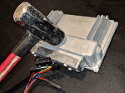
Thread Starter
TECH Fanatic


Joined: Jan 2018
Posts: 1,059
Likes: 198
 DIY VVT controller
 I recently came to the LS world from the Subaru world, and in both cases it's not unusual to put a newer motor with variable valve timing into an older car that doesn't support VVT. In my case, I started with a car that had intake VVT, and then upgraded to heads with both intake and exhaust VVT... and then I built something with an Arduino Due to control the valve exhaust valve timing.
Subaru calls their variable valve timing "Active Valve Control System" or AVCS. So the github project is unimaginatively named AVCS Controller:
https://github.com/LegacyNsfw/AvcsController
Of course it won't be plug-and-play with an LS, but it probably wouldn't be terribly hard to make it work. The biggest challenge would probably be figuring out the hardware to interface the cam sensor with the Arduino. I was too chicken to interface with the factor crank sensor, so I used an optical sensor on the crank pulley, so you could fabricate a bracket and do the same. Or, if you're comfortable interfacing with the LS crank sensor, I'm happy to work with you on the code to process that signal.
Why would you want to do this? Well, if all you care about is drag racing, you probably wouldn't - you'd just pick a cam that's tuned for whatever RPM range you use during a race. But, if you have a street/strip, road-course, or just road car, it could be useful. You could advance the cam at low RPM so that it behaves like a torquey truck cam with an intake valve closing angle around 30 degrees, and then retard it at high RPM so that it behaves a bit like a race cam, with an intake valve closing angle around 45-50 degrees. Assuming of course that the GM VVT mechanism allows that much movement... I haven't checked, but Subaru's certainly does.
Note that you'd want to be absolutely certain that PTV clearance is good with the cam fully advanced and fully retarded. Because I guarantee this thing is going to bounce off the stops when you're setting it up. It works pretty well in my Subaru though.
Subaru calls their variable valve timing "Active Valve Control System" or AVCS. So the github project is unimaginatively named AVCS Controller:
https://github.com/LegacyNsfw/AvcsController
Of course it won't be plug-and-play with an LS, but it probably wouldn't be terribly hard to make it work. The biggest challenge would probably be figuring out the hardware to interface the cam sensor with the Arduino. I was too chicken to interface with the factor crank sensor, so I used an optical sensor on the crank pulley, so you could fabricate a bracket and do the same. Or, if you're comfortable interfacing with the LS crank sensor, I'm happy to work with you on the code to process that signal.
Why would you want to do this? Well, if all you care about is drag racing, you probably wouldn't - you'd just pick a cam that's tuned for whatever RPM range you use during a race. But, if you have a street/strip, road-course, or just road car, it could be useful. You could advance the cam at low RPM so that it behaves like a torquey truck cam with an intake valve closing angle around 30 degrees, and then retard it at high RPM so that it behaves a bit like a race cam, with an intake valve closing angle around 45-50 degrees. Assuming of course that the GM VVT mechanism allows that much movement... I haven't checked, but Subaru's certainly does.
Note that you'd want to be absolutely certain that PTV clearance is good with the cam fully advanced and fully retarded. Because I guarantee this thing is going to bounce off the stops when you're setting it up.
It works pretty well in my Subaru though. Pantera EFI VVT Stand Alone Controller @ $200.00 Hi, I manufacture a "pic" based VVT controller that reads crank triggers AND MAP then provides a PWM signal to the VVT Solenoid.
This INCLUDES the GUI for precise calibration, RS-232 interface.
The cost is $200,00 USD.
Lance, Pantera EFI
This INCLUDES the GUI for precise calibration, RS-232 interface.
The cost is $200,00 USD.
Lance, Pantera EFI
Thread Starter
TECH Fanatic
Joined: Jan 2018
Posts: 1,059
Likes: 198
Do you have any pictures or documentation for it that you can share?
Could it be revised to work with different cam and crank trigger wheels?
I'm happy with what I've got for my car (and building it myself was fun) but if other people in the Subaru world want to do the same kind of conversion and don't want to build their own controller I could send them your way.
Could it be revised to work with different cam and crank trigger wheels?
I'm happy with what I've got for my car (and building it myself was fun) but if other people in the Subaru world want to do the same kind of conversion and don't want to build their own controller I could send them your way.
Thread Starter
TECH Fanatic
Joined: Jan 2018
Posts: 1,059
Likes: 198
The link in the first post has a little bit of information, and there's some discussion in this thread here:
http://www.romraider.com/forum/viewtopic.php?f=7&t=11237
Basically...
At idle the cam is effectively 222/222 @ 128 -2
At 2500 RPM (cruising RPM) it's 222/222 @ 113 +13
At 7000 RPM it's 222/222 @ 113 -7
It's turbocharged, so overlap doesn't get more than -4 degrees at 0.050.
Those numbers are basically just a starting point, they're not "proven" other than the fact that the car runs well and feels about right.
If I'd known a couple years ago what I know now about cams, and how VVT can make a big cam act like a small one, I would have gone bigger, like mid-230s duration at least.
The factory ECU can vary the intake cam angle with boost, but I haven't experimented with that since putting this engine in. I have a manifold pressure sensor for my cam controller but I haven't hooked it up yet.
http://www.romraider.com/forum/viewtopic.php?f=7&t=11237
Basically...
- the cam pulley can rotate on the end of the camshaft
- oil pressure is used to control the angle
- a spring pulls the cam pulley to maximum advance with no oil pressure
- there's a solenoid valve to control oil pressure
- you measure the angle by measuring the time between pulses from a crankshaft sensor and the camshaft sensor
- a weak signal to the solenoid lets the spring cause the exhaust cam to advance
- a strong signal to the solenoid causes oil pressure to overcome the spring, and the exhaust cam retards
At idle the cam is effectively 222/222 @ 128 -2
At 2500 RPM (cruising RPM) it's 222/222 @ 113 +13
At 7000 RPM it's 222/222 @ 113 -7
It's turbocharged, so overlap doesn't get more than -4 degrees at 0.050.
Those numbers are basically just a starting point, they're not "proven" other than the fact that the car runs well and feels about right.
If I'd known a couple years ago what I know now about cams, and how VVT can make a big cam act like a small one, I would have gone bigger, like mid-230s duration at least.
The factory ECU can vary the intake cam angle with boost, but I haven't experimented with that since putting this engine in. I have a manifold pressure sensor for my cam controller but I haven't hooked it up yet.
Last edited by NSFW; Nov 18, 2018 at 02:20 PM.
Subaru STI VVT HI ALL, the Subaru STI engne HAS the VVT motor on the INTAKE CAMSHAFT !
MY VVT controller MEASURES BOTH RPM and MAP !
This controller is in stock and also works well with the L-92 VVT engine.
Lance
MY VVT controller MEASURES BOTH RPM and MAP !
This controller is in stock and also works well with the L-92 VVT engine.
Lance

Staging Lane
Joined: May 2017
Posts: 61
Likes: 0
A couple of observations...
The LS VVT system can vary the overall advance of the cam, but cannot (sadly) change the LSA because it's just a single cam with both intake and exhaust lobes fixed onto it.
The Subaru system can be single AVCS on the intake cam only, or dual AVCS on both intake cam and exhaust cam. Both of these offerings can alter LSA.
There are still gains to be had in the VVT system though
The LS VVT system can vary the overall advance of the cam, but cannot (sadly) change the LSA because it's just a single cam with both intake and exhaust lobes fixed onto it.
The Subaru system can be single AVCS on the intake cam only, or dual AVCS on both intake cam and exhaust cam. Both of these offerings can alter LSA.
There are still gains to be had in the VVT system though
Trending Topics
Thread Starter
TECH Fanatic
Joined: Jan 2018
Posts: 1,059
Likes: 198
Subaru had intake VVT from about 2004 onward, and they added exhaust VVT for the 2008 STI. I think all of their current models have VVT for both but I'm not really sure.
Any considering an LS3 swap should probably take a close look at an L92 and Lance's VVT controller. It's really cool that there's an off-the-shelf solution.
Any considering an LS3 swap should probably take a close look at an L92 and Lance's VVT controller. It's really cool that there's an off-the-shelf solution.
LS1 Tech Stories
The Best V8 Stories One Small Block at Time

6 Common C5 Corvette Failures and What's Involved In Repairing Them
Pouria Savadkouei
Retro Modern Bandit Pontiac Trans AM Comes With Burt Reynolds' Autograph
Verdad Gallardo
Top 10 Greatest Cadillac V Series Performance Models Ever, Ranked
Pouria Savadkouei
Top 10 Most Powerful Chevy Trucks Ever Made!

Hennessey's New Supercharged Silverado ZR2 Has 700 HP
Verdad Gallardo
Coachbuilt N2A Anteros Is an LS2-Powered C6 Corvette In Italian Clothes
Verdad Gallardo
Awesome K5 Blazer Restomod Comes With C7 Corvette Power
Verdad Gallardo
10 Camaros You Should Never Buy


