



Ram effect

Teching In
Joined: Mar 2006
Posts: 44
Likes: 0

As long as it gets you more than a cold air intake and a K&N (if your don't care about your engine) you come out ahead. The .07 psi is at 70 mph, you'll get more at higher speeds.
There is far more to driving than the 1/4 mile.
Edit: anybody got times on the 1/4 mile with and without an air filter?
There is far more to driving than the 1/4 mile.
Edit: anybody got times on the 1/4 mile with and without an air filter?
Last edited by ConnClark; Apr 5, 2006 at 06:13 PM.
Originally Posted by P Mack
He said he achieved .07 above atmospheric, not a .07 increase if i'm reading it right.
The average sea level pressure is 29.92" of mercury, which equates to just under 14.7 psi. I would consider a .07 psi increase as pretty insignificant ...
Humm ... connclark could you clarify this for us?
Originally Posted by ConnClark
As long as it gets you more than a cold air intake and a K&N (if your don't care about your engine) you come out ahead. The .07 psi is at 70 mph, you'll get more at higher speeds.
There is far more to driving than the 1/4 mile.
Edit: anybody got times on the 1/4 mile with and without an air filter?
There is far more to driving than the 1/4 mile.
Edit: anybody got times on the 1/4 mile with and without an air filter?
I made 3 runs with the air filter, then pulled it for the last run to see if I would be faster.
The trap speed was almost identical. Didn't seem to make a difference.
However, on the dyno. Pulling the airfilter, lifting up the airbox, and running a fan got me about 12 rwhp!
Teching In
Joined: Mar 2006
Posts: 44
Likes: 0
Originally Posted by xphantomws6x
The average sea level pressure is 29.92" of mercury, which equates to just under 14.7 psi. I would consider a .07 psi increase as pretty insignificant ...
Humm ... connclark could you clarify this for us?
Humm ... connclark could you clarify this for us?

Detroit has spent money for metal on making horns on their air cleaners like the one above. As this just draws hot air from under the hood and has no ram air inlet that mates with it, they have to have some reason. Oh yes.... I belive its call Bernoulli's Principle. The horn serves no other purpose than raising the air pressure before it goes through the air filter to reduce the pressure drop across it, I would consider a .07psi increase signifigant by comparison.
After you consider how much money they could save on metal and labor making their air cleaners like the one below this must have some real bennefit. I mean they have done this for decades and these guys are so cheap that they wouldn't spend a penny to keep their mothers from being thrown out in the street. (Note to self, don't raise children to be auto execs)

Conclusion....
If detroit will spend money on getting minor gains with a horn on an air cleaner then ram air must be well worth it.
If you think your time would be better spent doing something rice like putting a leaf blower before your intake feel free to do so.

Staging Lane

Joined: Mar 2006
Posts: 50
Likes: 0
Detroit needed to use the THERMAC device on air cleaners to keep the air hot enough in cold weather to keep from freezing the carbs. They'd take hot air off the exhaust manifolds with that device (with thermal switch and vacuum control). Also that horn helps QUIET the intake noises quite a bit. It's hardly for the tuned HP increase.
Teching In
Joined: Mar 2006
Posts: 44
Likes: 0
not all air cleaners with air horns had THERMAC units. THERMACs mainly came out after passage of the clean air act.
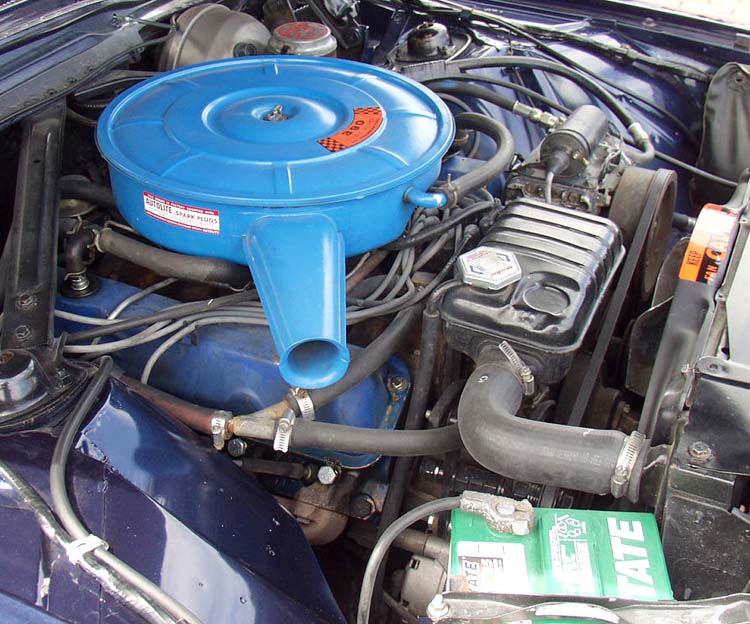
Edit: Note this is a picture of a 66 t-bird air cleaner. My 63 doesn't have a horn. A 66 t-birds engine noise is no quieter than a 63 .
Edit: Note this is a picture of a 66 t-bird air cleaner. My 63 doesn't have a horn. A 66 t-birds engine noise is no quieter than a 63 .
Last edited by ConnClark; Apr 5, 2006 at 09:09 PM.
Originally Posted by ConnClark
Detroit has spent money for metal on making horns on their air cleaners like the one above. As this just draws hot air from under the hood and has no ram air inlet that mates with it, they have to have some reason. Oh yes.... I belive its call Bernoulli's Principle. The horn serves no other purpose than raising the air pressure before it goes through the air filter to reduce the pressure drop across it, I would consider a .07psi increase signifigant by comparison.
After you consider how much money they could save on metal and labor making their air cleaners like the one below this must have some real bennefit. I mean they have done this for decades and these guys are so cheap that they wouldn't spend a penny to keep their mothers from being thrown out in the street. (Note to self, don't raise children to be auto execs)
Conclusion....
If detroit will spend money on getting minor gains with a horn on an air cleaner then ram air must be well worth it.
If you think your time would be better spent doing something rice like putting a leaf blower before your intake feel free to do so.
So because there was a "horn on the air cleaner" back in the 60's, it means that "ram-air" (completely different concept) works?
Ram-air = putting the air intake INTO the air stream, and claiming that it effectively "RAMs" the air into the intake, compressing the air and acting as a sort of supercharger. Making a larger air box to increase the pressure through the filter is a completely seperate topic, since that air still has increase in velocity to go through the intake tubing (and will decrease in pressure as a result).
A .07psi increase is not large at all. If your intake increases the standard atmospheric pressure of 14.7psi by .07 psi, to 14.77psi, that is not even a Half of a single percent increase in air pressure. I consider that an extremely Insignificant gain.
To put that in perspective, you would find more of a pressure difference in a 20 foot change of elevation.
LS1 Tech Stories
The Best V8 Stories One Small Block at Time

Top 10 Greatest Cadillac V Series Performance Models Ever, Ranked
Pouria Savadkouei
Top 10 Most Powerful Chevy Trucks Ever Made!

Hennessey's New Supercharged Silverado ZR2 Has 700 HP
Verdad Gallardo
Coachbuilt N2A Anteros Is an LS2-Powered C6 Corvette In Italian Clothes
Verdad Gallardo
Awesome K5 Blazer Restomod Comes With C7 Corvette Power
Verdad Gallardo
10 Camaros You Should Never Buy

10 LS Engine Myths That Refuse to Die
Verdad Gallardo
Five Reasons the Camaro Was the Most Pivotal Player in the Pony Car Wars 2.0
Brett Foote
10 Reasons the LS7 Is GM's Most Extreme Naturally Aspirated V8 Engine Ever
Verdad Gallardo
Originally Posted by xphantomws6x
So because there was a "horn on the air cleaner" back in the 60's, it means that "ram-air" (completely different concept) works?
Ram-air = putting the air intake INTO the air stream, and claiming that it effectively "RAMs" the air into the intake, compressing the air and acting as a sort of supercharger. Making a larger air box to increase the pressure through the filter is a completely seperate topic, since that air still has increase in velocity to go through the intake tubing (and will decrease in pressure as a result).
A .07psi increase is not large at all. If your intake increases the standard atmospheric pressure of 14.7psi by .07 psi, to 14.77psi, that is not even a Half of a single percent increase in air pressure. I consider that an extremely Insignificant gain.
To put that in perspective, you would find more of a pressure difference in a 20 foot change of elevation.
Ram-air = putting the air intake INTO the air stream, and claiming that it effectively "RAMs" the air into the intake, compressing the air and acting as a sort of supercharger. Making a larger air box to increase the pressure through the filter is a completely seperate topic, since that air still has increase in velocity to go through the intake tubing (and will decrease in pressure as a result).
A .07psi increase is not large at all. If your intake increases the standard atmospheric pressure of 14.7psi by .07 psi, to 14.77psi, that is not even a Half of a single percent increase in air pressure. I consider that an extremely Insignificant gain.
To put that in perspective, you would find more of a pressure difference in a 20 foot change of elevation.
What's the air pressure inside the airbox when an engine is sucking air?
It has to be LESS than 14.7 psi since the air is moving INTO the engine.
Let's say it's 13.7 for example. Going from 13.7 to 14.77 is a decent difference. It'll probably get you 10-15hp, which is basically what ram air claims.
Originally Posted by silverTA2002
Just a question.
What's the air pressure inside the airbox when an engine is sucking air?
It has to be LESS than 14.7 psi since the air is moving INTO the engine.
Let's say it's 13.7 for example. Going from 13.7 to 14.77 is a decent difference. It'll probably get you 10-15hp, which is basically what ram air claims.
What's the air pressure inside the airbox when an engine is sucking air?
It has to be LESS than 14.7 psi since the air is moving INTO the engine.
Let's say it's 13.7 for example. Going from 13.7 to 14.77 is a decent difference. It'll probably get you 10-15hp, which is basically what ram air claims.
The MAP sensor measures the relative change of air pressure inside the manifold itself and is normally used on forced induction cars to measure the boost PSI. I’m sure someone with tuning software could most certainly go see if there is any change in internal manifold pressure (map sensor voltage) with ram-air, and w/o ram-air. I would guarantee that it would barely be picked up by the map sensor at all. Of course you would have to account for any increase from the colder & denser air it would be picking up, and remove that from the equation. I would estimate that you would have to hit at least 100mph before you started to see an appreciable gain in pressure.
Anyways, I'm not saying that ram-air doesn't work .... it most certainly does, and as I said in a previous post it is used extensively on many aircraft engines. HOWEVER, at the speeds a normal street car travels, the gains from ram-air would be insignificant at best. A standard cold air intake would provide much more power by just bringing in colder air then a ram-air system would. If you're driving around town at 150mph, then by all means, strap a ram-air system to your car.

.


Originally Posted by Wild *****
So, to sum this all up: You will probably never achieve positive pressure in your intake, but you *MAY* reduce some of the negative pressure (vacuum) by having a functioning ram-air. The real benefit mainly comes from the fact that you are providing the densest, coolest air possible for your engine....
Good discussion, lots of numbers and formulae- I like both the 'hard science' and the seat-of-the-pants approach
Good discussion, lots of numbers and formulae- I like both the 'hard science' and the seat-of-the-pants approach

No matter what you say, physics shows that max ram air effect at 100mph is .18psi. What you have is a really nice, direct Cold Air system, and I'm sure it is worth some HP. But not due to any ram air effect other than the little bit possible. It's really not until you get close to 300mph that there's enough of a benefit to make going after it worthwhile.
Measuring 10HP at the track with a timeslip difference is a crapshoot as well. A tiny better launch, a tad more traction, a better shift, a small tailwind - any of those could change your times.
Jim
Measuring 10HP at the track with a timeslip difference is a crapshoot as well. A tiny better launch, a tad more traction, a better shift, a small tailwind - any of those could change your times.
Jim

Originally Posted by ConnClark
As long as it gets you more than a cold air intake and a K&N (if your don't care about your engine) you come out ahead. The .07 psi is at 70 mph, you'll get more at higher speeds.
There is far more to driving than the 1/4 mile.
Edit: anybody got times on the 1/4 mile with and without an air filter?
There is far more to driving than the 1/4 mile.
Edit: anybody got times on the 1/4 mile with and without an air filter?

TECH Resident
Joined: Feb 2002
Posts: 843
Likes: 0
From: Roseville, Ca.
Back when my car was 340rwhp, I gained almost 2 mph by adding some ghetto cold air tubes. The "Maytag Mod" consists of enlarging the bumper support holes to accept 2-4" aluminum dryer ducts into the nostrils of a Camaro. They're ovaled up the FRA area into the airbox where it's sealed. Although totally rice, I believe it's superior to FTRA on the big end, especially from the top of third on into triple digits. I don't remember the exact numbers, but the car gained a bit more in the last 1/8th. The intake temps (TB, MAF, airbox, etc.) seem cooler to the touch, less prone to soak.
Just my low tech personal experience in this high tech topic.
Just my low tech personal experience in this high tech topic.
Last edited by Steve Gunn; Apr 9, 2006 at 08:31 AM.
Originally Posted by DeltaT
No matter what you say, physics shows that max ram air effect at 100mph is .18psi. What you have is a really nice, direct Cold Air system, and I'm sure it is worth some HP. But not due to any ram air effect other than the little bit possible. It's really not until you get close to 300mph that there's enough of a benefit to make going after it worthwhile.
Measuring 10HP at the track with a timeslip difference is a crapshoot as well. A tiny better launch, a tad more traction, a better shift, a small tailwind - any of those could change your times.
Jim
Measuring 10HP at the track with a timeslip difference is a crapshoot as well. A tiny better launch, a tad more traction, a better shift, a small tailwind - any of those could change your times.
Jim
I was wondering how he figured a "10rwhp gain" via a track time, and how he can prove that entire 10rwhp is from the "ram-air" effect and not just colder air, less heat soak, track conditions, etc ... but after some thought I figured I'd just leave it alone.
Originally Posted by chrs1313
this is all that needs to be said, he is absolutely right and i have track results that prove a 10 wrhp gain over the FTRA cold air induction...bottom line it works



Teching In
Joined: Apr 2006
Posts: 14
Likes: 0
From: Nebraska
You've made my brain churn.
Imagine a sliding resonance box with variable volume. The box is controlled by an actuator programmed to choose its position based upon vehicle speed and rpm.
It would require a lot of testing, either in a combination wind tunnel/dyno or in a very consistant car on a very consistant track. Multiple runs at several box positions and airspeeds.
Alternately, would there be some group of sensors that would help compute an optimal airbox size? Vacuum, speed, and rpm combined?
Imagine a sliding resonance box with variable volume. The box is controlled by an actuator programmed to choose its position based upon vehicle speed and rpm.
It would require a lot of testing, either in a combination wind tunnel/dyno or in a very consistant car on a very consistant track. Multiple runs at several box positions and airspeeds.
Alternately, would there be some group of sensors that would help compute an optimal airbox size? Vacuum, speed, and rpm combined?
Like attaching a slide trombone to your intake? Now MY brain is churning.
That's rich! In many cases, so true.
Jim
"I gave up arguing a few posts ago ...."
Once you get past that you are then qualified to run a performance shop.
Once you get past that you are then qualified to run a performance shop.
Jim

11 Second Club
Joined: Nov 2005
Posts: 447
Likes: 0
From: Shingle Springs, CA
Man you have to love the debate!! Try this formula, it helped me with this issue.
If you take Ram Air Effect (RAC) and multiply it by 14.7 psi (pressure at sea level) and divide it by S.W.A.G it equals net Horse Power. It looks like this (rac*14.7/S.W.A.G.=HP) Oh, I forgot S.W.A.G.=scientific wild *** guess!
So when I use this model it gives me a lot more HP! lol
If you take Ram Air Effect (RAC) and multiply it by 14.7 psi (pressure at sea level) and divide it by S.W.A.G it equals net Horse Power. It looks like this (rac*14.7/S.W.A.G.=HP) Oh, I forgot S.W.A.G.=scientific wild *** guess!
So when I use this model it gives me a lot more HP! lol
Last edited by mvonada; Apr 11, 2006 at 01:55 PM. Reason: wrong word

