


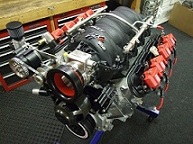


LSx head flow theory.

Thread Starter
Joined: Aug 2005
Posts: 2,649
Likes: 1
From: Mont Belvieu, TX
 LSx head flow theory.
 I spoke to one of our sponsors today about head flow on the LS7 heads. He brought up what I thought to be some interesting points. He stated that the reason these heads back up beyond .650 is that the air is moving too fast and that it detachs from the port walls and starts tumbling and basically doesn't allow anymore air to enter the ports. He had some interesting ideas (at least to me), about how to improve the performance of the ls7's. What he proposed doing was to fill in the runner and then reshape it to provide the optimum path to the valve. He was of the opinion also that the valves were to big for cube motors that these motors were being installed on. On another note, he felt that the exhaust side was not the issue with these heads. He felt that it was very effiicient in the scavenging of the exhaust gases. He said that when a cam with a large amount of overlap was installed, the amount of air that was being just pumped through the engine and not being used to produce power was exceedingly high.
I am trying to understand what we talked about today. When he was explaining it to me I grasped what he was saying, but the more I think about it, the more I confuse myself I guess.
Is what i posted above something that is widely known? If it is please let me know.
If there are two things that are preached to us by the "wise ones " that post on here, they are:
1. when it comes to camshafts, bigger is not always better, and
2. when it comes to cylinder heads, Don't buy just based on flow numbers.
By saying that then, why do we and just about everyone else use head flow numbers to "rate" the power potential of heads?
If the guy I talked to today reads this, please don't take this as I am questioning what you told me. I am just trying to understand it better.
I am trying to understand what we talked about today. When he was explaining it to me I grasped what he was saying, but the more I think about it, the more I confuse myself I guess.
Is what i posted above something that is widely known? If it is please let me know.
If there are two things that are preached to us by the "wise ones
" that post on here, they are:1. when it comes to camshafts, bigger is not always better, and
2. when it comes to cylinder heads, Don't buy just based on flow numbers.
By saying that then, why do we and just about everyone else use head flow numbers to "rate" the power potential of heads?
If the guy I talked to today reads this, please don't take this as I am questioning what you told me. I am just trying to understand it better.
What he was discussing on the port flow stuff is compressible fluid flow characteristics. Basically it involves maintaining laminar flow across the boundary layer on the port surfaces. When the boundary layer seperates or extends too far in the flow path, it becomes turbulent and causes the flow to stall.
See if you can look up boundary layer flow in a fluid mechanics book or website, there are probably good illustrations that describe what he was speaking about.
See if you can look up boundary layer flow in a fluid mechanics book or website, there are probably good illustrations that describe what he was speaking about.
The LS7 intake port is killer out of the box and very close perhaps to a completely optimized shape....with a little romancing in the right areas (a few cc's at best), I have seen over 391 CFM at .650 lift where it backs up (on the flowbench) shortly thereafter....not to mention the low and midlift flow is nothing short of phenominal. That said WHO CARES that it stalls slightly past .650 lift....and with an intake manifold bolted to it (real world) you will delay the point it stalls....not to mention how many people out there are really running much more than .650 lift net anyway. Whats great is you dont have to run a big cam which is harder on parts and compromises longevity. That kind of legitamate flow thru a smallblock cylinder head is more than most of you can even comprehend and flows as much or better than a fair amount of BBC heads can even come close to. The difference being that a BBC head would have a 300+ CFM exhaust port while this head can barely muster 230 CFM (with a pipe) out of the box.
IMO, they dropped the ball BIGTIME on the exhaust side and without some major modifications (relocating valves and the like) there's nothing that can really be done about it, not to mention the cross sectional area is very large and really requires a minumum of 427 CID to be reasonably effective. A slightly smaller port with only a small compromise in total flow and at least a 30 CFM (or more) better exhaust port would have worked even better IMO in most street/strip applications....more area under the curve AND peak power. I have ported the stock exhaust port and gotten it closer to 260-270 CFM (which is getting there) but even those gains only leave you with a 67% intake/exhaust ratio still forcing you to crutch the camshaft pretty heavily on the exhaust side (a negative for low and midrange power).
Am I complaining....hell no....every time I look at one (an LS7 head) I pinch myself and thank my lucky stars I'm heavily involved in the performance industry right now....its almost too good to be true to see this trend continue....at some point "Big Brother" is going to step in and we will all be driving electric scooters with zero emissions. There's never been a better time to be a "junky" in this hobby....
Tony M.
PS....And Dodge just assured the performance wars will continue by releasing a 600 BHP Viper....I love it.
IMO, they dropped the ball BIGTIME on the exhaust side and without some major modifications (relocating valves and the like) there's nothing that can really be done about it, not to mention the cross sectional area is very large and really requires a minumum of 427 CID to be reasonably effective. A slightly smaller port with only a small compromise in total flow and at least a 30 CFM (or more) better exhaust port would have worked even better IMO in most street/strip applications....more area under the curve AND peak power. I have ported the stock exhaust port and gotten it closer to 260-270 CFM (which is getting there) but even those gains only leave you with a 67% intake/exhaust ratio still forcing you to crutch the camshaft pretty heavily on the exhaust side (a negative for low and midrange power).
Am I complaining....hell no....every time I look at one (an LS7 head) I pinch myself and thank my lucky stars I'm heavily involved in the performance industry right now....its almost too good to be true to see this trend continue....at some point "Big Brother" is going to step in and we will all be driving electric scooters with zero emissions. There's never been a better time to be a "junky" in this hobby....
Tony M.
PS....And Dodge just assured the performance wars will continue by releasing a 600 BHP Viper....I love it.
Thread Starter
Joined: Aug 2005
Posts: 2,649
Likes: 1
From: Mont Belvieu, TX
Originally Posted by Tony Mamo @ AFR
The LS7 intake port is killer out of the box and very close perhaps to a completely optimized shape....with a little romancing in the right areas (a few cc's at best), I have seen over 391 CFM at .650 lift where it backs up (on the flowbench) shortly thereafter....not to mention the low and midlift flow is nothing short of phenominal. That said WHO CARES that it stalls slightly past .650 lift....and with an intake manifold bolted to it (real world) you will delay the point it stalls....not to mention how many people out there are really running much more than .650 lift net anyway. Whats great is you dont have to run a big cam which is harder on parts and compromises longevity. That kind of legitamate flow thru a smallblock cylinder head is more than most of you can even comprehend and flows as much or better than a fair amount of BBC heads can even come close to. The difference being that a BBC head would have a 300+ CFM exhaust port while this head can barely muster 230 CFM (with a pipe) out of the box.
IMO, they dropped the ball BIGTIME on the exhaust side and without some major modifications (relocating valves and the like) there's nothing that can really be done about it, not to mention the cross sectional area is very large and really requires a minumum of 427 CID to be reasonably effective. A slightly smaller port with only a small compromise in total flow and at least a 30 CFM (or more) better exhaust port would have worked even better IMO in most street/strip applications....more area under the curve AND peak power. I have ported the stock exhaust port and gotten it closer to 260-270 CFM (which is getting there) but even those gains only leave you with a 67% intake/exhaust ratio still forcing you to crutch the camshaft pretty heavily on the exhaust side (a negative for low and midrange power).
Am I complaining....hell no....every time I look at one (an LS7 head) I pinch myself and thank my lucky stars I'm heavily involved in the performance industry right now....its almost too good to be true to see this trend continue....at some point "Big Brother" is going to step in and we will all be driving electric scooters with zero emissions. There's never been a better time to be a "junky" in this hobby....
Tony M.
PS....And Dodge just assured the performance wars will continue by releasing a 600 BHP Viper....I love it.
IMO, they dropped the ball BIGTIME on the exhaust side and without some major modifications (relocating valves and the like) there's nothing that can really be done about it, not to mention the cross sectional area is very large and really requires a minumum of 427 CID to be reasonably effective. A slightly smaller port with only a small compromise in total flow and at least a 30 CFM (or more) better exhaust port would have worked even better IMO in most street/strip applications....more area under the curve AND peak power. I have ported the stock exhaust port and gotten it closer to 260-270 CFM (which is getting there) but even those gains only leave you with a 67% intake/exhaust ratio still forcing you to crutch the camshaft pretty heavily on the exhaust side (a negative for low and midrange power).
Am I complaining....hell no....every time I look at one (an LS7 head) I pinch myself and thank my lucky stars I'm heavily involved in the performance industry right now....its almost too good to be true to see this trend continue....at some point "Big Brother" is going to step in and we will all be driving electric scooters with zero emissions. There's never been a better time to be a "junky" in this hobby....
Tony M.
PS....And Dodge just assured the performance wars will continue by releasing a 600 BHP Viper....I love it.
Once again, we sort of flipped back and forth between the LS7 stuff and the cathedral stuff so I MAY( more like probably
 ) be getting confused. Anyone have anymore thoughts?
On The Tree
Joined: Sep 2004
Posts: 188
Likes: 1
From: Houston, TX
Reshaping of the short side radius on the LS7 intake port smooths it out. It only takes a few cc's. Not much.
I disagree with the over-scavenging. It's the opposite problem that exists, anti-scavenging. And what helps that? What Tony said, better exhaust flow.
I disagree with the over-scavenging. It's the opposite problem that exists, anti-scavenging. And what helps that? What Tony said, better exhaust flow.

TECH Resident
Joined: Dec 2004
Posts: 845
Likes: 0
From: K-W, Ontario
1. when it comes to camshafts, bigger is not always better, and
2. when it comes to cylinder heads, Don't buy just based on flow numbers.
2. when it comes to cylinder heads, Don't buy just based on flow numbers.
I have picked up bits of info from Darin Morgan's audio interview and have since
been reading heavily on head flow and port shape.
I'm not suggesting I'm a pro after hearing and reading this information, but
it has totally opened my eyes to marketing B.S.
As air speed increases, the port may go turbulent and back up the numbers.
Even changing the cam lift will not cure this issue. It takes a skilled porter
to correct these turbulent points without sacrificing low and mid lift flow.
I know my next set of heads will be selected based on new information and it
will not be mainly from flow numbers @ 28"...that's for damn sure.
Trending Topics
Probably not apples to apples but I need clarification. I thought I had read something about 500 CI Pro Stock motors and exhaust was only flowing around 60% of intake. Is there any point where such a low percentage would pay a dividend in performance. Why would GM leave such a big differential between int/exh flow?
Last edited by Chalky; Jan 12, 2007 at 03:25 PM.
LS1 Tech Stories
The Best V8 Stories One Small Block at Time

Topdon ONE vs. Artidiag 800 BT2: Which is the Diagnostic Tablet For You?
Pouria Savadkouei
Gas Monkey Built a 6-Wheel Ferrari Testarossa With a Corvette LT4 Engine
Verdad Gallardo
7 Most Reliable High-Performance Engines GM Has Ever Built
Verdad Gallardo
Amazing '71 Camaro Restomod Is Modern Muscle Car Under the Skin
Verdad Gallardo
6 Common C5 Corvette Failures and What's Involved In Repairing Them
Pouria Savadkouei
Retro Modern Bandit Pontiac Trans AM Comes With Burt Reynolds' Autograph
Verdad Gallardo
Top 10 Greatest Cadillac V Series Performance Models Ever, Ranked
Pouria Savadkouei
Top 10 Most Powerful Chevy Trucks Ever Made!

Hennessey's New Supercharged Silverado ZR2 Has 700 HP
Verdad Gallardo
Originally Posted by Chalky
Probably not apples to apples but I need clarification. I thought I had read something about 500 CI Pro Stock motors and exhaust was only flowing around 60% of intake. Is there any point where such a low percentage would pay a dividend in performance. Why would GM leave such a big differential between int/exh flow?
Nascar guys at the best have 70-75% E/I ratio with the same neightborhood of intake valve to bore size.
These guys all are trading off intake flow and valve size for exhaust flow and they get a ton of power out of it.
Bret
Thread Starter
Joined: Aug 2005
Posts: 2,649
Likes: 1
From: Mont Belvieu, TX
Originally Posted by Chalky
Probably not apples to apples but I need clarification. I thought I had read something about 500 CI Pro Stock motors and exhaust was only flowing around 60% of intake. Is there any point where such a low percentage would pay a dividend in performance. Why would GM leave such a big differential between int/exh flow?

TECH Fanatic
Joined: Mar 2004
Posts: 1,017
Likes: 0
From: Laguna Niguel, CA
Originally Posted by BLKWS.6
Could the SURFACE of the runners be modified? Much like the dimples on a golf-ball? Sorry for the noob contribution 
On The Tree
Joined: Sep 2004
Posts: 188
Likes: 1
From: Houston, TX
Originally Posted by Chalky
Probably not apples to apples but I need clarification. I thought I had read something about 500 CI Pro Stock motors and exhaust was only flowing around 60% of intake. Is there any point where such a low percentage would pay a dividend in performance. Why would GM leave such a big differential between int/exh flow?
An early opening exhaust valve will drastically hurt power on a low compression engine, so that's why you don't want to run very much spread on the exhaust lobe in those engines. The exhaust/intake ratio also needs to be higher on a low compression engine than on a Pro Stocker because of the restraint on duration due to having low compression.
Pro Stock & Comp Eliminator head porters set the heads up to favor the intake ports by taking valve area away from the exhaust and giving it to the intake. They make up for the lower exhaust flow rate with extra duration on the cam.
On The Tree
Joined: Oct 2003
Posts: 150
Likes: 0
From: harrisburg PA
Greg,
Most A, B and PS motors are fairly low SCR, and calc DCR due to the high VE. The last BC design I did was only 14.8:1 SCR. And very difficult to keep exhaust valves in.
You are 110% correct, the exhaust can mostly be fixed with lobe, if the design of the port is correct. The intake always shows gains, if the velocity profile is under control. You can't fix the motor dynamicaly with the intake lobe.
Playing with the R, ls7 and l92 castings has proven that times are about to change.... The port design and profile is nothing short of fantastic....We see it now in the ROX designs. I would hate to be a ford fan
Dennis
Most A, B and PS motors are fairly low SCR, and calc DCR due to the high VE. The last BC design I did was only 14.8:1 SCR. And very difficult to keep exhaust valves in.
You are 110% correct, the exhaust can mostly be fixed with lobe, if the design of the port is correct. The intake always shows gains, if the velocity profile is under control. You can't fix the motor dynamicaly with the intake lobe.
Playing with the R, ls7 and l92 castings has proven that times are about to change.... The port design and profile is nothing short of fantastic....We see it now in the ROX designs. I would hate to be a ford fan
Dennis
Thread Starter
Joined: Aug 2005
Posts: 2,649
Likes: 1
From: Mont Belvieu, TX
I guess my next question would be, WHY would a head that has increased flow numbers not make more power??
I believe it, I just want to know WHY? Does it have to do with a "swirl" in the flow, or is it something else?
We have all seen heads that just flat make more power than other higher flowing heads, even with lower numbers across the board. Similiar port sizes also.
I believe it, I just want to know WHY? Does it have to do with a "swirl" in the flow, or is it something else?
We have all seen heads that just flat make more power than other higher flowing heads, even with lower numbers across the board. Similiar port sizes also.
TECH Resident
Joined: Dec 2004
Posts: 845
Likes: 0
From: K-W, Ontario
Based on what I've read and learned from experienced head porters the flow
bench can sometimes lead you down the wrong path.
The flow numbers are based on single static depression and do not represent
the pulses, and velocity changes that occur during engine operation.
The flow numbers also do not account for heat, fuel, valve movement, nor
changing pressures in the cylinder and exhaust port.
According to some of the porters that I have learned from, the air speed at
specific areas in the port are more important than flow numbers.
Another major point to consider is that the best port deisgn which is designed
for a particular engine displacement, RPM range, bore diameter, intake manifold, etc. will not perform nearly as well on an engine working out of the
intended limits.
bench can sometimes lead you down the wrong path.
The flow numbers are based on single static depression and do not represent
the pulses, and velocity changes that occur during engine operation.
The flow numbers also do not account for heat, fuel, valve movement, nor
changing pressures in the cylinder and exhaust port.
According to some of the porters that I have learned from, the air speed at
specific areas in the port are more important than flow numbers.
Another major point to consider is that the best port deisgn which is designed
for a particular engine displacement, RPM range, bore diameter, intake manifold, etc. will not perform nearly as well on an engine working out of the
intended limits.
Thread Starter
Joined: Aug 2005
Posts: 2,649
Likes: 1
From: Mont Belvieu, TX
Originally Posted by Adrenaline_Z
Another major point to consider is that the best port deisgn which is designed
for a particular engine displacement, RPM range, bore diameter, intake manifold, etc. will not perform nearly as well on an engine working out of the
intended limits.

TECH Fanatic
Joined: Oct 2002
Posts: 1,842
Likes: 0
From: Dallas, North Mexico
Originally Posted by BLKWS.6
Could the SURFACE of the runners be modified? Much like the dimples on a golf-ball? Sorry for the noob contribution
TECH Fanatic
Joined: Oct 2002
Posts: 1,842
Likes: 0
From: Dallas, North Mexico
Originally Posted by Stang's Bane
I guess my next question would be, WHY would a head that has increased flow numbers not make more power??
I believe it, I just want to know WHY? Does it have to do with a "swirl" in the flow, or is it something else?
We have all seen heads that just flat make more power than other higher flowing heads, even with lower numbers across the board. Similiar port sizes also.
I believe it, I just want to know WHY? Does it have to do with a "swirl" in the flow, or is it something else?
We have all seen heads that just flat make more power than other higher flowing heads, even with lower numbers across the board. Similiar port sizes also.

Originally Posted by treyZ28
Engines are very dynamic. You have a ton of pressure waves/pulses, and NOTHING is linear in there. It isn't as simple as hooking a vacuum up to a pipe.