








Calculating cooling requirements
 Calculating cooling requirements
 Help a fellow learning engineer out. I say learning because I'm a sophomore and we've only touched on thermal dynamics as of yet. Basically I'm beating myself up lately trying to figure out if my cooling system is up to par in my off-road truck. I'm worried I wont have enough radiator surface area and/or volume.
So here's the build:
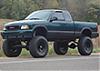
A 1996 GMC Sonoma, lifted God knows how much on 35" tires, 4L60E, 4wd, 4.30 gears.
Link to my truck...Link
It's getting:
A 5.3L bored over to 5.7L, stock LS1 pistons, XR259 camshaft (206/212, .515/.522 112LSA) with .550 lift springs, milled ported and polished 241's for 10.3:1 compression, stock F-body manifolds, true duals with "in-muffler" X-pipe crossover (courtesy of Magnaflow) looking for 375hp/390-400lb-ft torque. Nothing major, just a truck V8 is all.
The problem:
I'm stuffing a V8 into space designed for an inline 4-cylinder because even the V6 has cooling issues when pushed hard. I have the largest radiator I can fit in there, even taking advantage of my body lift.
So here's my cooling system:
-This is the radiator. Spark notes: 30.875" wide by 19" tall all aluminum radiator, 2.25" thick dual core with 1" tubes.
http://store.summitracing.com/partde...5&autoview=sku
-And I have the Lincoln Mark VIII 18" electric cooling fan behind that radiator. Claims put the Lincoln fan at 4500-5000 CFM. I trimmed the shroud down so it's not as deep; now assume a top pulling capacity of 4500 CFM max just to be safe and yield on the side of caution, plus I don't want the fan running at 100% all the time. And yes, I do have the electrical system to support that. A 250 amp alternator with a smaller pulley to up RPM's, two Yellow Top batteries and 1/0 gauge all throughout.
-I have a 15x7" transmission cooler plumbed in line to receive the transmission fluid first, then it goes to the radiator's internal transmission cooler, finally returning to the tranny after.
Here's why I'm worried:
My machine shop bored the 5.3L block over and said that the 99mm bore is fine, and he's already gone to work on it spec'd for replacement LS1 pistons from Speed Pro. He said #2 and #6 cylinders are at the minimum wall thickness and that I should be sure of my cooling system because more heat will be transfered now from the chambers and cylinders into the coolant via the thinner cylinder walls. Already cooling a V8 inside my little truck is a challenge onto itself, and I am confident that during normal hours of operation on-road my truck will cool perfectly as designed. It's the off-road experiences that have me worried.
I am worried that my radiator will be covered in mud, the fan will get soaked in water or be turned off manually by myself during a water crossing, and the motor will overheat. I live in Minnesota and most of the year it's below 90 degrees but I do 100% of my off-roading during the summer months. I want to make sure that if the electric fan fails, that I can return safely home on radiator alone for at least a 20 mile trip taking no less than 30 minutes. That is the goal, and now I ask if you guys know of a formula or a set of formulas that can assist in figuring out if my radiator has the capacity to cool my motor.
If you're still reading, thank you, sorry I know that was long but I had to get what I've been worrying about for the past week off my chest and into the open for discussion.
So here's the build:
A 1996 GMC Sonoma, lifted God knows how much on 35" tires, 4L60E, 4wd, 4.30 gears.
Link to my truck...Link
It's getting:
A 5.3L bored over to 5.7L, stock LS1 pistons, XR259 camshaft (206/212, .515/.522 112LSA) with .550 lift springs, milled ported and polished 241's for 10.3:1 compression, stock F-body manifolds, true duals with "in-muffler" X-pipe crossover (courtesy of Magnaflow) looking for 375hp/390-400lb-ft torque. Nothing major, just a truck V8 is all.
The problem:
I'm stuffing a V8 into space designed for an inline 4-cylinder because even the V6 has cooling issues when pushed hard. I have the largest radiator I can fit in there, even taking advantage of my body lift.
So here's my cooling system:
-This is the radiator. Spark notes: 30.875" wide by 19" tall all aluminum radiator, 2.25" thick dual core with 1" tubes.
http://store.summitracing.com/partde...5&autoview=sku
-And I have the Lincoln Mark VIII 18" electric cooling fan behind that radiator. Claims put the Lincoln fan at 4500-5000 CFM. I trimmed the shroud down so it's not as deep; now assume a top pulling capacity of 4500 CFM max just to be safe and yield on the side of caution, plus I don't want the fan running at 100% all the time. And yes, I do have the electrical system to support that. A 250 amp alternator with a smaller pulley to up RPM's, two Yellow Top batteries and 1/0 gauge all throughout.
-I have a 15x7" transmission cooler plumbed in line to receive the transmission fluid first, then it goes to the radiator's internal transmission cooler, finally returning to the tranny after.
Here's why I'm worried:
My machine shop bored the 5.3L block over and said that the 99mm bore is fine, and he's already gone to work on it spec'd for replacement LS1 pistons from Speed Pro. He said #2 and #6 cylinders are at the minimum wall thickness and that I should be sure of my cooling system because more heat will be transfered now from the chambers and cylinders into the coolant via the thinner cylinder walls. Already cooling a V8 inside my little truck is a challenge onto itself, and I am confident that during normal hours of operation on-road my truck will cool perfectly as designed. It's the off-road experiences that have me worried.
I am worried that my radiator will be covered in mud, the fan will get soaked in water or be turned off manually by myself during a water crossing, and the motor will overheat. I live in Minnesota and most of the year it's below 90 degrees but I do 100% of my off-roading during the summer months. I want to make sure that if the electric fan fails, that I can return safely home on radiator alone for at least a 20 mile trip taking no less than 30 minutes. That is the goal, and now I ask if you guys know of a formula or a set of formulas that can assist in figuring out if my radiator has the capacity to cool my motor.
If you're still reading, thank you, sorry I know that was long but I had to get what I've been worrying about for the past week off my chest and into the open for discussion.

TECH Regular
Joined: Feb 2006
Posts: 437
Likes: 2
From: Cleveland

I'd take this post to www.eng-tips.com AMAZING website for engineers working on problems. You could call a racing radiator company and they've got a sliding scale for horsepower, but it's not so cool if you haven't purchased their radiator. I'm working on a similar problem right now and I'd like to place two small bar and plate intercoolers (running in parallel) behind the front wheels for use as radiators. Problem is no direct airflow and I'm trying to keep weight at a minimum...I'm just not sure how small I can go.
I have a buddy that put his radiator back in his truck bed fabricated a shroud to pull down to it an also used a electric fan i will try to get a pic for ya. and this was a tacoma 400 sb swap
Wow, I can truly say I've never realized how messed up the cooling system can get for offroad trucks. All that crap has potential to get muddy like you mentioned, then after getting muddy have to cool a motor doing a bunch of work at low speeds.
It's hard to say how I would deal with this. It will honestly need as much volume as you can physically fit in the truck. Every square inch not taken up by roll cage/bars, motor or radiator needs to be extra volume for the coolant system. Is there enough room to run two of those radiators deep? Yeah the back one won't be nearly as efficient as the front one BUT it is a good way to add extra volume and the extra heat exchanger isn't going to hurt. I don't see any mention of a/c, it might be possible to run a slightly smaller radiator and sink it into the core support area to get more room in front of the crank pulley.
I also like the idea of putting the radiator in the bed of the truck but if the fans fail completely you'll have minimal flow across it. You could run a big shroud but that's just something to rip off in the rocks or plug up with mud.
Have you considered a mechanical fan with a custom shroud and a pusher fan to supplement at lower engine speds?

TECH Addict
Joined: Aug 2004
Posts: 2,866
Likes: 4
if you wanted to take it to extreams you could mount the rad in the back. i have seen it done in a few golfs and other cars to great effect! 
alternativelt you could try and slide the motor a little further back and/or mount the rad close to the engine. this extra room should help provent the rad getrting clogged up with mud. this is what the likes of Bolwer do with the off road rally trucks.
Chris.
alternativelt you could try and slide the motor a little further back and/or mount the rad close to the engine. this extra room should help provent the rad getrting clogged up with mud. this is what the likes of Bolwer do with the off road rally trucks.
Chris.
Trending Topics
I couldn't possibly give a definite number to all of the potential variables, but I can make a few observations based on personal experience. A single 18" diameter fan on that size radiator is highly unlikely to cool enough. Also, with that size radiator, unless you completely mud it up, it should get sufficient airflow going 20 miles in 30 minutes to safely get you home. I base these opinions on two things. The first is a friend's 6.0 Silverado SS that tried a similar single fan, and it wouldn't even cool enough to idle in traffic. The second is my personal 4.8 twin screw work truck when the flexalite duals burned the fuseholder coming out of Laredo. I drove it about 350 miles during the summer in Texas to get to my destination, and it never overheated in sometimes less than 35mph traffic. I apologize for the not nearly technically advanced advice.
LS1 Tech Stories
The Best V8 Stories One Small Block at Time

Topdon ONE vs. Artidiag 800 BT2: Which is the Diagnostic Tablet For You?
Pouria Savadkouei
Gas Monkey Built a 6-Wheel Ferrari Testarossa With a Corvette LT4 Engine
Verdad Gallardo
7 Most Reliable High-Performance Engines GM Has Ever Built
Verdad Gallardo
Amazing '71 Camaro Restomod Is Modern Muscle Car Under the Skin
Verdad Gallardo
6 Common C5 Corvette Failures and What's Involved In Repairing Them
Pouria Savadkouei
Retro Modern Bandit Pontiac Trans AM Comes With Burt Reynolds' Autograph
Verdad Gallardo
Top 10 Greatest Cadillac V Series Performance Models Ever, Ranked
Pouria Savadkouei
Top 10 Most Powerful Chevy Trucks Ever Made!

Hennessey's New Supercharged Silverado ZR2 Has 700 HP
Verdad Gallardo

Run a coolant that has better properties in it than water glycol coolant. I recommend Evans waterless coolant. Use a lower thermostat as much as you can get away with. I don't know all the thermostat ratings for your application with that specific engine. I would guess that the 160 degree would be okay in your situation.I would really go with the thermostat approach as the engine will only run as cool as the thermostat allows. I would pay very close attention to your fan shroud as too much trimming cuts down on its' ability to cool.
You mentioned mud and offroading, so I would not go with a fan with a very high cooling fin count even though you are concerned with cooling issues. I know in dirt track racing where there's the issue of mud build up on the radiator, the course of action is not to use a large cooling fin count but the opposite, so that the mud will not cake onto to the radiator. You could also use some wire meshing/screen in front of the radiator, it will grab the caked mud and debris that you come into. That way you can easily clean it when needed.
You mentioned mud and offroading, so I would not go with a fan with a very high cooling fin count even though you are concerned with cooling issues. I know in dirt track racing where there's the issue of mud build up on the radiator, the course of action is not to use a large cooling fin count but the opposite, so that the mud will not cake onto to the radiator. You could also use some wire meshing/screen in front of the radiator, it will grab the caked mud and debris that you come into. That way you can easily clean it when needed.
What speed is the trip? any stops?
Wow, I can truly say I've never realized how messed up the cooling system can get for offroad trucks. All that crap has potential to get muddy like you mentioned, then after getting muddy have to cool a motor doing a bunch of work at low speeds.
It's hard to say how I would deal with this. It will honestly need as much volume as you can physically fit in the truck. Every square inch not taken up by roll cage/bars, motor or radiator needs to be extra volume for the coolant system. Is there enough room to run two of those radiators deep? Yeah the back one won't be nearly as efficient as the front one BUT it is a good way to add extra volume and the extra heat exchanger isn't going to hurt. I don't see any mention of a/c, it might be possible to run a slightly smaller radiator and sink it into the core support area to get more room in front of the crank pulley.
I also like the idea of putting the radiator in the bed of the truck but if the fans fail completely you'll have minimal flow across it. You could run a big shroud but that's just something to rip off in the rocks or plug up with mud.
Have you considered a mechanical fan with a custom shroud and a pusher fan to supplement at lower engine speds?
Wow, I can truly say I've never realized how messed up the cooling system can get for offroad trucks. All that crap has potential to get muddy like you mentioned, then after getting muddy have to cool a motor doing a bunch of work at low speeds.
It's hard to say how I would deal with this. It will honestly need as much volume as you can physically fit in the truck. Every square inch not taken up by roll cage/bars, motor or radiator needs to be extra volume for the coolant system. Is there enough room to run two of those radiators deep? Yeah the back one won't be nearly as efficient as the front one BUT it is a good way to add extra volume and the extra heat exchanger isn't going to hurt. I don't see any mention of a/c, it might be possible to run a slightly smaller radiator and sink it into the core support area to get more room in front of the crank pulley.
I also like the idea of putting the radiator in the bed of the truck but if the fans fail completely you'll have minimal flow across it. You could run a big shroud but that's just something to rip off in the rocks or plug up with mud.
Have you considered a mechanical fan with a custom shroud and a pusher fan to supplement at lower engine speds?
Flywheel horsepower more than likely. I'm not too concerned about power, just any V8 will be nice but I've invested a good deal into this Gen III 5.7L. Right now I'm still rocking the 190hp 4.3L V6 so I'll be happy with whatever this iron block LS1 puts out. In my 1st post I listed the basics of my build, if you think I'm underestimating or overestimating the potential of my parts collection let me know. I'm conservatively hoping for 370hp and a little more torque, all below 6000 rpms. If you have any other questions regarding the motor I have just ask away and I'll try my best to answer them.
if you wanted to take it to extreams you could mount the rad in the back. i have seen it done in a few golfs and other cars to great effect!
alternativelt you could try and slide the motor a little further back and/or mount the rad close to the engine. this extra room should help provent the rad getrting clogged up with mud. this is what the likes of Bolwer do with the off road rally trucks.
Chris.
alternativelt you could try and slide the motor a little further back and/or mount the rad close to the engine. this extra room should help provent the rad getrting clogged up with mud. this is what the likes of Bolwer do with the off road rally trucks.
Chris.
I couldn't possibly give a definite number to all of the potential variables, but I can make a few observations based on personal experience. A single 18" diameter fan on that size radiator is highly unlikely to cool enough. Also, with that size radiator, unless you completely mud it up, it should get sufficient airflow going 20 miles in 30 minutes to safely get you home. I base these opinions on two things. The first is a friend's 6.0 Silverado SS that tried a similar single fan, and it wouldn't even cool enough to idle in traffic. The second is my personal 4.8 twin screw work truck when the flexalite duals burned the fuseholder coming out of Laredo. I drove it about 350 miles during the summer in Texas to get to my destination, and it never overheated in sometimes less than 35mph traffic. I apologize for the not nearly technically advanced advice.
Run a coolant that has better properties in it than water glycol coolant. I recommend Evans waterless coolant. Use a lower thermostat as much as you can get away with. I don't know all the thermostat ratings for your application with that specific engine. I would guess that the 160 degree would be okay in your situation.I would really go with the thermostat approach as the engine will only run as cool as the thermostat allows. I would pay very close attention to your fan shroud as too much trimming cuts down on its' ability to cool.
You mentioned mud and offroading, so I would not go with a fan with a very high cooling fin count even though you are concerned with cooling issues. I know in dirt track racing where there's the issue of mud build up on the radiator, the course of action is not to use a large cooling fin count but the opposite, so that the mud will not cake onto to the radiator. You could also use some wire meshing/screen in front of the radiator, it will grab the caked mud and debris that you come into. That way you can easily clean it when needed.
You mentioned mud and offroading, so I would not go with a fan with a very high cooling fin count even though you are concerned with cooling issues. I know in dirt track racing where there's the issue of mud build up on the radiator, the course of action is not to use a large cooling fin count but the opposite, so that the mud will not cake onto to the radiator. You could also use some wire meshing/screen in front of the radiator, it will grab the caked mud and debris that you come into. That way you can easily clean it when needed.

TECH Enthusiast
Joined: Aug 2006
Posts: 542
Likes: 0
From: Memphis, TN
evans is a great coolant, it is basically lifetime but it you ever have a leak, you better make sure you have some with you because you cant just pour in water or you will ruin all of that expensive coolant.


regarding the lincoln radiator fan moving 5000 cfm, I kinda doubt that. A whole house attic fan i will be buying (above) a 24" fan size running on a 120v 1/4 hp motor is 5000 cfm at full speed of 600 rpm.
I doubt a radiator fan with plastic blades running on 12v is capable of moving that much air, I don't see where the power is going to come from to move that much air.
so if you can get a realistic max air movement the fan can move,
then factor in (or guess) how much that will be reduced because the fan is pulling air through the radiator, then factor in how much that will be reduced by air not flowing out of the engine compartment.
The key to any cooling is not so much your capacity or volume, but how you manage it and how you manage the medium transferring heat out of the system- in this case the air. You can transfer the heat out of the radiator into the air passing through it, but you need a good amount of airflow passing through the radiator and especially out of the engine compartment for it to work.. that's basically how they design cooling systems on cars where the radiator is small and the engine is crammed in with no space. things are shaped and oriented to allow cool air to pass thru the radiator and out of the engine compartment. I would focus less on coolant type and since it's a truck consider hood vents or fender vents for airflow and heat to escape.
i can probably look up basic formulas for heat transfer if you really want them but the math like this can be off an orders of magnitude if you don't have real world numbers to back up assumptions you make on formulas and variables. you'd be better off comparing what you have, in terms of size/volume/capacity/geometry to something in production that works, then overkill it if possible (bigger radiator, fan, etc)

Teching In
Joined: May 2008
Posts: 1
Likes: 0
If you want a proper engineer-y answer to the question, you'll need to find yourself a heat transfer book that concerns itself with heat exchanger design. I used Incropera & Dewitt, which is what I'm basing this on:
As a rule of thumb, I believe modern engines only get 20-30% efficiency. Most energy goes in the coolant or out the tailpipe as waste heat. So I'd assume some worst case numbers - if you're getting 375hp as mechanical power, that means that you're actually combusting about 1875hp (=375/0.20). So if 40% is going out the tailpipe and 40% is absorbed by the coolant, your radiator has to evacuate 750hp.
now you can use newton's law of cooling:
q = U * A * delta-T
where:
q is your heatrate (750hp - now would be a good time to convert to metric)
U is the radiator's overall heat transfer coefficient
A is the surface area of the radiator
delta-T is the log-mean temperature difference between your coolant and atmospheric air.
unfortunately, the formula for computing U requires knowing a lot of numbers - efficiencies, fouling coefficients, wall conduction resistance, etc. There are formulas for all this, but your best bet is to find a heat transfer book and a sympathetic professor.
And as a disclaimer - I'm a recent grad myself, so please don't assume any of this is accurate. I know I'm lousy at thermofluids, so I made sure to get a job that wouldn't involve that body of knowledge.
-geoff
As a rule of thumb, I believe modern engines only get 20-30% efficiency. Most energy goes in the coolant or out the tailpipe as waste heat. So I'd assume some worst case numbers - if you're getting 375hp as mechanical power, that means that you're actually combusting about 1875hp (=375/0.20). So if 40% is going out the tailpipe and 40% is absorbed by the coolant, your radiator has to evacuate 750hp.
now you can use newton's law of cooling:
q = U * A * delta-T
where:
q is your heatrate (750hp - now would be a good time to convert to metric)
U is the radiator's overall heat transfer coefficient
A is the surface area of the radiator
delta-T is the log-mean temperature difference between your coolant and atmospheric air.
unfortunately, the formula for computing U requires knowing a lot of numbers - efficiencies, fouling coefficients, wall conduction resistance, etc. There are formulas for all this, but your best bet is to find a heat transfer book and a sympathetic professor.
And as a disclaimer - I'm a recent grad myself, so please don't assume any of this is accurate. I know I'm lousy at thermofluids, so I made sure to get a job that wouldn't involve that body of knowledge.
-geoff
Thank you geoff_c, this gives me something to go off of. I just got home from a long semester of C+'s and B grades so I currently don't have a professor to turn to until fall. I will order my books for next semester and see if my answers lie in there, which they should looking at the heat transfer book you linked me to.
All I've gotta find now is U and A.
All I've gotta find now is U and A.

Thanks for that PM too. I have my entire cooling system in boxes and on shelves in the garage already so I'm set. Actually, all that I need now for the complete motor swap is my wiring harness and an exhaust shop after all the work has been done.
