




CFM vs. Velocity

Staging Lane
Joined: Sep 2006
Posts: 50
Likes: 0
From: Wisconsin

The Stock LS-7 Head has a lots of tumble and Not much swirl from test that we ran lot of times the head that flows the most might not pull as good as a head that has less flow but has a lot more tumble

TECH Fanatic
Joined: Jun 2002
Posts: 1,979
Likes: 3
From: Upstate NY
"My heads flow 330 CFM!"
"Yeah, but MY heads flow at 720 ft per second, so I win!"

On The Tree
Joined: Nov 2007
Posts: 110
Likes: 0
Thank you I have never thought of myself as a Genius
And your point is?
I remember years ago, when every mag was teaching lessons about velocity, and "hogged" out heads, I could not talk cylinder heads at the track with out some bench racer regurgitating the same ol crap. Guess not much has changed So tell me, how do the small high velocity heads win again, I am confused?
Ya but I got a budy working on some 5.3 heads with over 800 ft per sec.
if 2 ports flow the same volume of air in the same amount of time, and one port is smaller, it MUST have more velocity....?
I remember years ago, when every mag was teaching lessons about velocity, and "hogged" out heads, I could not talk cylinder heads at the track with out some bench racer regurgitating the same ol crap. Guess not much has changed
So tell me, how do the small high velocity heads win again, I am confused?
"Yeah, but MY heads flow at 720 ft per second, so I win!"
TECH Fanatic
Joined: Jun 2002
Posts: 1,979
Likes: 3
From: Upstate NY
I'll let you in on my one-line formula to determine optimum valve lift using max flow and max velocity.
Lv = 1/Vm x Fm x KRE
The KRE factor is proprietary. If I told you I'd have to castrate you.


On The Tree
Joined: Mar 2003
Posts: 115
Likes: 0
From: Suffolk, VA
Well, since others with more knowledge have stated that a high velocity head flowing the same as a lower velocity head will not neccessarily make more power than another, instead of saying how dumb this thread has gotten why don't they enlighten the others who have made wrong assumptions? I know I will not have the time or money to experiment by doing it myself but I would like to be able to talk knowledgeably with a potential head porter and be able to tell when they are feeding me a line of crap. I don't understand all the negativeness. Reminds me of a local board full of immature high school kids.
On The Tree
Joined: Nov 2007
Posts: 110
Likes: 0
[QUOTE=JDM74;9536512]Well, since others with more knowledge have stated that a high velocity head flowing the same as a lower velocity head will not neccessarily make more power than another, instead of saying how dumb this thread has gotten why don't they enlighten the others who have made wrong assumptions? I know I will not have the time or money to experiment by doing it myself but I would like to be able to talk knowledgeably with a potential head porter and be able to tell when they are feeding me a line of crap. I don't understand all the negativeness. Reminds me of a local board full of immature high school kids.[/QUOTE
The reason the thread has "gotten" dumb is not because of the question, but the fools who try to be "gods"!
The reason the thread has "gotten" dumb is not because of the question, but the fools who try to be "gods"!
LS1 Tech Stories
The Best V8 Stories One Small Block at Time

Top 10 Greatest Cadillac V Series Performance Models Ever, Ranked
Pouria Savadkouei
Top 10 Most Powerful Chevy Trucks Ever Made!

Hennessey's New Supercharged Silverado ZR2 Has 700 HP
Verdad Gallardo
Coachbuilt N2A Anteros Is an LS2-Powered C6 Corvette In Italian Clothes
Verdad Gallardo
Awesome K5 Blazer Restomod Comes With C7 Corvette Power
Verdad Gallardo
10 Camaros You Should Never Buy

10 LS Engine Myths That Refuse to Die
Verdad Gallardo
Five Reasons the Camaro Was the Most Pivotal Player in the Pony Car Wars 2.0
Brett Foote
10 Reasons the LS7 Is GM's Most Extreme Naturally Aspirated V8 Engine Ever
Verdad Gallardo
Thread Starter
Joined: Oct 2006
Posts: 2,608
Likes: 0
From: Webb City, MO...out in the garage
Well, since others with more knowledge have stated that a high velocity head flowing the same as a lower velocity head will not necessarily make more power than another, instead of saying how dumb this thread has gotten why don't they enlighten the others who have made wrong assumptions? I know I will not have the time or money to experiment by doing it myself but I would like to be able to talk knowledgeably with a potential head porter and be able to tell when they are feeding me a line of crap. I don't understand all the negativeness. Reminds me of a local board full of immature high school kids.

i'm not trying to start pouring my own castings or anything, i just want to understand the subject matter thoroughly enough to have an intelligent conversation and ask better questions. you high-and-mighty experts were once in this position too, so don't condescend to me like a "noob" or whatever the current derogatory term is for someone who doesn't know as much as you...
also as stated above, i can't afford a flowbench, dyno, or the countless other tools and resources required to get the answers for myself, otherwise i would be doing exactly that.
to those that have been HELPFUL, thank you. i appreciate your input and would like to continue the discussion at hand...
On The Tree
Joined: Mar 2003
Posts: 115
Likes: 0
From: Suffolk, VA
[QUOTE=quik406;9536795] Well, by no means am I trying to be a God. I'm just thinking out loud hoping that if my thoughts are astray that maybe somebody would point it out and put me back in the right directions.
Well, since others with more knowledge have stated that a high velocity head flowing the same as a lower velocity head will not neccessarily make more power than another, instead of saying how dumb this thread has gotten why don't they enlighten the others who have made wrong assumptions? I know I will not have the time or money to experiment by doing it myself but I would like to be able to talk knowledgeably with a potential head porter and be able to tell when they are feeding me a line of crap. I don't understand all the negativeness. Reminds me of a local board full of immature high school kids.[/QUOTE
The reason the thread has "gotten" dumb is not because of the question, but the fools who try to be "gods"!
The reason the thread has "gotten" dumb is not because of the question, but the fools who try to be "gods"!

Filling the cylinder with air while the piston is coming up and the valve is still closing is the key, which has nothing to do with peak flow numbers near the peak valve lift, it has everything to do with good velocity, does this make sense?
The bottom line is, the power curve you end up with is FAR more dependant on which intake you use as compared to which head you use. A Fast 90 with a TFS 235/245 is going to make killer power everywhere, a LS7 package is going to make a bigger peak number, which do you want?
I'm sure you've seen this, but if not, here it is. https://ls1tech.com/forums/showthrea...tfs+235+vs+ls7
I like this daily driver, pump gas 402 with hyd roller cam that goes 9's on motor with TFS 235's http://www.fastlsx.com/forums/showthread.php?t=17587
Thread Starter
Joined: Oct 2006
Posts: 2,608
Likes: 0
From: Webb City, MO...out in the garage
Because peak airflow @ peak piston velocity does not fill the cylinder.
Filling the cylinder with air while the piston is coming up and the valve is still closing is the key, which has nothing to do with peak flow numbers near the peak valve lift, it has everything to do with good velocity, does this make sense?
The bottom line is, the power curve you end up with is FAR more dependant on which intake you use as compared to which head you use. A Fast 90 with a TFS 235/245 is going to make killer power everywhere, a LS7 package is going to make a bigger peak number, which do you want?
I'm sure you've seen this, but if not, here it is. https://ls1tech.com/forums/showthrea...tfs+235+vs+ls7
I like this daily driver, pump gas 402 with hyd roller cam that goes 9's on motor with TFS 235's http://www.fastlsx.com/forums/showthread.php?t=17587
Filling the cylinder with air while the piston is coming up and the valve is still closing is the key, which has nothing to do with peak flow numbers near the peak valve lift, it has everything to do with good velocity, does this make sense?
The bottom line is, the power curve you end up with is FAR more dependant on which intake you use as compared to which head you use. A Fast 90 with a TFS 235/245 is going to make killer power everywhere, a LS7 package is going to make a bigger peak number, which do you want?
I'm sure you've seen this, but if not, here it is. https://ls1tech.com/forums/showthrea...tfs+235+vs+ls7
I like this daily driver, pump gas 402 with hyd roller cam that goes 9's on motor with TFS 235's http://www.fastlsx.com/forums/showthread.php?t=17587
TECH Fanatic
Joined: Jun 2002
Posts: 1,979
Likes: 3
From: Upstate NY
True, Jason, but if someone reads a decent book or article on the subject and understands some of the basics about what moves air and how it moves in a head, they might then be able to ask a reasonable question and get a correct technical response.
In this thread there is so much misinformation coming from folks who obviously don't understand the basics, that there are virtually no reasonable (intelligent) questions. In order to answer some of them one would have to try to explain the basics which no one that I know of who really understands the basics is willing to do. That is what textbooks and technical articles are for.
The second sticky in this forum has some excellent reading recommendations. If someone REALLY wanted to understand and was willing to invest tens of hours of reading and rereading some of the stuff, he/she would find folks recommending certain things. IMO (never, ever humble) most of the folks I read here are unwilling to put forth the effort to learn. You can't even "teach them to fish."
I made some of the posts above just to point out how confused guys on this thread are. If somone really wants to learn the "truth", they first need to admit that what they know and spew out on line may not be the "truth" nor even in the same universe as the "truth". Many are reluctant to do that; they want affirmation that they know what they are talking about rather than the "truth" which is often very different from what they believe.
When someone wants to discuss something with me that I am familiar with, or is my life's work or my life's passion, and they say stuff that is so very wrong like they know it is the "truth", I first feel sorry for them, and then attempt to clarify one or two things. That usually brings out a defensive attitude because the KNOW that they know the "truth". At that point there is nothing more to discuss. As Colonel Jessep said, "You can't handle the truth." or at least I don't believe you want to work to learn it. That's the sad part.
End of rant. I'll get off my soapbox now.
Jon
In this thread there is so much misinformation coming from folks who obviously don't understand the basics, that there are virtually no reasonable (intelligent) questions. In order to answer some of them one would have to try to explain the basics which no one that I know of who really understands the basics is willing to do. That is what textbooks and technical articles are for.
The second sticky in this forum has some excellent reading recommendations. If someone REALLY wanted to understand and was willing to invest tens of hours of reading and rereading some of the stuff, he/she would find folks recommending certain things. IMO (never, ever humble) most of the folks I read here are unwilling to put forth the effort to learn. You can't even "teach them to fish."
I made some of the
posts above just to point out how confused guys on this thread are. If somone really wants to learn the "truth", they first need to admit that what they know and spew out on line may not be the "truth" nor even in the same universe as the "truth". Many are reluctant to do that; they want affirmation that they know what they are talking about rather than the "truth" which is often very different from what they believe.When someone wants to discuss something with me that I am familiar with, or is my life's work or my life's passion, and they say stuff that is so very wrong like they know it is the "truth", I first feel sorry for them, and then attempt to clarify one or two things. That usually brings out a defensive attitude because the KNOW that they know the "truth". At that point there is nothing more to discuss. As Colonel Jessep said, "You can't handle the truth." or at least I don't believe you want to work to learn it. That's the sad part.
End of rant. I'll get off my soapbox now.
Jon
Thread Starter
Joined: Oct 2006
Posts: 2,608
Likes: 0
From: Webb City, MO...out in the garage
i understand where you're coming from Jon. i know a lot, and learn fast, but at the same time i don't know **** and will be the first to admit it. i started this thread in hopes that some people with firsthand experience (or a degree on the subject matter) would chime in. EVEN IF THAT WERE THE CASE, i would not under any circumstances take what they say as gospel. i want a frame of reference before i dive head first into some deep reading/research. and even after that, the "experts" builing my bottom end and the "experts" assembling my heads or grinding my cam will be the ones i pay special attention to.
on the other hand, my car has been broke for several months, and i've had a bare LSX block sitting in its crate oh-so patiently waiting to be cut on and filled with parts. i want my car running/tuned before the middle of september and it's starting to drive me insane i'm trying to piece together a motor in my head before i start dumping copious amounts of cash into it....i want to know what top-end to run to get the power i'm after before i commit to making the shortblock XXX cubic inches, just in case the displacement i choose isn't enough. in other words, i don't want $6K in heads/valvetrain and fall 50hp short of my goal because i didn't build a big/strong enough bottom end.
i need my ducks in a row, and they're shitting in different ponds right now.
on the other hand, my car has been broke for several months, and i've had a bare LSX block sitting in its crate oh-so patiently waiting to be cut on and filled with parts. i want my car running/tuned before the middle of september and it's starting to drive me insane
i'm trying to piece together a motor in my head before i start dumping copious amounts of cash into it....i want to know what top-end to run to get the power i'm after before i commit to making the shortblock XXX cubic inches, just in case the displacement i choose isn't enough. in other words, i don't want $6K in heads/valvetrain and fall 50hp short of my goal because i didn't build a big/strong enough bottom end.i need my ducks in a row, and they're shitting in different ponds right now.
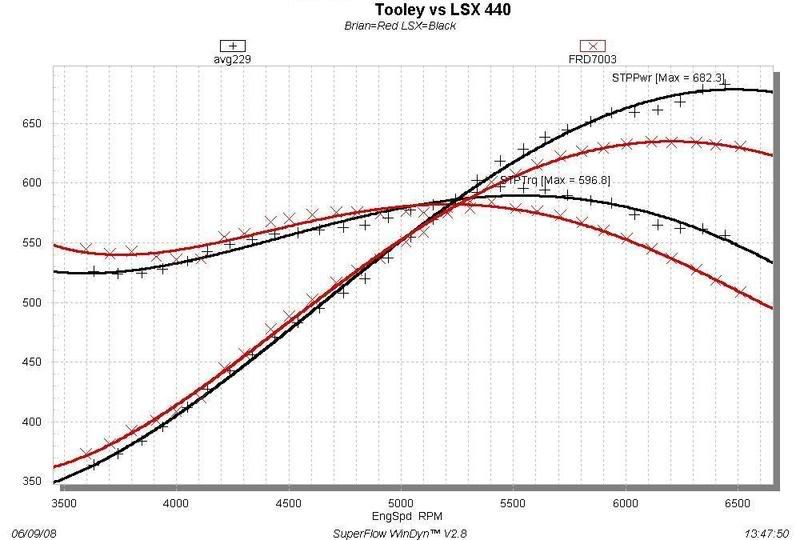
Here a dyno graph for you, the TFS 440 with more compressoin and the Fast intake port matched, versus my junk, which is a 6.0L iron block I bought off ebay for $250, bored 4.070" with a 4.100" Eagle crank, Eagle rods, Wiseco pistons, a crappy Weiand aluminum intake, TFS 235's and a Comp 248/254 113+3 and it made 635/580 without leaning on it on a conservative dyno...

i understand where you're coming from Jon. i know a lot, and learn fast, but at the same time i don't know **** and will be the first to admit it. i started this thread in hopes that some people with firsthand experience (or a degree on the subject matter) would chime in. EVEN IF THAT WERE THE CASE, i would not under any circumstances take what they say as gospel. i want a frame of reference before i dive head first into some deep reading/research. and even after that, the "experts" builing my bottom end and the "experts" assembling my heads or grinding my cam will be the ones i pay special attention to.
on the other hand, my car has been broke for several months, and i've had a bare LSX block sitting in its crate oh-so patiently waiting to be cut on and filled with parts. i want my car running/tuned before the middle of september and it's starting to drive me insane i'm trying to piece together a motor in my head before i start dumping copious amounts of cash into it....i want to know what top-end to run to get the power i'm after before i commit to making the shortblock XXX cubic inches, just in case the displacement i choose isn't enough. in other words, i don't want $6K in heads/valvetrain and fall 50hp short of my goal because i didn't build a big/strong enough bottom end.
i need my ducks in a row, and they're shitting in different ponds right now.
on the other hand, my car has been broke for several months, and i've had a bare LSX block sitting in its crate oh-so patiently waiting to be cut on and filled with parts. i want my car running/tuned before the middle of september and it's starting to drive me insane
i'm trying to piece together a motor in my head before i start dumping copious amounts of cash into it....i want to know what top-end to run to get the power i'm after before i commit to making the shortblock XXX cubic inches, just in case the displacement i choose isn't enough. in other words, i don't want $6K in heads/valvetrain and fall 50hp short of my goal because i didn't build a big/strong enough bottom end.i need my ducks in a row, and they're shitting in different ponds right now.
I know how you feel, I was there once also. I did the same thing you are doing. I got to a point that I felt like I could talk to someone and cipher out the BS. So I talked to several people and picked the one I felt most comfortable with and went from there. That is the best advice I have.
I just want to say that I have learned more in the course of my build than I ever thought I could learn about this stuff. Although I still don't know it all, my sense of smell is somewhat keener, if you know what I mean....

On The Tree

Joined: Jan 2008
Posts: 108
Likes: 3
From: Where you least expect me
Care to enlighten us stoopid folk?
In the "real world", I'm a systems engineer. That means when I design something, I start with the goal (requirements) in mind and go from there. If I were building a mild 350, I wouldn't need a set of 18 degree heads on it.
So "the biggest heads I can buy" are probably not what I'd go for, because maximized is seldom optimized.
So if you have constant test conditions and two ports which flow the same CFM, one with greater volume than the other, then the larger one has more turbulent flow. Since turbulence is cyclic, it has a frequency and makes noise. Aren't the best intake ports quiet on the flow bench?
For the smaller port to flow the same as the larger port, the smaller port would have to have a higher average flow density, which means that it wastes less volume with low energy (turbulent) flow.
In the "real world", I'm a systems engineer. That means when I design something, I start with the goal (requirements) in mind and go from there. If I were building a mild 350, I wouldn't need a set of 18 degree heads on it.
So "the biggest heads I can buy" are probably not what I'd go for, because maximized is seldom optimized.
So if you have constant test conditions and two ports which flow the same CFM, one with greater volume than the other, then the larger one has more turbulent flow. Since turbulence is cyclic, it has a frequency and makes noise. Aren't the best intake ports quiet on the flow bench?
For the smaller port to flow the same as the larger port, the smaller port would have to have a higher average flow density, which means that it wastes less volume with low energy (turbulent) flow.
Thread Starter
Joined: Oct 2006
Posts: 2,608
Likes: 0
From: Webb City, MO...out in the garage
that's the way i see it too. i don't have a degree, but i spent some time (on a full ride academic scholarship) at the university of missouri-rolla....so i have some engineering education of sorts. not much...but apparently enough to qualify me as stupid....
you touched on the main point i'm trying to address here: biggest = not always best. i know i can make "good" power by spending the most money imaginable on the biggest heads you can find, but i'm learning i can make 97% of the power for 50% of the cost...i'm not so hardcore that my street/strip car needs that extra 3%....total power aside, i want an efficient setup too. i don't want a top end that chokes my bottom end, nor do i want too much top end for the bottom to handle.
i'm leaning more and more back to the cathedral style head, probably a TFS245. i was set on LS7's for a while, but i dont want to buy a sheetmetal intake, or have to run a stock one either. the cathedral ports seem to offer equal or better exhaust flow with not-that-much-less intake flow plus i have several options on intakes. the cathedral ports are proven power-makers, LS7's are too, but have yet to come into their own, IMHO.
you touched on the main point i'm trying to address here: biggest = not always best. i know i can make "good" power by spending the most money imaginable on the biggest heads you can find, but i'm learning i can make 97% of the power for 50% of the cost...i'm not so hardcore that my street/strip car needs that extra 3%....total power aside, i want an efficient setup too. i don't want a top end that chokes my bottom end, nor do i want too much top end for the bottom to handle.
i'm leaning more and more back to the cathedral style head, probably a TFS245. i was set on LS7's for a while, but i dont want to buy a sheetmetal intake, or have to run a stock one either. the cathedral ports seem to offer equal or better exhaust flow with not-that-much-less intake flow plus i have several options on intakes. the cathedral ports are proven power-makers, LS7's are too, but have yet to come into their own, IMHO.

