



To: GM....Why a 3.622" stroke?
 To: GM....Why a 3.622" stroke?
 I was bored last night and got to playing around with desktop dyno software and I came across an interesting question. Why do you think GM designed the Gen III/IV LS1 with a 3.898" bore and 3.622" stroke to 5.7 liters, instead of sticking with the tried and true small block design of a 4.000" bore and 3.480" stroke to make the same 5.7 liters?
When I set up the two simulated dyno runs I had absolutely every other variable the exact same, except for the bore and stroke but both runs had 5.7L displacement. The two simulations had the exact same torque and horsepower curves from idle to red line, and according to the data tables the actual output was always within 2hp and about 3lb-ft of torque, so practically no difference. In real life you'd never feel a 2hp/3lb-ft increase difference.
Anyone have insight behind this change? I'm not complaining by ANY MEANS, I love these new motors, I'm just curious as to what they thought paving their own path for a new way to get to 5.7 liters would accomplish.
Let the discussion begin!

When I set up the two simulated dyno runs I had absolutely every other variable the exact same, except for the bore and stroke but both runs had 5.7L displacement. The two simulations had the exact same torque and horsepower curves from idle to red line, and according to the data tables the actual output was always within 2hp and about 3lb-ft of torque, so practically no difference. In real life you'd never feel a 2hp/3lb-ft increase difference.
Anyone have insight behind this change? I'm not complaining by ANY MEANS, I love these new motors, I'm just curious as to what they thought paving their own path for a new way to get to 5.7 liters would accomplish.
Let the discussion begin!
Here...Dyno 1 4" bore 3.480" crank
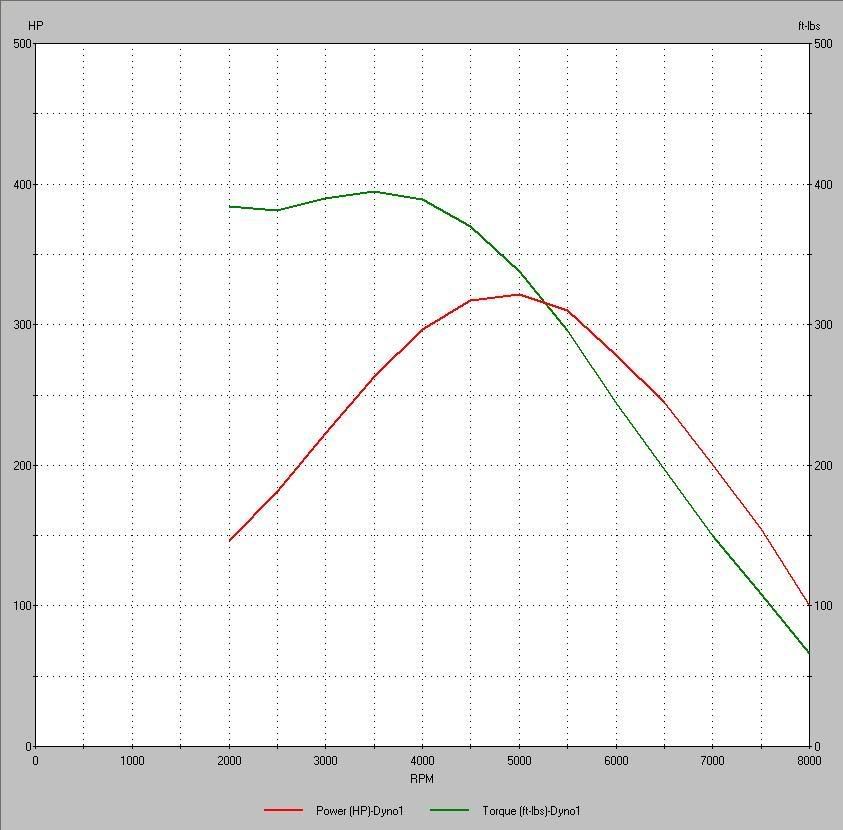
Dyno 2 3.898" bore 3.622" crank

Remember these are not the actual graphs of either motor. All I did was make two identical motors with regards to a different way to make 5.7 liters as seen with Gen I small block 5.7L's and Gen III 5.7L's like the LS1.
Dyno 2 3.898" bore 3.622" crank
Remember these are not the actual graphs of either motor. All I did was make two identical motors with regards to a different way to make 5.7 liters as seen with Gen I small block 5.7L's and Gen III 5.7L's like the LS1.
Smaller bore motors promote a more complete and efficient burn. The larger the bore becomes the harder it is to pass emissions requirements.
When the ls1 was being designed int the early 90's GM might have been under the impression that Emissions laws where going to get more strict, and when they didn't the motor was revised and slowly has continued to grow with the addition of new and more effective emission control devices.
When the ls1 was being designed int the early 90's GM might have been under the impression that Emissions laws where going to get more strict, and when they didn't the motor was revised and slowly has continued to grow with the addition of new and more effective emission control devices.
Yes I'm aware of this. I just got done building a 5.3L into a 5.7L. I told the machine shop, "bore over to 99mm, it's 96mm now." and he just looks at me funny and starts the conversion process. Anyways, desktop dyno runs in standard units, at least mine does because I don't change the units in the settings file so that's what I stated.
Trending Topics
Smaller bore motors promote a more complete and efficient burn. The larger the bore becomes the harder it is to pass emissions requirements.
When the ls1 was being designed int the early 90's GM might have been under the impression that Emissions laws where going to get more strict, and when they didn't the motor was revised and slowly has continued to grow with the addition of new and more effective emission control devices.
When the ls1 was being designed int the early 90's GM might have been under the impression that Emissions laws where going to get more strict, and when they didn't the motor was revised and slowly has continued to grow with the addition of new and more effective emission control devices.
LS1 Tech Stories
The Best V8 Stories One Small Block at Time

6 Common C5 Corvette Failures and What's Involved In Repairing Them
Pouria Savadkouei
Retro Modern Bandit Pontiac Trans AM Comes With Burt Reynolds' Autograph
Verdad Gallardo
Top 10 Greatest Cadillac V Series Performance Models Ever, Ranked
Pouria Savadkouei
Top 10 Most Powerful Chevy Trucks Ever Made!

Hennessey's New Supercharged Silverado ZR2 Has 700 HP
Verdad Gallardo
Coachbuilt N2A Anteros Is an LS2-Powered C6 Corvette In Italian Clothes
Verdad Gallardo
Awesome K5 Blazer Restomod Comes With C7 Corvette Power
Verdad Gallardo
10 Camaros You Should Never Buy

10 LS Engine Myths That Refuse to Die
Verdad Gallardo
Yes I'm aware of this. I just got done building a 5.3L into a 5.7L. I told the machine shop, "bore over to 99mm, it's 96mm now." and he just looks at me funny and starts the conversion process. Anyways, desktop dyno runs in standard units, at least mine does because I don't change the units in the settings file so that's what I stated.
As long as your parts don't end up like the space shuttle to Mars, we're good. Metric vs standard mix up my ***! It's prolly a cover up like they say in Transformers. 
Ooooooo.....Meagan Fox.
Ooooooo.....Meagan Fox.


On The Tree

Joined: Feb 2005
Posts: 178
Likes: 0
From: Odessa, TX
The 3.62 stroke at 6500 rpm and below in racing type applications does wonders. Most people in the 70's,80's,90's took 400 sbc cranks and put them in 350 blocks to make 383 (4.030x3.75). This type motor would result in a large increase in torque but not near as large for upper horsepower. The old 350 combo would make nice power upstairs but didn't have the torque. Split the 3.75 to 3.48 and you get 3.62 hmm. Maybe the best of both worlds. Born was the LS1 head that could flow on a small bore 3.898. Coupled with the 3.62 stroke to make 346 ci typcial sbc displacement. After that use your imagination LT1 vs LS1. I will say it again 402 (4.200 x 3.62) is going to be the best after market combo ever when people open there eyes.
Just my opinion.
Just my opinion.
Wow I never really looked at it this way. What an eye opener to the design process of GM before the LS1 ever came out. Way to go GM!



Joined: Apr 2006
Posts: 3,891
Likes: 1,137
From: Grand Rapids, Michigan
Regarding flame front burn theory, think of it this way: Pour two lines of equal amounts of gas out on the ground. One 3 feet long, one 6 feet long. Light them at the same time and you'll find that the flame hits the end of the 3 foot path quicker than the 6 foot path. Gasoline does not "explode" in the cylinder, it actually has a measurable burn time. Since an engine has a limited amount of time to burn the fuel, it becomes more efficient if the flame does not have to travel as far a distance.