


Th400 lq4. Converter to flexplate gap.


Thread Starter
Teching In
Joined: Oct 2008
Posts: 22
Likes: 0
From: Lincoln Nebraska.
 Th400 lq4. Converter to flexplate gap.
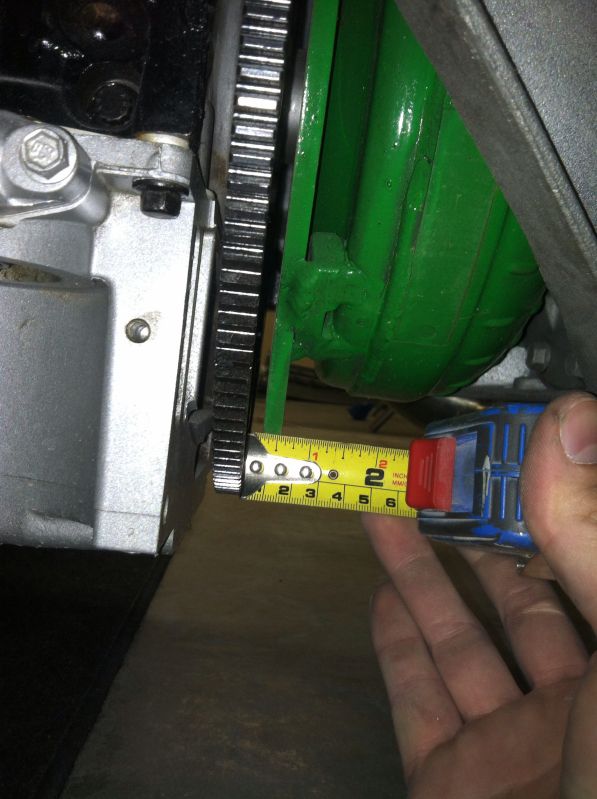
 I've neglected to ask this earlier, but my converter to flexplate has a gap. I used the tci flexplate and the spacer. The converter is pretty snug to turn on the motor as it's tight at the spacer. Should I just shim it and go? The converter is fully seated in the trans. Th400 and '03 lq4.


I had the same problem with my 5.3 and th350. I used three washers of the same grade and drove it without any issues for a year or so. Just make sure you have a little clearance between the converter and pump.

This is what you need to worry about right here. Maybe one of the transmission guru's can chime in on what the max spec could be, but 3/8" is usually what you shoot for. If you are +/- 1/16" of that, I would be fine with it.

I have the same set up, lq4 and a 400 with the TCI 399753 plate and tci converter but I think my converter come's out to far from the trans. Did you check to see if the spacer fit over the nose on the tc ? ( old pic, to far away )
Trending Topics

My concern is you said it was tight to turn. Can you push the converter all the way to the flexplate and does it spin. The converter pilot might be a little long and you are binding in the crank, which is not good.
Chris
Chris
Thread Starter
Teching In
Joined: Oct 2008
Posts: 22
Likes: 0
From: Lincoln Nebraska.
Weird.
I can still turn it, it's just definetaly not as free turning as some others I've turned by hand. This is just my first lsx build. As far as moving it front or back towards the trans or towards the flexplate, no. I cannot move it. The converter is from freakshow.
I can still turn it, it's just definetaly not as free turning as some others I've turned by hand. This is just my first lsx build. As far as moving it front or back towards the trans or towards the flexplate, no. I cannot move it. The converter is from freakshow.
Thread Starter
Teching In
Joined: Oct 2008
Posts: 22
Likes: 0
From: Lincoln Nebraska.


http://www.jakesperformance.com/Tran..._FAQ_Page.html
How do I know the converter is completely seated?
The old "3 clicks" method is not an accurate way to determine if the converter is correctly installed.
There MUST be clearance between the converter and flexplate when the trans is bolted to the engine.
In a perfect world this would be 1/8" or .125" everytime, and you just bolt it up and go.
In the real world, we have to check it and make adjustments as necessary.
On a typical GM engine, the flexplate mounting pads are 1" away from the bellhousing flange area of the block.
The converter pads when seated completely will be approximately 1 and 1/8th inch ( 1.125")recessed into the bellhousing.
Seat the converter, then measure the distance from the engine block bellhousing mating flange, to the mounting pad on the flexplate.
Then do the same from the transmission bellhousing mating face, to the converter mounting pads.
You should have the converter sitting deeper than the flexplate protrudes from the engine.
If so, you can now bolt the transmission to the engine.
With the trans bolted to the engine, you should be able to turn the converter freely.
Check the distance from the converter to the flexplate with the converter completely seated into the transmission.
You should have 1/8" to 3/16" clearance. (.125"-.187")
If it is more than 3/16", you should use flat ground washers to shim between the flexplate and converter.
How do I know the converter is completely seated?
The old "3 clicks" method is not an accurate way to determine if the converter is correctly installed.
There MUST be clearance between the converter and flexplate when the trans is bolted to the engine.
In a perfect world this would be 1/8" or .125" everytime, and you just bolt it up and go.
In the real world, we have to check it and make adjustments as necessary.
On a typical GM engine, the flexplate mounting pads are 1" away from the bellhousing flange area of the block.
The converter pads when seated completely will be approximately 1 and 1/8th inch ( 1.125")recessed into the bellhousing.
Seat the converter, then measure the distance from the engine block bellhousing mating flange, to the mounting pad on the flexplate.
Then do the same from the transmission bellhousing mating face, to the converter mounting pads.
You should have the converter sitting deeper than the flexplate protrudes from the engine.
If so, you can now bolt the transmission to the engine.
With the trans bolted to the engine, you should be able to turn the converter freely.
Check the distance from the converter to the flexplate with the converter completely seated into the transmission.
You should have 1/8" to 3/16" clearance. (.125"-.187")
If it is more than 3/16", you should use flat ground washers to shim between the flexplate and converter.
Weird.
I can still turn it, it's just definetaly not as free turning as some others I've turned by hand. This is just my first lsx build. As far as moving it front or back towards the trans or towards the flexplate, no. I cannot move it. The converter is from freakshow.
I can still turn it, it's just definetaly not as free turning as some others I've turned by hand. This is just my first lsx build. As far as moving it front or back towards the trans or towards the flexplate, no. I cannot move it. The converter is from freakshow.
Chris

Moderator


Joined: Aug 2010
Posts: 7,320
Likes: 526
From: Ann Arbor, MI
When you have the right converter and it is fully seated, you can easily pull the converter out to touch the flexplate and then push it back in to make the gap.
jrpimp00 has all the right and critical measurements.
As Chris mentions, if you cannot easily push/pull the converter back and forth, you have a major problem that must be solved before you trying bolting it up.
jrpimp00 has all the right and critical measurements.
As Chris mentions, if you cannot easily push/pull the converter back and forth, you have a major problem that must be solved before you trying bolting it up.
Moderator
Joined: Aug 2010
Posts: 7,320
Likes: 526
From: Ann Arbor, MI
If you cannot easily (e.g max 10 lb force) pull out the converter to touch the flexplate and "potentially" bolt up without any gap and without spacers, then something is WRONG.
The purpose for the spacers is so that the converter does not pull out so far that the pump is disengaged. Is is NOT to fill a gap you cannot close.
Did you get it ? if not, man I would just pull it back. If you think its a pain in the *** now, wait till it brakes and you still have to pull it out and then fix whats broke.$$$$
Sadly it needs to come out to check. But like these guys are saying, could get expensive if you don't check. And the problem you are having could possible cause a thrust failure in the engine.
Chris
Chris