




Multiple 4l80e pressure control solenoids failures
Thread Starter
Teching In
Joined: Oct 2017
Posts: 22
Likes: 3
From: OKLAHOMA
 Multiple 4l80e pressure control solenoids failures
 Really need some help here guys.
I put a 4l80E in my truck and have it wired for full manual shift. I have had 2 pressure control solenoids fail back to back. Can anyone help me out with what might be causing this?
Each solenoid fails after the first drive. This morning I drove the truck 15 miles to work and the previous time it failed after about a 5 mile drive. Each time the transmission is shifting fine until I shut it off and let it sit for a few minutes. Go to fire it back up and drive off and no forward gears. I can unplug the harness and it will default to second gear.
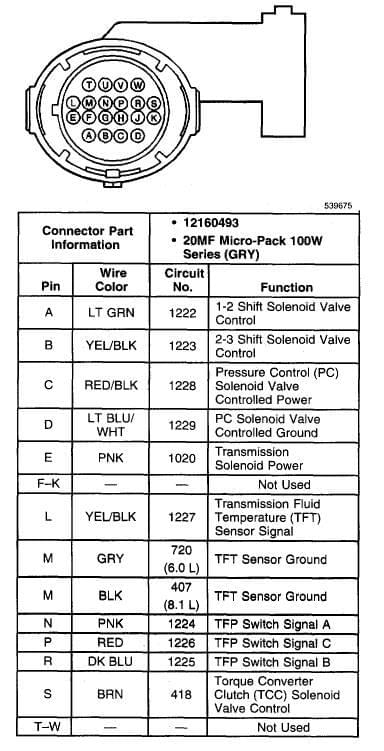
Wiring setup: Pins N-R-A together and tape into the harness.
Pins P-B together and tape into the harness.
Supply switched power to pin E to power up the transmission solenoids.
Supply ground to pin S to control lock up.
I put a 4l80E in my truck and have it wired for full manual shift. I have had 2 pressure control solenoids fail back to back. Can anyone help me out with what might be causing this?
Each solenoid fails after the first drive. This morning I drove the truck 15 miles to work and the previous time it failed after about a 5 mile drive. Each time the transmission is shifting fine until I shut it off and let it sit for a few minutes. Go to fire it back up and drive off and no forward gears. I can unplug the harness and it will default to second gear.
Wiring setup: Pins N-R-A together and tape into the harness.
Pins P-B together and tape into the harness.
Supply switched power to pin E to power up the transmission solenoids.
Supply ground to pin S to control lock up.
Thread Starter
Teching In
Joined: Oct 2017
Posts: 22
Likes: 3
From: OKLAHOMA
I checked the ohms reading and it said that it was bad so I replaced it. I did not realize that it was no longer actually functioning with the manual wiring. The first time this happened I pulled the pan and checked all of the solenoids and it was the only one that was bad. I replaced all of the solenoids (A & B shift, TCC, pressure control, pressure plate, and internal harness). I figured since I had the pan off I might as well swap them.
Thread Starter
Teching In
Joined: Oct 2017
Posts: 22
Likes: 3
From: OKLAHOMA
I stopped and picked up a line pressure gauge on my way home so I will check it once I get the truck back to my house. (Its sitting on a trailer in my shop at work). I may be thinking about this completely wrong as I am not very familiar with transmissions in general but reverse works great. So it must have some line pressure but I'm not really sure how the valve body works.

TECH Junkie


Joined: Jun 2008
Posts: 3,204
Likes: 1,391
From: Nitro Alley
I stopped and picked up a line pressure gauge on my way home so I will check it once I get the truck back to my house. (Its sitting on a trailer in my shop at work). I may be thinking about this completely wrong as I am not very familiar with transmissions in general but reverse works great. So it must have some line pressure but I'm not really sure how the valve body works.
To put this simply; the pressure control solenoid is doing the opposite.
The pump creates the line pressure, and the pressure control solenoid more or less bleeds off the line pressure.
The pressure control solenoid controls how much the line pressure is reduced.
The EPC needs a current (amperage) to pulse/ hold its valve open to lower the line pressure.
The pressure control solenoid does not need a current to maintain line pressure.
More current = Lower line pressure
Less current = Higher line pressure
No current = Maintained line pressure
Just as Mr. Maroony Da Monsta said:
The EPC could (resistance wise) be good or bad... It would make no difference in the line pressure produced.
Thread Starter
Teching In
Joined: Oct 2017
Posts: 22
Likes: 3
From: OKLAHOMA
Many people seem to think that the pressure control solenoid is pulsing to generate line pressure...
To put this simply; the pressure control solenoid is doing the opposite.
The pump creates the line pressure, and the pressure control solenoid more or less bleeds off the line pressure.
The pressure control solenoid controls how much the line pressure is reduced.
The EPC needs a current (amperage) to pulse/ hold its valve open to lower the line pressure.
The pressure control solenoid does not need a current to maintain line pressure.
More current = Lower line pressure
Less current = Higher line pressure
No current = Maintained line pressure
Just as Mr. Maroony Da Monsta said:
When wiring the valve-body control solenoids as you state you have... the EPC serves no purpose other then to prevent a line pressure circuit leak.
The EPC could (resistance wise) be good or bad... It would make no difference in the line pressure produced.
To put this simply; the pressure control solenoid is doing the opposite.
The pump creates the line pressure, and the pressure control solenoid more or less bleeds off the line pressure.
The pressure control solenoid controls how much the line pressure is reduced.
The EPC needs a current (amperage) to pulse/ hold its valve open to lower the line pressure.
The pressure control solenoid does not need a current to maintain line pressure.
More current = Lower line pressure
Less current = Higher line pressure
No current = Maintained line pressure
Just as Mr. Maroony Da Monsta said:
When wiring the valve-body control solenoids as you state you have... the EPC serves no purpose other then to prevent a line pressure circuit leak.
The EPC could (resistance wise) be good or bad... It would make no difference in the line pressure produced.
So I was able to get the truck back to my house today. The pressure control solenoid is not bad as I had thought previously. I just assumed it was since the first time I lost all forward gears I checked it and found that it was bad. I then replaced it, put the pan back on, filled it with fluid and it worked. I didn't know that the transmission would function fine once it cooled off as I never checked that when I had the issue the first time. So today I put it on jack stands and the transmission worked flawlessly. Ran it through all 4 gears and it had plenty of power to push through the brakes.
Cold pressure readings in gear no brake applied.
P-155 PSI
R-175 PSI
N-150 PSI
4-150 PSI
3-150 PSI
2-140 PSI
1-140 PSI
Let the the truck run in 4th gear for 30 minutes at 1500 rpm. Shut off the motor waited 5 minutes and started it back up. Took pressure readings in all gears and it was 100 psi across the board except for reverse and that was 140 psi.
Thoughts? I was planning to take the truck to the strip for the first time next weekend so If at all possible id like to get it back up and running ASAP.
Thank you all for the help.
Trending Topics
Thread Starter
Teching In
Joined: Oct 2017
Posts: 22
Likes: 3
From: OKLAHOMA
You were 100% correct. Nothing wrong with the solenoid. It gets warm and looses line pressure.
LS1 Tech Stories
The Best V8 Stories One Small Block at Time

Topdon ONE vs. Artidiag 800 BT2: Which is the Diagnostic Tablet For You?
Pouria Savadkouei
Gas Monkey Built a 6-Wheel Ferrari Testarossa With a Corvette LT4 Engine
Verdad Gallardo
7 Most Reliable High-Performance Engines GM Has Ever Built
Verdad Gallardo
Amazing '71 Camaro Restomod Is Modern Muscle Car Under the Skin
Verdad Gallardo
6 Common C5 Corvette Failures and What's Involved In Repairing Them
Pouria Savadkouei
Retro Modern Bandit Pontiac Trans AM Comes With Burt Reynolds' Autograph
Verdad Gallardo
Top 10 Greatest Cadillac V Series Performance Models Ever, Ranked
Pouria Savadkouei
Top 10 Most Powerful Chevy Trucks Ever Made!

Hennessey's New Supercharged Silverado ZR2 Has 700 HP
Verdad Gallardo
TECH Junkie


Joined: Dec 2012
Posts: 3,621
Likes: 1,334
From: Iowa
Something is worn...being low in all gear ranges it's either the pump or you've cracked the case with overpressure.
Accelerated pump wear occurs with maintained max line (usually it won't make a pump **** the bed in the amount of time you've had yours running)
cracking the case is a byproduct of how you accomplished your manual control...you (as well as many others) don't account for the extreme pressure in reverse...we're talking 2x what max line is in other gear ranges...add that to a channel casting that has probably 10-12 square inches of surface along its entirety...and you're looking at alooooot of stress...you wouldn't be the first guy to crack the case in this area.
I'm not 100% those are your issues...but they're on the list of possibilities.
Simpler issues would be worn PR/Boost...crappy AFL...etc
Accelerated pump wear occurs with maintained max line (usually it won't make a pump **** the bed in the amount of time you've had yours running)
cracking the case is a byproduct of how you accomplished your manual control...you (as well as many others) don't account for the extreme pressure in reverse...we're talking 2x what max line is in other gear ranges...add that to a channel casting that has probably 10-12 square inches of surface along its entirety...and you're looking at alooooot of stress...you wouldn't be the first guy to crack the case in this area.
I'm not 100% those are your issues...but they're on the list of possibilities.
Simpler issues would be worn PR/Boost...crappy AFL...etc
Thread Starter
Teching In
Joined: Oct 2017
Posts: 22
Likes: 3
From: OKLAHOMA
Something is worn...being low in all gear ranges it's either the pump or you've cracked the case with overpressure.
Accelerated pump wear occurs with maintained max line (usually it won't make a pump **** the bed in the amount of time you've had yours running)
cracking the case is a byproduct of how you accomplished your manual control...you (as well as many others) don't account for the extreme pressure in reverse...we're talking 2x what max line is in other gear ranges...add that to a channel casting that has probably 10-12 square inches of surface along its entirety...and you're looking at alooooot of stress...you wouldn't be the first guy to crack the case in this area.
I'm not 100% those are your issues...but they're on the list of possibilities.
Simpler issues would be worn PR/Boost...crappy AFL...etc
Accelerated pump wear occurs with maintained max line (usually it won't make a pump **** the bed in the amount of time you've had yours running)
cracking the case is a byproduct of how you accomplished your manual control...you (as well as many others) don't account for the extreme pressure in reverse...we're talking 2x what max line is in other gear ranges...add that to a channel casting that has probably 10-12 square inches of surface along its entirety...and you're looking at alooooot of stress...you wouldn't be the first guy to crack the case in this area.
I'm not 100% those are your issues...but they're on the list of possibilities.
Simpler issues would be worn PR/Boost...crappy AFL...etc
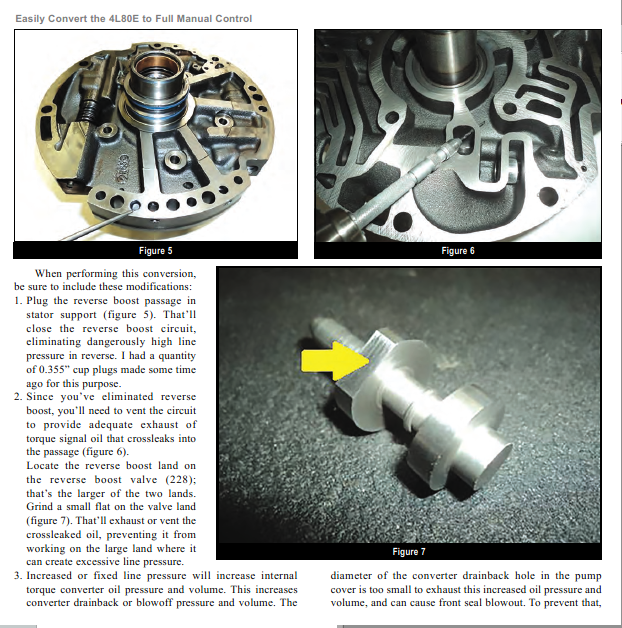
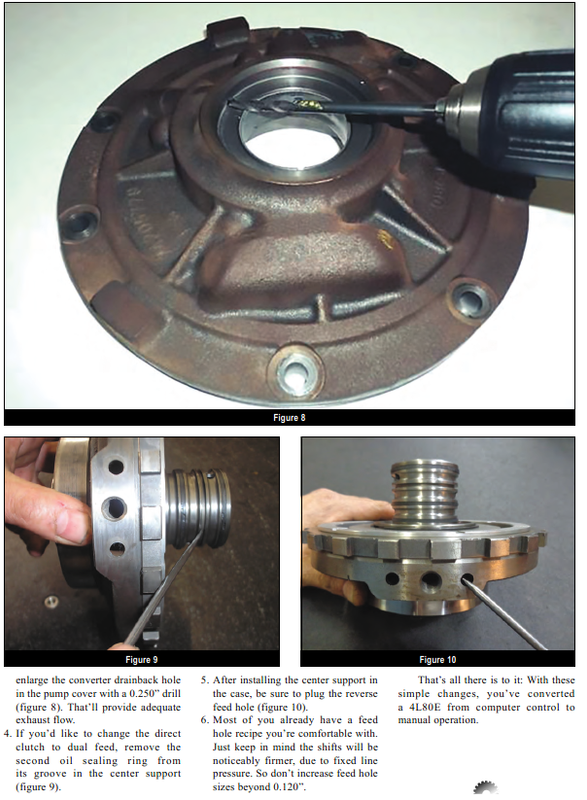
Thank you for the input. I did these modifications prior to making the transmission manual shift so hopefully this takes cracking the case out of the picture. I am going to pull the transmission this evening and take the pump out for inspection.
Thread Starter
Teching In
Joined: Oct 2017
Posts: 22
Likes: 3
From: OKLAHOMA
Do you think installing a new pump would remedy the situation all together? I can get a new pump for pretty cheap and if that can get me back up and running by this weekend it would be awesome.
TECH Junkie
Joined: Dec 2012
Posts: 3,621
Likes: 1,334
From: Iowa
I think properly diagnosing the issue and taking the corrective action after a diagnosis would be the best remedy.
AFL bore would still be suspect
Pump is suspect
clogged filter is possible
low fluid level
etc etc
I'd start with a pan drop and VB vacuum test along with visual inspection of the case
pump after that if it all checks out
AFL bore would still be suspect
Pump is suspect
clogged filter is possible
low fluid level
etc etc
I'd start with a pan drop and VB vacuum test along with visual inspection of the case
pump after that if it all checks out
Thread Starter
Teching In
Joined: Oct 2017
Posts: 22
Likes: 3
From: OKLAHOMA
I think properly diagnosing the issue and taking the corrective action after a diagnosis would be the best remedy.
AFL bore would still be suspect
Pump is suspect
clogged filter is possible
low fluid level
etc etc
I'd start with a pan drop and VB vacuum test along with visual inspection of the case
pump after that if it all checks out
AFL bore would still be suspect
Pump is suspect
clogged filter is possible
low fluid level
etc etc
I'd start with a pan drop and VB vacuum test along with visual inspection of the case
pump after that if it all checks out