





Torque Converter education

Very good thread, and excellent additions from Circle-D and Yank. This is why I always recommend a Yank or Vig converter ... I might add Circle-D, as they have a good product, but would like to see more customer results. I can spot a good converter over a bad unit, since I do have converter building/design experience from working at B&M. 

Launching!
Joined: Aug 2008
Posts: 251
Likes: 0
The reason I ask is that I just purchased one of these from ACE. I didn't think it made a difference but was wondering based on that comment or if that was just an over generalization.
https://ls1tech.com/forums/showthrea...ace+converters
https://ls1tech.com/forums/showthrea...ace+converters
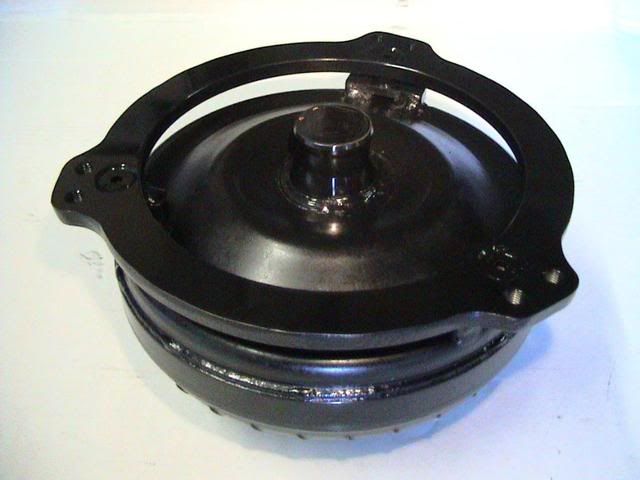
I'm still hoping someone will chime in on this one based on the statement made above. I'm not sure I'd call it a budget converter by any means and have no results yet so I will hold any judgment until I see some track times but I am curious to know how others feel about that design.
I'm still hoping someone will chime in on this one based on the statement made above. I'm not sure I'd call it a budget converter by any means and have no results yet so I will hold any judgment until I see some track times but I am curious to know how others feel about that design.
Im no converter guru so I cant say a whole lot but that converter you posted is exactly what sicko was talking about its a converter not made for your car that is torn down rebuilt with a few different components and a adapter is welded to it to make it fit, the main concern I see with the one you posted is the tiny lockup clutch. That band is very very small for such a heavy car. Other than that to me it seems they went through and strengthened everything well, but on the flip side it appears they still strengthened 4cyl torque converters to make them work with a 8.
I would be most curios what that converter started of as, if indeed it is a converter from a 4cyl car converted to work I would be concerned.
i had a tci 4200. it didnt give me problems, but wasn't real efficient like my Yank 4000 is. but it did hit hard though. but then i also didn't run the tci as long either. can't remember if it had the adapter ring or not. if all tci have the ring, then it did.
LS1 Tech Stories
The Best V8 Stories One Small Block at Time

Topdon ONE vs. Artidiag 800 BT2: Which is the Diagnostic Tablet For You?
Pouria Savadkouei
Gas Monkey Built a 6-Wheel Ferrari Testarossa With a Corvette LT4 Engine
Verdad Gallardo
7 Most Reliable High-Performance Engines GM Has Ever Built
Verdad Gallardo
Amazing '71 Camaro Restomod Is Modern Muscle Car Under the Skin
Verdad Gallardo
6 Common C5 Corvette Failures and What's Involved In Repairing Them
Pouria Savadkouei
Retro Modern Bandit Pontiac Trans AM Comes With Burt Reynolds' Autograph
Verdad Gallardo
Top 10 Greatest Cadillac V Series Performance Models Ever, Ranked
Pouria Savadkouei
Top 10 Most Powerful Chevy Trucks Ever Made!

Hennessey's New Supercharged Silverado ZR2 Has 700 HP
Verdad Gallardo


The only real difference of consequence between the two style converters is the size of the lockup clutch. As far as the fins and vanes sprags used etc the durability of either style in a quality built unit should the same, The billet types do offer the advantage of a larger lockup clutch giving it the ability to live longer with PWM functional and odd lockup situations like WOT lockup on the dyno and at the end of the track,
If you have the ring type i would not worry if it built by a reputable company its likely just fine.
We sell both style converters and I can say we have seen no appreciable issues with the lower cost units in the past two years.
If you have the ring type i would not worry if it built by a reputable company its likely just fine.
We sell both style converters and I can say we have seen no appreciable issues with the lower cost units in the past two years.
__________________


Teching In
Joined: May 2006
Posts: 31
Likes: 0
From: Texas
Ok - I own a semi-daily driver C5 Corvette with a tuned 405hp LS6. The car has a RPM Level 4 transmission (on order), 3.15 rear end, 295/35/19 rear tire, 10% under-drive pulley, Lg pro headers, high flow cats, and a B&B Bullet catback. I may end up with a supercharger, at some point, but no firm plans on it. I make about 10 passes down the 1/4 per year, but I drive aggressively on the street more often than that.
How do the budget converters (Fuddle, TCI, etc...) hold up in these conditions?
Are the smaller lockup clutches not suitable for this setup?
I would like for the car to remain as close to stock feeling as possible.
Which converter would you guys (vendors also welcomed)recommend for me and why (manufacturer, stall, stall ratio, etc..)?
All of you guys appear to be racers, so I'm asking these questions for me and the other non-racers.
Thanks for the input and the information!
How do the budget converters (Fuddle, TCI, etc...) hold up in these conditions?
Are the smaller lockup clutches not suitable for this setup?
I would like for the car to remain as close to stock feeling as possible.
Which converter would you guys (vendors also welcomed)recommend for me and why (manufacturer, stall, stall ratio, etc..)?
All of you guys appear to be racers, so I'm asking these questions for me and the other non-racers.
Thanks for the input and the information!
Last edited by Mister Peebody; Sep 27, 2008 at 10:54 PM. Reason: added info about car

11 Second Club
iTrader: (32)
Joined: Jan 2006
Posts: 3,701
Likes: 2
From: Southaven, MS (near Memphis, TN)
IMO, the Yank SS3600 in my car feels almost stock..sometimes I forget I have an aftermarket converters. Well worth the money.

Teching In
Joined: Feb 2007
Posts: 20
Likes: 0
From: Fort Bragg
Im no converter guru so I cant say a whole lot but that converter you posted is exactly what sicko was talking about its a converter not made for your car that is torn down rebuilt with a few different components and a adapter is welded to it to make it fit, the main concern I see with the one you posted is the tiny lockup clutch. That band is very very small for such a heavy car. Other than that to me it seems they went through and strengthened everything well, but on the flip side it appears they still strengthened 4cyl torque converters to make them work with a 8.
I would be most curios what that converter started of as, if indeed it is a converter from a 4cyl car converted to work I would be concerned.
I would be most curios what that converter started of as, if indeed it is a converter from a 4cyl car converted to work I would be concerned.
There is a pretty popular guy here in NC, Greg Slack, that does these type of converters. I believe he uses Nissan cores for powerglides. He isnt cheap by any means, and I dont hear any negative comments about his stuff.

On The Tree
Joined: Jun 2007
Posts: 184
Likes: 0

since you like to chat about converters i have one for you,
i install a yunk converter in my 2000 t/a and since i picked an unusual miss or hesitation at a very low speed.(in a clutch car it would be if you are moving at a low speed with a high gear!!!!!!!!!!!!)
any ideas?
thank you
i install a yunk converter in my 2000 t/a and since i picked an unusual miss or hesitation at a very low speed.(in a clutch car it would be if you are moving at a low speed with a high gear!!!!!!!!!!!!)
any ideas?
thank you

A note about balancing. There is balancing, and there
is balancing. Very few manufacturers appear to do a
dynamic / spin balance. TCI claims to (or did). My old
TCI 3000/2.2 was dead smooth, 97% efficient up top
and got there by 5000RPM, and its lockup went out
before I had 1000 miles on it (though I blame B&M
Trick Shi_t fluid for that, at least primarily). I had
to do a lot of trans tune messing to get it drivable.
Now the Fuddle I run, has a nice big lockup clutch
but they only "static balanced" their converters
(bubble gauge I guess) and it's had a resonant
vibration since day one and gave me a lot of false
misfire detects, so again I had to tune that out.
I have asked certain other mfrs about -how-
they balance their converters, and haven't had
anyone but TCI (this, only marketing material, not
a dude-in-the-know) say they do a spin balance.
I would say that single feature would be worth
another 50 bucks to me, just to know it's pimp
smooth on the low down as well as a beefy
lockup (supersize me, or STFU). And I have to
believe there's separate dimensions of abuse-
durability, vs wear-durability in any friction
system and a variety of frictions (just like brakes).
But nobody talks much about that, except to
get you all excited about Kevlar this and carbon
fiber that. Not much info about the relative merits
(or demerits) of paper, organic, Kevlar, carbon
ceramic, carbon fiber and so on. Like I've been
told Kevlar is tough for the track but more prone
to chatter / groan on soft apllies (true or not).
People need pros and cons to make a decent
personal decision and of course the slick sheet
only gives you the pros (and maybe somebody
else's cons).
The Fuddle also seems to have a split-second
"hesitation" where the RPMs jump but the torque
lags. As if you have to stir the pot for a moment
before it gets "up on plane". It doesn't seem to
bother anything, really. But the TCI didn't do
that. Maybe it's an artifact of the different
construction, 3000/2.2 vs 3500/2.0 or something.
But what, why and whether BrandA.ModelX does
or doesn't or nobody can say, who knows?
I'd like to see any vendors who are willing, stand
up and expound on these points.
is balancing. Very few manufacturers appear to do a
dynamic / spin balance. TCI claims to (or did). My old
TCI 3000/2.2 was dead smooth, 97% efficient up top
and got there by 5000RPM, and its lockup went out
before I had 1000 miles on it (though I blame B&M
Trick Shi_t fluid for that, at least primarily). I had
to do a lot of trans tune messing to get it drivable.
Now the Fuddle I run, has a nice big lockup clutch
but they only "static balanced" their converters
(bubble gauge I guess) and it's had a resonant
vibration since day one and gave me a lot of false
misfire detects, so again I had to tune that out.
I have asked certain other mfrs about -how-
they balance their converters, and haven't had
anyone but TCI (this, only marketing material, not
a dude-in-the-know) say they do a spin balance.
I would say that single feature would be worth
another 50 bucks to me, just to know it's pimp
smooth on the low down as well as a beefy
lockup (supersize me, or STFU). And I have to
believe there's separate dimensions of abuse-
durability, vs wear-durability in any friction
system and a variety of frictions (just like brakes).
But nobody talks much about that, except to
get you all excited about Kevlar this and carbon
fiber that. Not much info about the relative merits
(or demerits) of paper, organic, Kevlar, carbon
ceramic, carbon fiber and so on. Like I've been
told Kevlar is tough for the track but more prone
to chatter / groan on soft apllies (true or not).
People need pros and cons to make a decent
personal decision and of course the slick sheet
only gives you the pros (and maybe somebody
else's cons).
The Fuddle also seems to have a split-second
"hesitation" where the RPMs jump but the torque
lags. As if you have to stir the pot for a moment
before it gets "up on plane". It doesn't seem to
bother anything, really. But the TCI didn't do
that. Maybe it's an artifact of the different
construction, 3000/2.2 vs 3500/2.0 or something.
But what, why and whether BrandA.ModelX does
or doesn't or nobody can say, who knows?
I'd like to see any vendors who are willing, stand
up and expound on these points.
1-I can tell you our converters of both types are spin balanced.The machine from watching looks and works very similar to the speed balance machines used for wheels.
2-Kevlar has a lower friction Coefficient meaning more prone to slip but able to handle the higher temps very well when it does.And from what I have seen is more prone to things like chatter particularly when PWM is allowed to function.
3-Carbon fiber types in my opinon are the best compromise.
4- As for STR , K FACTOR, LOOSE ,TIGHT, EFFIECENCY thats really all in the MATH on what your making, Each change in STALL, STR ect has and effect on the others.
I can likley get all the math from our converter guy as thats not me and post it all. To me its mostly greek but then I am a trans guy.
Perhaps I will ask him to write it all out and then I will put it up on here.
2-Kevlar has a lower friction Coefficient meaning more prone to slip but able to handle the higher temps very well when it does.And from what I have seen is more prone to things like chatter particularly when PWM is allowed to function.
3-Carbon fiber types in my opinon are the best compromise.
4- As for STR , K FACTOR, LOOSE ,TIGHT, EFFIECENCY thats really all in the MATH on what your making, Each change in STALL, STR ect has and effect on the others.
I can likley get all the math from our converter guy as thats not me and post it all. To me its mostly greek but then I am a trans guy.
Perhaps I will ask him to write it all out and then I will put it up on here.
__________________

Well let me chime in. All of our converters are spin balanced. Both the piston and turbine balanced together before assembly and the entire unit as an assembly. Any quality converter will have this done to it and i am pretty sure that most of the sponsors on here do so. As far as clutch we use a propietary lining design and tested for PWM application.
Greg
Greg
__________________
FTI COMPETITION CONVERTERS AND TRANSMISSIONS
"IT'S NOT CHEATING, IT'S THE COMPETITIVE EDGE."
1-866-726-8358
info@ftiperformance.com
FTIPerformance.com
FTI Converter build sheet

FTI COMPETITION CONVERTERS AND TRANSMISSIONS
"IT'S NOT CHEATING, IT'S THE COMPETITIVE EDGE."
1-866-726-8358
info@ftiperformance.com
FTIPerformance.com
FTI Converter build sheet

Well let me chime in. All of our converters are spin balanced. Both the piston and turbine balanced together before assembly and the entire unit as an assembly. Any quality converter will have this done to it and i am pretty sure that most of the sponsors on here do so. As far as clutch we use a propietary lining design and tested for PWM application.
Greg
Greg
The only indication I've seen are plates welded on like OEM, TCI, and B&M, and others.
I've used converters that are supposedly balanced, but have no indication, no extra weld bead, no weight removed, nothing.
So how is weight added or subtracted to balance a converter?
