




What flexplate feedback needed??
 What flexplate feedback needed??
 So after some searching I really havent come to a decision on which flexplate to get. Should I get the 98 Flexplate which I believe is the same as the 06 traiblazer ss flexplate Gm Part Number 12580709 or should I go with the TCI SFI flexplate? Ive heard that tci flexplate has 7/16 holes and the converter uses alittle different size so there will be some slop there although people seem to run this combo with plenty of success but I dont want to run into stupid issues which seems to happen lately haha.... What should I go with....
Yes I have an opinion. Go with the TCI flexplate part #399753. I just installed it on my ls1 to 4l80e. Used 6 bolts off of a trucks stock torque converter. They are longer than stock and worked perfectly. The ones sent from YANK were too short. This bolted up great with my py3400. You should run this SFI plate if under 9.99, its good insurance too for only about 100 more.
GOOD LUCK!
If you need more info feel free to pm.
GOOD LUCK!
If you need more info feel free to pm.
Yes I have an opinion. Go with the TCI flexplate part #399753. I just installed it on my ls1 to 4l80e. Used 6 bolts off of a trucks stock torque converter. They are longer than stock and worked perfectly. The ones sent from YANK were too short. This bolted up great with my py3400. You should run this SFI plate if under 9.99, its good insurance too for only about 100 more.
GOOD LUCK!
If you need more info feel free to pm.
GOOD LUCK!
If you need more info feel free to pm.
I got it from a van acutally it was a 2000 or 2001. I did type truck but thats wrong, although i bet they are the same. HAHA...car isnt up and running for a while. I only have some weekends to work on it, 4l80e is in...still got wiring harness and yoke stuff etc...to finish. Just got a bung welded in my pan for temp gauge.
You are right about the incompatability with 4l80e converter. I spent too much time researching this crap haha. Glad to save anyone time. I would find the part number for stock flexplate bolts on trucks and vans and compare and order them off of a gmparts site of somesort. (I did that for stock bellhousing bolts that havent came in yet.)
You are right about the incompatability with 4l80e converter. I spent too much time researching this crap haha. Glad to save anyone time. I would find the part number for stock flexplate bolts on trucks and vans and compare and order them off of a gmparts site of somesort. (I did that for stock bellhousing bolts that havent came in yet.)
Trending Topics
Yea thanks I guess that whats ill have to do then. PSU 98 does the ls2 flexplate seem heavier duty then the 01-02 style flexplate. Btw ur car will prob run awsome with that verter installed that converter was awsome...
LS1 Tech Stories
The Best V8 Stories One Small Block at Time

Topdon ONE vs. Artidiag 800 BT2: Which is the Diagnostic Tablet For You?
Pouria Savadkouei
Gas Monkey Built a 6-Wheel Ferrari Testarossa With a Corvette LT4 Engine
Verdad Gallardo
7 Most Reliable High-Performance Engines GM Has Ever Built
Verdad Gallardo
Amazing '71 Camaro Restomod Is Modern Muscle Car Under the Skin
Verdad Gallardo
6 Common C5 Corvette Failures and What's Involved In Repairing Them
Pouria Savadkouei
Retro Modern Bandit Pontiac Trans AM Comes With Burt Reynolds' Autograph
Verdad Gallardo
Top 10 Greatest Cadillac V Series Performance Models Ever, Ranked
Pouria Savadkouei
Top 10 Most Powerful Chevy Trucks Ever Made!

Hennessey's New Supercharged Silverado ZR2 Has 700 HP
Verdad Gallardo I've never actually had the stock flexplate in my hands so I don't know how it will compare. I figured the LS2 piece was a relatively cheap "as long as I'm in there" replacement part. Do a quick search and you should find one of my posts from a few weeks back with a pic.
All I need for the install now is a trans cooler... just waiting on the tax refund
All I need for the install now is a trans cooler... just waiting on the tax refund
Yea im not sure which im going to go with ive heard the ls2/98 flexplate is stronger and I should be able to use the same verter bolts that I have now. The tci flexplate might be able to take more abuse and is sfi certified. There is some pretty fast cars on here running the tci flexplate with what seems to be no problems.
Ya, I just dont want to have to do the job twice. Thats why i spent the extra 100 bucks and got one. 207 bucks. NIce heavy duty piece. I glanced and didnt find a part number on those bolts but i know they can be found, usually on truckls1 websites.
I didnt notice any slop in the install....hmmmm. Are the holes bigger forsure? i coulda measured...it seemed fine to me. I remember reading something about 7/16ths bolts and if i wanted to use them id have to drill out the plate....
Just found this...
Flexplates are .035" thicker than stock and the starter ring is welded to both sides of the flexplate for additional strength. Constructed from a high tensile strength material these flexplates resist elongation and cracking. All 168 tooth flexplates have dual GM bolt patterns and are sized for stock 3/8" mounting bolts and can be easily drilled for 7/16" diameter high performance torque converter applications and are SFI 29.1 approved.
I think they are just as any other flexplate...id go for it imo. Like i said i didnt notice anything unusual everything seemed tight.
Flexplates are .035" thicker than stock and the starter ring is welded to both sides of the flexplate for additional strength. Constructed from a high tensile strength material these flexplates resist elongation and cracking. All 168 tooth flexplates have dual GM bolt patterns and are sized for stock 3/8" mounting bolts and can be easily drilled for 7/16" diameter high performance torque converter applications and are SFI 29.1 approved.
I think they are just as any other flexplate...id go for it imo. Like i said i didnt notice anything unusual everything seemed tight.

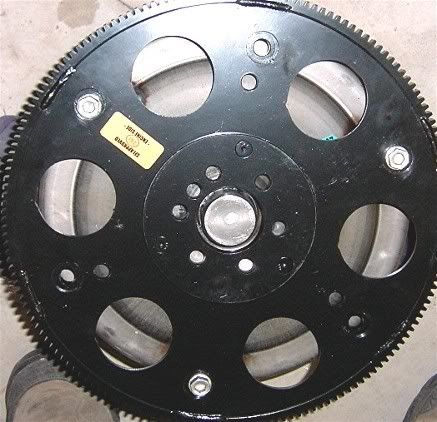
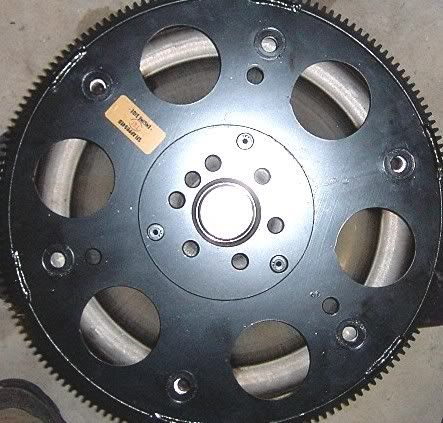
I just received my TCI LS1/Gen III truck flexplate. Untouched the converter bolt hole size is already 31/64", yet they included this notice in the box??? What size are the holes in the stock flexplate?
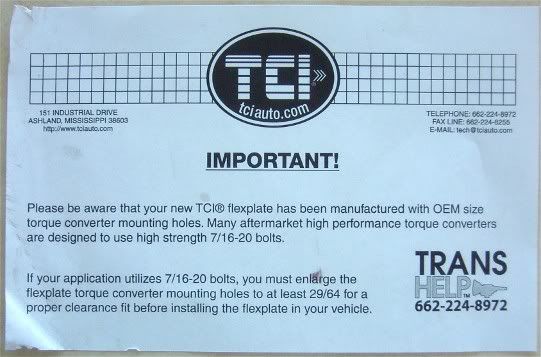
I wish I knew maybe someone maybe a sponser can chime in I appreciate the response as im not really sure what im going to do yet. I cant seem to find the right size bolts 4 the tci flexplate-yank converter.
The stock bolts are 10mm diameter and that's also standard on the PI Vig that I ordered for the 80E. Not sure what length I will need, I know the stock bolts were too long for the Vig I have on my current 60E. My new TC will have a 60E/LS1 style front half so it will bolt up to the LS1 flexpalte that will be sandwiched between the blown LSX 427 and 80E.
That notice from TCI doesn't make sense and it is confusing. I am trying to convince myself that the TCI hole size is OK...........................
If you spin the converter clockwise(looking at the back of the engine) before tightening the bolts, the edge of the hole will already be in contact with the side of the bolt, so there is no room for any lateral slippage. No matter what hole size/ bolt size there will only be a single point contact here anyway.
The larger hole only affects the amount of contact area for transmission of the clamping force to the bolt head. As long as the bolt flange is strong enough to take more clamping pressure on one side than the other, as the other side will be more over the hole. The major force vector on the bolts will be lateral engine torque(shear) anyway.
Bolt head area(factory bolts) = 277.45mm^2
Hole area including bevel = 153.85mm^2
Area for clamping = 124mm^2.= about the same as the end of a 1/2" rod. Which is a little greater than the cross-sectional area of the 10mm bolt. The clamping force will always be the same, but the force/mm^2 will be greater with a larger hole. A smaller, precisely centered hole could yield up to 33% more clamping area with the flange. With strong enough bolts it shouldn't matter though. Hopefully, I am correct.
That notice from TCI doesn't make sense and it is confusing. I am trying to convince myself that the TCI hole size is OK...........................
If you spin the converter clockwise(looking at the back of the engine) before tightening the bolts, the edge of the hole will already be in contact with the side of the bolt, so there is no room for any lateral slippage. No matter what hole size/ bolt size there will only be a single point contact here anyway.
The larger hole only affects the amount of contact area for transmission of the clamping force to the bolt head. As long as the bolt flange is strong enough to take more clamping pressure on one side than the other, as the other side will be more over the hole. The major force vector on the bolts will be lateral engine torque(shear) anyway.
Bolt head area(factory bolts) = 277.45mm^2
Hole area including bevel = 153.85mm^2
Area for clamping = 124mm^2.= about the same as the end of a 1/2" rod. Which is a little greater than the cross-sectional area of the 10mm bolt. The clamping force will always be the same, but the force/mm^2 will be greater with a larger hole. A smaller, precisely centered hole could yield up to 33% more clamping area with the flange. With strong enough bolts it shouldn't matter though. Hopefully, I am correct.
Last edited by DrX; Mar 27, 2008 at 09:36 AM.
Yea you really did ur homework it seems im also wondering what size bolts to go with as I heard the yank bolts are going to be 2 short I believe. Someone posted what size u need but I couldnt find them. I believe they said look for GRADE 8 12MMX1.5X20mm
