When you click on links to various merchants on this site and make a purchase, this can result in this site earning a commission. Affiliate programs and affiliations include, but are not limited to, the eBay Partner Network.
Take a look at the vid in post number 14, all be it at lower freq and bigger tubes, you can really hear the difference in the last part of the vid.
Also here:
2x COVID and double lung pneumonia. almost died with first go around. lost tons of weight, Every symptom on the list. Now at 17 months and still not back to 75%
Sorry to hear that -- my best wishes for your complete recovery. My wife and I managed to avoid it for 2 years, and then a couple of months ago we both contracted (Apr. 22). Omicron I'd guess -- little more than a 2-3 day head cold for us, followed by a gradually declining dry cough for about 6 weeks. Grateful it wasn't worse.
Love this topic -- it was being discussed at length (or ad nauseam) on the fox body Mustang forums about the same time novaman got the ball rolling here (2014). As my car was 5.0L Ford powered at the time, it RESONATED with me.
It's mentioned by a few others -- many (if not most) OEM mufflers have Helmholtz chambers built in. And they're specific to the power plant. If you cut open the V8, V6 or turbo 4 mufflers on the newer Mustangs, you'll see the internal construction is different for each. I put 5.0L Coyote mufflers behind the LS3 in mine. To my ear -- nice sound without being loud. And not a trace of resonance/drone anywhere.
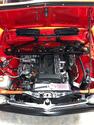
Of course, if you have a system on your car that you like, but drone is an issue - then the 1/4 wave tubes will solve your problem and preserve the system/sound you like. FWIW, look under the hood of almost any EFI car from the last 30 years and you'll see Helmholtz chambers/quarter wave tubes attached to the air inlet piping - for exactly the same reason. To quell intake drone. Pic of my wife’s 2016 Subie Crosstrek.
In my 66 Chevelle I’ve got a LFX V6 and I used a 3.5” aluminum tube for the intake tube to the filter. It drones pretty bad. So I just got a stock intake tube from a Camaro that has a helmholtz chamber built in. There two different one fir the Camaro, ie, V8 or V6. I’m hoping the V6 one I got helps.
The size of the chamber and tube are based on that entire OEM air intake box/assembly/piping. Looks like the length of your system may be different/longer. Hopefully it helps anyway.
Take a look at the vid in post number 14, all be it at lower freq and bigger tubes, you can really hear the difference in the last part of the vid.
Also here: https://www.youtube.com/watch?v=bHdHaYNX4Tk
Been laying low due to health reasons.
That's not good to hear, hopefully you're able to recover soon.
Really appreciate the reply and will send you an email soon. Just reply when you have time🙂
aknovaman, I did email you but maybe didn't send properly?
Basically my issue is drone in a V8 at 1500-1900rpm and I can get the pipe made and fitted but looking for length and diameter(same as main pipe?) measurements.
Should I get a 26.5" length pipe 3"(main pipe size) in diameter?(suit 1900rpm) or 33.6" long?(suit 1500rpm)
Here is an accurate method for significantly reducing exhaust drone using simple math calculations and just a little fab work. The process applies to every gas and diesel engine. My example is for a V8, but the math is slightly different with a 4 or 6 or diesel cylinder engine. Drone can be a huge annoyance especially after completing your swap only to find that it has a horrible interior noise at cruise speeds.
Drone has been discussed to death on other forums. However most pople just guess on how to fix the drone and dont analyze it mathmatically. The problem can be explained and fixed using simple terms using proveable calculations.
First and foremost, I wanted to eliminate drone without introducing any flow restriction; so here is a little theory and my solution.
Exhaust gas consists of 3 major components; Heat, Pressure and Sound. I will look at each portion in turn.
First, Heat. We can partially ignore this as it has little effect on the exhaust sound. It does change tone slightly with temperature variations. Exhaust temperature comes into play with the math calculations shown later.
Exhaust pressure pulses can be thought of as rolling tennis ***** down a pipe, one at a time. Each ball represents a cylinder pulse (bang) as each cylinder is fired. Between each pressure pulses, there is less pressure but still higher presure than atmosphere. When the exaust valve opens and a high pressure pulse pushes the previous pulse (ball) down the pipe just like cars driving down a freeway, all following each other in line. Each pulse actually scavenges or helps pull the next pulse from the exhaust port.
Next is Sound. On a small block Chevy the firing order is 18436572. The rythm applies to LS1 too but with a slightly different firing order. So, if you would stand behind the car and listen to each pressure pulse in turn at the end of both tail pipes, you hear the driver and passenger side pulses in the the following order. D represents the Driver side pulse or bang and P is the Passnger side pulse. You would hear this: DPPD, and then PDDP. Note: the rythm is opposite of each other but are all part of the 8 cylinders firing. Think of it as two 4 cylinder connected together with opposite firing orders. So, what you hear is one Driver pulse followed by two Passender pulses and then another Driver pulse. Then, one Passenger pulse and two Driver pulses then lastly a Passenger pulse. Thats the rumpidy rump we hear and love. It all repeats the cycle beginning with cylinder number 1.
Now you understand the rythm and what it consists of, we can move on to the next part.
To reduce and hopefully eliminate the drone, we need to understand what causes it and then counteract it.
The drone or resonance you hear inside the vehicle varies with RPM (exhaust Frequency), load on the chassis and exhaust airflow. Other variables can increase drone like tail pipe length and size.
Generally at cruising speeds, the noise (drone) you hear occurs around 2000 RPM.
To understand how drone is created, think of this. If you blow at a 90 degree angle across a coke bottle or milk jug, it will resonate, both at a different frequencies based on the container volume and how fast you blow across it. This is how a pipe organ functions. Different length pipes resonate at different frequencies. So with little air flow, the organ is quiet but with large amounts of airflow the organ gets really loud. When you blow across the bottle the sound waves go into the bottle and hit the back side and bounce back at the opening and either amplify or cancel each other out. This concept is the same as you jumping in a swimming pool. The water wave moves away from you, bounces off the opposite side of the pool and is reflected back at you.
In the exhaust system the pressure pulse (bang) needs something for it to bounce off of and cancel the next pressure wave out. To do this we need to add a resonant chamber like the coke bottle. This is actually pretty easy to build. First the chamber needs to be attached to the exhaust system at a 90 degree angle and be capped at the other end to reflect the sound back at the next exhaust pulse just like the coke bottle.
Here is when math comes into play. We need to determine the frequenct of the exhaust pulses to then determine how long the resonator needs to be to cancel the drone. If the exhaust drones at 2000 RPM on a V8 the exhaust pulse frequency is about 133 pulses per second or 133hz. If you want to figure it out yourself at various RPM, the formula is in the attached spreadsheet.
Looking at the spreadsheet chart, you can see the length of the resoantor needs to be approx 26 inches long. Most cars dont have room to add a capped pipe that long under our cars especially since it needs to be attached at a 90 degree angle to the exhaust system. The solution is to use a mandrel bent 'J' pipe. Simply cut a hole in the side of your exhaust and weld the end of the 'J" to it and lay the rest of it nest to your muffler or whereever it fits.
I will attach a picture/chart of the resonant RPM and length of resonator needed to greatly reduce the exhaust drone.
It really does work and cancels tons of resonance.
I forgot the chart at home but will edit and add it tonight.
I was reading your post on exhaust drone, a ton of information. I was hoping you could answer a question. Since the pipe cancels out a certain frequency of noise, does it need to be installed at the end by the tip? Can I install the pipe right after my x pipe on the tail pipe where I have more room. I have no cats or mufflers, 3 inch pipes.
6 Common C5 Corvette Failures and What's Involved In Repairing Them
Slideshow: From wobbling harmonic balancers to failed EBCMs, these are the issues that define long-term C5 ownership and what repairs typically involve.
Retro Modern Bandit Pontiac Trans AM Comes With Burt Reynolds' Autograph
Slideshow: A modern Camaro transformed into a retro icon, this limited-run "Bandit" build blends nostalgia with brute force in a way few revivals manage.
Top 10 Greatest Cadillac V Series Performance Models Ever, Ranked
Slideshow: Cadillac didn't just crash the high-performance luxury vehicle party, it showed up loud, supercharged, and occasionally a little unhinged...
Coachbuilt N2A Anteros Is an LS2-Powered C6 Corvette In Italian Clothes
Slideshow: A one-off sports car that looks like a vintage Italian exotic-but hides a C6 Corvette underneath-just sold for the price of a new mid-engine Corvette.