






5.3 temperature question

Thread Starter
Teching In
Joined: Aug 2018
Posts: 9
Likes: 1
 5.3 temperature question
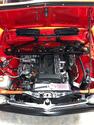
 Just finished my 1st LS conversion. A 2003 5.3 / 4L60 in a 62 Vette with A/C, PB, PS on a Corvette Correction chassis. Its got a basic tune now just to make some shake down runs. The only modification was to install an LS6 intake. Its got 140 miles on it since the install. (The engine has 150K on it.) After some short runs, the only issue is a reoccuring P0101, P0171, P0174 code, which would normally indicate a vacuum leak, but I can't find one anywhere. Today I made a 40 mile run - the longest so far - and the temp got up to 220 on the hiway with the A/C on. The outside temp was 103. Its running a Dewitts radiator for LS swaps. Since I'm old school and totally new to LS engines, it seems high. Is this a normal temp to expect?
I'm taking it to a tuner next week to get it dialed in and hopefully find my engine code problem.
I'm taking it to a tuner next week to get it dialed in and hopefully find my engine code problem.

TECH Senior Member


Joined: Jun 2016
Posts: 22,293
Likes: 3,617
From: Central Cal.
I would bet you have some air trapped in the engine yet. It is harder to get the LS engines totally full of coolant. Do a search as there are threads detailing how to fill the system
OEM applications don’t command high-speed fan until mid-220s. What fan do you have? Creeping temps on the highway indicate an airflow problem (assuming you don’t have air trapped in the system), with high pressure behind the radiator and/or leak paths between the radiator and core support or fan.

Teching In
Joined: Dec 2015
Posts: 48
Likes: 0
From: WI
I only have 1 fan and it kicks in at 210 deg F. It has worked fine up here in WI. This summer we have seen temps in the high 80's to mid 90's. Going up a hill here is what gets the hottest. The build was done 3 years ago. You do have the burp fitting to the radiator? Also your temps may be normal.
Thread Starter
Teching In
Joined: Aug 2018
Posts: 9
Likes: 1
The engine is stock with the exception of an LS6 intake. The rad is Dewitts unit for LS swaps in a 62 Vette. It has the one 16" spal fan already installed on it. No burp fitting that I know of. I have not blocked off the places where air is passing through the core support that would be pressurizing the engine compartment. That was a good suggestion as I placed the air filter directly behind the fresh air opening in the core support and did not build a cold air box around it. So a new project in the works. It has a 195 tstat that Dewitts supplies, but a 160 would only allow the flow to come on sooner. I do not have the rear steam vents hooked up, just the fronts going directly to the rad. The steam vent kit might be a solution also. I didn't do anything special while filling the system. Just filled it, and topped off after running a while. The overflow tank does show a little fluid in it after running a while at 190-200 deg, but gets sucked back in the rad after it cools down. Should I keep some coolant in it at all times to keep the rad completely full? I normally have the coolant level just over the core. Temps in the 80's & 90's would be a cold front here. Two weeks ago it was 114. Today was 103 and still in the hi 90's at night. Maybe 220 with A/C on full for a 40 mile run at 103 ambient is fairly normal for the middle of Texas.
With “enough” radiator, and a 195F t’stat on the inlet side, you should see head temps around 200F-205F under cruise even with high ambients. If your fan controller is set above that, you shouldn't have the fans on under cruise. If you’re seeing 220F as speed increases, and everything else is working as it should, I think airflow across the radiator is being impeded. As mentioned earlier - blocking all other paths at the front so all air has to cross the radiator is a step in the right direction. Additionally, anything you can do to create low pressure below and behind the radiator will enhance airflow through the radiator. Many cars have a small air dam just below the radiator for that purpose.
Last edited by Michael Yount; Aug 19, 2018 at 09:56 AM.
Here's an article about repurposing an OEM air dam (it's there just for the purpose mentioned above) from a Ford Ranger Pickup. Picture at the bottom of the link shows it's use on a fox body Mustang -- although the stock Stang's had their own version from the factory.
http://brazeauracing.com/mustang/airdam.htm
My car has an OEM device that many refer to as a "splash pan" -- although it's main purpose has nothing to do with preventing splashes into the compartment. It attaches below the radiator support and is the full width of the front frame rails (29"). It extends all the way to the engine/suspension crossmember. It's there to create low pressure below the engine at the back of the engine bay. This effectively "sucks" air across the radiator at speed and the the air leaves the engine compartment below/behind the crossmember.
http://brazeauracing.com/mustang/airdam.htm
My car has an OEM device that many refer to as a "splash pan" -- although it's main purpose has nothing to do with preventing splashes into the compartment. It attaches below the radiator support and is the full width of the front frame rails (29"). It extends all the way to the engine/suspension crossmember. It's there to create low pressure below the engine at the back of the engine bay. This effectively "sucks" air across the radiator at speed and the the air leaves the engine compartment below/behind the crossmember.
Last edited by Michael Yount; Aug 19, 2018 at 09:53 AM.
Trending Topics

TECH Fanatic


Joined: Sep 2008
Posts: 1,645
Likes: 526
On all my LS swaps I've had to "burp" the cooling system to get all the air out of the heads. What has worked the best for me is get the engine some what warmed up and then loosen up the temp sensor in the drivers side head just so some coolant comes out. I always seem to get a burp of air when I do it that way. Careful that coolant is hot don't over tighten the sensor it can break off. Ask me how I know.
With my 71 C3 LS1 swap running a 160 degree stat and a big griffin radiator I was lucky to hit 180 degrees on 80 degree day.
Also you will know when the thermostat is open if you take off the radiator cap and see good flow of coolant coming out off the radiator fins. Flow should vary as the rpm go up and down.
With my 71 C3 LS1 swap running a 160 degree stat and a big griffin radiator I was lucky to hit 180 degrees on 80 degree day.
Also you will know when the thermostat is open if you take off the radiator cap and see good flow of coolant coming out off the radiator fins. Flow should vary as the rpm go up and down.
LS1 Tech Stories
The Best V8 Stories One Small Block at Time

6 Common C5 Corvette Failures and What's Involved In Repairing Them
Pouria Savadkouei
Retro Modern Bandit Pontiac Trans AM Comes With Burt Reynolds' Autograph
Verdad Gallardo
Top 10 Greatest Cadillac V Series Performance Models Ever, Ranked
Pouria Savadkouei
Top 10 Most Powerful Chevy Trucks Ever Made!

Hennessey's New Supercharged Silverado ZR2 Has 700 HP
Verdad Gallardo
Coachbuilt N2A Anteros Is an LS2-Powered C6 Corvette In Italian Clothes
Verdad Gallardo
Awesome K5 Blazer Restomod Comes With C7 Corvette Power
Verdad Gallardo
10 Camaros You Should Never Buy

10 LS Engine Myths That Refuse to Die
Verdad Gallardo Teching In
Joined: Dec 2015
Posts: 48
Likes: 0
From: WI
I should clarify that what I said as a burp port is the steam vent and the rear is not there on my 03 but the front is connected to the radiator. I have no real coolant problems. Make sure all the air goes thru the radiator as in making a shroud for it. I would not run a cold thermostat in any engine as they are engineered to run in a specific temp range. This is for the best HP, torque and fuel economy. I have a 4 stroke boat motor that was filling up with gas in the crank case for years and finally found it was the thermostat that was stuck open. All engines do get some fuel in the crankcase but when it gets up to proper temperature the fuel vaporizes and exits the engine.The engine was running way to cold all the time and the fuel in the crankcase never reached a high enough temperature to change from a liquid to a vapor. I think my stat is 187 deg. F. I would guess my engine coolant temp would be from 200 to 220 on a normal day. I normally do not drive it with the scan tool hooked up to monitor it.
Just to clarify -- a shroud helps assure that all the air pulled by the fan comes across the radiator. However, that same shroud acts to BLOCK air from flow across the radiator when the fan is not on -- and it shouldn't be on when the car is at speed. It takes other things to be certain you get good flow across the rad when the fan isn't on.
My factory/crate LS3 came with a 187F t'stat (checked with thermometer in a pan of coolant on the cooktop) located on the inlet side of the engine. Under cruise with enough air moving over the radiator to keep the fans off, the temp sensor in the driver's side head sensor (the one the ecu uses) is 196/197F - read off the OBDII port with an app. When it's 30F outside, that may drop to 195F; when it's 95F I may see 198F. Clearly there is enough radiator capacity and air flow to reject enough heat to hold a constant temp regardless of the ambient temps. My fan controller is set to maintain a 203F operating temp (variable speed controller). When I'm going slowly enough that the fans are running, the head temps are in the 202F-204F -- again, little variation with ambient temps. The variation that does occur is that when it's warmer, the t'stat is open more; when it's cooler, it's open less; when it's warmer the fans run more often and faster; less often and slower when it's cooler. I use a Howe Racing 2 row (1" rows) aluminum unit - about a 23x16 core. Fans are SPAL dual 11" fully shrouded with flaps that allow air to pass through at cruising speeds when fans are off.
Someone noted earlier in the thread -- if you're using the unmodified factory ecu to operate your fans -- your engine temps with fans on will be quite a bit higher than my spread above. I may have it wrong -- but memory says the folks at PSI Conversions told me that my 08 Corvette ecu turned on fan one at 226F and off at 220F; fan two at something like 232F, off at 226F. Clearly those temps shouldn't cause a problem with the engine as they were OEM settings. But I wanted a tighter operating band than the almost 40F between 195F and 232F.
My factory/crate LS3 came with a 187F t'stat (checked with thermometer in a pan of coolant on the cooktop) located on the inlet side of the engine. Under cruise with enough air moving over the radiator to keep the fans off, the temp sensor in the driver's side head sensor (the one the ecu uses) is 196/197F - read off the OBDII port with an app. When it's 30F outside, that may drop to 195F; when it's 95F I may see 198F. Clearly there is enough radiator capacity and air flow to reject enough heat to hold a constant temp regardless of the ambient temps. My fan controller is set to maintain a 203F operating temp (variable speed controller). When I'm going slowly enough that the fans are running, the head temps are in the 202F-204F -- again, little variation with ambient temps. The variation that does occur is that when it's warmer, the t'stat is open more; when it's cooler, it's open less; when it's warmer the fans run more often and faster; less often and slower when it's cooler. I use a Howe Racing 2 row (1" rows) aluminum unit - about a 23x16 core. Fans are SPAL dual 11" fully shrouded with flaps that allow air to pass through at cruising speeds when fans are off.
Someone noted earlier in the thread -- if you're using the unmodified factory ecu to operate your fans -- your engine temps with fans on will be quite a bit higher than my spread above. I may have it wrong -- but memory says the folks at PSI Conversions told me that my 08 Corvette ecu turned on fan one at 226F and off at 220F; fan two at something like 232F, off at 226F. Clearly those temps shouldn't cause a problem with the engine as they were OEM settings. But I wanted a tighter operating band than the almost 40F between 195F and 232F.
TECH Fanatic
Joined: Sep 2008
Posts: 1,645
Likes: 526
I've tried using the steam port to "burp" the air out of the coolant system. Didn't work for me. I've had a LS3 swap, A LS2 bored and stroked to 427 cubes. Two L92 LS swapped with small cams. My current LS1 with small cam and AFR heads all running 160-180 degree thermostats. Never had a issue with running too cool. Due to normal stop and go traffic they all got up to 210-220 degrees. More than enough temp to burn off any vapor or oil residue.
Thread Starter
Teching In
Joined: Aug 2018
Posts: 9
Likes: 1
Sounds like I'm worried about nothing. Most folks I've talked to say 200-220 is pretty normal. I'm just remembering back in the day when were running our 283's and 327's and a few flatheads that 200 was getting pretty hot. Times have changed. I will address the trapped air possibility and air flow restriction in front of the radiator. The engine side of the radiator has the Dewitts installed fan and shroud with the pass through vents and rubber flaps on it. So I'm not worried about that side. The area behind the grill is fairly open, but does have a large Derale trans cooler and the A/C condenser in front of the radiator. I'll try to relocate the trans cooler or put some space between it and the condensor to reduce some of the restriction. On my C3 I put some rubber flaps between the core support and the body, hood, etc. to reduce air leakage that seemed to help a little. There sure is a lot to learn about the LS family of engines. I appreciate all the advice. I posted some pics in the New Member section, but the post has not been approved yet.
If you move the trans cooler away from the radiator then at low speeds your electric fans won’t pull as much air across the the trans cooler. Don’t know if that’s creating a problem for you or not.
Also keep in mind that older cars have poor airflow control around the radiator, and lack a belly (splash) pan or chin spoiler, so even a big radiator and fan might struggle to pull air across the core if underhood pressures are high relative to the front of the radiator. I took a quick look at some photos of the C2 core support area, and there is plenty of opportunity for air to bypass the radiator if rubber seals aren't installed (see here and here).
Your cooling is "OK" for now, considering the OEM operating range and ambient temps, but I'd consider sealing everything off including any holes in the core support and looking for ways to increase pressure in front of the radiator and reduce it behind. A magnehelic gauge is a cheap and effective way to gather data and troubleshoot. Here is some good reading material (check parts 1 and 3 for even more info).
Your cooling is "OK" for now, considering the OEM operating range and ambient temps, but I'd consider sealing everything off including any holes in the core support and looking for ways to increase pressure in front of the radiator and reduce it behind. A magnehelic gauge is a cheap and effective way to gather data and troubleshoot. Here is some good reading material (check parts 1 and 3 for even more info).
Thread Starter
Teching In
Joined: Aug 2018
Posts: 9
Likes: 1
Hookem-- Thanks for the link to the air dam article. Very interesting reading. I could not find the link to part 3, but will keep looking. Being an old engineer, that really gets my interest to just try and see how it effects the flow in the old Vettes. I have a manometer setup that I might be able to rig up to use and a really big shop fan that might show some results without having to drive it and a smoke generator that might work. This is going to be fun! I'm going to be able to play with it in the next few weeks and try to learn something. Its like a few years ago when I wanted to engrave something and ended up building a CNC engraver. It just snowballs. But, according to the article, the first thing I need to do is figure out where & what my "bonnet" is.
It just snowballs.
Here's part 3; it mainly addresses hood vents, but still has some good info.
I should also add that I started doing delta-P tests, but haven't gotten a chance to fully explore the effect that closing up my swiss-cheese radiator support and underbody modifications would have. I did close off the underside of my cowl hood based on a measured 1.5(!) inH2O on the freeway.
Thread Starter
Teching In
Joined: Aug 2018
Posts: 9
Likes: 1
Just did the string test yesterday and it does show that air is flowing back into the engine bay from the hood scoop. I temporarily plugged it with some foam and drove it around. Yesterday was a little cooler - only 103 and the temp stayed around 204. That was a noticeable drop. I had also made a splash pan out of ABS and formed it to block off the area between the grill and rad. Still need to seal some areas around the rad. Last night I took it to a tuner to get some shift points, etc. dialed in. Drove it about 40 miles under different conditions and made a bunch of hard WOT pulls up to about 90+. Watching his laptop while I was driving, he said the max temp he saw was 116 coming off the OBD2 port. That was with the A/C and hammering on it also. The temp on the Dakota Digital showed 220. So I guess the dash display is a little off. I think it can be calibrated. So far I'm happy. I'll post some pics of the splash pan the next time I get it up in the air and hopefully get the manometer tests done.

Just one other note. When I put an LQ9 in my 68 vette, I used a griffin radiator on the original core support, The radiator cap was not the highest point in the system. No way to completely bleed the air out of it. I added an inline cap at a higher point on the hose, but the original surge tank on the heater hose would work too.