








correct method and order for suspension adjustment?
 correct method and order for suspension adjustment?
 would one of the suspension gurus (i.e. bmr, umi, madman, etc) make a beginners guide for suspension adjustment? where to start, what order the adjustments should be made in, what each part should do when adjusted? i know there is a sticky but its alot of jumbled info thats hard to decipher
I would definitly agree, that a good guide to these cars are needed especially with some of the newer adjustible stuff thats out there but I suspect we wont see any trade secrets given out and often that is what makes a car "work".
You would be suprised how little can be found on the internet or in books and often its not for drag racing and if it is, its for a chassis other then ours.
You would be suprised how little can be found on the internet or in books and often its not for drag racing and if it is, its for a chassis other then ours.

TECH Resident
Joined: Sep 2010
Posts: 866
Likes: 0
From: Cartersville, Georgia
I just installed a Spohn full rear suspension with my S60 ... their basic instructions were a great place to start for the T/A and drag sway setup. The LCA's and PHBR adjustments are more for centering (LCA's-front to back & PHBR-left to right) than anything else.
Someone please chime in if I am wrong.
Someone please chime in if I am wrong.
I just installed a Spohn full rear suspension with my S60 ... their basic instructions were a great place to start for the T/A and drag sway setup. The LCA's and PHBR adjustments are more for centering (LCA's-front to back & PHBR-left to right) than anything else.
Someone please chime in if I am wrong.
Someone please chime in if I am wrong.
I believe OP knows how to adjust the suspension, I think he is looking for instruction on how to set correct LCA/torque arm angles, driveline angle, shock adjustments and their effects on the way the car launches, specific to setting up an F-body for track duty.. I'm interested as well..
There have been plenty of examples of cars that only run a good # when the conditions are near perfect but as soon as you throw a varible in there, they can be very much off the pace. I have personally seen it a few different times.
But like I said earlier, this maybe something that #1 people do not want to give away trade secrets and feel you need to learn it on your own and #2 and I hate to say this, there may not be many knowledgable people on tech anymore. Some have moved on to other cars or websites, or moved on to cars that are F bodies but cannot relate due to major changes in speed and chassis certs.
It is probably more so the #1 example, then #2 but we will see.

Teching In
Joined: Jan 2009
Posts: 29
Likes: 0
From: Foristell, Missouri
This is a tempting and compelling question, and good comments, too. It's true, those racers and manufacturers that have had some success do tend to keep the recipes to themsleves, as a little piece of "intellectual property", to have that edge against the competition, in both cases. It's the nature of competition. So, you may not find a "how to" that is specific to torque arm suspensions. You can find good publications that outline basic RWD drag suspensions and the physics that govern them, though, (I highly recommend Dave Morgan's Doorslammers) and with a little study time and an open mind, you can gain an understanding of how... and why they work. Sure, there may not be a torque arm example in the book, but think of a torque arm suspension as a cross betweeen a ladder bar suspension and a 4-link, but unique. Instant center, weight bias, % anti squat, CG height, percentage of rise, they are all parameters that are critical to record and track to gain some control in the tuning of your car, and they are critical to and adjustable parts of ladder, 4-link, AND torque arm suspensions.
To keep this brief (maybe too late), here are some torque arm suspension constants to keep in mind. Hint: Beware of Anecdotal Evidence to the contrary of the following.
1) Traction is a function of torque as much as anything else.
2) Short torque arms hit the tires harder than long torque arms, and are a great addition to a low to mid horsepower car. Lotsa HP cars with stock LCA front mounts should not have a short torque arm
3) Torque arms are not designed to push the car, and therefore the front mount is NEVER the instant center, although it does define the instant center fore-aft position. It is for this reason that TA front mount vertical adjustments NEVER change the instant center by more than a few insignificant millimeters. The TA is merely the lever that the engine's applied torque acts upon, against the mass of the car.
4) The angle of the lower control arms, together with the torque arm length, define the instant center point. Yes, you've seen it before.... draw a line thru the LCA bolts front to rear, and where that line intersects with a vertical line drawn thru the TA front pivot point is your car's instant center. Side view of the car to get this, of course.
Once you've got the instant center, the rest of the critical data can be found in the same manner as with other contemporary RWD drag suspensions.
Understanding the elementary physics is important. It will help you to make tuning decisions to affect the desired result. Get a book, forget what you've heard from others about how a car works, record a baseline dimensional sheet of your car, and document the changes you make with comments on the effects the changes had.... and ALWAYS get video of your car for evaluation!
Hope this helps.
To keep this brief (maybe too late), here are some torque arm suspension constants to keep in mind. Hint: Beware of Anecdotal Evidence to the contrary of the following.
1) Traction is a function of torque as much as anything else.
2) Short torque arms hit the tires harder than long torque arms, and are a great addition to a low to mid horsepower car. Lotsa HP cars with stock LCA front mounts should not have a short torque arm
3) Torque arms are not designed to push the car, and therefore the front mount is NEVER the instant center, although it does define the instant center fore-aft position. It is for this reason that TA front mount vertical adjustments NEVER change the instant center by more than a few insignificant millimeters. The TA is merely the lever that the engine's applied torque acts upon, against the mass of the car.
4) The angle of the lower control arms, together with the torque arm length, define the instant center point. Yes, you've seen it before.... draw a line thru the LCA bolts front to rear, and where that line intersects with a vertical line drawn thru the TA front pivot point is your car's instant center. Side view of the car to get this, of course.
Once you've got the instant center, the rest of the critical data can be found in the same manner as with other contemporary RWD drag suspensions.
Understanding the elementary physics is important. It will help you to make tuning decisions to affect the desired result. Get a book, forget what you've heard from others about how a car works, record a baseline dimensional sheet of your car, and document the changes you make with comments on the effects the changes had.... and ALWAYS get video of your car for evaluation!
Hope this helps.
Trending Topics
I would suggest that the best place to start would be adjusting your ride height followed by front end alignment.
Number four above is where a lot of people go wrong. Relocation brackets can be a bad thing when used improperly.
Number four above is where a lot of people go wrong. Relocation brackets can be a bad thing when used improperly.
LS1 Tech Stories
The Best V8 Stories One Small Block at Time

6 Common C5 Corvette Failures and What's Involved In Repairing Them
Pouria Savadkouei
Retro Modern Bandit Pontiac Trans AM Comes With Burt Reynolds' Autograph
Verdad Gallardo
Top 10 Greatest Cadillac V Series Performance Models Ever, Ranked
Pouria Savadkouei
Top 10 Most Powerful Chevy Trucks Ever Made!

Hennessey's New Supercharged Silverado ZR2 Has 700 HP
Verdad Gallardo
Coachbuilt N2A Anteros Is an LS2-Powered C6 Corvette In Italian Clothes
Verdad Gallardo
Awesome K5 Blazer Restomod Comes With C7 Corvette Power
Verdad Gallardo
10 Camaros You Should Never Buy

10 LS Engine Myths That Refuse to Die
Verdad Gallardo
You can take it to some one or you can make many passes at the track and try different settings. The problem with giving advice is that every car is different. What works on my set up won't on yours.
What I've found is that with out a rear drag bar the car tends to twist and the body squats toward the pass. side. An air bag might help but its just a band aid. The lower control arm relocation brackets help give you a positive IC on lowered cars. Stock the angle is neutral on a lowered car it may be neg.
The shock settings are what allow you to adjust for different track conditions.
If the track is good then firming up the compression in the rear hits the tires harder. If you do this and the car comes out then spins, firm up the rebound so that the weight stays planted longer. If it destroys the tire then loosen the compression so the hit is softer.
In the front the rebound is what controls the speed of the car coming up. Less rebound then the car comes up faster, more then it's slower. You should run as much compression as possible if the car pulls the wheels then it will help keep it from bottoming out when it comes down. If it comes down and bounces adjust as needed.
http://www.baselinesuspensions.com/i...A_Drag_Car.htm
What I've found is that with out a rear drag bar the car tends to twist and the body squats toward the pass. side. An air bag might help but its just a band aid. The lower control arm relocation brackets help give you a positive IC on lowered cars. Stock the angle is neutral on a lowered car it may be neg.
The shock settings are what allow you to adjust for different track conditions.
If the track is good then firming up the compression in the rear hits the tires harder. If you do this and the car comes out then spins, firm up the rebound so that the weight stays planted longer. If it destroys the tire then loosen the compression so the hit is softer.
In the front the rebound is what controls the speed of the car coming up. Less rebound then the car comes up faster, more then it's slower. You should run as much compression as possible if the car pulls the wheels then it will help keep it from bottoming out when it comes down. If it comes down and bounces adjust as needed.
http://www.baselinesuspensions.com/i...A_Drag_Car.htm
Here is another link to confuse us more. LOL
http://www.afcoracing.com/tech_pages/dragshock.shtml
The best thing that you can do is to video a close up of the rear body and tire of the car. Then you can see what the car is really doing.
I've been fighting not having enough anti squat. The car destroys the right rear tire, the body almost hits the track surface and the left front raises a foot higher then the right. With out a rear drag bar I'm screwed. Shocks are not going to fix it.
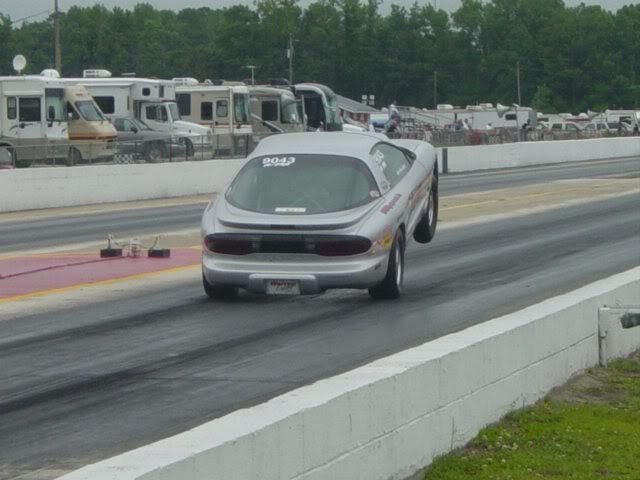
Ideally you want the front to raise off the ground equally say 6-8 inches and carry them out a few feet. Have the rear of the car raise up (this is anti squat at work) the tires plant and the car launches. Watch a NHRA Pro Stock car launch. The other cars to watch are the Stock and Super Stockers. More like how our cars are going to launch.
All the good launching cars in the Houston area have Mad Man equipment installed. They have front end limiters , drag bars,short t. arm, aftermarket springs ,etc. Doing it with a street type suspension is a big compromise and a pain in the azzz.
http://www.afcoracing.com/tech_pages/dragshock.shtml
The best thing that you can do is to video a close up of the rear body and tire of the car. Then you can see what the car is really doing.
I've been fighting not having enough anti squat. The car destroys the right rear tire, the body almost hits the track surface and the left front raises a foot higher then the right. With out a rear drag bar I'm screwed. Shocks are not going to fix it.
Ideally you want the front to raise off the ground equally say 6-8 inches and carry them out a few feet. Have the rear of the car raise up (this is anti squat at work) the tires plant and the car launches. Watch a NHRA Pro Stock car launch. The other cars to watch are the Stock and Super Stockers. More like how our cars are going to launch.
All the good launching cars in the Houston area have Mad Man equipment installed. They have front end limiters , drag bars,short t. arm, aftermarket springs ,etc. Doing it with a street type suspension is a big compromise and a pain in the azzz.
TECH Resident
Joined: Sep 2010
Posts: 866
Likes: 0
From: Cartersville, Georgia
Why "say" a posting is wrong without correcting it or educating the poster?? There are a few members who are actually here to learn and not just here to bash others just to make themselves feel good. I am not saying this is your intention, but it seems that is what alot of this forum is all about.
TECH Resident
Joined: Sep 2010
Posts: 866
Likes: 0
From: Cartersville, Georgia
Now these posts are really informative ... thanks "1lejohn".
I have been looking at shocks as my next upgrade, although, I want to run a few passes first on what I have thus far. You mention both rebound and compression changes independently, so I suspect double adjustables would be more advantageous.
I have been looking at shocks as my next upgrade, although, I want to run a few passes first on what I have thus far. You mention both rebound and compression changes independently, so I suspect double adjustables would be more advantageous.
Now these posts are really informative ... thanks "1lejohn".
I have been looking at shocks as my next upgrade, although, I want to run a few passes first on what I have thus far. You mention both rebound and compression changes independently, so I suspect double adjustables would be more advantageous.
I have been looking at shocks as my next upgrade, although, I want to run a few passes first on what I have thus far. You mention both rebound and compression changes independently, so I suspect double adjustables would be more advantageous.
The problem with these cars is the Torque arm not many people know how to set them up. The Mustang crowd has Maxium Motor Sports who sells T arm conversion kits for Fox Bodies and SN 95 types. They seem to have a big advantage in Road course racing using the arm. When you get down to it that is what the the T.arm design does best. IMO.
Ok here is my list on what to add and adjust and in what order. You need to decide how hard core and what NVH problems you can live with. DISCLAIMER I'm no expert this is just MHOP.
1 Tires get a good set of race tires. (duh) right. I would stick with one type be it a drag radial or a true slick. I don't recommend an ET street type tire any more.
2 Make sure you have the proper size rim for the tire your running. We fought a poor handling car due to a mismatched tire and rim combo. 11" tire on a 8" rim doesn't work.
3 Replace the stock Torque arm with an adjustable type, and relocate the mount off of the tranny tail shaft. Long arm or short arm you decide. This was one of my best bang for the buck mods and it helps the tranny stay alive.
4 Rear lower control arms and pan hard bar. I would make them both adjustable type. Buy quality ones and be done with it. These will help with centering the rear and allow you to fit bigger tires. This all helps the car leave straight at the launch. Rear lower control arm relocation brackets. These help bring the lower arms back into the positive position ( The front of the arm pointing up) When you lower a car the arms tend to go negative which is fine for handling not so for a drag launch. The more positive the harder the tires are planted on the hit. Can you say wheelie.
5 Adjust the rear and set the pinion angle shoot for a 16th of an inch on the side to side and fore to aft on the housing. The pinion angle should be slighty down say a degree or two no more. On a stock car it is at zero or neutral. Since we have a T. arm it controls the housing and keeps it from rotating. Basically don't have the drive shaft and the housing in a bind. Don't get stuck on this it's not that important with this type of suspension. On the old Mopars with leaf springs or stock 4 link cars ,old Chevelles or Fox bodies it becomes more so. The stangs are now using a wish bone attached to the chassis and rear housing. H'mm sounds like a Torque arm .
6 Drag bar if making good power say 500 on up. If not an air bag or 2 can help with suspension pre loading. If the car is not leaving straight then you'll need to fix it with one of these. I ran bags on my 3rd gen and on this car till it dry rotted. I need to make the decision if I want to install a drag bar. I'm running the stock anti sway bar but it's not working. I need to try the car with out it. Note when running sticky tires and the rear bar with no front bar the car will push bad. Can you say under steer.
7 To the front. Remove weight from the nose. Skinny tires and wheels help with rolling resistance or pump up those street tires. Don't run street radials (wide tires ) with slicks Its like driving on ice. Skinny radials are ok. Get a front end alginment with the car nosed up and weight in the drivers seat. This is how your going to be running down the track. Right?
Front sway bar do I run it or not? If you remove it you save some weight , and it makes the car transfer weight alittle easier. If your making good power you can use it as a front end travel limiter. It also helps with that nasty squating the rear tends to do. It comes down to if the rest of the suspension is working ditch it and install limiters.
8 Tighten the car up. Install frame connectors ,a roll bar and replace worn stock suspension bushings. A unibody car is like a piece of ply wood it flexes. This wastes time and power on the 60' clock. Instead of moving the car forward we are moving it up and twisting it.
9 Time for shocks. Now that the rest of the car is working you can fine tune it. The major brands all seem to work with some sucess. If you street drive more then race then a quailty stock replacment type will be ok. I had my old combo running high tens with Koni sport shocks. I've moved on to Affco's you can always change back and forth. With a coil over type in the front you can adjust ride height.
Setting the shocks is a learning process that I'm still working on.
1 Tires get a good set of race tires. (duh) right. I would stick with one type be it a drag radial or a true slick. I don't recommend an ET street type tire any more.
2 Make sure you have the proper size rim for the tire your running. We fought a poor handling car due to a mismatched tire and rim combo. 11" tire on a 8" rim doesn't work.
3 Replace the stock Torque arm with an adjustable type, and relocate the mount off of the tranny tail shaft. Long arm or short arm you decide. This was one of my best bang for the buck mods and it helps the tranny stay alive.
4 Rear lower control arms and pan hard bar. I would make them both adjustable type. Buy quality ones and be done with it. These will help with centering the rear and allow you to fit bigger tires. This all helps the car leave straight at the launch. Rear lower control arm relocation brackets. These help bring the lower arms back into the positive position ( The front of the arm pointing up) When you lower a car the arms tend to go negative which is fine for handling not so for a drag launch. The more positive the harder the tires are planted on the hit. Can you say wheelie.
5 Adjust the rear and set the pinion angle shoot for a 16th of an inch on the side to side and fore to aft on the housing. The pinion angle should be slighty down say a degree or two no more. On a stock car it is at zero or neutral. Since we have a T. arm it controls the housing and keeps it from rotating. Basically don't have the drive shaft and the housing in a bind. Don't get stuck on this it's not that important with this type of suspension. On the old Mopars with leaf springs or stock 4 link cars ,old Chevelles or Fox bodies it becomes more so. The stangs are now using a wish bone attached to the chassis and rear housing. H'mm sounds like a Torque arm .
6 Drag bar if making good power say 500 on up. If not an air bag or 2 can help with suspension pre loading. If the car is not leaving straight then you'll need to fix it with one of these. I ran bags on my 3rd gen and on this car till it dry rotted. I need to make the decision if I want to install a drag bar. I'm running the stock anti sway bar but it's not working. I need to try the car with out it. Note when running sticky tires and the rear bar with no front bar the car will push bad. Can you say under steer.
7 To the front. Remove weight from the nose. Skinny tires and wheels help with rolling resistance or pump up those street tires. Don't run street radials (wide tires ) with slicks Its like driving on ice. Skinny radials are ok. Get a front end alginment with the car nosed up and weight in the drivers seat. This is how your going to be running down the track. Right?
Front sway bar do I run it or not? If you remove it you save some weight , and it makes the car transfer weight alittle easier. If your making good power you can use it as a front end travel limiter. It also helps with that nasty squating the rear tends to do. It comes down to if the rest of the suspension is working ditch it and install limiters.
8 Tighten the car up. Install frame connectors ,a roll bar and replace worn stock suspension bushings. A unibody car is like a piece of ply wood it flexes. This wastes time and power on the 60' clock. Instead of moving the car forward we are moving it up and twisting it.
9 Time for shocks. Now that the rest of the car is working you can fine tune it. The major brands all seem to work with some sucess. If you street drive more then race then a quailty stock replacment type will be ok. I had my old combo running high tens with Koni sport shocks. I've moved on to Affco's you can always change back and forth. With a coil over type in the front you can adjust ride height.
Setting the shocks is a learning process that I'm still working on.
Last edited by 1lejohn; Jul 1, 2011 at 10:34 AM.
Why "say" a posting is wrong without correcting it or educating the poster??
The IC on a torque arm set up should always be directly below the front mounting point of the torque arm. The lower control arms should be level with the sub frame connectors. A lot of guys on here will tell you to run your lower control arms in the lowest position when running relocation brackets. This will often point the control arms at the torque arm behind the front mount. That puts the torque arm in an incredible bind.
I would also suggest that a Super Stocker or Pro Stock has no real place in this thread.
I do agree that Stockers are a great place for good ideas, but then I am extremely biased on that subject.

Teching In
Joined: Jan 2009
Posts: 29
Likes: 0
From: Foristell, Missouri
Great stuff in this thread! I'll only reiterate that understanding the geometry and physics of launching a car is the best way to tune your own car. Sure, it's an investment of time reading and studying, but it's either that or time wasted making erroneous adjustments based on data from others, many times bad data. BEWARE is good advice, per GIZMO's comment. Find a source or two you can trust, and do some trials with what you've learned. That's science, and it works.
I'll also clarify:
1) The instant center on a torque arm car is ALWAYS directly below, or, even directly above the torque arm front mount.
2) The torque arm suspension is VERY similar to a 4-link, in that the adjustment of multiple links nets a numerous assortment of instant centers. But don't get caught up in labels... study the geometry and physics lessons you'll see in these publications and work on your car. If you get stuck, find someone you trust to guide you through it. Make good choices.
3) If the torque arm is installed correctly, it cannot bind within the range of adjustment given on popular LCA relo kits. That is precisely why it has a sliding front mount, or a pivoting link on the front of various aftermarket arms. Suspension no-workey if it was rigidly mounted.
4) Ride height directly changes the instant center and center of gravity of the car. Higher hits the tire harder, and lower softens the hit. Given so many adjustments available to control torque's aggression on your tires, I wouldn't worry too much about ride height from the stock dimension, until your car gets so fast and powerful that it threatens a damaging wheelie. Then lower it as much as possible.
5) The LCA relo brackets were developed to allow multiple instant center height settings, and, depending on the car, the lowest hole may not be the right setting.
6) Yes, BEWARE is some of the best advice. I could not agree more!
I'll also clarify:
1) The instant center on a torque arm car is ALWAYS directly below, or, even directly above the torque arm front mount.
2) The torque arm suspension is VERY similar to a 4-link, in that the adjustment of multiple links nets a numerous assortment of instant centers. But don't get caught up in labels... study the geometry and physics lessons you'll see in these publications and work on your car. If you get stuck, find someone you trust to guide you through it. Make good choices.
3) If the torque arm is installed correctly, it cannot bind within the range of adjustment given on popular LCA relo kits. That is precisely why it has a sliding front mount, or a pivoting link on the front of various aftermarket arms. Suspension no-workey if it was rigidly mounted.
4) Ride height directly changes the instant center and center of gravity of the car. Higher hits the tire harder, and lower softens the hit. Given so many adjustments available to control torque's aggression on your tires, I wouldn't worry too much about ride height from the stock dimension, until your car gets so fast and powerful that it threatens a damaging wheelie. Then lower it as much as possible.
5) The LCA relo brackets were developed to allow multiple instant center height settings, and, depending on the car, the lowest hole may not be the right setting.
6) Yes, BEWARE is some of the best advice. I could not agree more!
Last edited by aeicoo; Jul 2, 2011 at 09:56 AM. Reason: Ride height addition
TECH Resident
Joined: Sep 2010
Posts: 866
Likes: 0
From: Cartersville, Georgia
I think that I was pretty clear when I said you should adjust your ride height first. That would include aligning the front end. That means install the shocks, springs, wheels, tires, suspension, etc. that you plan to run. If you want to make a ride height adjustment by adjusting coil overs, changing springs, etc. do it first. Then set about setting-up the rear suspension.
Sorry, not bashing, but when anyone compares a torque arm suspension to a four link suspension you need to beware.
The IC on a torque arm set up should always be directly below the front mounting point of the torque arm. The lower control arms should be level with the sub frame connectors. A lot of guys on here will tell you to run your lower control arms in the lowest position when running relocation brackets. This will often point the control arms at the torque arm behind the front mount. That puts the torque arm in an incredible bind.
I would also suggest that a Super Stocker or Pro Stock has no real place in this thread.
I do agree that Stockers are a great place for good ideas, but then I am extremely biased on that subject.
Sorry, not bashing, but when anyone compares a torque arm suspension to a four link suspension you need to beware.
The IC on a torque arm set up should always be directly below the front mounting point of the torque arm. The lower control arms should be level with the sub frame connectors. A lot of guys on here will tell you to run your lower control arms in the lowest position when running relocation brackets. This will often point the control arms at the torque arm behind the front mount. That puts the torque arm in an incredible bind.
I would also suggest that a Super Stocker or Pro Stock has no real place in this thread.
I do agree that Stockers are a great place for good ideas, but then I am extremely biased on that subject.
I only mentioned the ability to center the rear in the wheel well with adjustable LCA's and side to side with an adjustable PHBR in "number four above where alot of people go wrong". I mentioned nothing about adjustable LCA's brackets.
Now that we are on the subject, virtually "everyone" says to run the LCA's on the lowest setting of a relocation LCA bracket for the track. You said that can be a bad thing when used improperly. I only wanted your explanation. I am trying to grasp an understanding of all that is involved in setting up the suspension before finishing the mods and hitting the track for trial and error setups.
Thanks for explaining. I didn't mean to accuse you of bashing, but you have to admit, there is a whole lot of that here. I am here to share ideas, exchange information and learn what others in the LSx world are finding what works with these cars.