







Need help with shift points

Thread Starter
Joined: Mar 2005
Posts: 2,161
Likes: 4
From: Millstone Twp, NJ
 Need help with shift points
 I recently made some runs on the dyno and my results are below.
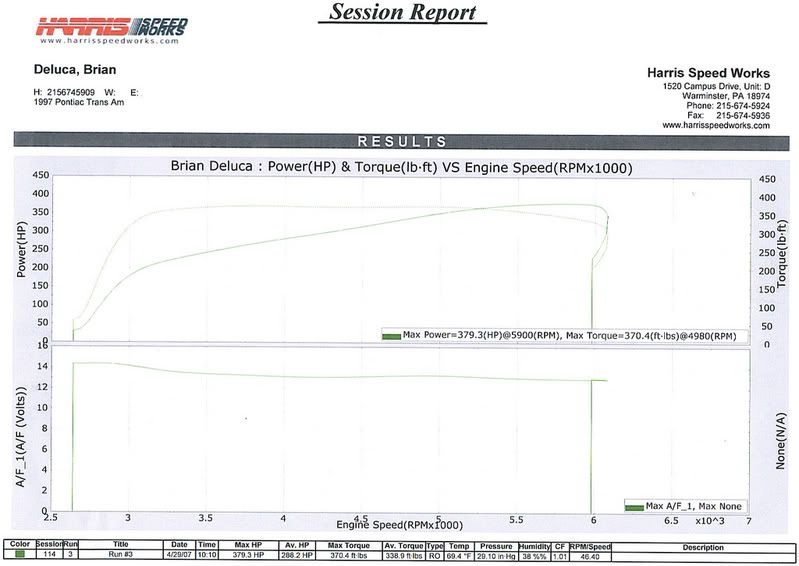
NA:
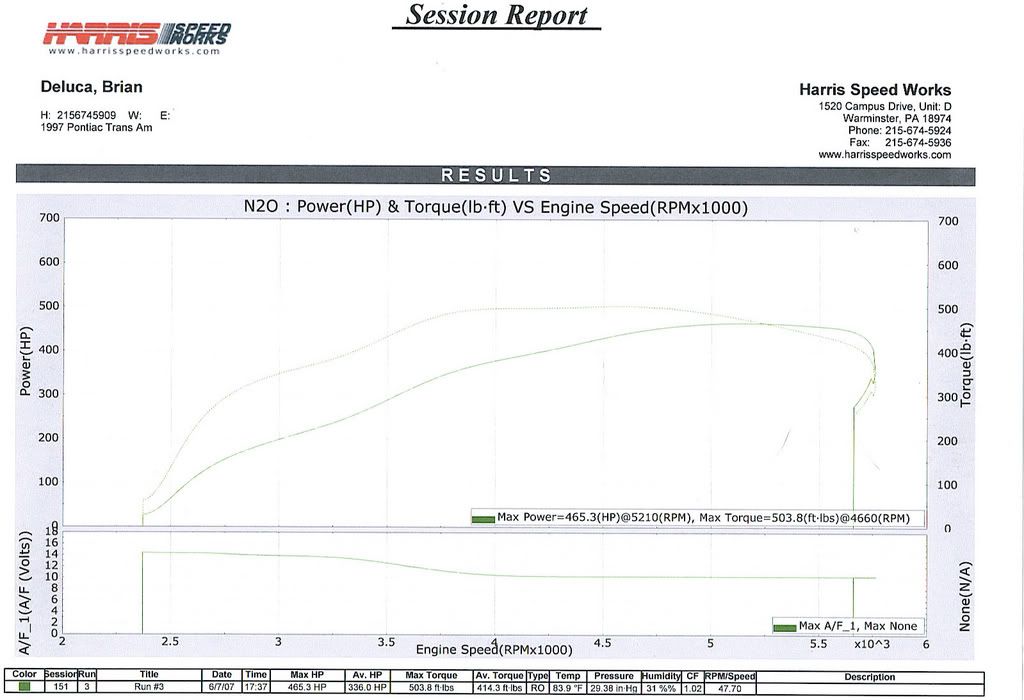
100 Hit:
So the question is, what rpm should I be shifting at running NA or on the juice?
The rev limiter is set at 6500rpm currently but looking at the NA graph, I am not making any more power past 59XXrpm. Also, on the juice, my power peaks at 52XXrpm and then trails down just a bit. I want to stay in the biggest chunk in power so again...looking for some info.
M6 car btw with 3.42's in the rear.
-Brian
NA:
100 Hit:
So the question is, what rpm should I be shifting at running NA or on the juice?
The rev limiter is set at 6500rpm currently but looking at the NA graph, I am not making any more power past 59XXrpm. Also, on the juice, my power peaks at 52XXrpm and then trails down just a bit. I want to stay in the biggest chunk in power so again...looking for some info.
M6 car btw with 3.42's in the rear.
-Brian
6 & 8 Second Club
Joined: Aug 2006
Posts: 2,284
Likes: 0
From: Illinois, RT 66 dragway area
.
We've done this a few times before. It is more of an art than science. Every engine/car will have a sweet spot. I was taught on my BBC, drag only, big rollers to start at 1000 above peak power.
.
We've done this a few times before. It is more of an art than science. Every engine/car will have a sweet spot. I was taught on my BBC, drag only, big rollers to start at 1000 above peak power.
.
I agree with Mr D.
Shift points are shift points. You do not have to change them from N/A to nitrous.
If you have a rev limit of 6500, shift at 6350-6400 - leave a little room for error.
I assume that you have the car tuned for both NA and nitrous??? Why did they cut the nitrous run short? In fact both dyno runs IMO should have been run to the rev limiter.
Good luck.
David
Shift points are shift points. You do not have to change them from N/A to nitrous.
If you have a rev limit of 6500, shift at 6350-6400 - leave a little room for error.
I assume that you have the car tuned for both NA and nitrous??? Why did they cut the nitrous run short? In fact both dyno runs IMO should have been run to the rev limiter.
Good luck.
David

King of the radial tires
Joined: Nov 2001
Posts: 391
Likes: 0
From: Beyond the beltway in Maryland
The core issue with shift points involves, first, a literal calculation and, second, track testing to verify the correctness of the calculation.
To do the caculation you need
(1) the spreadsheet rwhp data values of the runs, not the graphs.
(2) your tranny ratios for each forward gear.
Caculate for say 4500-6600 the delivered-rwhp in each gear.
Then look at the pre-shift delivered-rwhp at each rpm above the peak, and compare it to the post-shift delivered-rwhp.
You want to keep reving the motor higher so long as the delivered-horsepower pre-shift exceed the delivered-horsepower post-shift.
I did those calculations for all my stock Z06s and concluded that the ideal shift point for each car for 1-2, 2-3, and 3-4 is right before the limiter. So with a fast clutch leg, I target clutch-in for the rev-limiter minus 100 rpm.
I have verified these shift points at the drag strip and confirmed they are ideal in a stock Z06.
With that said, your results may vary from mine; but the procedure for determining the ideal shift point remains valid. Most dyno shops keep runs stored on their dyno-puter and can print out the spread sheet data for your runs.
Ranger
To do the caculation you need
(1) the spreadsheet rwhp data values of the runs, not the graphs.
(2) your tranny ratios for each forward gear.
Caculate for say 4500-6600 the delivered-rwhp in each gear.
Then look at the pre-shift delivered-rwhp at each rpm above the peak, and compare it to the post-shift delivered-rwhp.
You want to keep reving the motor higher so long as the delivered-horsepower pre-shift exceed the delivered-horsepower post-shift.
I did those calculations for all my stock Z06s and concluded that the ideal shift point for each car for 1-2, 2-3, and 3-4 is right before the limiter. So with a fast clutch leg, I target clutch-in for the rev-limiter minus 100 rpm.
I have verified these shift points at the drag strip and confirmed they are ideal in a stock Z06.
With that said, your results may vary from mine; but the procedure for determining the ideal shift point remains valid. Most dyno shops keep runs stored on their dyno-puter and can print out the spread sheet data for your runs.
Ranger
Thread Starter
Joined: Mar 2005
Posts: 2,161
Likes: 4
From: Millstone Twp, NJ
The power falls off past 6K so I told them to rev it to 6200 rpm because I didn't see a point in running in higher than the peak. They may have been going by my tach for the rpms since I know its a bit off.
-brian
-brian
King of the radial tires
Joined: Nov 2001
Posts: 391
Likes: 0
From: Beyond the beltway in Maryland
Originally Posted by Blackbirdws6
The power falls off past 6K so I told them to rev it to 6200 rpm because I didn't see a point in running in higher than the peak. They may have been going by my tach for the rpms since I know its a bit off.
-brian
-brian
Where you shift depends on your objective. I'm trying to find the lowest possible ET in my stock cars. Doing that requires optimal shift points.
Anyone that shares that objective needs to do the calculation I've described. I've found a shift short by 300 rpms from optimal on the 1-2 costs about .15 seconds; the same on the 2-3 costs about .10. Those are big swings for shift point errors.
On the LS1 and LS6 motor, the tac lags behind actual motor rpm on the 1-2 and 2-3; so the driver must calibrate the clutch-in rpm to make the shift before hitting the limiter.
Ranger
Trending Topics
If you are going by the factory tach, shift it at 6000 n/a because the tach is a little slow from where the motor is actually at... with the nitrous on I'd shift it earlier because nitrous usually likes the lug of an earlier shift to use the tq that's generated, try shifting on the just at 5500.
If you're going by a shift light, n/a shift at 6100, nitrous at about 5600
If you're going by a shift light, n/a shift at 6100, nitrous at about 5600
LS1 Tech Stories
The Best V8 Stories One Small Block at Time

Amazing '71 Camaro Restomod Is Modern Muscle Car Under the Skin
Verdad Gallardo
6 Common C5 Corvette Failures and What's Involved In Repairing Them
Pouria Savadkouei
Retro Modern Bandit Pontiac Trans AM Comes With Burt Reynolds' Autograph
Verdad Gallardo
Top 10 Greatest Cadillac V Series Performance Models Ever, Ranked
Pouria Savadkouei
Top 10 Most Powerful Chevy Trucks Ever Made!

Hennessey's New Supercharged Silverado ZR2 Has 700 HP
Verdad Gallardo
Coachbuilt N2A Anteros Is an LS2-Powered C6 Corvette In Italian Clothes
Verdad Gallardo
Awesome K5 Blazer Restomod Comes With C7 Corvette Power
Verdad Gallardo
10 Camaros You Should Never Buy
Thread Starter
Joined: Mar 2005
Posts: 2,161
Likes: 4
From: Millstone Twp, NJ
Thanks for all the input guys. I've noticed the stock tach lags behind the actual rpm of the motor. I have a shift light set at 6k but may bump it up a 100 rpm if I feel I'm getting quicker at it. I like the calculation a lot and I will take a look at the data to see where that would put me.
-brian
-brian

I would use a shift light to learn the timing of the shift.
My theory with LS1 F-bodies has always been 200rpm above the peak HP.
NA 6100
N2O 5500 [that is strangely low]
My theory with LS1 F-bodies has always been 200rpm above the peak HP.
NA 6100
N2O 5500 [that is strangely low]
King of the radial tires
Joined: Nov 2001
Posts: 391
Likes: 0
From: Beyond the beltway in Maryland
LS6 and LS7 motors produce the greatest horsepower under the curve when reved to just before the limiter. I'd be shocked it that were not true with the LS1 and LS2.
If the motor is still making more HP than it will post-shift, then don't shift yet. Simple as that.
The LS1/LS6 motor has a network speed that is much slower than the LS2/LS7. That means when the LS1/LS6 motor is in 1st and 2d gear the tac will lag behind the true motor rpm. So the driver must interpolate to get execute clutch-in just before hitting the limiter. 3d gear registers true however. The tac and the actual rpm coincide.
Those conclusions are based on my calculation, field checked by 500 passes.
Ranger
If the motor is still making more HP than it will post-shift, then don't shift yet. Simple as that.
The LS1/LS6 motor has a network speed that is much slower than the LS2/LS7. That means when the LS1/LS6 motor is in 1st and 2d gear the tac will lag behind the true motor rpm. So the driver must interpolate to get execute clutch-in just before hitting the limiter. 3d gear registers true however. The tac and the actual rpm coincide.
Those conclusions are based on my calculation, field checked by 500 passes.
Ranger
Thread Starter
Joined: Mar 2005
Posts: 2,161
Likes: 4
From: Millstone Twp, NJ
I am looking to finally hit the track and get some passes in to try a couple different shift pts. My only guess on the peak nitrous power rpm being so low is possibly because its reaching the maximum flow the heads will allow. I did find it odd as well but if thats the case then I will just spin the motor lower. It's still a stock bottom end so that really won't bother me spinning it lower but it cuts my powerband a bit short. I'll see what happens. Thanks again.