






static compression affect on turbo spool

Thread Starter
Staging Lane
Joined: May 2013
Posts: 77
Likes: 0
From: OKC, OK
 static compression affect on turbo spool
 Im in the process of putting together parts to build my ls2 shortblock. Ive searched around but come up with alot of conflicting info. How much if any effect does static comp have on spool time? Im basically looking at the difference between 9.2:1 vs 10:1 scr. For what ots worth this will be with an m6 and running on e85.
Im in the process of putting together parts to build my ls2 shortblock. Ive searched around but come up with alot of conflicting info. How much if any effect does static comp have on spool time? Im basically looking at the difference between 9.2:1 vs 10:1 scr. For what ots worth this will be with an m6 and running on e85.
Thread Starter
Staging Lane
Joined: May 2013
Posts: 77
Likes: 0
From: OKC, OK
Sweet nice to know! Id honestly love to run 10:1 but this is a budget rebuild and Im kinda stuck on piston choices. I can go Wiseco, but the only 4.010 piston option puts me at 9.2:1 (this is even with some milling on the heads). I could go to the Autotec pistons (which would also save $75) and get 10:1, but it would be a 4032 piston, and Im a bit concerned with running a 4032 piston with boost. However, it will be on E85 and my goal is prob 700-750whp at the most, so Im still debating.
Trending Topics
TECH Apprentice


Joined: Apr 2012
Posts: 333
Likes: 4
From: New Zealand
I think quench has a big impact on response and snappiness if the tune is adjusted accordingly. I've seen a Viper V10 with more snap and response at 9.5:1 and with twin small GT35R's than the stock 10:1 motor - due to tight quench via custom fit pistons.
LS1 Tech Stories
The Best V8 Stories One Small Block at Time

6 Common C5 Corvette Failures and What's Involved In Repairing Them
Pouria Savadkouei
Retro Modern Bandit Pontiac Trans AM Comes With Burt Reynolds' Autograph
Verdad Gallardo
Top 10 Greatest Cadillac V Series Performance Models Ever, Ranked
Pouria Savadkouei
Top 10 Most Powerful Chevy Trucks Ever Made!

Hennessey's New Supercharged Silverado ZR2 Has 700 HP
Verdad Gallardo
Coachbuilt N2A Anteros Is an LS2-Powered C6 Corvette In Italian Clothes
Verdad Gallardo
Awesome K5 Blazer Restomod Comes With C7 Corvette Power
Verdad Gallardo
10 Camaros You Should Never Buy

10 LS Engine Myths That Refuse to Die
Verdad Gallardo
9 Second Club
Joined: Nov 2003
Posts: 13,616
Likes: 185
From: Norn Iron
Sweet nice to know! Id honestly love to run 10:1 but this is a budget rebuild and Im kinda stuck on piston choices. I can go Wiseco, but the only 4.010 piston option puts me at 9.2:1 (this is even with some milling on the heads). I could go to the Autotec pistons (which would also save $75) and get 10:1, but it would be a 4032 piston, and Im a bit concerned with running a 4032 piston with boost. However, it will be on E85 and my goal is prob 700-750whp at the most, so Im still debating.







That is interesting, was the tune optimized with the change in compression?
I think quench has a big impact on response and snappiness if the tune is adjusted accordingly. I've seen a Viper V10 with more snap and response at 9.5:1 and with twin small GT35R's than the stock 10:1 motor - due to tight quench via custom fit pistons.
I think quench has a big impact on response and snappiness if the tune is adjusted accordingly. I've seen a Viper V10 with more snap and response at 9.5:1 and with twin small GT35R's than the stock 10:1 motor - due to tight quench via custom fit pistons.
I’d think high static compression bleeding off cyl pressure with the cam would have a few negative side effects over a low compression turbo engine.
Higher duration shifts the power band up higher in the RPM range. This also usually requires more ign lead (counterproductive to power).
For all the OEM short blocks utilizing high compression (10:1+) and a larger cam to make things “snappy”. I’d think you’d be giving up an optimum peak torque and RPM range in boost… for a little out of boost performance. (bad trade IMO).
Ideally wouldn’t you want to…
1. Plot where you want peak torque and your redline for your specific engines top end/intake.
2. Pick a cam to match that RPM band with the least amount of overlap. (which will also allow you the least amount of ign lead)
3. Pick your fuel
4. Lastly pick your static compression based off the dynamic compression produced by the amount of boost you want to run and your chosen cam?
Last edited by Forcefed86; May 2, 2014 at 10:32 AM.
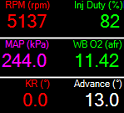
In an automatic car it will make more RPM on the converter (while on the transbrake). More RPM = spool faster (as side effect of more RPM, not directly from the cr change).
More compression won't change how much air the motor ingests. More compression also puts more heat in the combustion cycle instead of out the exhaust (wasted). Same cfm, slightly lower EGTs = won't spool faster (at the same RPM).
More compression won't change how much air the motor ingests. More compression also puts more heat in the combustion cycle instead of out the exhaust (wasted). Same cfm, slightly lower EGTs = won't spool faster (at the same RPM).
