








What cubic inch is too large?

What's the CH that was referenced?
If your going aftermarket block, 6 bolt heads, and your not turbo limited I would go a little larger. I really like 4.125" bore with a 3.6-4.0" stroke. So 388" to 427" and run enough exhaust turbine wheel and your good to go. Most guys are running a single turbo with a limited turbine so to many cubes choke it.
If you look at the actual main journal/rod journal overlap of a 3.62x LS crank vs say a 4", it is a substantial difference
We are blessed with a large main and rod journals, giving us nice overlap.
The high power stuff is flexing the crank, and there aren't many CCW options, so putting the stiffest crank in there will keep the bottom the happiest
Sure race car where they tear down often and are doing bearings big deal, but high power street car that has long tear down intervals, it makes a difference
CH is the compression height of the piston, the distance from pin to crown. This is the area you have to work with for adequate lands and ring pack
Good deal less on a 4" vs 3.6 in a standard 9.24 deck block. ~1.3 vs 1.1
We are blessed with a large main and rod journals, giving us nice overlap.
The high power stuff is flexing the crank, and there aren't many CCW options, so putting the stiffest crank in there will keep the bottom the happiest
Sure race car where they tear down often and are doing bearings big deal, but high power street car that has long tear down intervals, it makes a difference
CH is the compression height of the piston, the distance from pin to crown. This is the area you have to work with for adequate lands and ring pack
Good deal less on a 4" vs 3.6 in a standard 9.24 deck block. ~1.3 vs 1.1
Here is a pic of a stock crank. Line showing where you are looking at.
I don't have a 4" laying here to take pic of
Good pic of the stock crank showing how much undercut their is at the fillet also

I don't have a 4" laying here to take pic of
Good pic of the stock crank showing how much undercut their is at the fillet also

LS1 Tech Stories
The Best V8 Stories One Small Block at Time

6 Common C5 Corvette Failures and What's Involved In Repairing Them
Pouria Savadkouei
Retro Modern Bandit Pontiac Trans AM Comes With Burt Reynolds' Autograph
Verdad Gallardo
Top 10 Greatest Cadillac V Series Performance Models Ever, Ranked
Pouria Savadkouei
Top 10 Most Powerful Chevy Trucks Ever Made!

Hennessey's New Supercharged Silverado ZR2 Has 700 HP
Verdad Gallardo
Coachbuilt N2A Anteros Is an LS2-Powered C6 Corvette In Italian Clothes
Verdad Gallardo
Awesome K5 Blazer Restomod Comes With C7 Corvette Power
Verdad Gallardo
10 Camaros You Should Never Buy

10 LS Engine Myths That Refuse to Die
Verdad Gallardo
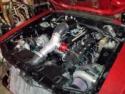

I can tell you this....
with MY 408 Ci
at 12 psi, with a twin 66's ON pump gas 93 octane
I make enough power to run 5.50's and 5.60's in the 1/8th AT 130MPH
Good luck getting there with a 5.3L at those boost levels...
and I'm planning on turning it up to around 20 psi on c16
with MY 408 Ci
at 12 psi, with a twin 66's ON pump gas 93 octane
I make enough power to run 5.50's and 5.60's in the 1/8th AT 130MPH
Good luck getting there with a 5.3L at those boost levels...
and I'm planning on turning it up to around 20 psi on c16
If you look at the actual main journal/rod journal overlap of a 3.62x LS crank vs say a 4", it is a substantial difference We are blessed with a large main and rod journals, giving us nice overlap. The high power stuff is flexing the crank, and there aren't many CCW options, so putting the stiffest crank in there will keep the bottom the happiest Sure race car where they tear down often and are doing bearings big deal, but high power street car that has long tear down intervals, it makes a difference CH is the compression height of the piston, the distance from pin to crown. This is the area you have to work with for adequate lands and ring pack Good deal less on a 4" vs 3.6 in a standard 9.24 deck block. ~1.3 vs 1.1
A. Stock stroke
B. The difference between the 408 and 370 piston was rediculous.
If that's your thinking why go any more cubes than stock at all? Just forged it and run more boost? Not being a smartness. It's a legit question because I am in this boat and this next build is where is really starts to get expensive as far as more cubes, better heads, better turbos, setups and so on. I'm trying to get educated to make the best decision. My thought was bigger motor + bigger turbo = more power.


I can tell you this....
with MY 408 Ci
at 12 psi, with a twin 66's ON pump gas 93 octane
I make enough power to run 5.50's and 5.60's in the 1/8th AT 130MPH
Good luck getting there with a 5.3L at those boost levels...
and I'm planning on turning it up to around 20 psi on c16
with MY 408 Ci
at 12 psi, with a twin 66's ON pump gas 93 octane
I make enough power to run 5.50's and 5.60's in the 1/8th AT 130MPH
Good luck getting there with a 5.3L at those boost levels...
and I'm planning on turning it up to around 20 psi on c16
If the goal was 5.50's, I could easily get the same performance from a 5.3 by dropping base compression and adding boost to make up for difference. Why is manifold pressure relevant? You simply drop your SCR enough to reach your goal with the available octane.
I'd prefer an oversquare motor to a stroked one for a max effort FI build. The larger stroked motors will have more reciprocating weight and more stress on the moving parts. There are large advantages to higher RPM when dealing with FI race engines. A smaller engine will allow more RPM with less back pressure. This will let you extract more power from the turbo.
What class doesn't limit turbo size anyway?
Last edited by Forcefed86; Jan 1, 2015 at 08:21 PM.
I dont' like this logic... If your building a power adder car, let the power adder do the work. The turbo is more efficient at making power. I'd want to make as much power as possible with the turbo. Going through all the trouble to run forced induction and only running 12lbs seems backwards to me.
If teh goal was 5.50's, I could easily get the same performance from a 5.3 by dropping base compression and adding boost to make up for difference. Why is manifold pressure relevant? You simply drop your SCR enough to reach your goal with the available octane.
I'd prefer an oversquare motor to a stroked one for a max effort FI build. The larger stroked motors will have more reciprocating weight and more stress on the moving parts. There are large advantages to higher RPM when dealing with FI race engines. A smaller engine will allow more RPM with less back pressure. This will let you extract more power from the turbo.
What class doesn't limit turbo size anyway?
If teh goal was 5.50's, I could easily get the same performance from a 5.3 by dropping base compression and adding boost to make up for difference. Why is manifold pressure relevant? You simply drop your SCR enough to reach your goal with the available octane.
I'd prefer an oversquare motor to a stroked one for a max effort FI build. The larger stroked motors will have more reciprocating weight and more stress on the moving parts. There are large advantages to higher RPM when dealing with FI race engines. A smaller engine will allow more RPM with less back pressure. This will let you extract more power from the turbo.
What class doesn't limit turbo size anyway?
the goal is Faster than that.....
but just showing I got there with low boost on a 6.8L vs having to go high boost on a 5.3L to achieve the same thing
when I turn up the boost.....its on like donkey king...
there is a limit to how much cylinder pressure you can get before you start to lift the heads and push water....and you reach it much sooner with a 5.3L on a lot of boost than you do with a bigger motor on less boost
also, your cam is going to dictate how far up the RPM scale you can push the RPM...it doesnt matter how much boost you make if your cam cant support the CFM flow.
so spinning the engine higher doesnt mean didly squat if you dont have a cam that can do it.(and most people have WAY too small of a cam to support high rpm turbo stuff)
Where are these times lips and videos BTW?


Launching!
Joined: Oct 2006
Posts: 201
Likes: 0
From: Grand Rapids, MI
Launching!
Joined: Oct 2006
Posts: 201
Likes: 0
From: Grand Rapids, MI
In a perfect world, you are correct. Larger engine + larger turbo = more power. The problem with that is, there is not an infinite number of turbine sizes available. You need to size your engine based on which turbos are in your budget that will reach your power goals. Most people don't want to buy a full frame s500 or similar sized turbo. Lots of people need to make their horsepower goal on a single s400 turbo. When you limit yourself in those areas, turbine flow becomes the limiting factor much earlier than compressor.
Look at class racing. There is a reason Carl Stevens is building 480" hemis now when the norm has been 526" for ever and ever. There is a reason you don't see very many unlimited turbo cars over 600". There is a reason Ultra Street guys are getting away from 427" and building smaller engines in the 370-380" range. To be honest I'm not sure why no one has tried to run a 2JZ in that class. With the turbos you're limited to, a 3.0L could dominate that class.
Jack