When you click on links to various merchants on this site and make a purchase, this can result in this site earning a commission. Affiliate programs and affiliations include, but are not limited to, the eBay Partner Network.
Direct methanol injection through blending at the rail?
Wild brain storming here, but...
If one were to install a fitting similar to this on the feed of each rail. (with a check valve or solenoid) Then run straight methanol (or even water/meth). Would it not basically be "blending the fuel" and "direct injected"?
I know water will destroy tanks and injectors if it sets for any length of time. But done in this manor the methanol (or water/meth mix) Would only be in contact with the injector for a few seconds. Then immediately flushed with your standard fuel when you lift. With such a brief period of exposure I doubt water would have any ill effects. Straight methanol sure wouldn't.
Would be similar to adding 10-20-30% methanol to your fuel tank before going to the track. Meth pump would have to fight standard fuel pump pressures. But the flow VS pressure would stabilize and you'd basically get what you get as far as volume to each fuel rail.
Benefits would be:
1.) Equal distribution with zero real fuel system exposure to methanol.
2.) Easy installation (no nozzles etc)
3.) Would only consume your AUX injected fluid while system is active.
4.) possibility of adding small % of water for direct port water injection on top.
Possible issues
1.) Fuel could back feed into your methanol/water tank if solenoid or check valve fails. Maybe run a check valve and a solenoid as a failsafe? (believe most pumps have a check valve as well)
2.) Uneven "blending" initially until all fuel in rail is flowing 100% "blended" fuel. (may need to turn system on pre-race, before burnout, etc)
3.) Possible injector damage with water?
Defiantly could be an issue! But depends how you have the system plumbed. I run the system return at the regulator by the tank and dead head the rails. Plumbed this way that wouldn't be an Issue.
Similar to a dead head dual fuel setup I was thinking of running.
Depending on which fuel pump was powered you'd get race or 91. Or if both pumps were powered you'd get a mix of the 2. Returns remain un-mixed.
Idea above would be similar but less complex since you wouldn't need the additional regulator and fuel pump. Just a water/meth pump and a few fittings.
Last edited by Forcefed86; Nov 19, 2020 at 11:45 AM.
You'd almost never get a perfect mixture. I deal with inline mixers a lot for chemicals at work, and a uniform mixture inside of the rails would be almost impossible.
How would what ever mixture it netted not be consistent? I'm not saying I'd be able to control what percent of methanol to fuel I'd get, only that it would stabilize and the result in teh same mixture each time... Which would make tuning pretty easy.
What ever mixture it netted when X pressure/flow's meet through Y orifice would be repeatable, no? How would it differ from say a blender pump at an E85 gas station? Only difference being your pumping it into the rail Vs the tank.
You'd almost never get a perfect mixture. I deal with inline mixers a lot for chemicals at work, and a uniform mixture inside of the rails would be almost impossible.
This was my first thought. If you inject at the end of each rail with check valves, how do you guarantee that the cylinders on each back get an equal amount of the meth/water.
What ever mixture it netted when X pressure/flow's meet through Y orifice would be repeatable, no? How would it differ from say a blender pump at an E85 gas station? Only difference being your pumping it into the rail Vs the tank.
Sorry for the long reply, Your question just got me thinking lol
I think the biggest factor you are overlooking, If you have two pumps dumping into a tank they are not fighting each other and each pump is able to flow consistently because there is no head pressure. In the case of a blend setup like e85 everything is flow measured and computer controlled to get the correct mixture, One pump can flow less than the other and the computer will compensate for it.
The way you want to do it, Both pumps will see a head pressure and a slight difference in pressure at one pump can mean a huge swing in the mixture and I'm talking less than a pound difference can throw off the mixture enough to make the car run extremely rich or lean. Think of it this way, One pump drops by a half a pound of pressure due to heat/tank volume or whatever. That mean the other pump is seeing a half pound less head pressure and able to flow considerably more volume. You could actually force fuel backwards into one line. Here's another way to look at it, If you have an pressure vessel and you connect a pressurized line (50.0psi) to it (think air tank) it will flow until the pressure is balanced (Tank and line at 50.5psi) Now you hook another pressurized line (49.8psi) to it, Not only will the lower pressure line not flow air into the pressure vessel the pressure vessel will flow air into the line as it tries balance out. That's basically the same thing that will happen in your pressure vessel (fuel rail) at idle and light throttle because very little is flowing anywhere. For it to work you would pressure and flow rate of both systems to be 100% identical and that's nearly impossible.
Another point, How would you tune it unless you ran a water meth mixture all the time? Injecting water meth into the rail will displace fuel and would have to be compensated in the tune.
Last edited by LLLosingit; Nov 19, 2020 at 03:58 PM.
How would what ever mixture it netted not be consistent? I'm not saying I'd be able to control what percent of methanol to fuel I'd get, only that it would stabilize and the result in teh same mixture each time... Which would make tuning pretty easy.
What ever mixture it netted when X pressure/flow's meet through Y orifice would be repeatable, no? How would it differ from say a blender pump at an E85 gas station? Only difference being your pumping it into the rail Vs the tank.
Several reasons why it wouldn't be consistent. Fuel pressure between the two would always have to be identical, or at least a constant ratio.
This means with boost as well, you would have to make sure that both regulators have the exact pressure increase with boost.
Also, both fuels wouldn't be perfectly mixed as soon as they enter the rail. Mixing takes time. Each injector would see a different percentage of methanol that could easily fluctuate based on the mixing pattern.
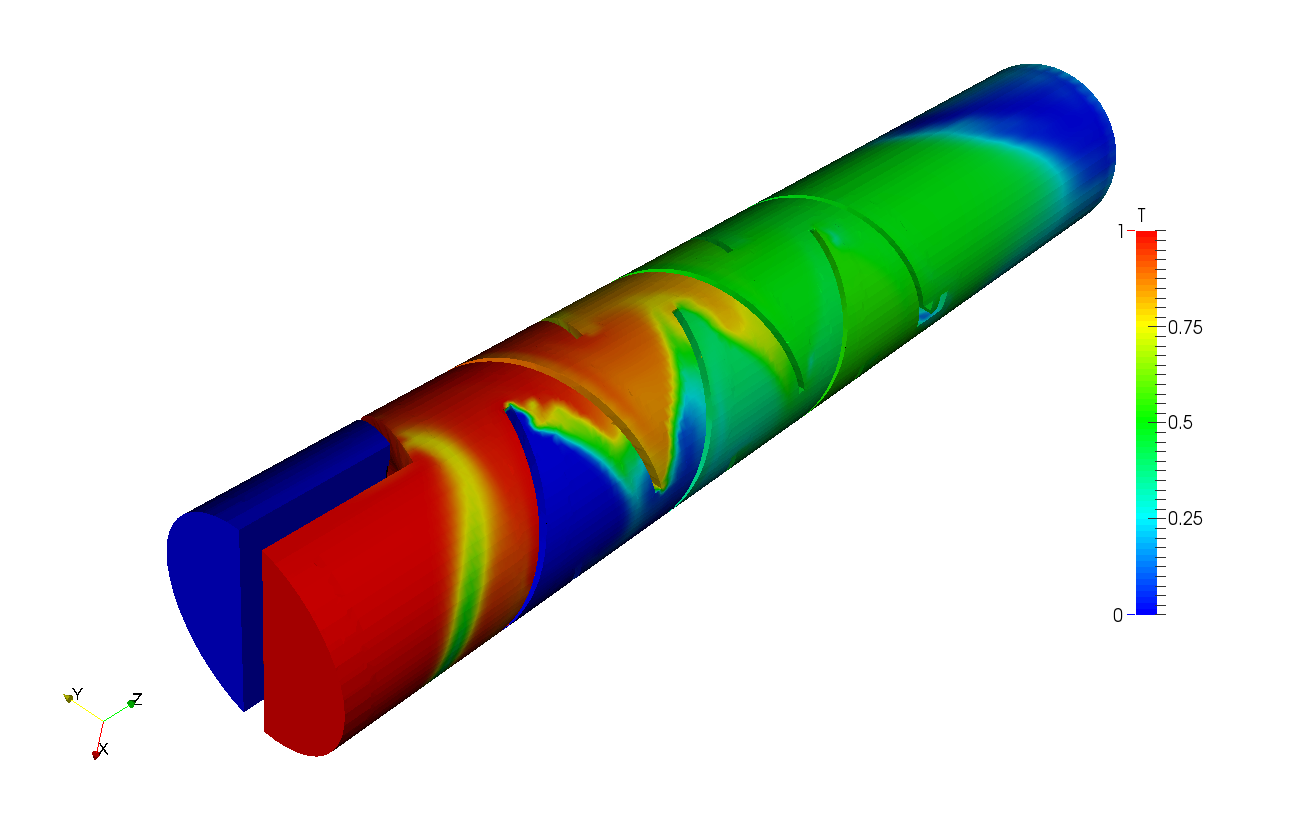
This picture shows a static mixer, like we use where I work. 2 fluids are forced through a pipe that basically has a corkscrew in the middle to force the fluids to mix. Its not instantaneous.
Fluid mixing takes time, and there is absolutely not enough time to do it in the fuel rails at the velocity they're moving.
Even the static mixers don't mix our fluids well enough. 2 nearly identical fluids have to be mixed again afterwards.
And here is a typical T-junction mixer, like what you're proposing.
Basically, unless they're mixed in the tank, there will be no consistent or uniform ratio, and you'll grenade something because the front and back cylinders will be off by .2 Lambda.
Long replies welcome! I appreciate the interest! I'm not confident this will work, just trying to figure out the reasons why It wont. Which Awesomeauto has explained to me quite well. (thanks!)
1.) This wouldn't be a huge amount of aux fuel with 1 standard methanol pump. And I'm not targeting equal flow or pressure. The big kicker is, I don't really care what the mixture is! As long as it was repeatable and consistent.
I would be running 40-50psi more pressure out of the methanol pump that the fuel pump. So if I left my fuel pressure static at say 60psi and my methanol kit was at a solid 100psi. That pressure delta is what will give me my flow of methanol into the line. As long as that delta doesn't change, the amount of methanol introduced (in boost only) Would be the same.
2.) The setup I'm talking about would have the regulator at the tank and the methanol mixed pre-rail entrance. There is no way for the methanol to flow backwards into the fuel line or tanks (there are check valves on the fuel pumps and meth pump). The only place for the methanol to go is into the injector. (or nowhere if pressure equalized) This working would rely on the methanol pump having more pressure than the fuel system. If not, there would be no flow into the line. The system would be momentary. So as soon as your pass was done. "gas" would flush and clean all the lines and injectors of methanol quickly.
3.) Tuning would be simple as the system is not active when not in boost. As long as the "mixture" was consistent I could tune for it in the boost only cells. Also the fuel correction/autotune would take care of any anomalies or slight swings in AFR.
My big question was...
Will spraying 20gph of methanol at 100psi (40 psi greater than fuel system) into a relatively small area fuel line fitting do an adequate job of mixing the 2 fuels pre-rail? OR would the fuels have some kind of odd boundary layer in the rail. Causing some injectors get more methanol than others? Which would defeat the whole purpose of "direct injection". Sounds like they would... Bummer!
I was hoping since the system was dead headed and there was a constant supply pre rail that eventually what ever was in the rail would have to equalize and blend.
Last edited by Forcefed86; Nov 20, 2020 at 09:28 AM.
.....Causing some injectors get more methanol than others? ... Bummer!
This is my main concern. I don't think it would balance the way it needs to. You'd be better off having a way to cut off the gas entirely and switch to meth during WOT. There would be some transition time but at least you would know that all injectors get the same "mix" of meth, because there is no mix.
That could work! But takes the simple and cheap out of the equation. I'm not looking to set the world on fire power wise and defiantly don't need a full on methanol fuel system. I might not even need the meth injection honestly.
Building a Twin 78/75 5.3 and will be on E85 without an intercooler. Don't plan on more than 20lbs. May not even see that. Always been a fan of water meth is all. If I could find a way to distribute it evenly and cheap, it would be a bonus. Esp. If I could do it with out drilling 8 holes in my intake and running an octopus of plumbing.
Those 16 injector Holley intakes are getting almost affordable and have some potential for sure. Hopefully people start using them in this manor. Cruise around on 80's and pump fuel. Then have some 210s kick on with straight methanol while in boost.
You'd still need it in every runner to ensure equal distribution. That was the appeal of the original idea. That, and it would cost next to nothing, be maintenance free and simple to install. The meth nozzles atomize and distribute to the cylinders better than an injector placed upstream would.
But yes, a 16 injector system would me pretty darn good! My ECU could do it easily. But the cost and effort/maintenance of having 2 dedicated fuel systems and dealing with the pitfalls of a methanol fuel on this sort of build aren't justified.
I'll just deal with the typical uneven distribution and spray a smallish amount at each turbo inlet and call it a day.
You'd still need it in every runner to ensure equal distribution. That was the appeal of the original idea. That, and it would cost next to nothing, be maintenance free and simple to install. The meth nozzles atomize and distribute to the cylinders better than an injector placed upstream would.
But yes, a 16 injector system would me pretty darn good! My ECU could do it easily. But the cost and effort/maintenance of having 2 dedicated fuel systems and dealing with the pitfalls of a methanol fuel on this sort of build aren't justified.
I'll just deal with the typical uneven distribution and spray a smallish amount at each turbo inlet and call it a day.
The idea with the injector is more precise control over the amount of meth. You aren’t getting equal distribution with either of your methods either. Scott Taylor uses 2 large injectors in the intake on his car Track doe for straight methanol that’s where I got the idea.
The amount injected/control isn't really the issue IMO. Most don't use half what the typical baby water/meth pumps put out and a simple PWM setup has always removed any "bog" in my case. Its that fact that it doesn't distribute well. So some cylinders get flooded and others get very little. Manifold design will play a big roll, but the only real option for us V8 folk with typical poor "wet flow" manifolds is to have a direct port kit. Seen a few setups spraying injectors upstream of the TB and they all seem to have similar issues to the kits.
Also unless you spray pre-turbo, the "charge cooling" isn't drastically effected. So you're risking a charge pipe bomb for very little gain by spraying a lot of fuel there. That Travis Quillen fella sprayed 4 2000cc injectors in the charge pipe post turbo. Aside from frosty cold pipes, he found little to no gains compared to spraying at the injector and scrapped the idea. (this is with methanol).
Yet when you spray pre-turbo, large gains are easily seen.
I'm surprised nobody has really come up with a spray rail that inserts into an intake. You could easily get away with 4 nozzles as opposed to 8.
But 8 directed at each runner probably preferred.
But it still needs suitable valving to prevent sucking fluid in under vacuum.
With the large open plenum alloy intakes, especially with a bolt on lid it should be fairly easy to achieve. Even a piece of square alloy tube with nozzles drilled/tapped into it ( or round, square maybe easier to DIY ). Although you wouldn't really want a large volume inside the rail as it's more that could dribble fluid, plus delay on spray because of distance from any check valves etc.
I was thinking of something similar. Weld it to the floor facing up with 4 nozzles. Have a bulkhead fitting on the back of the intake to attach the feed hose.
6 Common C5 Corvette Failures and What's Involved In Repairing Them
Slideshow: From wobbling harmonic balancers to failed EBCMs, these are the issues that define long-term C5 ownership and what repairs typically involve.
Retro Modern Bandit Pontiac Trans AM Comes With Burt Reynolds' Autograph
Slideshow: A modern Camaro transformed into a retro icon, this limited-run "Bandit" build blends nostalgia with brute force in a way few revivals manage.
Top 10 Greatest Cadillac V Series Performance Models Ever, Ranked
Slideshow: Cadillac didn't just crash the high-performance luxury vehicle party, it showed up loud, supercharged, and occasionally a little unhinged...
Coachbuilt N2A Anteros Is an LS2-Powered C6 Corvette In Italian Clothes
Slideshow: A one-off sports car that looks like a vintage Italian exotic-but hides a C6 Corvette underneath-just sold for the price of a new mid-engine Corvette.








 Direct methanol injection through blending at the rail?