





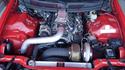


Exhaust temps STS
 Exhaust temps STS
 I brought my infrared temp gun home from work last night and was checking different areas to see what temps items where. Engine was up to temp and had been driven for about 15 miles. It was 65* outside. And I had a buddy hold the rpms about 2k. A/F 14.7:1
1. Exhuast Manifolds 380-400*
2. Top of Cat 400*
3. Outlet of Cat 525*+
4. Y-Pipe joint 450*
5. Half way down I pipe 250-300*
5. Over Axle pipe 180-225*
6. Turbine housing 380*
7. Muffler after turbo 300*
8. Exhaust tip 280*
9. Exhaust gasses leaving tip 330*
I'm going to wrap my exhaust with 2" heat wrap from the y-pipe to the turbo
this week. I'll re-check temps for comparison. I'll also be going back for a new dyno tune with a two bar map sensor. Maybe I'll do a run where the only change is heat wrap. Has any one else got solid numbers to back up wraping the exhaust. More Hp more tq or earlier spool? I know a lot of people have tried wrapping the exhaust but I wasn't able to find any REAL numbers.
1. Exhuast Manifolds 380-400*
2. Top of Cat 400*
3. Outlet of Cat 525*+
4. Y-Pipe joint 450*
5. Half way down I pipe 250-300*
5. Over Axle pipe 180-225*
6. Turbine housing 380*
7. Muffler after turbo 300*
8. Exhaust tip 280*
9. Exhaust gasses leaving tip 330*
I'm going to wrap my exhaust with 2" heat wrap from the y-pipe to the turbo
this week. I'll re-check temps for comparison. I'll also be going back for a new dyno tune with a two bar map sensor. Maybe I'll do a run where the only change is heat wrap. Has any one else got solid numbers to back up wraping the exhaust. More Hp more tq or earlier spool? I know a lot of people have tried wrapping the exhaust but I wasn't able to find any REAL numbers.
That is great man! Me and Zombie have always talked about doing this but we were too lazy.... I will make it a point to try to take the same temps with mine being Insulated with 1/2" ceramic batting and exhaust wrap on top of that.
Jared
Jared
Also forgot to mention that this is a great way to see if your cats are working! The temp out of the cat must be higher than the inlet temp. That is if you havn't hollowed them out yet! 
Well I've gotta keep my cats here in CA.  So i was taking my Y and I pipe off so I could wrap them. I've had a little rattle for a long time and I thought it was the valvetrain. Nope my drivers side cats gone loose. Its not broken up or setting any codes but the honeycomb is loose
  . Any one try to get the extended emmision warranty replacement of thier cats with a rear mount turbo and wrapped pipes? Any body have an 02 low milage F-body drivers side cat laying around they want to get rid of cheap? Other than that the y-pipe back is wrapped except for the last foot. I ran out of wrap.
  I used 100' of 2" wrap and need a few more feet. I'll get temps sunday but for now I'm done and time for a
So i was taking my Y and I pipe off so I could wrap them. I've had a little rattle for a long time and I thought it was the valvetrain. Nope my drivers side cats gone loose. Its not broken up or setting any codes but the honeycomb is loose . Any one try to get the extended emmision warranty replacement of thier cats with a rear mount turbo and wrapped pipes? Any body have an 02 low milage F-body drivers side cat laying around they want to get rid of cheap? Other than that the y-pipe back is wrapped except for the last foot. I ran out of wrap. I used 100' of 2" wrap and need a few more feet. I'll get temps sunday but for now I'm done and time for a Trending Topics
LS1 Tech Stories
The Best V8 Stories One Small Block at Time

6 Common C5 Corvette Failures and What's Involved In Repairing Them
Pouria Savadkouei
Retro Modern Bandit Pontiac Trans AM Comes With Burt Reynolds' Autograph
Verdad Gallardo
Top 10 Greatest Cadillac V Series Performance Models Ever, Ranked
Pouria Savadkouei
Top 10 Most Powerful Chevy Trucks Ever Made!

Hennessey's New Supercharged Silverado ZR2 Has 700 HP
Verdad Gallardo
Coachbuilt N2A Anteros Is an LS2-Powered C6 Corvette In Italian Clothes
Verdad Gallardo
Awesome K5 Blazer Restomod Comes With C7 Corvette Power
Verdad Gallardo
10 Camaros You Should Never Buy

10 LS Engine Myths That Refuse to Die
Verdad Gallardo
Just driving around today I can tell a good bit of difference. I didn't have my temp gun so no numbers yet, but I would recommend it so far by the SOTP meter. Also going to the GM dealer tuesday the service manager wants to see my car before he'll decide if the cats are gonna be covered under warranty. Also gonna put Zip Ties around my OBDII port so they cant connect to it and flash my tune out.

What temp do you run your car at? I still have my summer fan setting and just realised that my temp was 173.. Made my wideband not want to work at all. Let it get to 215 and it started working fine.
I assume with the sts you should run it in the 200's?
I assume with the sts you should run it in the 200's?
Well I've done my street tests and all I have to say is wow. While I had my pipes off I high temp siliconed all the joints that where not welded. So now there are defintatly no leaks. I'm not sure if there where any before?? Before: second Gear pull from a 15mph roll 7psi @3700 rpm 
After: second gear pull from a 15mph roll 7psi @3200 rpm
That is an outstanding 500rpm more that I'm now pulling full boost. I'm getting my 2.5 bar tune at Haddad wednesday and then hitting the track jan 13th so I'll try to get some numbers dyno and strip
After: second gear pull from a 15mph roll 7psi @3200 rpm
That is an outstanding 500rpm more that I'm now pulling full boost. I'm getting my 2.5 bar tune at Haddad wednesday and then hitting the track jan 13th so I'll try to get some numbers dyno and strip

you guys ever think about ceramic coating the inner part of your manifolds and exhaust pipes?
anyone care to share info why keeping the exhaust temp as high as possible to the rear is important? does that essentially help exhaust flow?
anyone care to share info why keeping the exhaust temp as high as possible to the rear is important? does that essentially help exhaust flow?
remember that turbos dont work just off flow, but also off heat, that's why i'm so curious to see how much better it gets if you dont lose all the heat while going all the way to the back. coating manifolds is an old trick, but an expensive one, that's why i think stainless headers and thermal wrap would probably be a much more financially-savvy solution. mostly it would probably show up in how quickly the boost hits, and from the initial findings it looks like it's about right.
its not really that they work on heat...but the speed of the exhaust is decreased as the heat drops. basically the longer you can keep the exhaust hot the quicker it will get to the back of the car. so the goal is to keep the heat in all the way to the back

The simple answer is heat = energy.
More heat = more exhaust volume = less exhaust molecules needed to turn the turbine = less energy used = better effecciency = lower backpressure = less pumping losses = more power.
More heat = more exhaust volume = less exhaust molecules needed to turn the turbine = less energy used = better effecciency = lower backpressure = less pumping losses = more power.

Simple Thermodynamics. PV=nRT.
V is the volume the gas occupies. In an exhaust system, that volume is defined by the exhaust pipes. Thus, in an exhaust system, V is constant.
Without getting into detail, n (# of moles of the gas) may be considered constant.
R is the ideal or universal gas constant (i.e., another constant).
Thus, the only variables are P and T. As temperature (T) of the exhaust gas increases (or decreases), the pressure (P) exerted by the gas also increases (or decreases). The higher pressure gas results in a higher gas velocity. This higher pressure (and higher velocity) results in shorter spool time relative to colder exhaust temperatures.
V is the volume the gas occupies. In an exhaust system, that volume is defined by the exhaust pipes. Thus, in an exhaust system, V is constant.
Without getting into detail, n (# of moles of the gas) may be considered constant.
R is the ideal or universal gas constant (i.e., another constant).
Thus, the only variables are P and T. As temperature (T) of the exhaust gas increases (or decreases), the pressure (P) exerted by the gas also increases (or decreases). The higher pressure gas results in a higher gas velocity. This higher pressure (and higher velocity) results in shorter spool time relative to colder exhaust temperatures.
Last edited by NigelTufnel; Dec 20, 2006 at 12:19 PM.