







Has this Happened to anyone before?
 Has this Happened to anyone before?
 Hello all, I Have been a Member here for around 4 years but never posted. I have learned alot from everyone here over the years, and pretty much know the in's and out's of my 2000 Trans Am. My car has treated me well and has not had alot of the dreaded common problems that many F-body owners have had, until recently. I thought my DS window motor was starting to go so I bought one and was ready to install it until i came across this. 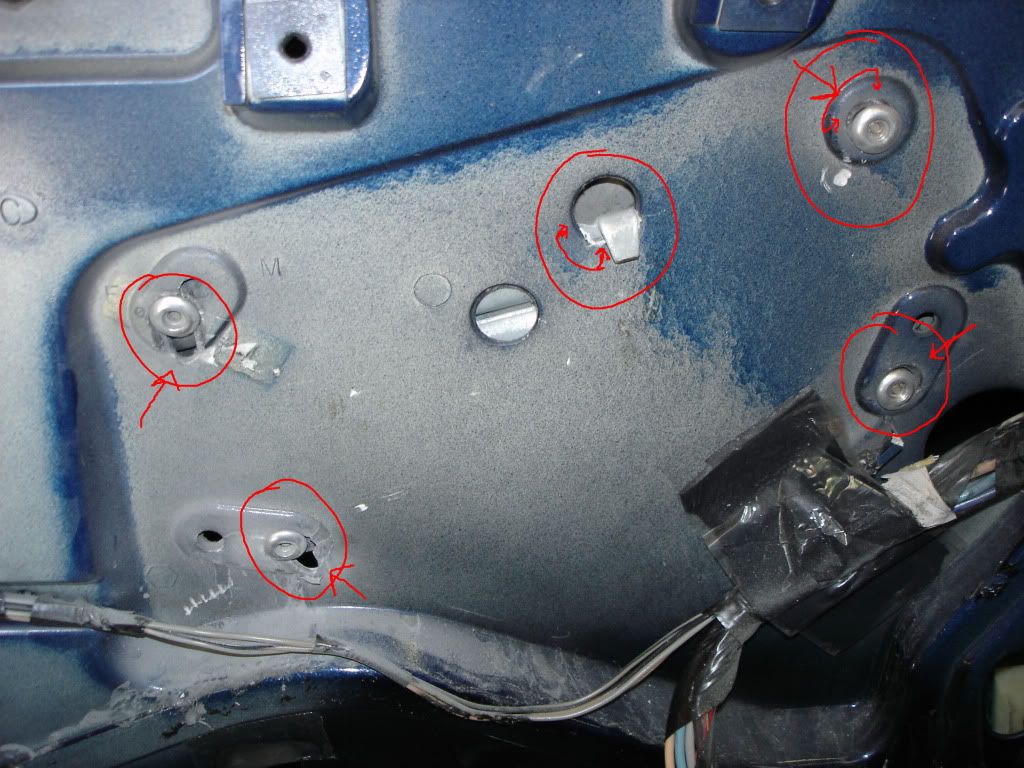
The Rivits that hold in the regulator/Motor in place have Enlongated their Holes over time and now when the Window is down they are in the right place, but when the window is up they are not. Now I know why I have been having problems when the window moves, the whole regulator/motor Assembly also moves causing the motor to slow down, Stumble, chatter etc.. So I Think I am going to Try to Fiberglass the holes & re-drill them, Add bolts to replace the rivits. Hopefully it will work. I tried to Search all over the web to see if anyone else had this happen to their f-body, but did not find any results. If this has happened before what was a Sucessful repair. Thanks for any help you have, all of you have helped me out in the past many times.
Eric
The Rivits that hold in the regulator/Motor in place have Enlongated their Holes over time and now when the Window is down they are in the right place, but when the window is up they are not. Now I know why I have been having problems when the window moves, the whole regulator/motor Assembly also moves causing the motor to slow down, Stumble, chatter etc.. So I Think I am going to Try to Fiberglass the holes & re-drill them, Add bolts to replace the rivits. Hopefully it will work. I tried to Search all over the web to see if anyone else had this happen to their f-body, but did not find any results. If this has happened before what was a Sucessful repair. Thanks for any help you have, all of you have helped me out in the past many times.
Eric
Eric
Thanks for your reply, You dont think that overtime the bolts will start to move down Like the rivets are doing now? It seems like there is alot of force from the motor that it might move down. I guess I could use star washers that will dig into the surface to help. I am just concerened about the strength of the mounting surface since the holes are out of shape.
Eric
Eric
Just use bolt with washers and also lock washers. watch out with the spring! it has tension that can spring back on you. I use two vice grips to lock it in place before taking motor out of regulator. good luck
Thanks for the reply, I have seen the spring. Where do you put the vice grips? on the spring its self, or the lift assembly? I am thinking about doing one rivet at a time then installing the bolts one at a time as i go so there not all drilled out at the same time.
Trending Topics
The composite panel is damaged and you'll need something substantial to give the regulator something to mount to. With the damage you have, bolts/washers may work for a while, but they'll just be postponing the inevitable.
This post has the best fix (a full plate) that I have seen for the problem: https://ls1tech.com/forums/general-m...-included.html
This post has the best fix (a full plate) that I have seen for the problem: https://ls1tech.com/forums/general-m...-included.html
LS1 Tech Stories
The Best V8 Stories One Small Block at Time

Topdon ONE vs. Artidiag 800 BT2: Which is the Diagnostic Tablet For You?
Pouria Savadkouei
Gas Monkey Built a 6-Wheel Ferrari Testarossa With a Corvette LT4 Engine
Verdad Gallardo
7 Most Reliable High-Performance Engines GM Has Ever Built
Verdad Gallardo
Amazing '71 Camaro Restomod Is Modern Muscle Car Under the Skin
Verdad Gallardo
6 Common C5 Corvette Failures and What's Involved In Repairing Them
Pouria Savadkouei
Retro Modern Bandit Pontiac Trans AM Comes With Burt Reynolds' Autograph
Verdad Gallardo
Top 10 Greatest Cadillac V Series Performance Models Ever, Ranked
Pouria Savadkouei
Top 10 Most Powerful Chevy Trucks Ever Made!

Hennessey's New Supercharged Silverado ZR2 Has 700 HP
Verdad Gallardo
The composite panel is damaged and you'll need something substantial to give the regulator something to mount to. With the damage you have, bolts/washers may work for a while, but they'll just be postponing the inevitable.
This post has the best fix (a full plate) that I have seen for the problem: https://ls1tech.com/forums/general-m...-included.html
This post has the best fix (a full plate) that I have seen for the problem: https://ls1tech.com/forums/general-m...-included.html
OMFG... That's such an awesome thread... Sweet!
The composite panel is damaged and you'll need something substantial to give the regulator something to mount to. With the damage you have, bolts/washers may work for a while, but they'll just be postponing the inevitable.
This post has the best fix (a full plate) that I have seen for the problem: https://ls1tech.com/forums/general-m...-included.html
This post has the best fix (a full plate) that I have seen for the problem: https://ls1tech.com/forums/general-m...-included.html
Thanks wssix99 that is what I was Looking for. I traced out the Pattern of the door before I posted my Issue on here to make a plate, but I was not sure it would be a good idea due to that part of the door flexes when the window moves. I was worried some other part of the door would break when it flexes. I will use thin metal to make the plate so it can flex with the door. I think I am going to use Bolts instead of the rivets that they used. Thanks Again. I will update as I go.
Thanks wssix99 that is what I was Looking for. I traced out the Pattern of the door before I posted my Issue on here to make a plate, but I was not sure it would be a good idea due to that part of the door flexes when the window moves. I was worried some other part of the door would break when it flexes. I will use thin metal to make the plate so it can flex with the door. I think I am going to use Bolts instead of the rivets that they used. Thanks Again. I will update as I go.
After you have the plate in, the composite will still be taking shear force in the remaining "good" holes you have left. If you bond the plate to the door, then that force will be distributed across the bonded surface and will be much stronger.
Bolts vs. rivets. If you are going to use the plate, bolts should be fine - just be sure to use lock-tite! For composite only installations, rivets are much better. (They are special steel mandrel, aluminum jacketed rivets, special made for composites. They get a much better bite on the composite than a bolt will and the soft jackets won't overstress the material.)
I wouldn't worry about the flex too much. Keep in mind that you'll need enough thickness in the plate to resist the shear force that the regulator creates. (This is the same force that was powerful enough to cut through the composite.) I'd suggest going with a 1/8" steel plate. If you use anything thinner, the regulator could bend or tear the plate.
After you have the plate in, the composite will still be taking shear force in the remaining "good" holes you have left. If you bond the plate to the door, then that force will be distributed across the bonded surface and will be much stronger.
Bolts vs. rivets. If you are going to use the plate, bolts should be fine - just be sure to use lock-tite! For composite only installations, rivets are much better. (They are special steel mandrel, aluminum jacketed rivets, special made for composites. They get a much better bite on the composite than a bolt will and the soft jackets won't overstress the material.)
After you have the plate in, the composite will still be taking shear force in the remaining "good" holes you have left. If you bond the plate to the door, then that force will be distributed across the bonded surface and will be much stronger.
Bolts vs. rivets. If you are going to use the plate, bolts should be fine - just be sure to use lock-tite! For composite only installations, rivets are much better. (They are special steel mandrel, aluminum jacketed rivets, special made for composites. They get a much better bite on the composite than a bolt will and the soft jackets won't overstress the material.)
- The rivets are a bitch to drill out. You will need to use a center punch to make a dimple right in the middle of the rivet mandrel. If you don't get the drill centered on that steel mandrel, things will suck because the rivet jacket is aluminum. (The bit will walk on you like crazy and take out more of the fiberglass if you aren't centered.)
- Use gloves when taking the regulator out! The arms are sharp.
- Take out both the back vertical roller guide and your door speakers in order to get the thing out.
- Keep the motor ON the regulator until you get the whole unit out of the door. From that point, you run the motor to align the center holes in the regulator. Then put a bolt and some very large fender washers through the hole before you drill out the motor. (That way, the bolt keeps the regulator from "exploding," loosing the clock spring, and decapitating someone.
- Go to NAPA and buy some Syl-Glyde grease. This is an EXACT match for the guide grease in the door and will allow you to re-lube the tracks when you put everything back together. (If you use a different type of grease, you could have a bad reaction and the tracks could gum up.)
- Watch the glass when you take the regulator out. When you get the reg off the track, the glass will drop.
- Take your time, this job will **** you off the first time you do it.
YES!!!
- The rivets are a bitch to drill out. You will need to use a center punch to make a dimple right in the middle of the rivet mandrel. If you don't get the drill centered on that steel mandrel, things will suck because the rivet jacket is aluminum. (The bit will walk on you like crazy and take out more of the fiberglass if you aren't centered.)
- Use gloves when taking the regulator out! The arms are sharp.
- Take out both the back vertical roller guide and your door speakers in order to get the thing out.
- Keep the motor ON the regulator until you get the whole unit out of the door. From that point, you run the motor to align the center holes in the regulator. Then put a bolt and some very large fender washers through the hole before you drill out the motor. (That way, the bolt keeps the regulator from "exploding," loosing the clock spring, and decapitating someone.
- Go to NAPA and buy some Syl-Glyde grease. This is an EXACT match for the guide grease in the door and will allow you to re-lube the tracks when you put everything back together. (If you use a different type of grease, you could have a bad reaction and the tracks could gum up.)
- Watch the glass when you take the regulator out. When you get the reg off the track, the glass will drop.
- Take your time, this job will **** you off the first time you do it.
- The rivets are a bitch to drill out. You will need to use a center punch to make a dimple right in the middle of the rivet mandrel. If you don't get the drill centered on that steel mandrel, things will suck because the rivet jacket is aluminum. (The bit will walk on you like crazy and take out more of the fiberglass if you aren't centered.)
- Use gloves when taking the regulator out! The arms are sharp.
- Take out both the back vertical roller guide and your door speakers in order to get the thing out.
- Keep the motor ON the regulator until you get the whole unit out of the door. From that point, you run the motor to align the center holes in the regulator. Then put a bolt and some very large fender washers through the hole before you drill out the motor. (That way, the bolt keeps the regulator from "exploding," loosing the clock spring, and decapitating someone.
- Go to NAPA and buy some Syl-Glyde grease. This is an EXACT match for the guide grease in the door and will allow you to re-lube the tracks when you put everything back together. (If you use a different type of grease, you could have a bad reaction and the tracks could gum up.)
- Watch the glass when you take the regulator out. When you get the reg off the track, the glass will drop.
- Take your time, this job will **** you off the first time you do it.