






AC Condensation?

Thread Starter
On The Tree
Joined: Aug 2011
Posts: 185
Likes: 22
 AC Condensation?
 I finally had some significant seat time in the WS6 yesterday. After sitting for 4 years, and initially thinking the AC was broken a few weeks ago (blew warm air), it started to blow cold just as I wanted to recharge the air conditioning. It was/has been ice cold. Until yesterday sort of. I had at least 1 and 1/2 hours driving her around, with the AC on the whole time. Fan was blowing at the 3rd hash mark. Toward the end of the ride, the "ice cold" feeling was not as prevalent, and when I went to put the car away on the trickle charger, I noticed the following:

The arrow is pointing to where there was a drip of water(?) dripping down onto the exhaust manifold - you cannot see it in the picture from the wires laying over the area, but it was coming from where the metal piece meets the hose. The circled area is condensation on that hose which is part of the air conditioning system.
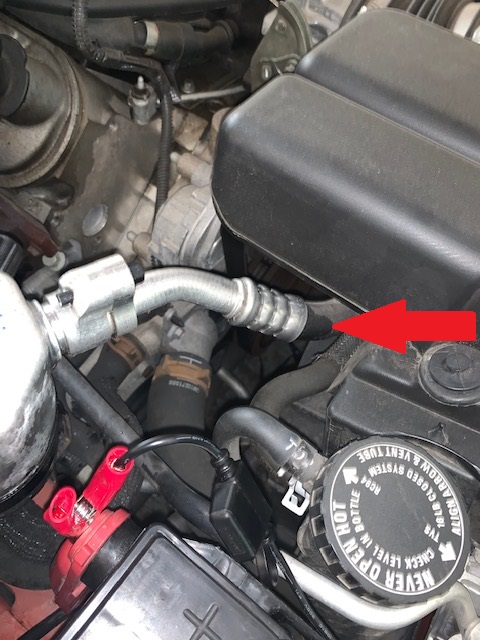
Here the arrow is pointing to what looks like a leak in the hose, but I am not sure. I did see water dripping from there as well.
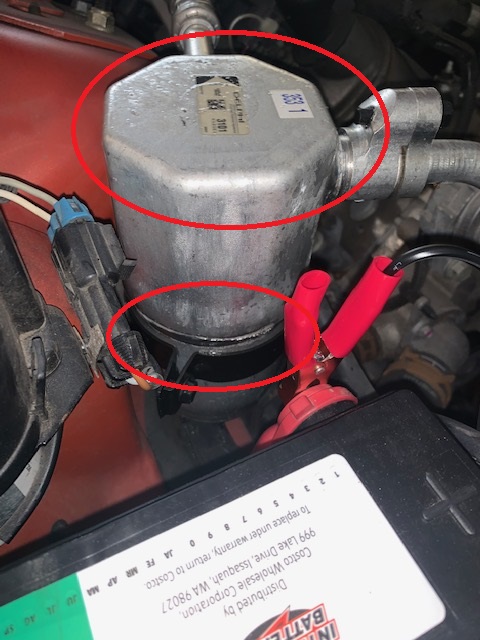
The circled areas in this picture represent where there was alot of condensation.
I do not know much about air conditioning systems in cars and how to service them, but I'm assuming I have an issue here. If so, is it a serious problem, or am I looking at some seals or a hose or both? The car sat in a garage for 4 years (a nice garage), and the air conditioning wasn't used since, or possibly before all that much.
The arrow is pointing to where there was a drip of water(?) dripping down onto the exhaust manifold - you cannot see it in the picture from the wires laying over the area, but it was coming from where the metal piece meets the hose. The circled area is condensation on that hose which is part of the air conditioning system.
Here the arrow is pointing to what looks like a leak in the hose, but I am not sure. I did see water dripping from there as well.
The circled areas in this picture represent where there was alot of condensation.
I do not know much about air conditioning systems in cars and how to service them, but I'm assuming I have an issue here. If so, is it a serious problem, or am I looking at some seals or a hose or both? The car sat in a garage for 4 years (a nice garage), and the air conditioning wasn't used since, or possibly before all that much.

That is condensation from what I can tell. Perfectly normal. The engine bay is hot and those lines/canister are very cold. Every car will have condensation like that. Inside an AC system is a gas, not a liquid.
As for your issues I am not sure what is going on there. I would hook a gauge up to it and see what it reads for a level.
As for your issues I am not sure what is going on there. I would hook a gauge up to it and see what it reads for a level.
Thread Starter
On The Tree
Joined: Aug 2011
Posts: 185
Likes: 22
That is condensation from what I can tell. Perfectly normal. The engine bay is hot and those lines/canister are very cold. Every car will have condensation like that. Inside an AC system is a gas, not a liquid.
As for your issues I am not sure what is going on there. I would hook a gauge up to it and see what it reads for a level.
As for your issues I am not sure what is going on there. I would hook a gauge up to it and see what it reads for a level.
Thread Starter
On The Tree
Joined: Aug 2011
Posts: 185
Likes: 22
Thanks. I'll hook up a gauge to it this weekend and see if it's low. I just never saw condensation on AC lines before under the hood of a vehicle drip - I guess that's because with my daily driver, I do not open the hood after driving it to put the trickle charger on.
At the age of these cars, the seals in the compressors are starting to go bad. Pressure will leak internally - so if the system is charged, you most likely need a rebuilt compressor.
If the car was sitting for 4 years, that most certainly didn't help the compressor seals.
If the car was sitting for 4 years, that most certainly didn't help the compressor seals.
Thread Starter
On The Tree
Joined: Aug 2011
Posts: 185
Likes: 22
At the age of these cars, the seals in the compressors are starting to go bad. Pressure will leak internally - so if the system is charged, you most likely need a rebuilt compressor.
If the car was sitting for 4 years, that most certainly didn't help the compressor seals.
If the car was sitting for 4 years, that most certainly didn't help the compressor seals.
Trending Topics

Joined: Nov 2001
Posts: 34,643
Likes: 2,571
From: Schiller Park, ILL Member: #317
With that said, if it's not getting cold enough there could be several reasons for such (low Freon, compressor fatigue, or even something as simple as a blockage in front of the condenser, etc.)
LS1 Tech Stories
The Best V8 Stories One Small Block at Time

Gas Monkey Built a 6-Wheel Ferrari Testarossa With a Corvette LT4 Engine
Verdad Gallardo
7 Most Reliable High-Performance Engines GM Has Ever Built
Verdad Gallardo
Amazing '71 Camaro Restomod Is Modern Muscle Car Under the Skin
Verdad Gallardo
6 Common C5 Corvette Failures and What's Involved In Repairing Them
Pouria Savadkouei
Retro Modern Bandit Pontiac Trans AM Comes With Burt Reynolds' Autograph
Verdad Gallardo
Top 10 Greatest Cadillac V Series Performance Models Ever, Ranked
Pouria Savadkouei
Top 10 Most Powerful Chevy Trucks Ever Made!

Hennessey's New Supercharged Silverado ZR2 Has 700 HP
Verdad Gallardo
Coachbuilt N2A Anteros Is an LS2-Powered C6 Corvette In Italian Clothes
Verdad Gallardo Thread Starter
On The Tree
Joined: Aug 2011
Posts: 185
Likes: 22
Yes. There is lubrication oil present in the AC system, and it's not circulating if the car is sitting for long periods (years). Although many systems on the car will be just fine sitting for years (sometimes many years) in proper storage, A/C systems tend not to endure this type of scenario nearly as well.
The condensation on those hoses and components is normal, as mentioned above. You see this specifically/only on certain AC components because said components are relatively cold (when the system is in operation) as compared to other components in the otherwise hot engine bay, as also mentioned above. When the surface temp of those AC components drops low enough to cause the air passing over them to be cooled to below the ambient dew point, you will see condensation form on their surface. This is natural occurrence which has nothing to do with the AC system itself, this is the same process by which all condensation forms. In fact, this condensation is actually an indication that the system is working, at least to some degree - it is NOT an indication/symptom of any sort of system failure.
With that said, if it's not getting cold enough there could be several reasons for such (low Freon, compressor fatigue, or even something as simple as a blockage in front of the condenser, etc.)
The condensation on those hoses and components is normal, as mentioned above. You see this specifically/only on certain AC components because said components are relatively cold (when the system is in operation) as compared to other components in the otherwise hot engine bay, as also mentioned above. When the surface temp of those AC components drops low enough to cause the air passing over them to be cooled to below the ambient dew point, you will see condensation form on their surface. This is natural occurrence which has nothing to do with the AC system itself, this is the same process by which all condensation forms. In fact, this condensation is actually an indication that the system is working, at least to some degree - it is NOT an indication/symptom of any sort of system failure.
With that said, if it's not getting cold enough there could be several reasons for such (low Freon, compressor fatigue, or even something as simple as a blockage in front of the condenser, etc.)
Good to know, thank you for the detailed explanation. I'm familiar with condensation overall, but have never dealt with it regarding an AC system on a vehicle, or otherwise. I wanted to verify that this is normal, and not an issue.
Now onto finding out if there's anything further that needs to be addressed, given the blowing of "kind of cold air" at the end of my travels on Monday, but ICE COLD air otherwise that day, and the weekends before since getting her roadworthy. Thanks again!

Here's a company that explains why these rubber seals rot out when not used: https://www.aquasealrubber.co.uk/unc...es-rubber-rot/"Why does rubber dry out?
Because all types of rubber (whether synthetic or natural) are polymers, they’re susceptible to most types of degeneration, including ultraviolet radiation, heat, cold, ozone erosion, and oxidation.
When manufacturers treat rubber, they add a protective compound to the mixture. With regular use, the rubber products flex and compress. This causes the protective compound to be pushed to the surface of the rubber product, meaning it is less vulnerable to any erosion it may be experiencing.
This is why tires that are used daily tend to be in better condition (rot-wise) than those left in a garage."
Because all types of rubber (whether synthetic or natural) are polymers, they’re susceptible to most types of degeneration, including ultraviolet radiation, heat, cold, ozone erosion, and oxidation.
When manufacturers treat rubber, they add a protective compound to the mixture. With regular use, the rubber products flex and compress. This causes the protective compound to be pushed to the surface of the rubber product, meaning it is less vulnerable to any erosion it may be experiencing.
This is why tires that are used daily tend to be in better condition (rot-wise) than those left in a garage."