




My catch can routing ok?

It could cause poor performance. Concerning the valve cover breather, you will smell crankcase by products since they are vented to atmosphere. This is one of the many reasons I don't like venting to atmosphere.
Last edited by 405HP_Z06; Jul 6, 2009 at 05:11 PM.

TECH Regular
Joined: Mar 2007
Posts: 455
Likes: 0
From my experience, the second catch can on the clean air side is needed when road racing the car. For normal street driving, the dirty side catch can is adequate to catch most air born vapor (assuming the catch can is designed correctly). However, during road racing the top end of the engine becomes loaded with oil causing the clean air side to ingest oil into the intake.
From my experience, when I'm street driving the dirty side catches most of the oil vapor. During HPDE weekends, the clean air side usually catches just as much or more than the dirty side. This is why I run two separate catch cans.
From my experience, when I'm street driving the dirty side catches most of the oil vapor. During HPDE weekends, the clean air side usually catches just as much or more than the dirty side. This is why I run two separate catch cans.
A variable orifice PCV valve regulates PCV flow using the pintle and manifold vacuum. High manifold vacuum pulls the pintle closed to reduce PCV flow. As manifold vacuum decreases, the pintle opens the orifice to allow increased PCV flow. With a fixed orifice valve, the size of the orifice regulates PCV flow independant of manifold vacuum.
Last edited by 405HP_Z06; Jul 6, 2009 at 03:12 PM.
TECH Regular
Joined: Mar 2007
Posts: 455
Likes: 0
Makes perfect sense now.I have done some research and found a lot of sources that agree with what you just typedhttp://www.automedia.com/PCV_Valve/ccr20050101pv/1.I got it backwards...the EGR system doesnt work at WOT.
Last edited by lovescamaros28; Jul 6, 2009 at 03:11 PM.
Makes perfect sense now.I have done some research and found a lot of sources that agree with what you just typedhttp://www.automedia.com/PCV_Valve/ccr20050101pv/1.However,I have obtained information from sources such as this that stress something completely different............see high manifold pressurehttp://members.rennlist.com/pbanders/PCV.htm
High Manifold Pressure
This mode corresponds to an intake backfire condition. Here, the high positive pressure in the manifold presses the disk tightly against the crankcase side seat, sealing the PCV valve and preventing flame propagation into the crankcase to prevent an explosion.
This mode corresponds to an intake backfire condition. Here, the high positive pressure in the manifold presses the disk tightly against the crankcase side seat, sealing the PCV valve and preventing flame propagation into the crankcase to prevent an explosion.
Any variable orifice PCV valve is designed to function in this manner. Fixed orifice PCV valves will not prevent crankcase pressurization caused by an intake backfire.
TECH Regular
Joined: Mar 2007
Posts: 455
Likes: 0
[QUOTE=405HP_Z06;11866760]The 'High Manifold Presssure' section in the link http://members.rennlist.com/pbanders/PCV.htm references engine backfire conditions within the intake manifold.
Any variable orifice PCV valve is designed to function in this manner. Fixed orifice PCV valves will not prevent crankcase pressurization caused by an intake backfire.[/QUOTE
Yeah I noticed that after I posted it.Thanks for the little re-fresher on the PCV system though.
Any variable orifice PCV valve is designed to function in this manner. Fixed orifice PCV valves will not prevent crankcase pressurization caused by an intake backfire.[/QUOTE
Yeah I noticed that after I posted it.Thanks for the little re-fresher on the PCV system though.
But will this smell be so strong that you would smell it from the car or by a person standing out on the road that you drove past?
LS1 Tech Stories
The Best V8 Stories One Small Block at Time

6 Common C5 Corvette Failures and What's Involved In Repairing Them
Pouria Savadkouei
Retro Modern Bandit Pontiac Trans AM Comes With Burt Reynolds' Autograph
Verdad Gallardo
Top 10 Greatest Cadillac V Series Performance Models Ever, Ranked
Pouria Savadkouei
Top 10 Most Powerful Chevy Trucks Ever Made!

Hennessey's New Supercharged Silverado ZR2 Has 700 HP
Verdad Gallardo
Coachbuilt N2A Anteros Is an LS2-Powered C6 Corvette In Italian Clothes
Verdad Gallardo
Awesome K5 Blazer Restomod Comes With C7 Corvette Power
Verdad Gallardo
10 Camaros You Should Never Buy

10 LS Engine Myths That Refuse to Die
Verdad Gallardo Quite possibly. If the engine is loose enough to produce a serious amount of blowby, it could be detected by a passerby. Are you sure you have the system routed correctly? Are you using an external PCV valve? Refresh my memory on your exact configuration.
Driver side has one port in the rear that has the pcv valve and the hose runs from there into the top of my extreme can then out the side which has a built in pcv valve to the intake for vacuum. I did always hear hissing but thought it was the air entering the can, now I am wondering if the can has a leak?
Passenger side has one port upfront that I capped, I also capped the TB fresh air source and put on a filtered oil fill cap.
Driver side has one port in the rear that has the pcv valve and the hose runs from there into the top of my extreme can then out the side which has a built in pcv valve to the intake for vacuum. I did always hear hissing but thought it was the air entering the can, now I am wondering if the can has a leak?
Driver side has one port in the rear that has the pcv valve and the hose runs from there into the top of my extreme can then out the side which has a built in pcv valve to the intake for vacuum. I did always hear hissing but thought it was the air entering the can, now I am wondering if the can has a leak?
 ?
? Does that mean drivers left or right and not sure what a secret means but it is an LS2 with the SC installed in a 71 camaro. The vacuum sources are on top of each other and the bottom has the brake line and the top has the line from the catch can.

I just pulled my intake and found a lot more oil then I would like to have.
http://i2.photobucket.com/albums/y11...n/DSC02690.jpg
Im running the rev-xtreme can, with a LS6 valley cover. But I had the valve cover breather in the pass. VC. (plus the rear VC ports are conexted)
http://i2.photobucket.com/albums/y11...n/IMG_2800.jpg
But 405_ is saying the breather mixes the clean and dirty sides. So I guess I should remove it. And run a line from the front port on the pass VC, to the TB nipple. Like this (green line)
http://www.andersonperformance.net/pcv-1ext.jpg
And that should help alot. But should I plug the rear ports on the VC, then the driver would have nothing, like in the diagram?
http://i2.photobucket.com/albums/y11...n/DSC02690.jpg
Im running the rev-xtreme can, with a LS6 valley cover. But I had the valve cover breather in the pass. VC. (plus the rear VC ports are conexted)
http://i2.photobucket.com/albums/y11...n/IMG_2800.jpg
But 405_ is saying the breather mixes the clean and dirty sides. So I guess I should remove it. And run a line from the front port on the pass VC, to the TB nipple. Like this (green line)
http://www.andersonperformance.net/pcv-1ext.jpg
And that should help alot. But should I plug the rear ports on the VC, then the driver would have nothing, like in the diagram?
Correct, drivers left and right. Is your can still hissing? Have you measured vacuum at this port under various conditions to ensure your not getting any boost here?


Joined: Oct 2006
Posts: 2,608
Likes: 0
From: Webb City, MO...out in the garage
sorry for not reading through all of this, i just wanted to verify that my routing will be ok. My setup is a NA LSX 454, wet sump, with GM Performance Parts valve covers and a RevXtreme catch can:
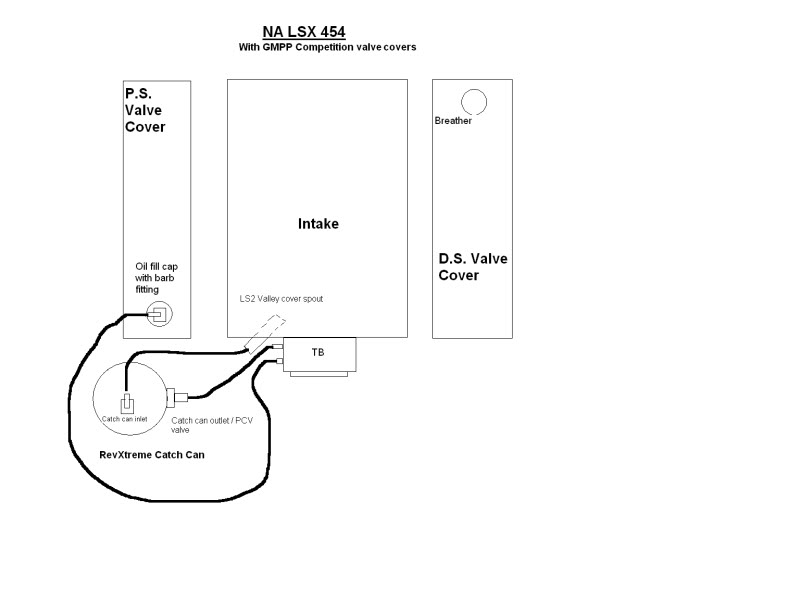
ANOTHER question i have is: what type of breather works and looks good with the GMPP valve covers? and where do i get them? assuming my routing is correct, i'm betting i have to make my own filler cap with a barb fitting installed...
ANOTHER question i have is: what type of breather works and looks good with the GMPP valve covers? and where do i get them? assuming my routing is correct, i'm betting i have to make my own filler cap with a barb fitting installed...
sorry for not reading through all of this, i just wanted to verify that my routing will be ok. My setup is a NA LSX 454, wet sump, with GM Performance Parts valve covers and a RevXtreme catch can:
<image snipped>
ANOTHER question i have is: what type of breather works and looks good with the GMPP valve covers? and where do i get them? assuming my routing is correct, i'm betting i have to make my own filler cap with a barb fitting installed...
<image snipped>
ANOTHER question i have is: what type of breather works and looks good with the GMPP valve covers? and where do i get them? assuming my routing is correct, i'm betting i have to make my own filler cap with a barb fitting installed...
Joined: Oct 2006
Posts: 2,608
Likes: 0
From: Webb City, MO...out in the garage

also, that was how i was suggested to do it by Tracy at RevXtreme since i already had two valve covers with breather holes. If it isn't necessary, and someone will trade me a new GMPP Competition valve cover without the hole for mine, i'll trade...but if it isn't going to hurt anything than i'll leave it.