






Pick a CATCH CAN

Easy to remove & replace. less than $5 bucks.
Lots of nice looking cans that are only maginally effective, so thats where the decision comes in...looks & small size or functionality. Can't have both.....and if you want something close the Mike Norris one would be the the closest to that mix IMHO.
All one has to do is look at the internal design to clearly see why.

what is the purpose for having the vent cap...still the system is supposed to be closed anf now it is open so the actual air metered in not going into the engine...it is pulling some from the vent and some from the tb, even if the amount is small, why have the vent i dont see the need...
I don't have the ls6 conversion valley cover done... so looking at those diagrams didn't help me much. Just confused me more...
I've removed my AIR and EGR stuff...
one thing I don't wanna do, is bolt a catch can to the head covering up my nice AFR logo... I'm proud of that!
I've removed my AIR and EGR stuff...
one thing I don't wanna do, is bolt a catch can to the head covering up my nice AFR logo... I'm proud of that!
Tell me where and how many ports you have and I'll post the correct diagram:
- DS valve cover
- PS valve cover
- Throttle body
- CAI
The key to a well functioning catch can is to design it so gravity can do it's job and allow the carry over oil to drop out of suspension. If the catch can is too small, it won't allow the PCV stream to slow down enough for gravity to work. If the can relies solely on a material acting as a condensing agent for carry over oil, they saturate quickly restricting flow and don't prevent carry over oil ingestion. There is nothing wrong with using a condensing agent, just not as the primary method of extraction. These cans don't employ a dispersion tube, so the PCV stream can simply flow from one port to the other without much resistance.
The magic number is 1 meter/second. PCV flow must slow to 1 m/s or less for as long as possible. This is the point at which carry over oil will drop out of suspension from the PCV stream. A small can has real problems decreasing flow to the specified minimum for any amount of time, if at all.
Both the RevX and SM use a chambered design with a long dispersion tube. This works to semi-separate the in/out ports of the can while the dispersion tube forces the PCV stream to the bottom of the can. This allows the stream to decrease velocity so gravity can work to remove carry over oil.
HTH,
You seem very informative and like you know what the hell your talking about. I would like to know what is wrong with some of the other catch cans on the market. I liked the Rev Extreme and almost purchased one untill I came across a thread with people that had them. Alot of them were rattling and making noise. For instance, what is wrong with the Elite catch can. It seem to have all the features of the Rev without the built in PCV valve. Everything else looks good.
I think I covered this is the previous post where the OP as the same question. If it's still not clear or you have additional questions, post up.

Good choice.

LS1 Tech Stories
The Best V8 Stories One Small Block at Time

6 Gifts Neither Your Dad Nor Grad Will Shove Into the 'Trinket Drawer'
Brett Foote
Topdon ONE vs. Artidiag 800 BT2: Which is the Diagnostic Tablet For You?
Pouria Savadkouei
Gas Monkey Built a 6-Wheel Ferrari Testarossa With a Corvette LT4 Engine
Verdad Gallardo
7 Most Reliable High-Performance Engines GM Has Ever Built
Verdad Gallardo
Amazing '71 Camaro Restomod Is Modern Muscle Car Under the Skin
Verdad Gallardo
6 Common C5 Corvette Failures and What's Involved In Repairing Them
Pouria Savadkouei
Retro Modern Bandit Pontiac Trans AM Comes With Burt Reynolds' Autograph
Verdad Gallardo
Top 10 Greatest Cadillac V Series Performance Models Ever, Ranked
Pouria Savadkouei
Top 10 Most Powerful Chevy Trucks Ever Made!





I changed my plan..
A friend of mine got this from Harbor Freight for $10..it's an Air Compressor Water/Air Seperator. I just removed the internals and attached the fittings for the Hoses to put it on the Car. It has 1/4" NPT Threads so that helps greatly. This one is bolting to the passenger's side Head, inline on the Vacumm Tube from the Valve Cover to the Intake. I have another one to put on the driver's side inline from the PCV Valve to the Intake. The clear part unscrews to empty it.

There was a guy on the other page that had something similar..I don't have EGR so I'm making a bracket to attach it to the Head.
A friend of mine got this from Harbor Freight for $10..it's an Air Compressor Water/Air Seperator. I just removed the internals and attached the fittings for the Hoses to put it on the Car. It has 1/4" NPT Threads so that helps greatly. This one is bolting to the passenger's side Head, inline on the Vacumm Tube from the Valve Cover to the Intake. I have another one to put on the driver's side inline from the PCV Valve to the Intake. The clear part unscrews to empty it.
There was a guy on the other page that had something similar..I don't have EGR so I'm making a bracket to attach it to the Head.
I understand how confusing it can be. Depending on the valve cover, valley cover, and engine type, a number of factors are evaluated to ensure the PCV system will function correctly.
I have posted diagrams for LS1's without a valley cover PCV port. There are many diagrams because many different configurations are possible depending on the combination of parts.
Tell me where and how many ports you have and I'll post the correct diagram:
It's the internal design of the catch can that makes all the difference. Most other cans are either empty or use some type of material as a condensing agent for carry over oil in the PCV stream.
The key to a well functioning catch can is to design it so gravity can do it's job and allow the carry over oil to drop out of suspension. If the catch can is too small, it won't allow the PCV stream to slow down enough for gravity to work. If the can relies solely on a material acting as a condensing agent for carry over oil, they saturate quickly restricting flow and don't prevent carry over oil ingestion. There is nothing wrong with using a condensing agent, just not as the primary method of extraction. These cans don't employ a dispersion tube, so the PCV stream can simply flow from one port to the other without much resistance.
The magic number is 1 meter/second. PCV flow must slow to 1 m/s or less for as long as possible. This is the point at which carry over oil will drop out of suspension from the PCV stream. A small can has real problems decreasing flow to the specified minimum for any amount of time, if at all.
Both the RevX and SM use a chambered design with a long dispersion tube. This works to semi-separate the in/out ports of the can while the dispersion tube forces the PCV stream to the bottom of the can. This allows the stream to decrease velocity so gravity can work to remove carry over oil.
TLewis4095 covered this in an earlier post.
You can mount them anywhere you like. The head is just a common place many use. Mine are mounted on the head, so I can't help you here.
HTH,
I have posted diagrams for LS1's without a valley cover PCV port. There are many diagrams because many different configurations are possible depending on the combination of parts.
Tell me where and how many ports you have and I'll post the correct diagram:
- DS valve cover
- PS valve cover
- Throttle body
- CAI
It's the internal design of the catch can that makes all the difference. Most other cans are either empty or use some type of material as a condensing agent for carry over oil in the PCV stream.
The key to a well functioning catch can is to design it so gravity can do it's job and allow the carry over oil to drop out of suspension. If the catch can is too small, it won't allow the PCV stream to slow down enough for gravity to work. If the can relies solely on a material acting as a condensing agent for carry over oil, they saturate quickly restricting flow and don't prevent carry over oil ingestion. There is nothing wrong with using a condensing agent, just not as the primary method of extraction. These cans don't employ a dispersion tube, so the PCV stream can simply flow from one port to the other without much resistance.
The magic number is 1 meter/second. PCV flow must slow to 1 m/s or less for as long as possible. This is the point at which carry over oil will drop out of suspension from the PCV stream. A small can has real problems decreasing flow to the specified minimum for any amount of time, if at all.
Both the RevX and SM use a chambered design with a long dispersion tube. This works to semi-separate the in/out ports of the can while the dispersion tube forces the PCV stream to the bottom of the can. This allows the stream to decrease velocity so gravity can work to remove carry over oil.
TLewis4095 covered this in an earlier post.
You can mount them anywhere you like. The head is just a common place many use. Mine are mounted on the head, so I can't help you here.
HTH,
I'll take an engine bay photo of my current setup, so that you may understand the plumbing of my particular PCV routing...
now.... the rest of you post more pics!


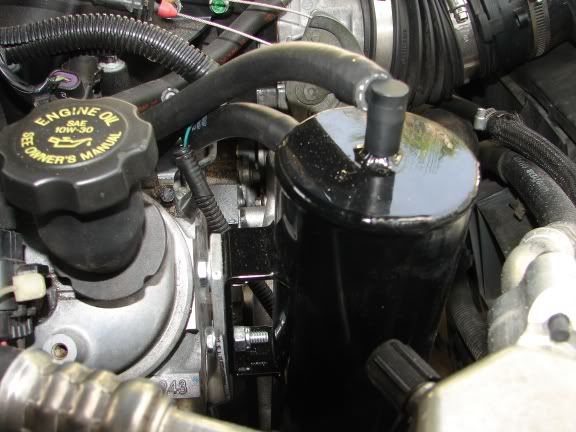
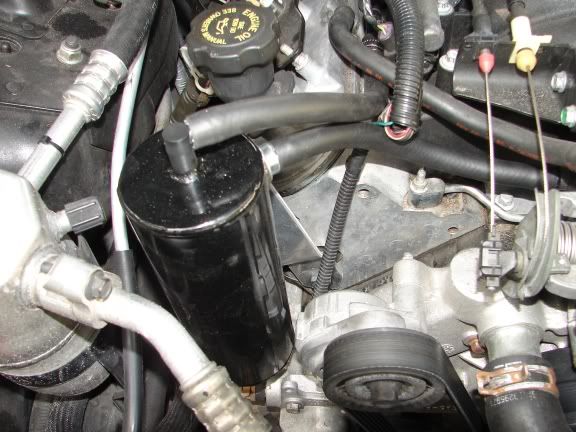


question? i have open breather filters in my valve covers in both sides is that bad to do? or will that work. I tried to follow what yall have said as much as i can but that alot of stuff lol..


yeah just bypass the PVC and throw catch can on with a vent and call it a day...