




plugs and wires

There were tests done showing like 15 hp gains.. Of course most dont believe such things, but its a 0ohm wire " very near to it as you can get" and causes less interference then other wires could.
That said, I love mine! Also for detailing they are blue not red like msd so they have the "look factor"
That said, I love mine! Also for detailing they are blue not red like msd so they have the "look factor"
V power is what the Standard NGK's are. And the V power plugs work great. T
Just a little side info: The stock wires are plenty sufficient. I just recommend MSD's because they flex and will stay off the header. If there was no issue with burning on the header then I would say use the stock wires. Plug wires in general are a waste of money. If someone did a legit testing of wires, I would imagine that Granettelli's would only be superior in pricing, and that there wouldn't be any actual performance gains. Not trying to come off rude, but like I said, plug wires in general are a waste of money.
Today's ignition systems are very stout and reliable and generally do not need to be upgraded even when putting out over double the factory power.
Just a little side info: The stock wires are plenty sufficient. I just recommend MSD's because they flex and will stay off the header. If there was no issue with burning on the header then I would say use the stock wires. Plug wires in general are a waste of money. If someone did a legit testing of wires, I would imagine that Granettelli's would only be superior in pricing, and that there wouldn't be any actual performance gains. Not trying to come off rude, but like I said, plug wires in general are a waste of money.
Today's ignition systems are very stout and reliable and generally do not need to be upgraded even when putting out over double the factory power.
Launching!
Joined: Dec 2009
Posts: 273
Likes: 0
From: California
MSD wires with Denso Iridiums.
A bullet proof combination that will run superbly for years under any condition.
You should get 70k from the Densos no problem.
I always said a used set of Denso Iridium will run better than a new set of anything else.
A bullet proof combination that will run superbly for years under any condition.
You should get 70k from the Densos no problem.
I always said a used set of Denso Iridium will run better than a new set of anything else.
Wana buy my used denso plugs with about 29k on them??? Lol shoot me an offer..

FormerVendor
Joined: Jul 2008
Posts: 77
Likes: 0
We have a promotion.
Zero ohm NGK copper spark plugs to replace the TR55's, or zero ohm WeaponX ExtremeX Iridium spark plugs with our 8.8mm PowerCORE wire for a limited time for LS1TECH members.
We found that the best performance was using a zero ohm plug and ~150ohms in the wire to tame electrical interferences. The overall circuit improvement with our setup is anywhere from 4850ohms to 9850ohms less resistance depending on the spark plug used. We have tried to lower resistance further but some applications we found couldn't handle the increased interference energy.
Zero ohm NGK copper spark plugs to replace the TR55's, or zero ohm WeaponX ExtremeX Iridium spark plugs with our 8.8mm PowerCORE wire for a limited time for LS1TECH members.
We found that the best performance was using a zero ohm plug and ~150ohms in the wire to tame electrical interferences. The overall circuit improvement with our setup is anywhere from 4850ohms to 9850ohms less resistance depending on the spark plug used. We have tried to lower resistance further but some applications we found couldn't handle the increased interference energy.
Last edited by WeaponX_Perf; Oct 5, 2011 at 08:47 AM.

TECH Resident
Joined: Sep 2009
Posts: 859
Likes: 2
From: Frozen Tundra, WI
Don't ever buy new "factory" plug wires. You pay the same price and sometimes more and all you do is get more resistance. This equates to less spark energy which will negatively impact your HP/Trq. Something with 50 ohms or less per foot is a much better choice than any factory plug wire which typically has 500-900 ohms per foot. Some guys make the silly choice of buying high dollar coils only to suppress much of that energy with factory plug wires. I am not talking about a night and day difference but it may be 1/2 to a full car length in the quarter which can mean getting the win...well worth it to me. We mod our cars for the max amount of "reasonable" performance we can get...why waste your money on an inferior product?? $.02
FormerVendor
Joined: Jul 2008
Posts: 77
Likes: 0
Don't ever buy new "factory" plug wires. You pay the same price and sometimes more and all you do is get more resistance. This equates to less spark energy which will negatively impact your HP/Trq. Something with 50 ohms or less per foot is a much better choice than any factory plug wire which typically has 500-900 ohms per foot. Some guys make the silly choice of buying high dollar coils only to suppress much of that energy with factory plug wires. I am not talking about a night and day difference but it may be 1/2 to a full car length in the quarter which can mean getting the win...well worth it to me. We mod our cars for the max amount of "reasonable" performance we can get...why waste your money on an inferior product?? $.02

There is also a very large portion of the equation 95% of the population doesn't understand when it comes to circuit resistance in an ignition system.
The wire is typically less then 10% of the total circuit resistance. I guess the best way to show this is with this.
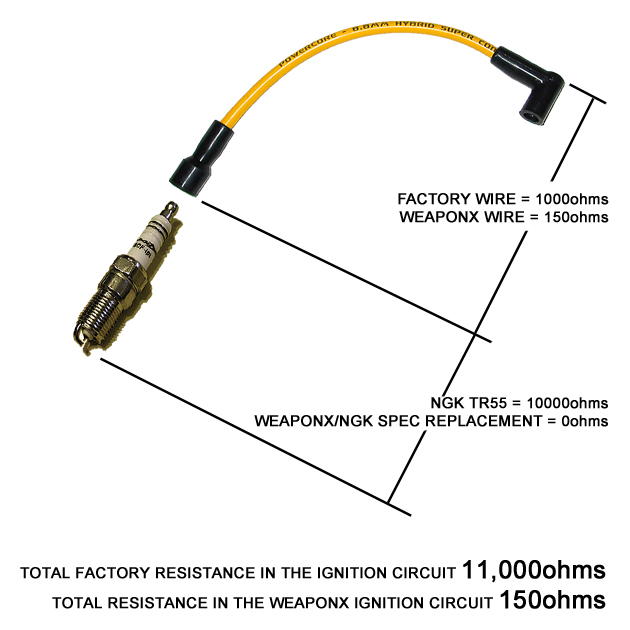
Most people are convinced that they did themselves a favor by lowering the resistance of the wire to 0 or 50 ohms but this means the only thing you accomplished was reducing your circuit resistance from 11000ohms to 10050ohms. Hardly worth an honorable mention.
What we did here was create a complete system resistance of 150ohms (necessary to reduce interference levels) and spec a 0 ohm spark plug. We know many people are die hard NGK fans so we are one of the only companies to offer an NGK brand, zero resistance plug which is equivlant to a TR55 / TR6. We also offer our ExtremeX Iridium with a zero ohm resistance. Now with the WeaponX setup the circuit resistance drops from 11,000ohms to 150ohms!
What people seem to be missing is that even with a 0 ohm wire you are still stuck with a 10,000ohm resistance in the spark plug so you have claimed less then 10% of the system resistance back and you can't goto a 0 ohm spark plug because it introduces potential electronic issues in the system.
With the WeaponX system you reduce your system resistance 99.99%! We tried every variation and the highest output and lowest reliable circuit resistance to prevent interference is 150ohms.
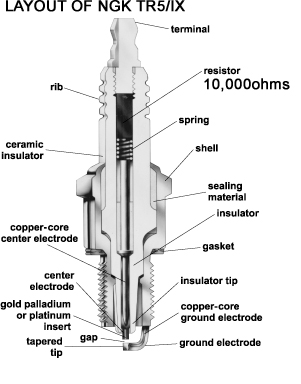
Below is also an internal picture of the NGK TR55. If anybody has a used one, smash it up. What you will find is a chunk of carbon in the middle of the plug used to create resistance. Our spec'd plugs use a solid piece of copper right to the electrode on the other side of the plug allowing for a zero ohm plug.
Hope this clears things up a bit.
LS1 Tech Stories
The Best V8 Stories One Small Block at Time

6 Common C5 Corvette Failures and What's Involved In Repairing Them
Pouria Savadkouei
Retro Modern Bandit Pontiac Trans AM Comes With Burt Reynolds' Autograph
Verdad Gallardo
Top 10 Greatest Cadillac V Series Performance Models Ever, Ranked
Pouria Savadkouei
Top 10 Most Powerful Chevy Trucks Ever Made!

Hennessey's New Supercharged Silverado ZR2 Has 700 HP
Verdad Gallardo
Coachbuilt N2A Anteros Is an LS2-Powered C6 Corvette In Italian Clothes
Verdad Gallardo
Awesome K5 Blazer Restomod Comes With C7 Corvette Power
Verdad Gallardo
10 Camaros You Should Never Buy

10 LS Engine Myths That Refuse to Die
Verdad Gallardo
FormerVendor
Joined: Jul 2008
Posts: 77
Likes: 0
Based on our testing the NGK TR5IX (which I assume is what you mean over TR51X) is the same as the TR55 except it has the Iridium center electrode. They are a good plug, and we do recommend Iridium over standard, but keep in mind 99.9% of all plugs you find on the shelf for road driven vehicles will have a high value internal resistor since they are required to reduce noise emissions in and around the vehicle.
TECH Resident
Joined: Sep 2009
Posts: 859
Likes: 2
From: Frozen Tundra, WI
Actually...I was not referring to your wires at all. It just happened to be the sequence my post came up. You did a great job of sharing some detailed info though. That is appreciated and now I am curious how much your zero ohm plugs cost?? Would they function adequately with my 50 ohm wires?? I need a custom length wire.
FormerVendor
Joined: Jul 2008
Posts: 77
Likes: 0
Actually...I was not referring to your wires at all. It just happened to be the sequence my post came up. You did a great job of sharing some detailed info though. That is appreciated and now I am curious how much your zero ohm plugs cost?? Would they function adequately with my 50 ohm wires?? I need a custom length wire.
The Iridium zero ohm plugs for LS1TECH members are $4.99 each.
In regards to the wire. We chose to use a newer spiral wound design which lessens power loss, I should probably share some tech information somewhere, but 'most' (I will qualify and explain) low resistance spiral wound designs should be OK reducing interference to acceptable levels.
The reason we opted to produce a 150ohm wire is because there are a hand full of vehicles that respond worse to interference then others and using the 150ohm worked for all the vehicles we tested. This is primarily due to OE wiring layouts from vehicle to vehicle. Going less in resistance seemed to trigger issues in some vehicles but not in others when using a 0 ohm plug. For the most part we noticed that most well made spiral wound conductors would keep interference levels in check, but not all in every vehicle. All that being said, it may work but going too low with a zero ohm plug could potentially result in intermittent electronic issues with the combination. All in all the ~20-70 ohm area seems to be getting close to the red zone where maybe it will hold up, and maybe it won't.
On the other end of the spectrum, we can say with 100% certainty that we do not recommend a 0 ohm wire with zero ohm plugs. We started to see power loss and ECU issues result with the combination regardless of any other interference suppression methods we used.
All in all the difference between a 0ohm wire or even a 300ohm wire will be nil on the dyno. LS1TECH members can lookup a dyno where a moderator here dyno'd new TR5's vs our Iridiums and he made 2rwhp through the band and about 5rwhp at redline when dropping circuit resistance 10,000ohms. A couple hundred ohms wouldn't even be measurable in terms of engine power output.
I attached the dyno for reference.
Anyone looking for a performance plug, IMHO the only real choice available is ours. But that I am sure will be a hotly debated remark.
Last edited by WeaponX_Perf; Sep 30, 2011 at 12:51 PM.
