




Excessive crank case pressure?

Thread Starter
Joined: Jan 2002
Posts: 4,072
Likes: 76
From: Casselberry FL
 Excessive crank case pressure?
 Motor was rebuilt last summer, re-using Wiseco KA398A07 pistons with a set of Total Seal CR1005-35 rings recommended by Wiseco. I had Vengeance install a ported 92mm intake/tb in December. I have a Norris Motorsports catch can, the LS6 valley cover, and have the tubing oriented correctly per Mike. The catch can is effectively dry and this is the first time I've opened it it since it was installed months ago. I have the Katech ported oil pump.
I've recently noticed more oil usage each month, maybe 1.5-2qts each month. There are oil puddles in my intake bellow, and oil residue in the front of my TB blade. Mike thought this would indicate too much crank case pressure, probably related to the rings. For now I've rerouted the catch can between the valve cover pipe and the TB and routed the LS6 valley cover direct to the intake (with an OEM PCV valve mixed in).
Hopefully this will control where the oil is going, but are there any methods (besides motor disassembly) to determine what's causing the excessive pressure, or how 'excessive' it is compared to normal? Any other investigations I should consider?
I've recently noticed more oil usage each month, maybe 1.5-2qts each month. There are oil puddles in my intake bellow, and oil residue in the front of my TB blade. Mike thought this would indicate too much crank case pressure, probably related to the rings. For now I've rerouted the catch can between the valve cover pipe and the TB and routed the LS6 valley cover direct to the intake (with an OEM PCV valve mixed in).
Hopefully this will control where the oil is going, but are there any methods (besides motor disassembly) to determine what's causing the excessive pressure, or how 'excessive' it is compared to normal? Any other investigations I should consider?
Give us a description of how the PCV system was routed per Mike & how it is routed now (again). If your catch can was empty, it could be that the PCV was not routed correctly. Oil in front of the TB blade travels there from the PCV routing, not blowby. So, my guess is improper PCV routing from the start.
Thread Starter
Joined: Jan 2002
Posts: 4,072
Likes: 76
From: Casselberry FL
Photos of how the setup was before I spoke with Mike this morning are here:
http://s222.photobucket.com/albums/dd173/evcass/PCV/
I'll add some photos of the currently altered setup in a bit.
http://s222.photobucket.com/albums/dd173/evcass/PCV/
I'll add some photos of the currently altered setup in a bit.
Thread Starter
Joined: Jan 2002
Posts: 4,072
Likes: 76
From: Casselberry FL
Isn't the oil breather cap the solution which leaves a nasty residue all over the engine bay?
I didn't have any extra fuel line laying around, so I temporarily used clear tubing. I left it on for this photo to make it easier to distinguish the lines, but I'll be replacing it with fuel line today. Here's the photo of how it's currently connected:
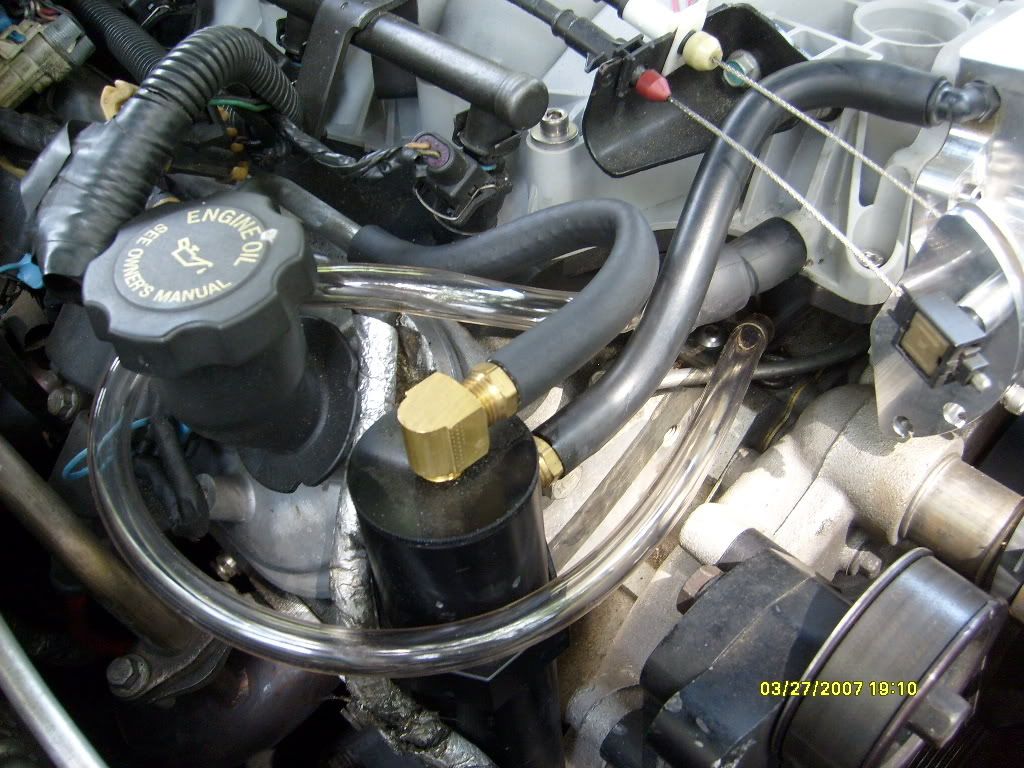
I didn't have any extra fuel line laying around, so I temporarily used clear tubing. I left it on for this photo to make it easier to distinguish the lines, but I'll be replacing it with fuel line today. Here's the photo of how it's currently connected:
Jim,
Take a look at this thread: https://ls1tech.com/forums/generatio...outing-ok.html It's long but has all of the information your looking for.
In a nutshell, you have the catch can on the wrong side of the PCV system when running a single can. In the picture above, your can is currently on the clean side which is not typically the problem in street and drag applications. For single can applications, it should be inline on the dirty side (between the valley cover and intake).
Also, your PCV valve is oriented backwards. Flip it around the other direction. The flat side of the PCV valve should be between the engine and valley cover and the nipple end should be between the intake and PCV valve.
Think 'old school' when the PCV valve was in the valve cover. The flat side of the valve faced down into the valve cover and the nipple pointed up.
HTH,
Take a look at this thread: https://ls1tech.com/forums/generatio...outing-ok.html It's long but has all of the information your looking for.
In a nutshell, you have the catch can on the wrong side of the PCV system when running a single can. In the picture above, your can is currently on the clean side which is not typically the problem in street and drag applications. For single can applications, it should be inline on the dirty side (between the valley cover and intake).
Also, your PCV valve is oriented backwards. Flip it around the other direction. The flat side of the PCV valve should be between the engine and valley cover and the nipple end should be between the intake and PCV valve.
Think 'old school' when the PCV valve was in the valve cover. The flat side of the valve faced down into the valve cover and the nipple pointed up.
HTH,
Trending Topics
I've got alot better idea. Cap that nipple that teh catch can is attached to on the valve cover and the TB, and put your catch can in line with the PCV valve. That way there's only one route for air to go from the crankcase to the intake, and it has to go thru the PCV valve and the catch can.
I bet you hook it up that way and you will see alot of oil in the catch can, almost immediately.
I bet you hook it up that way and you will see alot of oil in the catch can, almost immediately.
LS1 Tech Stories
The Best V8 Stories One Small Block at Time

Topdon ONE vs. Artidiag 800 BT2: Which is the Diagnostic Tablet For You?
Pouria Savadkouei
Gas Monkey Built a 6-Wheel Ferrari Testarossa With a Corvette LT4 Engine
Verdad Gallardo
7 Most Reliable High-Performance Engines GM Has Ever Built
Verdad Gallardo
Amazing '71 Camaro Restomod Is Modern Muscle Car Under the Skin
Verdad Gallardo
6 Common C5 Corvette Failures and What's Involved In Repairing Them
Pouria Savadkouei
Retro Modern Bandit Pontiac Trans AM Comes With Burt Reynolds' Autograph
Verdad Gallardo
Top 10 Greatest Cadillac V Series Performance Models Ever, Ranked
Pouria Savadkouei
Top 10 Most Powerful Chevy Trucks Ever Made!

Hennessey's New Supercharged Silverado ZR2 Has 700 HP
Verdad Gallardo Thread Starter
Joined: Jan 2002
Posts: 4,072
Likes: 76
From: Casselberry FL
Aaron,
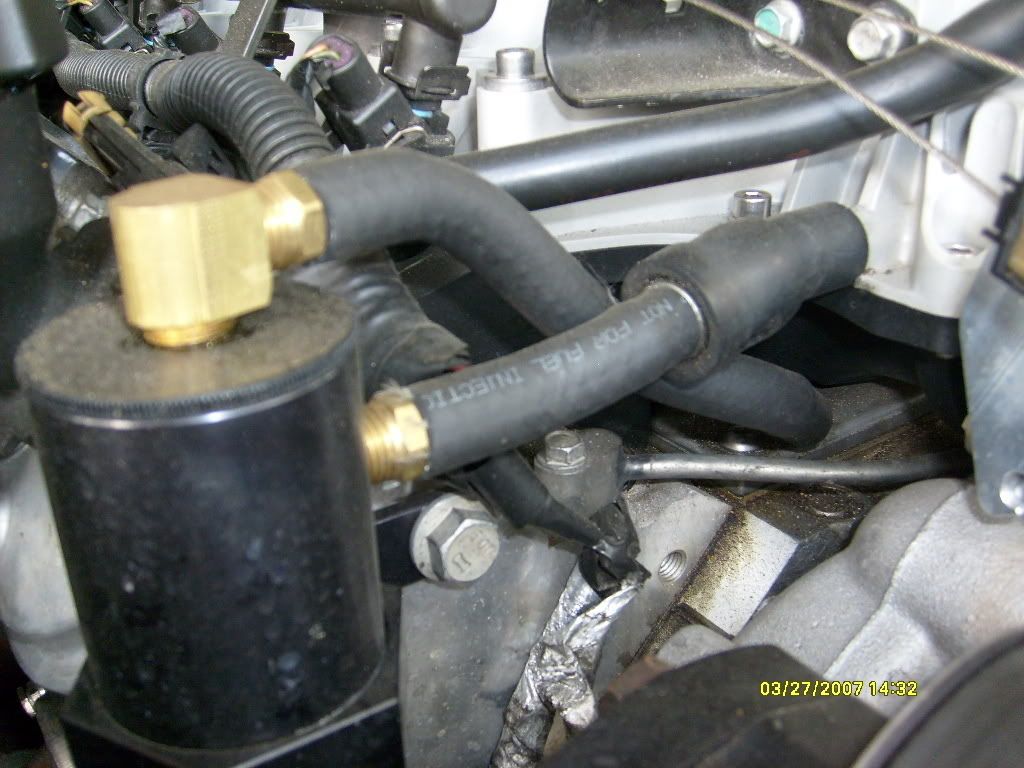
My original setup was this...
Your diagram in the other thread shows this...

The only thing I see wrong with the original config which wasn't trapping the oil is that the PCV valve is flipped. The last picture in my previous post was Mike's recommendation because it appeared to be setup correctly based upon where the tubes were connected, so he thought it might be coming back in from the fresh air side.
So you think put it back to the original orientation, flip the valve, and check in a few days?
Any con's to capping the nipples on the TB & valve cover?
My original setup was this...
Your diagram in the other thread shows this...
The only thing I see wrong with the original config which wasn't trapping the oil is that the PCV valve is flipped. The last picture in my previous post was Mike's recommendation because it appeared to be setup correctly based upon where the tubes were connected, so he thought it might be coming back in from the fresh air side.
So you think put it back to the original orientation, flip the valve, and check in a few days?
Any con's to capping the nipples on the TB & valve cover?
Last edited by JimMueller; Mar 27, 2009 at 03:00 PM.
Aaron,
My original setup was this...
<image snipped>
Your diagram in the other thread shows this...
<image snipped>
The only thing I see wrong with the original config which wasn't trapping the oil is that the PCV valve is flipped. The last picture in my previous post was Mike's recommendation because it appeared to be setup correctly based upon where the tubes were connected, so he thought it might be coming back in from the fresh air side.
So you think put it back to the original orientation, flip the valve, and check in a few days?
Any con's to capping the nipples on the TB & valve cover?
My original setup was this...
<image snipped>
Your diagram in the other thread shows this...
<image snipped>
The only thing I see wrong with the original config which wasn't trapping the oil is that the PCV valve is flipped. The last picture in my previous post was Mike's recommendation because it appeared to be setup correctly based upon where the tubes were connected, so he thought it might be coming back in from the fresh air side.
So you think put it back to the original orientation, flip the valve, and check in a few days?
Any con's to capping the nipples on the TB & valve cover?
The clean air line (valve cover to throttle body) is required for the PCV system to function correctly. Clean air comes in through this line, through the crankcase, and then out through the valley cover. Do NOT cap this line unless you COMPLETELY eliminate the PCV system and vent the crankcase to atmosphere.

Thread Starter
Joined: Jan 2002
Posts: 4,072
Likes: 76
From: Casselberry FL
I flipped the valve and switched back to this morning's routing. I'll report back in a few days. If I see the catch can working, then I'll use GM's version of Summers Eve to clean out the oil.
Devil's advocate, what's the next step(s) if I continue to see oil in the lid/bellows/TB/intake? And the next question, will the wet compression test be the defining test to determine why the oil is getting to the catch can?
Devil's advocate, what's the next step(s) if I continue to see oil in the lid/bellows/TB/intake? And the next question, will the wet compression test be the defining test to determine why the oil is getting to the catch can?
Only item that you may want to consider (with your current, correctly directed PCV valve) is to "T" the drivers' side valve cover into the line running from the valley cover nipple to the catch can. This will allow the flow of air through the drivers' side valve area & create an additional place for oil to pass.
Side Note: My experience has been that when oil exits the crank case, it preffers to exit @ the rear of the drivers' side valve cover more so than from a valley cover nipple. So, connecting the drivers' side valve cover in the way described is doubley benefitial.
(Sorry about the word "doubley," couldn't think of a better term)
Side Note: My experience has been that when oil exits the crank case, it preffers to exit @ the rear of the drivers' side valve cover more so than from a valley cover nipple. So, connecting the drivers' side valve cover in the way described is doubley benefitial.
(Sorry about the word "doubley," couldn't think of a better term)

On my car I am still using the pcv system that came on the LS1 engines that starts at the rear corner of the drivers V/C around the back of the intake where it has a "Y " to the rear of the pasenger side V/C and then on to the pcv valve . I re-routed the pcv valve to the top side of the catch can and ran the hose coming out of the catch can to the nipple on the intake manifold . The hose coming from the T/B nipple to the front nipple on the passenger side V/C was left the way it came from GM . So far this has worked perfect for me . You might try a new pcv valve too if you have not already because sometimes they stick open which renders them useless . Hope this helps and good luck !
Thread Starter
Joined: Jan 2002
Posts: 4,072
Likes: 76
From: Casselberry FL
Just an update that after merely turning the PCV valve around I am now getting oil in the catch can. So I used top end cleaner a few days ago and will change the oil today. I haven't T'ed the driver side valve cover or performed a wet compression test yet.
