



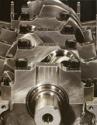



Changing rod bolts

Have your machinest cut the cap and rod side about 1 1/2 to 2 thousandths each and then put the bolts in and resize. That will give enough to work with and it will only shorten the rod 1 to 2 thousandths. It is my opinion that you might roll the dice and get by without resizing, but that is one of those pay now or pay later things.....
I am running ARP rod bolts in stock rods and have hit 7400 rpms several times without any problems.Most bearing failures after a rod bolt swap in ls1s is from installation error.

Joined: Aug 2007
Posts: 24,241
Likes: 89
From: Turnin' Wrenches Infractions: 005
IMO it's crapshoot....I have seen some 01-02 guy run countless passes at 7k and seen a few pulled on the trailer. My 98 will never see anything over 6600k until my forged sb goes in.
FWIW ARP recomends resizing rods for their swap but I know a couple guys who have direct swapped successfully then read a few on here who have not. Katech was designed for a stock swap and that is what I would do unless it is a rebuild. Hell ARP's are physically bigger and just doesn't make sense to me they would be a drop in but I honestly have never done it.... If I were to do it OEM motor Katech is my only option and the tensile strength on those bolts are phenomenal....They cost a ton of $$$$ for a reason....
FWIW ARP recomends resizing rods for their swap but I know a couple guys who have direct swapped successfully then read a few on here who have not. Katech was designed for a stock swap and that is what I would do unless it is a rebuild. Hell ARP's are physically bigger and just doesn't make sense to me they would be a drop in but I honestly have never done it.... If I were to do it OEM motor Katech is my only option and the tensile strength on those bolts are phenomenal....They cost a ton of $$$$ for a reason....
Not this again.
7000RPM here, daily, multiple times daily. Going on 3 years now. Just swapped in some ARPs the right way: one at a time and no resizing. Believe it or not, this IS the norm.
7000RPM here, daily, multiple times daily. Going on 3 years now. Just swapped in some ARPs the right way: one at a time and no resizing. Believe it or not, this IS the norm.
Yes, it IS the norm, and that IS the problem. Good luck to ya though, I hope you have better luck than others.
Joined: Aug 2007
Posts: 24,241
Likes: 89
From: Turnin' Wrenches Infractions: 005
Can someone please explain the thery behind doing one rod bolt at a time. Why cant the cap be removed then replaced without resizing? How can you machine using correct bolts then release the cap for final install without A. going through two sets of new bolts? and B. the cap still has to be completely removed for attachment to the crank??
Can someone please explain the thery behind doing one rod bolt at a time. Why cant the cap be removed then replaced without resizing? How can you machine using correct bolts then release the cap for final install without A. going through two sets of new bolts? and B. the cap still has to be completely removed for attachment to the crank??
LS1 Tech Stories
The Best V8 Stories One Small Block at Time

Topdon ONE vs. Artidiag 800 BT2: Which is the Diagnostic Tablet For You?
Pouria Savadkouei
Gas Monkey Built a 6-Wheel Ferrari Testarossa With a Corvette LT4 Engine
Verdad Gallardo
7 Most Reliable High-Performance Engines GM Has Ever Built
Verdad Gallardo
Amazing '71 Camaro Restomod Is Modern Muscle Car Under the Skin
Verdad Gallardo
6 Common C5 Corvette Failures and What's Involved In Repairing Them
Pouria Savadkouei
Retro Modern Bandit Pontiac Trans AM Comes With Burt Reynolds' Autograph
Verdad Gallardo
Top 10 Greatest Cadillac V Series Performance Models Ever, Ranked
Pouria Savadkouei
Top 10 Most Powerful Chevy Trucks Ever Made!

Hennessey's New Supercharged Silverado ZR2 Has 700 HP
Verdad Gallardo Rod bolts
 20k on my ms3 h/c ,on top of 77k at install ,all stock bottom end...leave on the lmtr at 6850rpm .Check WS6TRANSAM 01 ,he runs a cartek set up ,stock bottom end with arp rod bolts & runs mid to low 10's with many passes on it.Fact is if you beat on it hard enuf stuff will break sooner or later,it is the nature of the beast!
Can someone please explain the thery behind doing one rod bolt at a time. Why cant the cap be removed then replaced without resizing? How can you machine using correct bolts then release the cap for final install without A. going through two sets of new bolts? and B. the cap still has to be completely removed for attachment to the crank??
Some still believe that replacing the bolts can cause distortion. This is not always the case. Increasing the fastener torque can distort the rod and cap, but installing a stronger bolt by itself will not.
As far as the people who spin bearings not too long after a rod bolt install - so what? The bolts usually accompany a cam swap. Look how many people spin bearings after just a cam swap without touching the rod bolts. There are FAR too many people like me who just installed the bolts one by one and have had no problems, with high RPMs, and have been doing so for a LONG time.


these rods are the cracked style so they only go together one way with its match so why would you have to get it resized just to change the bolts nothing is changing just curious i just purchased a crate engine took it apart installed bigger cam and arp bolts i hope i don't have any issues
When changing the rod bolts you should have it resized for the fact of the clamping force being changed effects the roundness of the rod journal. As in most cases people dont have problems but in order to do things the right way would be to have the rods resized. Its nice to hear that soo many people have such good luck by just changing the rod bolts and be done with it but if im going through all the work to do something that could cause failure then why not just get a gasket set and some new rings and freshen up the motor while ur doing all that work and do it right. Or do it twice if your luck isnt so good.
Traditional rods have a machined mating surface for the caps. Removing a bolt from the cap will cause the cap to shift. The LS1 uses a cracked cap design. The mating surface is not smooth, it is somewhat rough and as long as one bolt remains torqued, it is impossible for the cap to shift.
Some still believe that replacing the bolts can cause distortion. This is not always the case. Increasing the fastener torque can distort the rod and cap, but installing a stronger bolt by itself will not.
As far as the people who spin bearings not too long after a rod bolt install - so what? The bolts usually accompany a cam swap. Look how many people spin bearings after just a cam swap without touching the rod bolts. There are FAR too many people like me who just installed the bolts one by one and have had no problems, with high RPMs, and have been doing so for a LONG time.
Some still believe that replacing the bolts can cause distortion. This is not always the case. Increasing the fastener torque can distort the rod and cap, but installing a stronger bolt by itself will not.
As far as the people who spin bearings not too long after a rod bolt install - so what? The bolts usually accompany a cam swap. Look how many people spin bearings after just a cam swap without touching the rod bolts. There are FAR too many people like me who just installed the bolts one by one and have had no problems, with high RPMs, and have been doing so for a LONG time.
Installing stronger rod bolts properly generally results in distortion, otherwise they are probably not doing their job. Fasteners work just like a spring. The more torque you apply, the more "spring pressure" there is to hold the two pieces together. The 2000hp LSX guys are not using ARP L19 headstuds so that they can torque them to the same value as an ARP 8740 head stud. They torque them much higher because they need that extra clamping force to keep the head on the block when they cram 30psi through there. Same applies to rod bolts. What's the point of a stronger bolt if you don't take advantage of the increase in clamping force? With no increase in clamping load, the same amount of force is going to pull apart the rod just as it does with the stock bolts, only this time, the stronger bolt has more room to stretch more before it's yield and before actually breaking. That is, if the extreme distortion itself doesn't spin a bearing first. Now you have the illusion that you can turn higher RPM, and more force is pulling the rod apart further from the inertia loads and returning on the compression loads. With a rod bolt being similar to a spring, I can only imagine this as an equivalent to valvefloat.
Like I said, I've measured the distortion from using ARP rod bolts. I would never feel comfortable running something that I know is that bad in any of my cars, or in anyone else's car. If you've had luck with them well I'm glad. I wouldn't wish that you blow a motor. However, I would like people to understand what it is they are risking. Also, if you look at those who spun bearings from a cam swap, it's typically a pinched o-ring.
When changing the rod bolts you should have it resized for the fact of the clamping force being changed effects the roundness of the rod journal. As in most cases people dont have problems but in order to do things the right way would be to have the rods resized. Its nice to hear that soo many people have such good luck by just changing the rod bolts and be done with it but if im going through all the work to do something that could cause failure then why not just get a gasket set and some new rings and freshen up the motor while ur doing all that work and do it right. Or do it twice if your luck isnt so good.

My stock 99 shortblock survived at 7,000 until I sold it (about 15,000 miles at 7,000 on top of the 80K that were on it).....and it continued living after I sold the engine
-Will
-Will

Here is MY experience on this only. I swapped a set of Katech bolts into my H/C/I LS1 motor and ran it for 5K miles before selling it. I spun the motor beyond 7K rpm's before and after the rodbolt swap. I had no issues at all. On the current LS2 I have I again used the Katech rodbolts but when the rotater was out I had the big end of the rod checked with them installed and I was told they were OK. This was using the torque figures supplied by Katech. So far there is less than 1K miles on the motor but I have turned it 7200 and all seems well. Again this is just my experience here and that dont means it's correct LOL.
To be 100% truthfull the number 6 rod was a bit tight on the big end compared to the other 7. Coincidentally this LS2 short had a spun bearing when I got it and it was number 6. The rod was honed and so far as stated above all is good.
To be 100% truthfull the number 6 rod was a bit tight on the big end compared to the other 7. Coincidentally this LS2 short had a spun bearing when I got it and it was number 6. The rod was honed and so far as stated above all is good.


FWIW, i installed ARP rod bolts in a set of stock rods, and checked them at the machine shop at school, and it changed .001 out of round...when your checking rods, or mains for that matter, your limit is .0005 bigger than spec...now, i know its only a half thousandth out of spec, but when it comes to oil clearences and 6500-7000 RPM's, i wont take my chances. resize everytime.
I've heard bad things about guys switching rod bolts and then 5000 miles or so they let go.. thats one reason im still on stockers. I didnt read the whole thread, but isnt there something different you have to do with arp rod bolts or stockers, like some certain you have to do to the rod.. I remember hearing something but cant think of it.