






Just had motor rebuilt! Please Help

Thread Starter
Staging Lane
Joined: Dec 2009
Posts: 82
Likes: 0
 Just had motor rebuilt! Please Help
 Ok so this is def something that i wasnt want to post but you guys are the s*** when it comes to LS engines. So i put all kinds of goodies in my motor, Cam,springs, oil pump, timing chain, LS7 lifters, ond others, but ive just rolled 1,000 miles and i cant help but notice a slit tick or tap in the engine. Its not loud but def noticable and driving me crazy. My bud who built the engine was pretty confident on the build but this noise, to me shouldnt be there. A couple people say that my lifters might not be pumping up like they should. I checked the torque on the rockers hoping one had backed off but NOPE! Whats you guys think it could be. I built the motor for boost and IMOP dont think that i should put turbo on till i get further advise on what is goin on. Please any advise.

Registered User
Joined: Feb 2012
Posts: 40
Likes: 0
From: Lima,OH
Is it bottom end noise like a spun bearing or what kind of noise is it and where does it sound like it is coming from. One of my buddies just built a engine not too long ago and spun a bearing in about that length of time started as the slightest noise that barely anyone could hear but him but then it finally became a lot louder and it was easy to tell what it was. Also like conan said did you check your push rod length? and could be exhaust gaskets those are a pain in the a$$!
Thread Starter
Staging Lane
Joined: Dec 2009
Posts: 82
Likes: 0
The push rods come in the Cam Kit i bought from Texas Speed, so rods and springs were provided. And the noise is in the top of the engine .Its not a knock just a slight tap. But i do have a exhaust leak due to BS exhaust pipe. While the engine was out i replaces all barrens. And yes new header gaskets.
Registered User
Joined: Feb 2012
Posts: 40
Likes: 0
From: Lima,OH
A brand new bearing can still fail in the first 1000 miles happens probably more than you might realize if for example wrong torque was used or something along those lines. I would first get that exhuast leak fixed first though. Sorry for two posts forgot to mention about the bearing though.
Trending Topics

On The Tree
Joined: Jun 2010
Posts: 137
Likes: 0
From: Maryland
It would be best if you provided a Video with clear sound. It could just be that infamous sewing machine tick that almost everyone has.
Is the tick consistent?
Is the tick deep in sound like a knock?
Is the ticking sound very light like a quiet tapping noise?
Does it get faster as rpms increase?
Does it get louder as rpms increase?
Answers to these would be helpful as well. Good luck man!
Is the tick consistent?
Is the tick deep in sound like a knock?
Is the ticking sound very light like a quiet tapping noise?
Does it get faster as rpms increase?
Does it get louder as rpms increase?
Answers to these would be helpful as well. Good luck man!
LS1 Tech Stories
The Best V8 Stories One Small Block at Time

Gas Monkey Built a 6-Wheel Ferrari Testarossa With a Corvette LT4 Engine
Verdad Gallardo
7 Most Reliable High-Performance Engines GM Has Ever Built
Verdad Gallardo
Amazing '71 Camaro Restomod Is Modern Muscle Car Under the Skin
Verdad Gallardo
6 Common C5 Corvette Failures and What's Involved In Repairing Them
Pouria Savadkouei
Retro Modern Bandit Pontiac Trans AM Comes With Burt Reynolds' Autograph
Verdad Gallardo
Top 10 Greatest Cadillac V Series Performance Models Ever, Ranked
Pouria Savadkouei
Top 10 Most Powerful Chevy Trucks Ever Made!

Hennessey's New Supercharged Silverado ZR2 Has 700 HP
Verdad Gallardo
Coachbuilt N2A Anteros Is an LS2-Powered C6 Corvette In Italian Clothes
Verdad Gallardo Thread Starter
Staging Lane
Joined: Dec 2009
Posts: 82
Likes: 0
It would be best if you provided a Video with clear sound. It could just be that infamous sewing machine tick that almost everyone has.
Is the tick consistent?
Is the tick deep in sound like a knock?
Is the ticking sound very light like a quiet tapping noise?
Does it get faster as rpms increase?
Does it get louder as rpms increase?
Answers to these would be helpful as well. Good luck man!
Is the tick consistent?
Is the tick deep in sound like a knock?
Is the ticking sound very light like a quiet tapping noise?
Does it get faster as rpms increase?
Does it get louder as rpms increase?
Answers to these would be helpful as well. Good luck man!
No to deep sound
Yes its is quite
Yes
Yes
On The Tree
Joined: Jun 2010
Posts: 137
Likes: 0
From: Maryland
^ Ok I'm betting it's just the infamous sewing machine tick. It's really common in LS1's. You'll know if it's a lifter because the tick will be loud and easily heard outside the car with the hood closed. If it was a spun bearing then it would be a bit deeper and have a "chugging" pattern in the sound.
I don't think you have anything to worry about. If you are paranoid - grab a mechanic's stethoscope and place it on the valve covers on top of each cylinder and listen for irregularities. If they all sound the same and all you have is a very light, quiet tapping noise then I wouldn't worry about it. Getting used to the louder valvetrain in these Ls motors is one thing some people never get used to.
A short video with revs would still be very good just to confirm.
I don't think you have anything to worry about. If you are paranoid - grab a mechanic's stethoscope and place it on the valve covers on top of each cylinder and listen for irregularities. If they all sound the same and all you have is a very light, quiet tapping noise then I wouldn't worry about it. Getting used to the louder valvetrain in these Ls motors is one thing some people never get used to.
A short video with revs would still be very good just to confirm.




Sounds like a lifter not pumping up to me. I could be wrong. I would pull the valve cover on the side that the sound is strongest, and look and see if one of the rockers isn't getting oiled. If one isn't getting oiled then I would say that you have a lifter that isn't pumping up.

hard to tell from video clip could just be the sewing machine noise thats common when you go to a more aggressive cam i would strongly urge you to buy a push rod length checker and re check pushrod length just cause tsp sent you the rods with the cam doesn't mean they are the proper length they sent pushrods with my cam and heads that i bought from tsp and they ended up being to short if i had just went with what they sent i would have beaten my valve train to death and im sure the sewing machine noise would have been loud as hell, i ended up trading them in for longer ones. so if you measure and they are correct than thats one thing you can cross off the list


TECH Addict
Joined: Sep 2009
Posts: 2,481
Likes: 5
From: PA/MD
How many turns from 0 lash to torque are you putting on the rockers? That could tell you really quick if you have the right length pushrods....stock should be around 1 1/4-1 1/2 turns.....I have mine set up and pretty quiet at 1/2- 3/4 turn from 0 lash to torque
Registered User
Joined: Feb 2012
Posts: 40
Likes: 0
From: Lima,OH
In my opinion it is either a lifter not getting oil up or a bearing. Kind of leaning towards a bearing but that could be false becuase that video is a little distorted hard to tell... That's pretty much like my friends sounded that I just helped him pull his engine and replace his spun bearing, except he replaced all of them then dropped his motor back in and that noise was gone. But you really don't know til you get down in the engine and start looking at different things.
On The Tree
Joined: Jun 2010
Posts: 137
Likes: 0
From: Maryland
Yep - it's hard to tell from the video - I tried listening to it without bass and then with bass and the sound is difficult to make out.
The best thing to do is start ruling out possible culprits. First things first, go to your local auto store and buy a mechanics stethoscope:
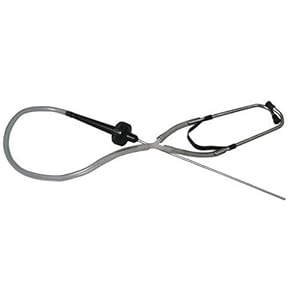
Listen to any cylinders that sound abnormal from the rest. If you can limit it down to the "problem" area then you'll have less work to do. If all sound the same then I would check the obvious things first on the valvetrain: rockers, pushrods, lifters, alignment, etc.
Read this -
Try this method with the pushrods and make sure you have the right length. Usually if the sewing machine sound is excessive then you may be running too short of a pushrod. Also make sure all your rockers are centered on the valve stems - if they are a little off they could be clipping it and making a tapping noise. Make sure you see all rockers have a little bit of oil on them and if you have the valve covers off you can lightly press on each rocker/pushrod end and check for collapsed lifters. If one of the lifters compresses that means it needs to be replaced. These are some immediate, easy checks to complete and you can figure out where it's coming from it'll make fixing it easier.
The sound: is it coming from the top end of the motor or the bottom end?
Top End = Valvetrain
Bottom End = Oh no lol
Good luck man!
The best thing to do is start ruling out possible culprits. First things first, go to your local auto store and buy a mechanics stethoscope:
Listen to any cylinders that sound abnormal from the rest. If you can limit it down to the "problem" area then you'll have less work to do. If all sound the same then I would check the obvious things first on the valvetrain: rockers, pushrods, lifters, alignment, etc.
Read this -
Originally Posted by XtraCajunSS
FWIW, EVERY cam install I have done using the LS7 lifter with a cam with greater than .600" lift (read smaller base circle) AND stock heads w/GM MLS gaskets has taken 7.425" pushrods for ~.050"-.060" preload. We measure lifter preload on each and every cam install we do. I have never had a lifter failure nor do we end up with the dreaded "sewing machine" noise.
Its very simple, If you change ANY of the following:
valve sizes, valve job, head milling, thinner/thicker head gaskets, decked block, cam with an altered base circle, etc... YOU MUST CHECK FOR PROPER PUSHROD LENGTH.
I have helped countless numbers of individuals with this process over the phone, via email, and PM's. I've posted the process on at least 3 occasions.
Here it is again in a nutshell:
1. Using the EO/IC method, get the lifter to the base circle of the cam.
2. Using a known length pushrod (7.400" is a good start with stock rockers) run the rocker arm bolt down to zero lash. This is easily done with your fingers "wiggling" the rocker, the point at which the "slack" is just gone is zero lash.
3. Set your torque wrench to 22 lb./ft. Tighten the rocker to full torque and count the number of turns it takes to get there. 1 full turn wtih a stock 8mm X 1.25 bolt is ~.047" preload as measured at the pushrod/rocker interface.
4. I normally shoot for 1 1/4 to 1 3/4 turns with stock type lifters like Comp 850's, LS1, LS7 etc.
For an example, if you use a 7.400" pushrod and come up with 3/4 of a turn, you will need at least .025" longer pushrod to get into range. If you end up with 2 1/4 turns, you will need one .025" shorter...
I might not know everything but I will tell you that this method has worked for me year after year cam swap after cam swap. We average 3 cam swaps a week here so you can do the math.
If you are not familiar with the EO/IC method for determining valve events in a 4 stroke engine, its very simple:
For a given cylinder as the Exhaust valve is Opening, the intake lifter will be on the base circle of the cam and lash/preload should be checked for that intake valve.
For a given cylinder as the Intake valve is Closing, the exhaust lifter will be on the base circle of the cam and lash/preload should be checked for that exhaust valve.
THIS METHOD ALWAYS WORKS!!!
I hope this helps someone. I have explained it so many times I think I do it in my sleep!!!
Shane
FWIW, EVERY cam install I have done using the LS7 lifter with a cam with greater than .600" lift (read smaller base circle) AND stock heads w/GM MLS gaskets has taken 7.425" pushrods for ~.050"-.060" preload. We measure lifter preload on each and every cam install we do. I have never had a lifter failure nor do we end up with the dreaded "sewing machine" noise.
Its very simple, If you change ANY of the following:
valve sizes, valve job, head milling, thinner/thicker head gaskets, decked block, cam with an altered base circle, etc... YOU MUST CHECK FOR PROPER PUSHROD LENGTH.
I have helped countless numbers of individuals with this process over the phone, via email, and PM's. I've posted the process on at least 3 occasions.
Here it is again in a nutshell:
1. Using the EO/IC method, get the lifter to the base circle of the cam.
2. Using a known length pushrod (7.400" is a good start with stock rockers) run the rocker arm bolt down to zero lash. This is easily done with your fingers "wiggling" the rocker, the point at which the "slack" is just gone is zero lash.
3. Set your torque wrench to 22 lb./ft. Tighten the rocker to full torque and count the number of turns it takes to get there. 1 full turn wtih a stock 8mm X 1.25 bolt is ~.047" preload as measured at the pushrod/rocker interface.
4. I normally shoot for 1 1/4 to 1 3/4 turns with stock type lifters like Comp 850's, LS1, LS7 etc.
For an example, if you use a 7.400" pushrod and come up with 3/4 of a turn, you will need at least .025" longer pushrod to get into range. If you end up with 2 1/4 turns, you will need one .025" shorter...
I might not know everything but I will tell you that this method has worked for me year after year cam swap after cam swap. We average 3 cam swaps a week here so you can do the math.
If you are not familiar with the EO/IC method for determining valve events in a 4 stroke engine, its very simple:
For a given cylinder as the Exhaust valve is Opening, the intake lifter will be on the base circle of the cam and lash/preload should be checked for that intake valve.
For a given cylinder as the Intake valve is Closing, the exhaust lifter will be on the base circle of the cam and lash/preload should be checked for that exhaust valve.
THIS METHOD ALWAYS WORKS!!!
I hope this helps someone. I have explained it so many times I think I do it in my sleep!!!
Shane
The sound: is it coming from the top end of the motor or the bottom end?
Top End = Valvetrain
Bottom End = Oh no lol
Good luck man!