








Lq4 block machine work
 Lq4 block machine work
 I am somewhat new to the ls world, i have a lq4 6.0 block that i plan on boring. When i asked the machine shop if they use torque plates, he said its not need on ls block because of where the head bolts are positioned, it does not effect the deck when torqued, has anyone else had experiance with this?
Thanks!
Thanks!
And what happens if a block is bored or honed without plates? Will it just not run? Lose 200 HP? Lay a smoke cloud a mile long? I'd really love to hear real life stories on this...

TECH Addict
Joined: Sep 2009
Posts: 2,481
Likes: 5
From: PA/MD
But how much do they move around when torqued? Your guess is as good as mine until we get someone to do a lot of measuring for us with heads off, torque plate on, and I guess heads on an empty block so it can be measured from up through the bottom
From what I "understand" when the heads are torqued down the block will slightly distort causing the bores to be pulled slightly. By using the the torque plate you are simulating the same pull and twist on the block that it would see in real life when assembled and you can get a truer/rounder bore to promote better sealing, less blow by, more even wear and longer engine life.
But how much do they move around when torqued? Your guess is as good as mine until we get someone to do a lot of measuring for us with heads off, torque plate on, and I guess heads on an empty block so it can be measured from up through the bottom
But how much do they move around when torqued? Your guess is as good as mine until we get someone to do a lot of measuring for us with heads off, torque plate on, and I guess heads on an empty block so it can be measured from up through the bottom

Trending Topics
I'm not a machinist nor do I claim to be a know-it-all so you can take my advice with a grain of salt. Personally, on all of my builds and tear downs I have NEVER seen a difference in wear of a cylinder in a properly assembled and maintained engine whether it was honed using a plate or not. Now keep in mind I'm not talking about a 1000+hp race engine, but I've seen/run and torn down plenty in the upper ranges of the aforementioned number.
What I will say is the machinist is the most critical part. You can have a **** machinist with the best tools in the world do a crap job, and the best machinist in the world with ancient tools create an amazing product. Machines themselves haven't changed to the extent many think, but more so the advent of computers has enabled the process to be repeated more reliably/easily and at a faster rate. That said, a CNC is incredible and makes things easy for the machinist in many aspects, but it still comes down to the machinist.
With that in mind, I will tell you what my machinist told me and I trust his word. He's been building/racing for the past 40 years, and I still remember watching his Pro-Mod as a child some 30 years ago. I asked these same questions and he has never steered me wrong. While a torque plate does have it's place, it isn't warranted on most builds if the machinist is doing his job and has the correct machines. I honestly can't regurgitate all the info he spouted out about the changes in machining over the years or all the terms he used but the way he put it made absolute sense at the time and my results have always been stellar with his work and guidance, and without a torque plate.
Also, think about this. A torque plate is meant to stress the block exactly as head would when torqued down but therein lay the problems. Do you honestly think a generic 2" thick (or whatever thickness plate your particular machinist uses) will exactly replicate the head casting? Different deck thickness heads will not create the same amount of stresses/distortion so how can you expect one singular piece to be able to account for every different type of head that might possibly be used on your particular block at a given torque value? Then there is thermal expansion of the parts being machined and keeping them at the proper temp if you want it done correctly. There are so many different steps in a correctly done application with torque plate honing that many shops that may actually use a plate when honing don't do, so it negates the actual use of the plate itself. IMHO, the most critical step besides have a competent machinist correctly do the initial machine work is in the measurement, documentation, and assembly of the engine itself. Given the same engine PROPERLY machined and assembled, the only difference being one plate honed and the other not, most individuals would be hard pressed to find a difference. My .02
What I will say is the machinist is the most critical part. You can have a **** machinist with the best tools in the world do a crap job, and the best machinist in the world with ancient tools create an amazing product. Machines themselves haven't changed to the extent many think, but more so the advent of computers has enabled the process to be repeated more reliably/easily and at a faster rate. That said, a CNC is incredible and makes things easy for the machinist in many aspects, but it still comes down to the machinist.
With that in mind, I will tell you what my machinist told me and I trust his word. He's been building/racing for the past 40 years, and I still remember watching his Pro-Mod as a child some 30 years ago. I asked these same questions and he has never steered me wrong. While a torque plate does have it's place, it isn't warranted on most builds if the machinist is doing his job and has the correct machines. I honestly can't regurgitate all the info he spouted out about the changes in machining over the years or all the terms he used but the way he put it made absolute sense at the time and my results have always been stellar with his work and guidance, and without a torque plate.
Also, think about this. A torque plate is meant to stress the block exactly as head would when torqued down but therein lay the problems. Do you honestly think a generic 2" thick (or whatever thickness plate your particular machinist uses) will exactly replicate the head casting? Different deck thickness heads will not create the same amount of stresses/distortion so how can you expect one singular piece to be able to account for every different type of head that might possibly be used on your particular block at a given torque value? Then there is thermal expansion of the parts being machined and keeping them at the proper temp if you want it done correctly. There are so many different steps in a correctly done application with torque plate honing that many shops that may actually use a plate when honing don't do, so it negates the actual use of the plate itself. IMHO, the most critical step besides have a competent machinist correctly do the initial machine work is in the measurement, documentation, and assembly of the engine itself. Given the same engine PROPERLY machined and assembled, the only difference being one plate honed and the other not, most individuals would be hard pressed to find a difference. My .02
LS1 Tech Stories
The Best V8 Stories One Small Block at Time

Topdon ONE vs. Artidiag 800 BT2: Which is the Diagnostic Tablet For You?
Pouria Savadkouei
Gas Monkey Built a 6-Wheel Ferrari Testarossa With a Corvette LT4 Engine
Verdad Gallardo
7 Most Reliable High-Performance Engines GM Has Ever Built
Verdad Gallardo
Amazing '71 Camaro Restomod Is Modern Muscle Car Under the Skin
Verdad Gallardo
6 Common C5 Corvette Failures and What's Involved In Repairing Them
Pouria Savadkouei
Retro Modern Bandit Pontiac Trans AM Comes With Burt Reynolds' Autograph
Verdad Gallardo
Top 10 Greatest Cadillac V Series Performance Models Ever, Ranked
Pouria Savadkouei
Top 10 Most Powerful Chevy Trucks Ever Made!

Hennessey's New Supercharged Silverado ZR2 Has 700 HP
Verdad Gallardo From what I "understand" when the heads are torqued down the block will slightly distort causing the bores to be pulled slightly. By using the the torque plate you are simulating the same pull and twist on the block that it would see in real life when assembled and you can get a truer/rounder bore to promote better sealing, less blow by, more even wear and longer engine life.
But how much do they move around when torqued? Your guess is as good as mine until we get someone to do a lot of measuring for us with heads off, torque plate on, and I guess heads on an empty block so it can be measured from up through the bottom
But how much do they move around when torqued? Your guess is as good as mine until we get someone to do a lot of measuring for us with heads off, torque plate on, and I guess heads on an empty block so it can be measured from up through the bottom

TECH Apprentice


Joined: Oct 2007
Posts: 302
Likes: 20
Torque plates are used on big blocks and older small blocks because the top of the bore distorts when the bolts are tightened down. It actually pulls the cylinder wall away from the center of the bore which creates small areas adjacent to each bolt that the ring can't follow, causing blow-by/leakage. I'll try to post a pic that shows this clearly.
LS engine head bolts are completely isolated from the cylinder, so there can't be any of the same type of distortion. My guy says to continue to use them, apparently there is slight bore distortion where the head/gasket presses against the top of the cylinder and the torque plate simulates this as well.
LS engine head bolts are completely isolated from the cylinder, so there can't be any of the same type of distortion. My guy says to continue to use them, apparently there is slight bore distortion where the head/gasket presses against the top of the cylinder and the torque plate simulates this as well.
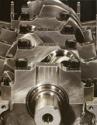



Mine is good to .0005 and while I do see some distortion towards the lower end of bores extending into the crank case on OEM castings and occasionally at the top(~1 in 3) pre machining, I've yet to been able to measure any appreciative difference between a plate honed to non plate honed block from my machinist with my guage. That said, he also takes extreme care and uses top notch Sunnen machines. I don't doubt there is benefit to it in certain situations, but if machine work is done correctly without it, most folks would never see the differences and many are caught up in it as a must which isn't always true. Can't hurt, but people seem to think it is an absolute must which isn't always the case and in some respects isn't always properly done.
Mine is good to .0005 and while I do see some distortion towards the lower end of bores extending into the crank case on OEM castings and occasionally at the top(~1 in 3) pre machining, I've yet to been able to measure any appreciative difference between a plate honed to non plate honed block from my machinist with my guage. That said, he also takes extreme care and uses top notch Sunnen machines. I don't doubt there is benefit to it in certain situations, but if machine work is done correctly without it, most folks would never see the differences and many are caught up in it as a must which isn't always true. Can't hurt, but people seem to think it is an absolute must which isn't always the case and in some respects isn't always properly done.
I have not, but if I did I would need to be reading them with the plate on and the block at honing temperature and not ambient. Have you? The factory blocks are making ridiculous power, even those with high mileage, so as I said I doubt the average person is going to see a huge difference in sealing with quality machine work without the process. The problem with the process is there are so many variables that it's hard to quantify accurately. You have to account for the stresses of the actual plate which can vary due to thickness, material, bolt torque, etc. and then you have to factor in the block type and material as well, hot honed, etc. Good article to read found here and might give you food for thought about the different results between processes and real world results and not just a random person on a forum claiming a HP increase or decrease attributed to one or the other.
http://www.circletrack.com/techartic...g/viewall.html
http://www.circletrack.com/techartic...g/viewall.html
I have not, but if I did I would need to be reading them with the plate on and the block at honing temperature and not ambient. Have you? The factory blocks are making ridiculous power, even those with high mileage, so as I said I doubt the average person is going to see a huge difference in sealing with quality machine work without the process. The problem with the process is there are so many variables that it's hard to quantify accurately. You have to account for the stresses of the actual plate which can vary due to thickness, material, bolt torque, etc. and then you have to factor in the block type and material as well, hot honed, etc. Good article to read found here and might give you food for thought about the different results between processes and real world results and not just a random person on a forum claiming a HP increase or decrease attributed to one or the other.
http://www.circletrack.com/techartic...g/viewall.html
http://www.circletrack.com/techartic...g/viewall.html
Hot honing in contrast, is not so easy. It's more expensive and cumbersome, and since the piston manufacturers' recommended clearances are for measurements taken at room temp, it adds much more time making it even more expensive. After all that, the change you see is worth only a few tenths.
A torque plate is an instrument that costs only about $300, which in a machine shop among other machines and tooling, is relatively inexpensive. Adding the torque plate to the honing process is relatively simple which is why it is so popular among more "professional" machine shops. Yes, I have measured the bores with the torque plates on and off of the block and even on the LS engines, I've seen over .001" change in several areas over the entire cylinder.
Hot honing in contrast, is not so easy. It's more expensive and cumbersome, and since the piston manufacturers' recommended clearances are for measurements taken at room temp, it adds much more time making it even more expensive. After all that, the change you see is worth only a few tenths.
Hot honing in contrast, is not so easy. It's more expensive and cumbersome, and since the piston manufacturers' recommended clearances are for measurements taken at room temp, it adds much more time making it even more expensive. After all that, the change you see is worth only a few tenths.
Hell, I've seen a .001 change just from torquing the heads another 20 lbs so who's to say that the same forces exerted with the plate will exactly duplicate the head, much less at operating temp versus ambient. This is why I'm saying that it's not nearly as easy to define how well it works or how much power it's truly worth, and let's face it...you won't find a thread or mag article that will state that because to be quite honest it's impossible to calculate. Differing blocks with different amounts of core shift can have drastically different results. My point is that anyone who tells you it's an absolute must and that a machine shop that doesn't perform it always isn't worth a damn is full of **** themselves and regurgitating what they've read in magazines and forums. It's amazing how many people on this forum will spout off about it then do a build based off an OEM shortblock that was never plate honed to begin with.
If a machine shop doesn't use torque plates and tries to persuade the customer that its not needed, I say move on to another one that does use them. You can sit there and say I'm full of it all you want, but I have over 5 years of experience machining and building engines that I've built my conclusions upon. Just because there isn't an exact number to quantify its benefits does not mean its not worth doing. I don't think you'll ever see an exact number on how much more accurate a micrometer and bore gage is over Plastigage, but again, all professional machine shops use them and not Plastigage.