


PVC system & Vaccum pump???


Thread Starter
On The Tree
Joined: Aug 2009
Posts: 183
Likes: 0
 PVC system & Vaccum pump???
 Okay guys, im putting my 383 Ls1 back together & i need alil help with my PVC system. I have 11:1 compression & i was wondering what i should do to improve my system. Like catch can or vacuum pump? At wide open throttle my vacuum gauge reads 0 vacuum.
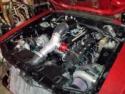


that is the correct reading at WOT.....
it should be 0 vacuum at WOT... higher vacuum at idle and part throttle...
if you didnt see vacuum at WOT, then that would be a sign of restriction somewhere between the air filter and the cylinder
a catch can would be a good start... help keep oil mist out of the intake as much as you can
a vacuum pump would be better...you always gain power from a vacuum pump as a low pressure in the crankcase helps with windage issues and it also allows oil to flow better.
if you go to a vacuum pump.. you ditch the stock PCV system and vent to atmosphere.
it should be 0 vacuum at WOT... higher vacuum at idle and part throttle...
if you didnt see vacuum at WOT, then that would be a sign of restriction somewhere between the air filter and the cylinder
a catch can would be a good start... help keep oil mist out of the intake as much as you can
a vacuum pump would be better...you always gain power from a vacuum pump as a low pressure in the crankcase helps with windage issues and it also allows oil to flow better.
if you go to a vacuum pump.. you ditch the stock PCV system and vent to atmosphere.
Thread Starter
On The Tree
Joined: Aug 2009
Posts: 183
Likes: 0
Okay thats good info. I guess my next question would be. Would i benefit from the pump. Cause my engine builder said he wanted 8 to 9 pounds of vacuum at max rmp. I know i need to do something with my system, i had oil all in my intake runners. I know i could pick up hp by going pump instead of catch can. But is it worth the 840 bucks? Ir should i spend alil money & go catch can.
Okay thats good info. I guess my next question would be. Would i benefit from the pump. Cause my engine builder said he wanted 8 to 9 pounds of vacuum at max rmp. I know i need to do something with my system, i had oil all in my intake runners. I know i could pick up hp by going pump instead of catch can. But is it worth the 840 bucks? Ir should i spend a lil money & go catch can.
8-9 PSI vacuum is 18 Inches of mercury...you will suck the oil off the write pins and damage your engine
(1 PSI = 2.036025 InHg @ 32*F)
a vacuum pump is always worth the money...
dollar to horsepower is not a huge amount...maybe 15 hp on an engine not set up specifically for a vacuum pump... upwards of 30-50 on engines that are designed for a vacuum pump
but the other benefits are very worth the price..
again, lower atmosphere inside the crank helps to alleviate windage problems and allows oil to do its job better
you will better suck moisture out of the crankcase as well
and your engine and rings will seal better with a vacuum pump
and people pay a lot more money for a lot less HP sometimes...How much is a FAST intake?(more than a vaccum pump setup) and how much do people gain??? (15-20 HP?)

TECH Senior Member
Joined: Feb 2009
Posts: 5,445
Likes: 4
check the moroso vacuum pumps ,or try a electric pump.I think the air pump on 2000 and older f-bodies could be converted to vacuum pumps .the is a valve you install in the system to control how much vacuum the system will make .
Thread Starter
On The Tree
Joined: Aug 2009
Posts: 183
Likes: 0
So what is correct vacuum i should have? I mean i thought i was all good with 0 at wide open. I guess im ignorant when it comes to this system. All i know is my paper work says no more than 8-9 of vacuum at max rmp. So how do i know the correct way to setup my system? What vacuum should i be looking to achieve? 0 or by putting a pump on it can i set it to my desired vacuum?

Trending Topics
I think when he said his builder wants to see 9psi at WOT, he was talking about crankcase pressure, not Manifold pressure.
Thread Starter
On The Tree
Joined: Aug 2009
Posts: 183
Likes: 0
He wants crankcase pressure not manifold. Im just gonna put a catch can on it, to get rid of some of the oil in the intake runners. Idk if the 900 bucks for a pump is worth it to me. When you really dont need one. I mean i have great oil pressure & i know if i put a pump on it i will gain alil power. But honestly i think ill just put a catch can on it & try that route. My gauge was hooked to my intake so i wasnt getting a true crankcase reading anyways.
what you will find is that at WOT, you are typically pressurizing the crankcase....which is bad in general, but theres no way around it...all engines will allow some cylinder pressure to get past the rings and pressurize the crankcase.
if you had your gauge on the manifold, you wont have any indication of crankcase pressure
you wont know if you really need one until you actually check the crankcase pressure.
you can add a Tee to the existing PCV lines and then put your gauge on it to see what you are really making in the crankcase.
that will determine if you need a vacuum pump or not....it can also tell you some things about how your rings were set up.
and again...if he wants 8-9 psi...he's not very smart...
you want 10-12 inches at WOT which is around 5-6 psi unless you have spent a bunch of extra money on stuff so you can run more vacuum (like oil squirters and special wrist pins)
if you had your gauge on the manifold, you wont have any indication of crankcase pressure
you wont know if you really need one until you actually check the crankcase pressure.
you can add a Tee to the existing PCV lines and then put your gauge on it to see what you are really making in the crankcase.
that will determine if you need a vacuum pump or not....it can also tell you some things about how your rings were set up.
and again...if he wants 8-9 psi...he's not very smart...
you want 10-12 inches at WOT which is around 5-6 psi unless you have spent a bunch of extra money on stuff so you can run more vacuum (like oil squirters and special wrist pins)
Thread Starter
On The Tree
Joined: Aug 2009
Posts: 183
Likes: 0
He did say inches. Im just not very smart yet with this system. But you are enlightening me. So i should buy a inch pound gauge & install & check pressure. To determine wether or not i need a vacuum pump. Its just a all forged 383 with 11:1 compression. TF 215 heads, 102mm FAST & 595/595 238/242 112 cam. All motor.. So i dont see why it would need a vacuum pump. But im no engine builder by any means. I just wanna get rid of the oil in the intake. I had to pull the motor apart due to a intake valve not sealing. & found alot of oil in the intake runners of mu SuperVic intake. So when i get it back together i wanna have the oil problem resolved.
He did say inches. Im just not very smart yet with this system. But you are enlightening me. So i should buy a inch pound gauge & install & check pressure. To determine whether or not i need a vacuum pump. Its just a all forged 383 with 11:1 compression. TF 215 heads, 102mm FAST & 595/595 238/242 112 cam. All motor.. So i dont see why it would need a vacuum pump. But im no engine builder by any means. I just wanna get rid of the oil in the intake. I had to pull the motor apart due to a intake valve not sealing. & found alot of oil in the intake runners of mu SuperVic intake. So when i get it back together i wanna have the oil problem resolved.
its in PSI or InHg
(pounds per square inch or inches of mercury)
you can check it with any gauge that can read both vacuum and positive pressure
I dont think you understand quite how a vacuum pump works...
it is useful on ALL motors...ALL MEANS ALL,AND THATS ALL, ALL MEANS.
going to a vacuum pump means you get rid of the stock PCV completely...no lines connect from the crankcase to the intake...therefore no oil can ever get into the intake.
you go from Valve covers or the Valley cover and go to a vacuum pump, then out to a catch can that vents to atmosphere.
it requires multiple baffles so you arent just sucking oil out as the oil will be suspended in the air as a mist.
the baffle give the oil mist a place to stick to so that the oil drops out of the air.
with just a catch can, they often do not have enough baffles or surface area to allow the oil to drop out, so you typically still get oil into the intake...just not as much as you would without one
the vacuum created with a vacuum pump lowers the atmosphere in the crankcase...helps with ring seal and engine seals(you wont have any oil leaks while driving with a vacuum pump)
helps with oil windage(which robs power)
and helps with pulling moisture out of the oil


