


mid range/torquey/road race cam?


12 Second Club
Joined: Sep 2005
Posts: 4,273
Likes: 0
From: Bucks County, Pa.


Have you run this at any events yet? If yes, how does it feel? How does the fall off above 5800RPM feel? If not, when do you expect to attend your next event?
My dyno peaks around 5600 and sort of flat lines to 6400, and I've convinced myself it's the VE's picked by PatG back in 2010. Every dyno I go to the operator wants me to give them money in the future to diagnose the non-standard graph behavior. My piston CFM demand is only ~300...MAF & TB both easily flow that CFM, Rick's manifold is supposed to flow that above .600 valve lift, fuel pressure is fine, no exhaust back pressure problems; advance/VE/MAF was tuned on a Mustang dyno, and VE/MAF was touched up on the street; CylAir just stops increasing at peak HP. What I'd like to do is keep the HP curve climbing past it's current peak without affecting the curve below the current peak.
But everything I see says it will be a trade off. These numbers were pretty close to the Mustang dyno, ironically, not sure if one was calibrated to read like the other.

My dyno peaks around 5600 and sort of flat lines to 6400, and I've convinced myself it's the VE's picked by PatG back in 2010. Every dyno I go to the operator wants me to give them money in the future to diagnose the non-standard graph behavior. My piston CFM demand is only ~300...MAF & TB both easily flow that CFM, Rick's manifold is supposed to flow that above .600 valve lift, fuel pressure is fine, no exhaust back pressure problems; advance/VE/MAF was tuned on a Mustang dyno, and VE/MAF was touched up on the street; CylAir just stops increasing at peak HP. What I'd like to do is keep the HP curve climbing past it's current peak without affecting the curve below the current peak.
But everything I see says it will be a trade off. These numbers were pretty close to the Mustang dyno, ironically, not sure if one was calibrated to read like the other.

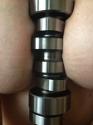

Have you run this at any events yet? If yes, how does it feel? How does the fall off above 5800RPM feel? If not, when do you expect to attend your next event?
My dyno peaks around 5600 and sort of flat lines to 6400, and I've convinced myself it's the VE's picked by PatG back in 2010. Every dyno I go to the operator wants me to give them money in the future to diagnose the non-standard graph behavior. My piston CFM demand is only ~300...MAF & TB both easily flow that CFM, Rick's manifold is supposed to flow that above .600 valve lift, fuel pressure is fine, no exhaust back pressure problems; advance/VE/MAF was tuned on a Mustang dyno, and VE/MAF was touched up on the street; CylAir just stops increasing at peak HP. What I'd like to do is keep the HP curve climbing past it's current peak without affecting the curve below the current peak.
But everything I see says it will be a trade off. These numbers were pretty close to the Mustang dyno, ironically, not sure if one was calibrated to read like the other.

My dyno peaks around 5600 and sort of flat lines to 6400, and I've convinced myself it's the VE's picked by PatG back in 2010. Every dyno I go to the operator wants me to give them money in the future to diagnose the non-standard graph behavior. My piston CFM demand is only ~300...MAF & TB both easily flow that CFM, Rick's manifold is supposed to flow that above .600 valve lift, fuel pressure is fine, no exhaust back pressure problems; advance/VE/MAF was tuned on a Mustang dyno, and VE/MAF was touched up on the street; CylAir just stops increasing at peak HP. What I'd like to do is keep the HP curve climbing past it's current peak without affecting the curve below the current peak.
But everything I see says it will be a trade off. These numbers were pretty close to the Mustang dyno, ironically, not sure if one was calibrated to read like the other.
If its the cam in your signature, I think that the cam could be improved. Your IVC is early and your EVO is late. If you wanted to maintain the current drivability and torque, and yet rev higher, i'd suggest something like this - 228/232-114+3. That would move you IVC from 41 to 45 and your EVO from 49 to 53, both of which would support higher revving. You'd still have 2 degrees of overlap, so your idle quality would be about the same. If you don't want to give up too much torque, you could do a 4-degree advance and still have a IVC of 44 degrees, which would still make quite a difference. That cam would still be nice and torque, just rev higher.
An alternate option would be to run the same durations and a wider LSA, like 222/230-116+2. This would rev, but you would sacrifice torque to do it.
Your car looks like it wants to pull higher but something is holding it back. If you're positive the exhaust is not backing it up, then I'd look into cam options. Bottom line, you need to get the spent fuel out earlier and delay that IVC just a touch to support higher RPM -especially on a larger cube engine (>346, anyway)

Teching In
Joined: Apr 2015
Posts: 23
Likes: 1
So I am doing a similar thing,
Any estimates on how a 226/232 114+2 1/45/52/0 would behave from an RPM perspective?
LS1, ls6 intake, 241 heads, 1.75 longtubes no cats
Any estimates on how a 226/232 114+2 1/45/52/0 would behave from an RPM perspective?
LS1, ls6 intake, 241 heads, 1.75 longtubes no cats
Last edited by arutha; Apr 27, 2016 at 10:09 PM.
It'll likely carry power to 6500 and drop off fast after that. If you plan to DD it, you'll feel the power kick in somewhere around 2500 rpm.
my old cam would just keep climbing (it was a typical peaky/dyno queen cam. 242ish 607/608 112?)
ie you could feel the car come alive about 5500 and continue to really make power the longer you held it. exhaust note would really come alive too. but it had to build, like a turbo car.
the new cam you really dont feel the lower power band power, its more sneaky/hidden. the upper end feels kinda weak.
I have. you definatly feel it run out.
my old cam would just keep climbing (it was a typical peaky/dyno queen cam. 242ish 607/608 112?)
ie you could feel the car come alive about 5500 and continue to really make power the longer you held it. exhaust note would really come alive too. but it had to build, like a turbo car.
the new cam you really dont feel the lower power band power, its more sneaky/hidden. the upper end feels kinda weak.
my old cam would just keep climbing (it was a typical peaky/dyno queen cam. 242ish 607/608 112?)
ie you could feel the car come alive about 5500 and continue to really make power the longer you held it. exhaust note would really come alive too. but it had to build, like a turbo car.
the new cam you really dont feel the lower power band power, its more sneaky/hidden. the upper end feels kinda weak.


Most of those will perform about the same. The torquer2 will be the biggest pain in the *** to drive. The one Kip suggested will be the easiest daily driver. The 227,228 cams will all be within 3-5 hp of each other. The tick SNS will get the most looks from dudes in mullets and night ranger t-shirts. The cam Geoff spec'ed and the cam Kip spec'ed will both be the gentlest on the valve train.
Martin designed the SNS2 and still made a slightly different recommendation for you.
I would go with the cam Martin spec'ed. Tick usually has Kip grind them. I would request that. Kip will not only send a cam card, but a cam doctor report of the cam so you know you got what you wanted.
Martin designed the SNS2 and still made a slightly different recommendation for you.
I would go with the cam Martin spec'ed. Tick usually has Kip grind them. I would request that. Kip will not only send a cam card, but a cam doctor report of the cam so you know you got what you wanted.

if you were to ask me right now, having run the cam now in my car, yes i would probly move the power band up 500/800/1000ish rpm
you can really see, feel, hear it run out on the big end. passes are more difficult on the straights.
Your 227/235 @.050 112.5+3 cam is IVO 4, IVC 43, EVO 53, EVC 2, 6* of overlap @ .050 but overlap is biased toward the exhaust. I remember reading somewhere that having the overlap be intake biased helps the power carry as well. In post #34, Darth elaborated that an IVC of 43/44 corresponds to a 4800 peak torque and 6300 peak HP on a stock or Fast intake, yet your dyno clearly shows TQ is peaking near 4800 but HP is only peaking around 5800RPM. What type of intake manifold do you have? Did Patrick have any comments on the curve when he tuned it?
Last edited by JimMueller; Nov 22, 2016 at 03:08 PM.
id love to hear that feedback too. to learn for the next one.
one thing i think i would do from the TINY bit of knowledge i have is have both the I & E duration in the 23x's ie I=low 23x E=high 23x
instead of the I in the 22x's. from what i understand that would move the powerband up.
im running a Fast 90 setup.
Patrick didnt have any comments, hes not a man of many words. but i trusted everyones recomendation for him, and would/will be going back to him for my new car.
one thing i think i would do from the TINY bit of knowledge i have is have both the I & E duration in the 23x's ie I=low 23x E=high 23x
instead of the I in the 22x's. from what i understand that would move the powerband up.
im running a Fast 90 setup.
Patrick didnt have any comments, hes not a man of many words. but i trusted everyones recomendation for him, and would/will be going back to him for my new car.
A few things I've seen cause it to peak early, though if PatG did your tuning I'd be surprised if he didn't pick up on something and have any feedback:
A collapsing intake hose. Sounds weird, but if the tubing isn't rigid enough, I've seen the thing get sucked in and choke off the motor.
Spark plugs too hot, causing reduced spark at peak power. Possibly even some KR.
A less than optimal merge. This hit my car. The Y pipe merge was a dead-head instead of the two lines coming in parallel.
Plugged cats. Also hit mine really hard. Cost me 70 rwhp on the dyno.
Valve float either from a weak spring or pushrods flexing. I doubt this, but always good to include everything. Typically the tuner and/or dyno operator pick up on valve float.
Cam timing off - I don't think this is very likely, but if it's accidentally advanced a couple of degrees either from grind or installation, it'll peak early. However, you'd also have a weird torque curve too. So I really don't think this is it.
Some simple tricks to shift the power curve - x pipe and dual exhaust shifted my peak power north by 300 rpm. Simply retarding the cam a couple degrees will shift it, but you'll sacrifice torque - same is true if you move to a bigger cam. A shorter runner intake will shift peak power north.
A collapsing intake hose. Sounds weird, but if the tubing isn't rigid enough, I've seen the thing get sucked in and choke off the motor.
Spark plugs too hot, causing reduced spark at peak power. Possibly even some KR.
A less than optimal merge. This hit my car. The Y pipe merge was a dead-head instead of the two lines coming in parallel.
Plugged cats. Also hit mine really hard. Cost me 70 rwhp on the dyno.
Valve float either from a weak spring or pushrods flexing. I doubt this, but always good to include everything. Typically the tuner and/or dyno operator pick up on valve float.
Cam timing off - I don't think this is very likely, but if it's accidentally advanced a couple of degrees either from grind or installation, it'll peak early. However, you'd also have a weird torque curve too. So I really don't think this is it.
Some simple tricks to shift the power curve - x pipe and dual exhaust shifted my peak power north by 300 rpm. Simply retarding the cam a couple degrees will shift it, but you'll sacrifice torque - same is true if you move to a bigger cam. A shorter runner intake will shift peak power north.
On another forum it looks like he bought a '09 Z06 and was going to offer this car up for sale.
http://www.frrax.com/rrforum/index.p...ic=17639&st=60
http://www.frrax.com/rrforum/index.p...ic=17639&st=60